
Custom Street Light Buyer Decision Framework: Landscape vs Courtyard vs Solar
Independent Industry Reference · Custom Outdoor Lighting Procurement
Most custom street light procurement decisions are made in the wrong order. A buyer selects a fixture family — landscape, courtyard or solar — and then searches for site data that supports the choice. Reversing that sequence is the most practical change a specifying team can make: read the site first, define the lighting task, and let the fixture family follow from the evidence.
The scale behind that decision is measurable. Grand View Research valued the global street lighting market at USD 9.1 billion in 2023 and projected it to reach USD 11.6 billion by 2030, a CAGR of 3.6%. LED luminaires already accounted for 79.7% of that revenue in 2023. Once LED is the default light source, differentiation shifts away from technology type and toward fit: mounting height, power envelope, power source, control architecture, mechanical structure, and the environmental envelope a fixture has to survive.
Three fixture families frame that trade-off clearly. The BF-LSL-4000-120W is a custom LED landscape street light in the custom decorative landscape street lights category. The BF-AGL-4000-60W is an ancient-style courtyard lamp in the Aluminum/Steel Cast Outdoor Lamp category. The BF-SL-8M-100W is a separate-type solar street lamp designed for municipal road lighting and other outdoor applications. All three are produced by Zhongshan Baifu Street Lamp Co., Ltd., trading as BAIFU LIGHTING — a custom outdoor lighting manufacturer based in Guzhen Town, Zhongshan City, Guangdong, China, established in 2013 and offering OEM, ODM and project-based lighting solutions.
This framework compares the three on the parameters that actually change a bill of materials, a structural calculation or an acceptance test: mounting height, LED power options, input voltage, control method, IP rating, operating temperature, service life and pole material. It then converts those parameters into procurement terms and acceptance criteria, so a buyer can match specification to site data instead of defaulting to one fixture category.
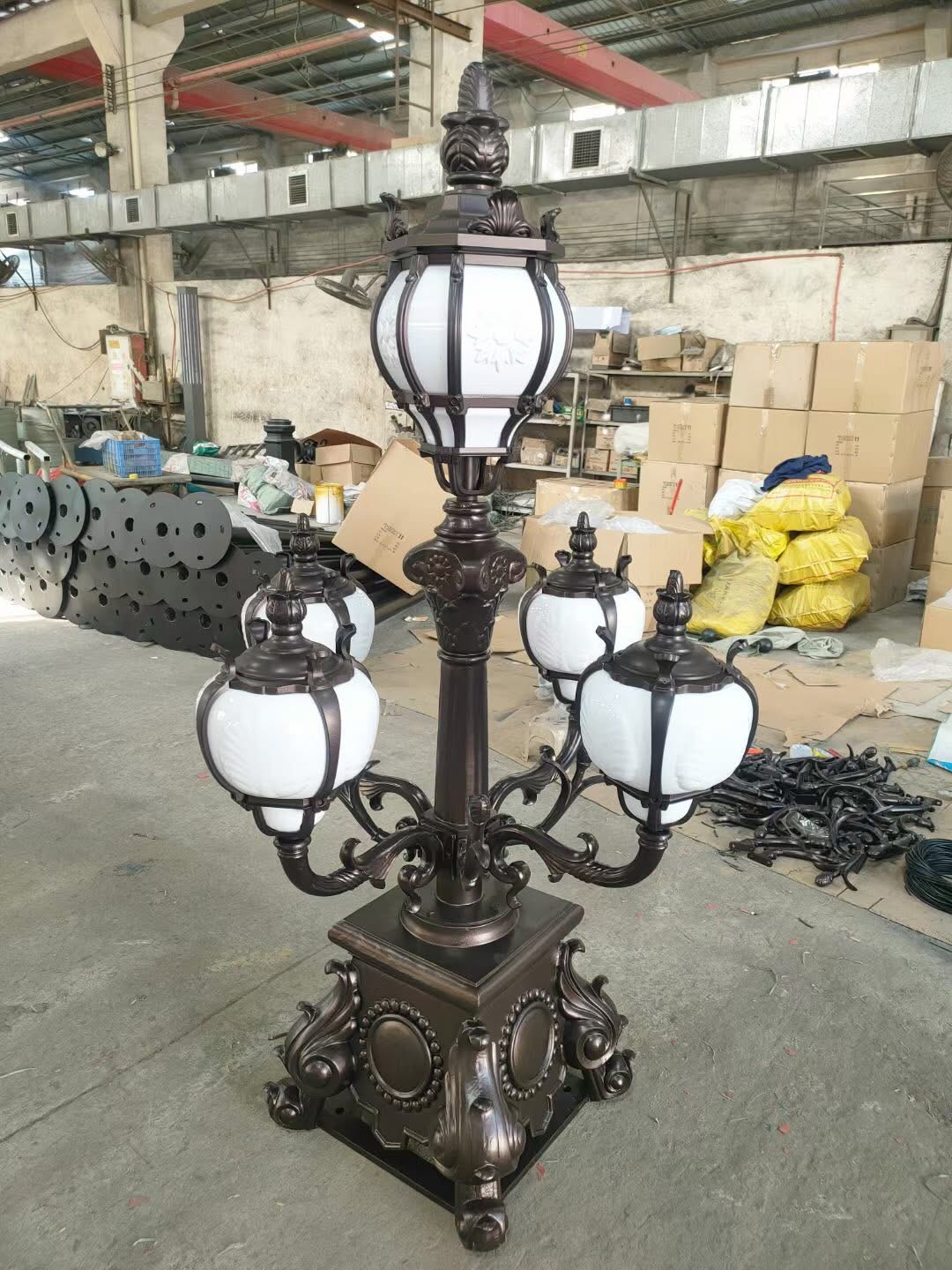
Courtyard-class luminaire: all-aluminum five-head garden lamp, the pedestrian-scale end of the custom outdoor lighting range (BF-AGL-4000-60W family).
Why the Fixture Family Should Be the Last Decision, Not the First
The fixture family follows from three site facts: the scale of the lighting task, the availability of a mains supply, and the ambient conditions the installation must tolerate. Each of those facts eliminates options quickly, which is why starting from a product category rather than from site data is a fragile approach.
1. Lighting task and mounting scale
Mounting height is the anchor of the whole comparison. The BF-AGL-4000-60W courtyard lamp installs at 3–4 meters, customizable, with LED power options of 30W, 40W, 50W, 60W and 80W and a lighting mode described as unidirectional or multi-faceted soft lighting. That places it at pedestrian scale. The BF-LSL-4000-120W landscape street light mounts at 6m, 8m, 10m or 12m, customizable, with LED power options from 60W to 200W and a choice of road lighting distribution, plaza lighting distribution or decorative landscape distribution — roadway and open-space scale. The BF-SL-8M-100W solar street lamp is built on an 8-meter single-arm conical pole with a 100W LED luminaire.
2. Power source
Two families are mains-powered at AC 85–265V, 50/60Hz. The third is standalone: it lists a 200W high-efficiency monocrystalline silicon solar panel, a 12V 80Ah maintenance-free lead-acid battery, and a stated operating mode of 10–12 hours of lighting per day with 2–3 days of battery life in rainy conditions, configurable according to project requirements. Whether a grid connection exists at the pole location is therefore a binary filter, not a preference.
3. Environmental envelope
The two mains fixtures are rated from -30°C to +60°C. The solar model is rated from -20°C to +60°C. That ten-degree difference at the cold end does not decide most projects, but it does decide some, and it is the kind of boundary that is easier to see before a model is written into a tender than after.
The Three Fixture Types, Defined
BF-LSL-4000-120W — Custom LED Landscape Street Light
The BF-LSL-4000-120W is a non-standard, project-specific luminaire rather than a fixed catalogue item. Mounting height options are 6 m, 8 m, 10 m and 12 m, customizable to project requirements. LED power is offered in seven steps: 60W, 80W, 100W, 120W, 150W, 180W and 200W. Luminaire efficacy is at least 130 lm/W, input is AC 85–265V at 50/60Hz, power factor is PF≥0.95, and the electric shock protection class is Class I.
Structurally, the lamp pole can be conical, square, special-shaped or an artistic structure, and brackets are available as single arm, double arms, multi-arms, or combined high-low lamp heads. Materials listed are Q235 hot-dip galvanized steel, 304 stainless steel, die-cast aluminum lamp housings, high-transmittance tempered glass, stainless steel fasteners, with hot-dip galvanizing followed by outdoor electrostatic powder coating. Decorative capability is the differentiating layer: hollow patterns, luminous decorations, city logos, cultural totems and project-specific elements can be built into the design. Control ranges from standard on-off to optional photocell, timer, 0–10V dimming, DALI and smart lighting control.
BF-AGL-4000-60W — Ancient-Style Courtyard Lamp
The BF-AGL-4000-60W is classified under Aluminum/Steel Cast Outdoor Lamps, with a high-pressure cast aluminum lamp body and a Q235 hot-dip galvanized steel pole. Installation height is 3–4 meters, customizable. LED power options are 30W, 40W, 50W, 60W and 80W, at not less than 130 lm/W, with the same AC 85–265V, 50/60Hz input, PF≥0.95 and Class I shock protection as the landscape fixture.
The lamp cover can be high-transparency tempered glass or UV-resistant PC. Standard colors are black, dark grey and copper brown, customizable against an RAL color card. Control is conventional switch control with optional light control, time control and intelligent control. Fixing is via a flange base with pre-installed anchor bolts, and wind resistance capacity is described as structural design based on lamp height and local wind speed.
BF-SL-8M-100W — Separate-Type Solar Street Lamp
The BF-SL-8M-100W is classified as a separate-type solar street lamp. Its specification lists an 8-meter single-arm conical pole in Q235 high-quality steel with hot-dip galvanizing followed by electrostatic spraying, a 100W LED luminaire with luminous efficacy of at least 150 lm/W, a 200W high-efficiency monocrystalline silicon solar panel, and a 12V 80Ah maintenance-free lead-acid battery. The lamp arm installation angle is stated as 90°, protection level is IP65/IP66, and color temperature options are 3000K, 4000K, 5000K and 6000K.
Control is light control plus time control, with optional intelligent dimming. Installation is fixed by pre-buried anchor bolts, and wind resistance grade is based on structural design according to the wind speed at the project location. Customization is available on height, power, color, battery capacity, solar panel and light pole design. The quality guarantee period is stated as according to project configuration and contract requirements.
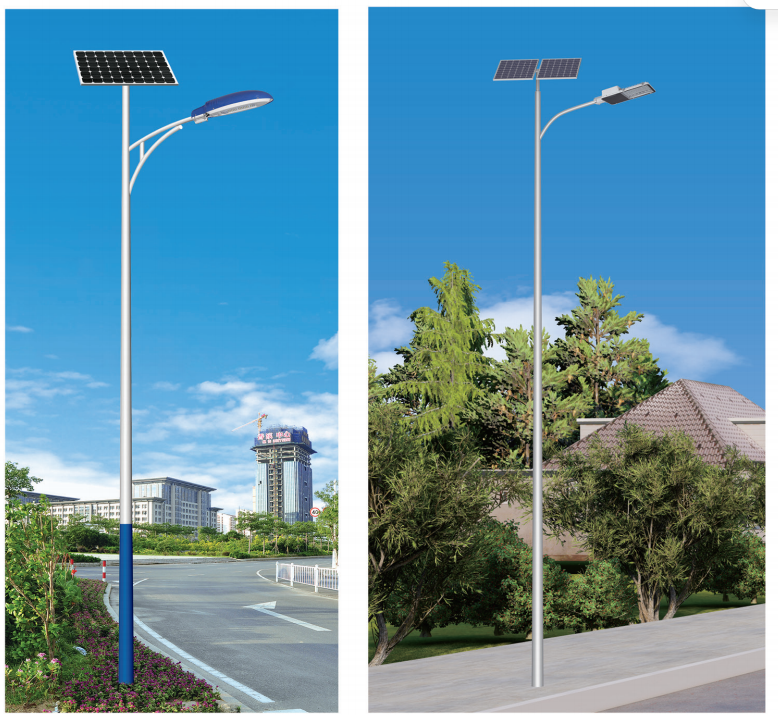
Separate-type solar configuration: 8 m conical pole, 100W LED luminaire, 200W monocrystalline panel, 12V 80Ah battery (BF-SL-8M-100W).
Specification Comparison: Landscape, Courtyard and Solar Side by Side
The table below places the three models on the parameters most often written into a specification sheet. Values are as stated for each model; where a parameter is configuration-dependent, it is marked optional in the source specification.
| Parameter | BF-LSL-4000-120W | BF-AGL-4000-60W | BF-SL-8M-100W |
|---|---|---|---|
| Fixture category | Custom decorative landscape street lights | Aluminum/Steel Cast Outdoor Lamp | Separate-type solar street lamp |
| Mounting height | 6 m / 8 m / 10 m / 12 m, customizable | 3–4 m, customizable | 8 m single-arm conical pole |
| LED power options | 60W, 80W, 100W, 120W, 150W, 180W, 200W | 30W, 40W, 50W, 60W, 80W | 100W |
| Input voltage | AC 85–265V, 50/60Hz | AC 85–265V, 50/60Hz | Not stated (solar powered) |
| Luminous efficacy | ≥130 lm/W | ≥130 lm/W | ≥150 lm/W |
| Colour temperature | 2700K, 3000K, 4000K, 5000K, 6000K | 3000K, 4000K, 5000K, 6000K | 3000K, 4000K, 5000K, 6000K |
| CRI / power factor | Ra≥70 (Ra≥80 optional) / PF≥0.95 | Ra≥70 / PF≥0.95 | Ra≥70 / not stated |
| IP rating / shock class | IP65 or IP66 / Class I | IP65/IP66 / Class I | IP65/IP66 / not stated |
| Service life | ≥50,000 hours | ≥50,000 hours | Not stated |
| Operating temperature | -30°C to +60°C | -30°C to +60°C | -20°C to +60°C |
| Control method | On-off standard; photocell, timer, 0–10V dimming, DALI, smart lighting control optional | Conventional switch; light control, time control, intelligent control optional | Light control + time control; intelligent dimming optional |
| Installation interface | Flange base with embedded anchor bolts | Flange base with pre-installed anchor bolts | Pre-buried anchor bolts |
A second comparison layer sits below the electrical data. Pole material and finish determine how the fixture ages in a coastal, desert or humid market: the landscape model uses Q235 hot-dip galvanized steel plus 304 stainless steel, die-cast aluminum housings and tempered glass; the courtyard model pairs a cast aluminum body with a Q235 hot-dip galvanized pole; the solar model uses a Q235 steel pole with hot-dip galvanizing and electrostatic spraying. All three specify surface treatment through outdoor electrostatic powder coating or electrostatic spraying, and all three describe wind resistance as a structural design input based on the wind speed at the project location rather than a fixed figure.
Matching Specification to Site Data — A Six-Step Sequence
A specification becomes defensible when each parameter can be traced to a site fact. The following sequence is the order in which the three models separate from one another.
- Step 1 — Fix the mounting height and the lighting task. Pedestrian walkways, courtyards and garden paths sit at 3–4 m; roadways, plazas and large landscape areas sit at 6–12 m. The courtyard model cannot be pushed upward to solve a roadway problem, and the landscape model does not become a courtyard fixture by reducing power.
- Step 2 — Confirm whether a mains supply reaches the pole. If AC 85–265V is available, two families remain in scope. If it is not, the solar model becomes the default candidate, and the conversation moves to panel orientation, battery capacity and rainy-day autonomy.
- Step 3 — Check the ambient temperature envelope against the site record. -30°C to +60°C covers the mains fixtures; -20°C to +60°C applies to the solar model.
- Step 4 — Set the control level before pricing. Standard on-off, photocell, timer, 0–10V dimming, DALI and smart lighting control are options on the landscape model; switch control with optional light, time or intelligent control applies to the courtyard model; light control plus time control with optional intelligent dimming applies to the solar model.
- Step 5 — Define the structural conditions. Pole form (conical, square, special-shaped, artistic), bracket configuration (single, double, multi-arm, combined high-low), installation interface (flange base with embedded or pre-installed anchor bolts, or pre-buried anchor bolts), and site wind speed all feed the structural design.
- Step 6 — Define finish and identity requirements. Standard colors on the courtyard model are black, dark grey and copper brown, customizable against an RAL card; the landscape model lists dark grey, black, silver grey and bronze with RAL customization, plus decorative hollow patterns, luminous decorations, city logos and cultural totems.
Application Fit in Practice
The BF-LSL-4000-120W is specified for urban roads, parks, plazas, commercial streets and large-scale landscape lighting projects, and its applicable industries extend to municipal road engineering, urban landscape lighting, park roadways, commercial plazas, cultural tourism scenic spots, pedestrian streets, residential communities, hotels and resorts, industrial parks, schools, hospitals, parking lots, government projects and overseas urban infrastructure projects. Its light distribution options — road, plaza or decorative landscape — are what allow one housing family to serve both a photometric task and an identity task on the same corridor.
The BF-AGL-4000-60W is aimed at residential and commercial landscape lighting: residential communities, villa courtyards, urban parks, commercial plazas, hotels and resorts, schools, hospitals, pedestrian streets, garden landscapes, community roads and parking lots. Its 3–4 meter installation height and 30–80W power range describe a fixture that lights the pedestrian plane rather than the carriageway.
The BF-SL-8M-100W is positioned for municipal road lighting and related outdoor applications, including rural roads, urban side roads, industrial parks, residential communities, park roads, schools, hospitals, parking lots, commercial plazas, government projects and overseas infrastructure projects. With a 200W panel, a 12V 80Ah battery and a stated 2–3 days of rainy-day battery life, it is designed for corridors where a grid connection is impractical or expensive to bring to the pole.
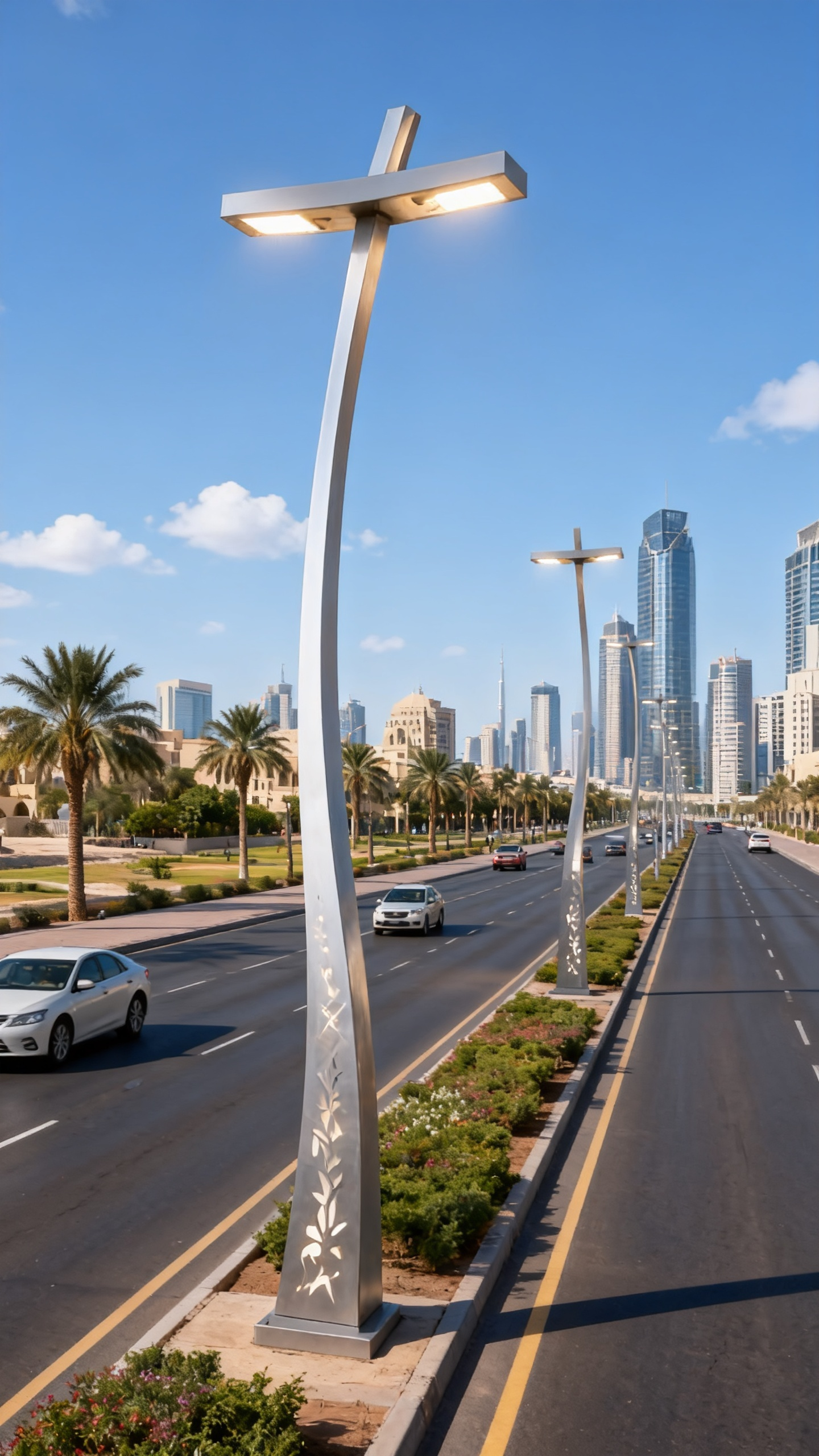
Roadway-scale application: custom double-headed landscape street light configuration along an urban municipality road (BF-LSL-4000-120W family).
From Specification to Procurement Terms and Acceptance Criteria
The most common failure in custom outdoor lighting procurement is not technical. It is a commercial document that describes the product in adjectives instead of parameters. The three models share an underlying structure that makes the translation straightforward: each has a category, a height, a power envelope, an input or energy source, an IP rating, a temperature range, a control method, a pole material and an installation interface.
Those parameters belong in the purchase terms verbatim: model designation and category; mounting height and pole form; LED power and luminous efficacy; colour temperature, CRI and power factor; input voltage or solar bill of materials (200W monocrystalline panel, 12V 80Ah maintenance-free lead-acid battery); IP rating and shock protection class; operating temperature range and service life; control method and any optional modules; pole material, surface treatment and RAL colour reference; and the installation interface — flange base with embedded or pre-installed anchor bolts, or pre-buried anchor bolts.
Acceptance criteria follow the same logic, mirroring the manufacturing steps a supplier controls. For custom outdoor lighting manufacturing these include metal fabrication, cutting, forming, welding, structural assembly, surface treatment, outdoor powder coating, electrical assembly, product inspection, aging testing, packaging and export delivery. In practice, the acceptance gate for a non-standard design is dimensional and finish verification against the approved drawing set, plus inspection and aging test records for the electrical assembly, and a documentation review covering English product specifications, packaging information and export documentation. The warranty position should also be written down rather than assumed: the solar model states its quality guarantee period as according to project configuration and contract requirements, while the mains models state a service life of at least 50,000 hours, which is a rated life, not a warranty term.
Boundaries and Trade-offs Buyers Should Accept Upfront
A credible framework names what each option cannot do, not only what it can.
- The solar model carries an energy-storage dependency. Its stated operating temperature begins at -20°C rather than -30°C, its autonomy is expressed as 2–3 days of battery life in rainy conditions on a configurable basis, and its battery is a maintenance-free lead-acid type. Solar selection therefore depends on local solar resource data and on how much autonomy the client is willing to pay for.
- The courtyard model has a hard ceiling. At a 3–4 meter installation height and 30–80W, it is a pedestrian-scale fixture with unidirectional or multi-faceted soft lighting. It is not a substitute for a road lighting luminaire.
- The landscape model is non-standard by definition. Because appearance design, height, power, bracket structure, color, patterns, light source configuration and intelligent control can all be customized, and because wind resistance is a structural design input tied to pole height and site wind speed, each project carries an engineering validation step. Buyers should expect drawing approval and a longer pre-production cycle than a catalogue purchase.
- Ingress protection is not photometric compliance. An IP65 or IP66 rating describes enclosure protection, not lighting quality. The European standard EN 13201 series (parts 1–5) defines quality, performance and energy indicators for road and street lighting design, and ANSI/IES RP-8 is the primary American national standard for lighting roadway and parking facilities. Buyers should specify the design basis separately from the hardware rating.
- Supply is fragmented. CSIL data indicates that the top 10 companies in the global lighting fixtures market, including Signify and Osram, account for just over 20% of total market share. That concentration level means factory-level verification of the actual manufacturer remains a meaningful procurement step.
What the Market Data Suggests for the Next Buying Cycle
Control readiness is becoming a default expectation rather than an upgrade. Berg Insight reported that the installed base of smart street lights globally reached 32.9 million units at the end of 2024, with a 20.9% CAGR projected through 2029, and that Signify held approximately 5.8 million installed lighting controls as of late 2024. On the interoperability side, the D4i and Zhaga standards are increasingly adopted in smart street lighting for interoperability between sensors and luminaires.
The regional picture is uneven. CSIL identifies Africa as the fastest-growing regional lighting market, with over 4% average annual growth since 2018 driven by public infrastructure projects, while China's exports of lighting products reached USD 56.3 billion in 2023 — a figure that reflected a 7% year-on-year decrease, per the China Association of Lighting Industry as reported by China Daily. The practical implication for specification writers is modest but real: because the three fixture families already offer optional control layers — photocell, timer, 0–10V dimming, DALI and smart lighting control on the landscape model; light, time and intelligent control on the courtyard model; intelligent dimming on the solar model — control readiness can be specified at the interface level without committing the whole project to a single control ecosystem on day one.
Future Outlook
Two shifts are likely to change how these three families are compared. The first is the continuing separation of hardware from control: as modular LED light sources and standardized control interfaces become more common, the fixture decision increasingly reduces to optics, structure and enclosure, while dimming and monitoring migrate to a replaceable layer. The second is the maturing of solar specifications, where autonomy, panel power and battery capacity are increasingly written as explicit contract parameters — as they already are in the BF-SL-8M-100W specification, which states panel power, battery capacity and rainy-day autonomy as separate line items.
Neither shift removes the underlying requirement. A purchaser still has to be able to answer, in writing, why a 4-meter courtyard luminaire, a 10-meter landscape luminaire or an 8-meter solar luminaire is the right fit for a specific stretch of ground.
Frequently Asked Questions
1. What is the most fundamental difference between the three fixture families?
Mounting height and power envelope. The BF-AGL-4000-60W courtyard lamp installs at 3–4 m with 30–80W LED power. The BF-LSL-4000-120W landscape street light installs at 6–12 m with 60–200W LED power. The BF-SL-8M-100W solar street lamp uses an 8 m pole with a 100W LED luminaire and draws its energy from a 200W monocrystalline panel and a 12V 80Ah battery rather than from the mains.
2. How should a buyer decide the mounting height?
From the lighting task, not from habit. Pedestrian-scale areas such as courtyards, garden paths and community roads align with the 3–4 m installation height of the courtyard model. Roadways, plazas and large landscape areas align with the 6 m, 8 m, 10 m or 12 m mounting options of the landscape model. The solar model is specified at 8 m on a single-arm conical pole.
3. Can one control strategy be used across all three fixture types?
No single control standard applies. The landscape model uses standard on-off control with optional photocell, timer, 0–10V dimming, DALI and smart lighting control. The courtyard model uses conventional switch control with optional light control, time control and intelligent control. The solar model uses light control plus time control with optional intelligent dimming. Control requirements should therefore be specified per fixture family rather than as a single project-wide line item.
4. How does operating temperature influence the choice?
The two mains-powered fixtures are rated from -30°C to +60°C. The solar model is rated from -20°C to +60°C. For sites where the recorded ambient range extends below -20°C, the solar configuration's suitability should be confirmed against project conditions before it is written into the specification.
5. Does an IP65 or IP66 rating mean a fixture meets road lighting standards?
No. IP65 and IP66 describe ingress protection for the enclosure, and all three models specify IP65/IP66. Road lighting quality and performance are addressed separately by standards such as the EN 13201 series (parts 1–5) in Europe and ANSI/IES RP-8 in the United States. A specification should therefore state both the enclosure rating and the lighting design basis.
6. What acceptance criteria should be applied before shipment?
Verification should follow the manufacturing steps the supplier controls: dimensional and finish checks against the approved drawings, inspection and aging testing of the electrical assembly, confirmation of the specified IP rating, control method, colour temperature and surface treatment, and a documentation review covering the product specification, packaging information and export documentation. For the solar model, the panel power, battery type and capacity, and the stated rainy-day autonomy should be confirmed as separate line items.
Projects that require a comparison against site data rather than a catalogue selection typically need engineering input at the specification stage — product selection, CAD drawing development, lighting configuration recommendations, appearance design evaluation, sample development and project quotation. The customized product album is available here: BAIFU LIGHTING customized album (PDF).