
Custom Street Light Design: A Practical Guide for Municipal and Architectural Projects
Custom street light design has become a core requirement in modern municipal and architectural lighting projects. Standard luminaire catalogs no longer satisfy the expectations of urban planners, landscape architects, and project owners who want a lighting system to reflect local identity, support smart city operation, and meet project-specific engineering constraints. This guide provides a factual overview of what custom street light design involves, how manufacturers like Zhongshan Baifu Street Lamp Co., Ltd. (BAIFU LIGHTING) execute it, and what buyers should evaluate during design, engineering, and procurement.
What Does Custom Street Light Design Mean in Practice?
Custom street light design refers to developing a street lighting product that is not a standard catalog unit. Instead, the luminaire, the pole, the bracket, or the whole assembly is engineered according to project-specific requirements. Common customization examples include pole height, arm structure, decorative patterns, colors, surface finish, LED power, solar configuration, and control system.
For non-standard and project-specific outdoor lighting projects, a manufacturer is expected to support pole heights, arm structures, lamp designs, decorative patterns, colors, surface finishes, LED power, solar configurations, and smart lighting functions. In other words, the design process is not only about aesthetics; it also has to satisfy mechanical, electrical, thermal, and photometric requirements.
Why Custom Street Lighting Is Becoming the Norm
Global market trends show that street lighting is no longer treated as a simple functional commodity. The global street lighting market was valued at USD 9.1 billion in 2023 and is projected to reach USD 11.6 billion by 2030, according to Grand View Research. LED lighting accounted for 79.7% of total revenue in 2023. At the same time, smart city development has accelerated the adoption of intelligent lighting infrastructure: the installed base of smart street lights globally reached 32.9 million units by the end of 2024, with a projected CAGR of 20.9% through 2029, according to Berg Insight.
This shift creates new procurement problems for buyers. When a project requires architectural street lighting, decorative lighting poles, or municipal lighting systems, the available standard products often fail to meet design intent or site conditions. Custom street lighting exists to close that gap. It allows urban lighting design to combine photometric performance, energy efficiency, and a unique visual identity.
How Custom Street Light Design Works at a Manufacturing Level
A reliable manufacturing partner should provide a structured development process. At BAIFU LIGHTING, engineering support includes product selection, CAD drawing development, lighting configuration recommendations, appearance design evaluation, sample development, and project quotation. This means a buyer can move from a design concept to a manufacturable lighting product without switching between multiple suppliers.
From Concept to Manufacturable Design
The process usually begins with a project brief. The buyer shares the intended application, pole height, lighting performance targets, visual style, and any site-specific constraints. The manufacturer then evaluates whether the requested design can be produced using the available manufacturing capabilities, including metal fabrication, cutting, forming, welding, structural assembly, surface treatment, outdoor powder coating, electrical assembly, product inspection, aging testing, packaging, and export delivery.
Design Parameters That Usually Require Customization
- Mounting height (e.g., 6m, 8m, 10m, 12m, or other project-specific values)
- LED power and luminance configuration (e.g., from 30W to 200W depending on the fixture type)
- Pole structure (conical, square, special-shaped, or artistic)
- Bracket style (single arm, double arms, multi-arms, combined high-low lamp heads)
- Color temperature and color rendering requirements
- Surface treatment and standard colors or RAL-matched colors
- Smart control options such as photocell, timer, 0–10V dimming, DALI, and remote management
- Decorative features such as hollow patterns, luminous pieces, city logos, or cultural totems
Engineering and Technical Parameters in Custom Street Lights
Design alone is not enough. A custom street light must be structurally safe, electrically compliant, and durable under local climate conditions. The table below summarizes typical technical parameters that buyers should verify with the manufacturer during the design stage.
| Parameter | Typical Values Found in BAIFU LIGHTING Products |
|---|---|
| Luminaire efficacy | ≥130 lm/W for custom landscape street lights and cast courtyard lamps; ≥150 lm/W for solar street lights |
| IP rating | IP65 or IP66 |
| Input voltage | AC 85–265V, 50/60Hz |
| Color rendering index | Ra≥70; Ra≥80 optional |
| Power factor | PF≥0.95 |
| Service life | ≥50,000 hours |
| Operating temperature | -30°C to +60°C (for mains-powered fixtures); -20°C to +60°C (for the BF-SL-8M-100W solar street light) |
| Protection class | Class I |
Wind resistance is another critical parameter. A custom street light pole should be designed according to the wind speed of the project location. BAIFU LIGHTING indicates that wind resistance is based on structural design tailored to pole height and local wind speed. For solar street lights, the product can be fixed by pre-buried anchor bolts, and the wind resistance grade is calculated on the basis of the project site.
Product Examples: How Customization Is Applied
To better understand how the above principles are applied, it is useful to look at three types of products that serve different project requirements.
Custom LED Landscape Street Lights — Model BF-LSL-4000-120W
This is a custom decorative landscape street light designed for urban roads, parks, plazas, commercial streets, and large-scale landscape lighting projects. The luminaire is constructed from Q235 hot-dip galvanized steel, 304 stainless steel, die-cast aluminum lamp housings, high-transmittance tempered glass, stainless steel fasteners, and outdoor electrostatic powder coating. Mounting height can be selected from 6m, 8m, 10m, or 12m, and can also be customized beyond these values. LED power levels range from 60W to 200W, meaning the same design can be adapted to different road widths and lighting poles. Decorative features such as hollow patterns, luminous decorations, city logos, cultural totems, and other exclusive project elements are optional. 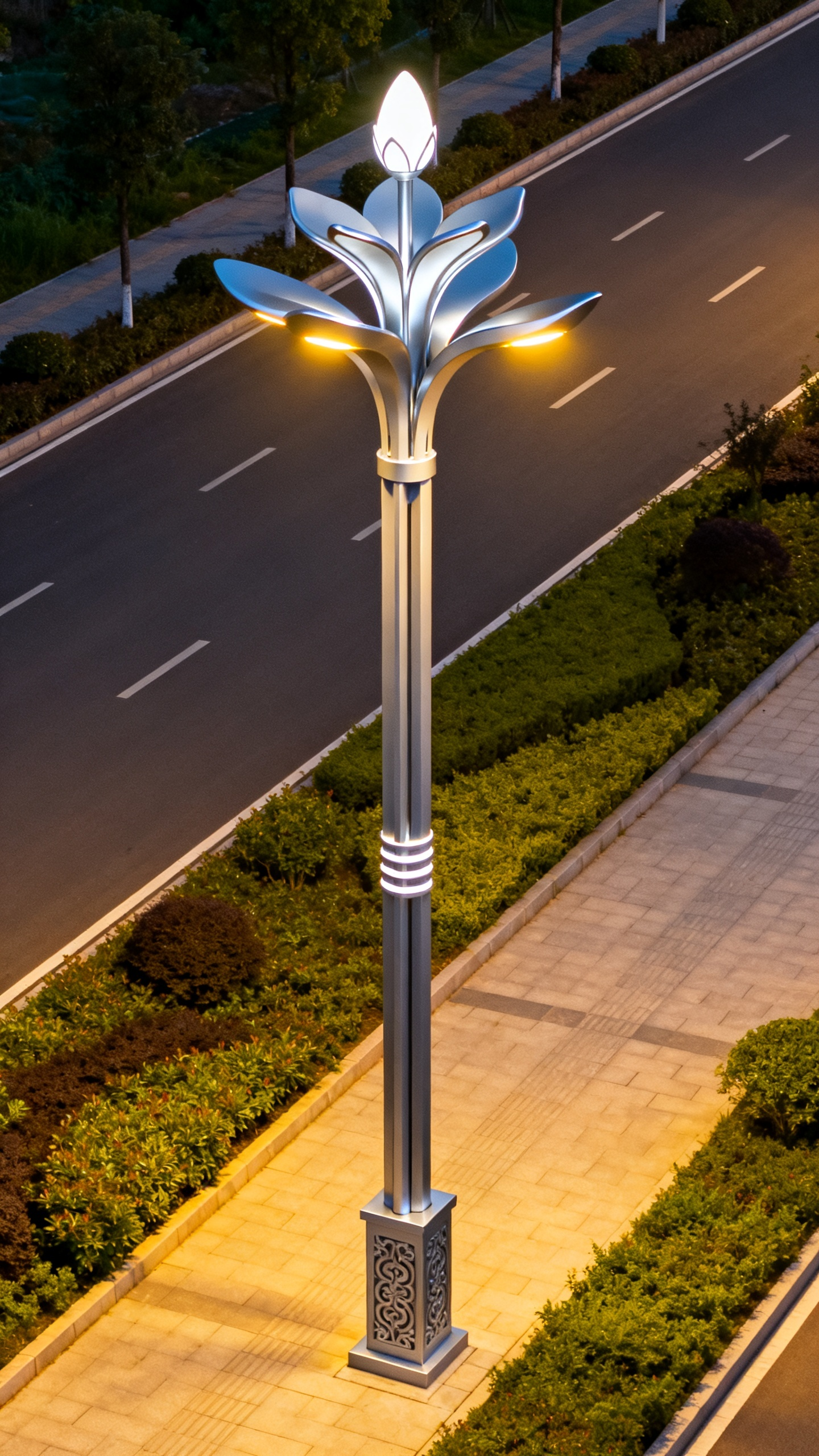
Ancient-Style Courtyard Lamp — Model BF-AGL-4000-60W
For residential communities, villa courtyards, hotels, and heritage-style environments, the BF-AGL-4000-60W belongs to the Aluminum/Steel Cast Outdoor Lamp category. It uses a high-pressure cast aluminum lamp body and a Q235 hot-dip galvanized steel pole, which is a classic structural combination for outdoor decorative lighting. Installation height is 3–4 meters, with LED powers ranging from 30W to 80W. This product is a suitable example of how custom lighting poles and fixtures can align with a specific architectural style while maintaining outdoor-grade reliability. 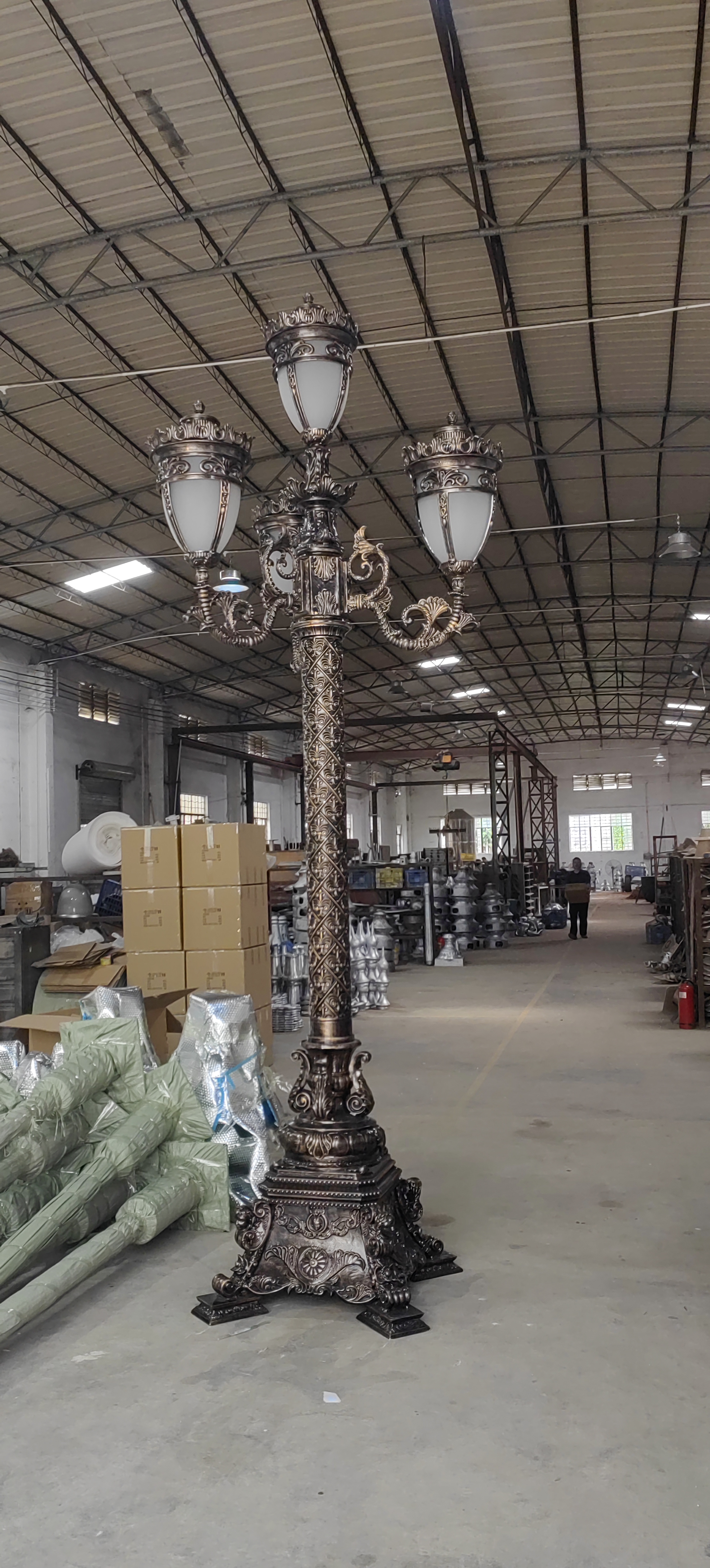
8-Meter Split-Type Solar LED Street Lamp — BF-SL-8M-100W
For projects where mains electricity is unavailable or where energy independence is preferred, the BF-SL-8M-100W provides a separate-type solar street light configuration. It uses an 8-meter single-arm conical pole made of Q235 steel with hot-dip galvanizing and electrostatic spraying. The LED lamp delivers a luminous efficacy of ≥150 lm/W, powered by a 200W monocrystalline silicon solar panel and a 12V 80Ah maintenance-free lead-acid battery. The system runs 10–12 hours per day and can support 2–3 rainy days, configurable according to the project. Control options include light control, time control, and intelligent dimming. This model is designed for municipal road lighting, rural roads, urban side roads, industrial parks, residential communities, and other public infrastructure projects. 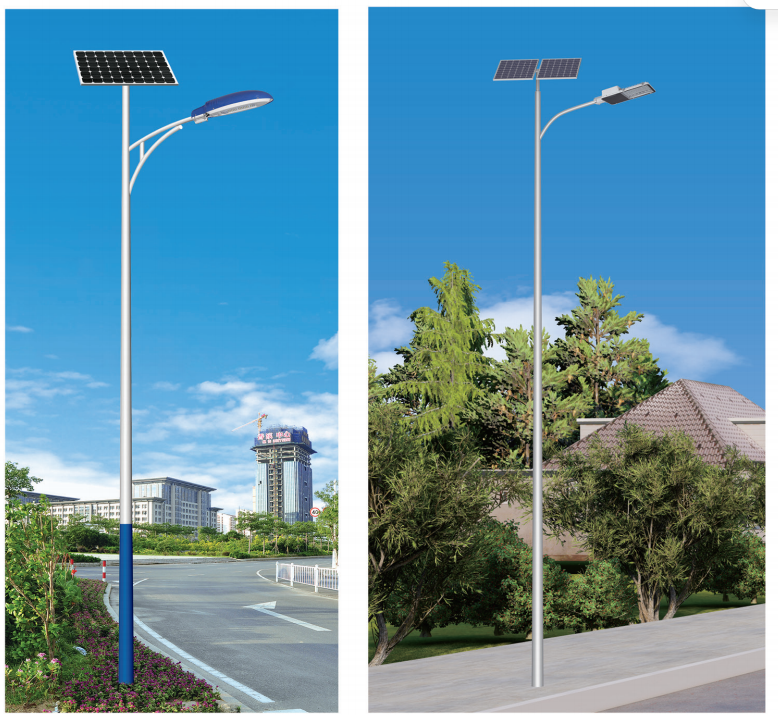
Project Scenarios for Custom Street Lighting
The application range of custom street lights can be broadly grouped into several project types. A manufacturer is often asked to deliver simultaneously on functional lighting, decorative appearance, and project-specific installation conditions.
- Municipal street lighting renovation: Roads and public areas that require improved energy efficiency, compliance, or better light distribution.
- Urban landscape lighting: Parks, plazas, commercial streets, and waterfront areas where aesthetic quality is inseparable from the lighting solution.
- Architectural and decorative projects: Hotels, resorts, cultural tourism scenic areas, and pedestrian streets that require bespoke luminaires or custom lighting pole designs.
- Public space and community lighting: Schools, hospitals, residential communities, parking lots, and industrial parks where durability and maintenance are key concerns.
- Solar-powered infrastructure projects: Rural roads, side roads, and overseas projects where grid supply is not guaranteed, using configurations such as the BF-SL-8M-100W.
What to Evaluate When Selecting a Custom Street Light Manufacturer
Custom street lights are almost always developed by an Original Equipment Manufacturer (OEM) or Original Design Manufacturer (ODM). Buyers should not simply compare model codes; they need to compare the supplier’s engineering capacity, manufacturing complexity, and ability to handle project-based customization.
Design and Engineering Capability
Confirm that the manufacturer offers the engineering services required for non-standard products. BAIFU LIGHTING, for example, provides CAD drawing support, lighting configuration recommendations, appearance design evaluation, and sample development. These services are critical for municipal contractors, design firms, and procurement companies that need dependable documentation before finalizing a project.
Manufacturing and Assembly Capability
A supplier with in-house metal fabrication can produce poles, brackets, and housings with better consistency than one that outsources key processes. The manufacturing capabilities of BAIFU LIGHTING include metal fabrication, cutting, forming, welding, structural assembly, surface treatment, outdoor powder coating, electrical assembly, and inspection. In-house manufacturing also simplifies quality control, shipping coordination, and custom packaging.
Reference Base and Market Experience
Buyers should ask about the manufacturer’s export reach and project diversity. BAIFU LIGHTING exports to 71 countries, with major markets in the Middle East, Central Asia, North America, Southeast Asia, and Africa. Export business represents 45% of total sales, and the company supplies municipal contractors, engineering companies, developers, landscape designers, architects, and project procurement firms. The company has more than 13 years of outdoor lighting experience and produces around 50,000 units annually.
Quality Assurance and After-Sales Documentation
For international projects, the manufacturer should be able to provide English product specifications, quotations, CAD drawings, packaging information, export documentation, and shipment coordination. A company profile, product album, and factory information help confirm that the manufacturer has a real, verifiable operating base.
Traditional Solutions vs. Custom Street Lighting
Standard street lighting products have a clear advantage: lower upfront cost and immediate availability. For many basic municipal roads and maintenance projects, a standard LED street light can meet the required photometric performance at a significantly lower unit cost than a custom design. Standard products also reduce project risk because they are usually already tested and documented.
Custom street light design, on the other hand, addresses the limitations of standard products. When a project requires a specific architectural style, site-specific pole height, cultural elements, smart city integration, or solar-powered operation, standard luminaires become a compromise. A custom manufacturer can adjust the design to satisfy both lighting standards and aesthetic integration.
Market Trends Shaping the Future of Custom Street Lights
The direction of the street lighting market is clear: LED is the dominant technology, smart controls are expanding, and interoperability standards are becoming increasingly important. The D4i and Zhaga standards are being adopted in smart street lighting to improve interoperability between sensors and luminaires. Although this trend primarily applies to connected lighting assets, it has consequences for custom design. A custom street light manufactured today should ideally accommodate options like 0–10V dimming, DALI, photocell, timer, and smart lighting control so that the asset is not obsolete before it is installed.
Regional market dynamics also favor a diverse manufacturing approach. Africa is recognized as the fastest-growing regional lighting market, with annual growth above 4% since 2018, driven by public infrastructure projects. Buyers operating in these markets often need solar street lights and robust, non-standard solutions for conditions that differ from Western European street lighting contexts. This makes access to a flexible Chinese manufacturer with export experience a meaningful procurement advantage.
Future Outlook: From Light Fixture to Urban Infrastructure Element
As smart city programs mature, the definition of a street light asset is likely to shift. A custom street light pole may eventually be designed as a multi-functional infrastructure element that supports sensors, cameras, wireless communication, environmental monitoring, and public safety functions. For custom lighting manufacturers, this trajectory will increase the value of modular designs, smart control compatibility, and design that accommodates future hardware additions. Buyers may want to plan for these capabilities even if they are not required from day one.
FAQ
What is a custom street light?
A custom street light is a street lighting product developed according to project-specific requirements rather than selected from a standard catalog. Customization can cover pole height, arm structure, lamp design, decorative patterns, colors, surface finishes, LED power, solar configuration, and smart lighting functions. The BF-LSL-4000-120W, BF-AGL-4000-60W, and BF-SL-8M-100W are examples of products manufactured with different levels of project customization by BAIFU LIGHTING.
What design parameters can be customized in a street light?
Typical customizable parameters include mounting height, LED power, color temperature, color rendering index, pole structure, bracket arrangement, IP rating, control system, surface finish, colors, decorative patterns, and even integration of solar components. BAIFU LIGHTING supports customization of height, power, color, battery capacity, solar panel, and lighting pole design for its solar street light products. For custom LED landscape street lights, the company also supports customization of appearance, bracket structure, light distribution, luminous decorations, and intelligent control systems.
How do OEM and ODM outdoor lighting services differ?
With OEM services, the buyer’s design or specification is manufactured by the supplier. With ODM services, the supplier uses its own design capability to develop a new product according to the buyer’s project requirements. BAIFU LIGHTING provides both OEM and ODM outdoor lighting manufacturing, alongside project-based lighting solutions, and also offers related engineering services such as CAD drawing development, configuration recommendations, and sample development.
What makes a custom street light suitable for municipal and architectural projects?
A custom street light becomes suitable when it satisfies three conditions: it must meet the performance requirements of the project, it could be reliably manufactured with a clear production process, and it has a design that the project owner or architect considers visually appropriate. Products like the BF-LSL-4000-120W are intended for municipal road engineering, urban landscape lighting, park roadways, commercial plazas, cultural tourism scenic spots, and pedestrian streets, where both performance and appearance matter.
How should a buyer evaluate a solar street light for a custom project?
Buyers should check the pole height, LED power, solar panel power, battery type and capacity, daily lighting time, backup days for rainy weather, control method, and wind resistance design. The BF-SL-8M-100W, for instance, uses a 100W LED, 200W monocrystalline solar panel, and 12V 80Ah maintenance-free lead-acid battery, with 10–12 hours of lighting per day and configurable battery life for rainy days. Wind resistance is designed according to the wind speed of the project location.