
Custom Street Light Selection: Supplier Types Compared
Non-standard street lighting has become a routine requirement in municipal, architectural and landscape projects. The global street lighting market is projected to grow from USD 9.1 billion in 2023 to USD 11.6 billion by 2030, a compound annual growth rate of 3.6%, according to Grand View Research. At the same time, the top 10 lighting fixture companies—including Signify and Osram—account for just over 20% of total market revenue, according to CSIL. For procurement teams evaluating a custom street light supplier, this combination of growth and fragmentation means that supplier capability must be verified project by project rather than assumed from brand size.
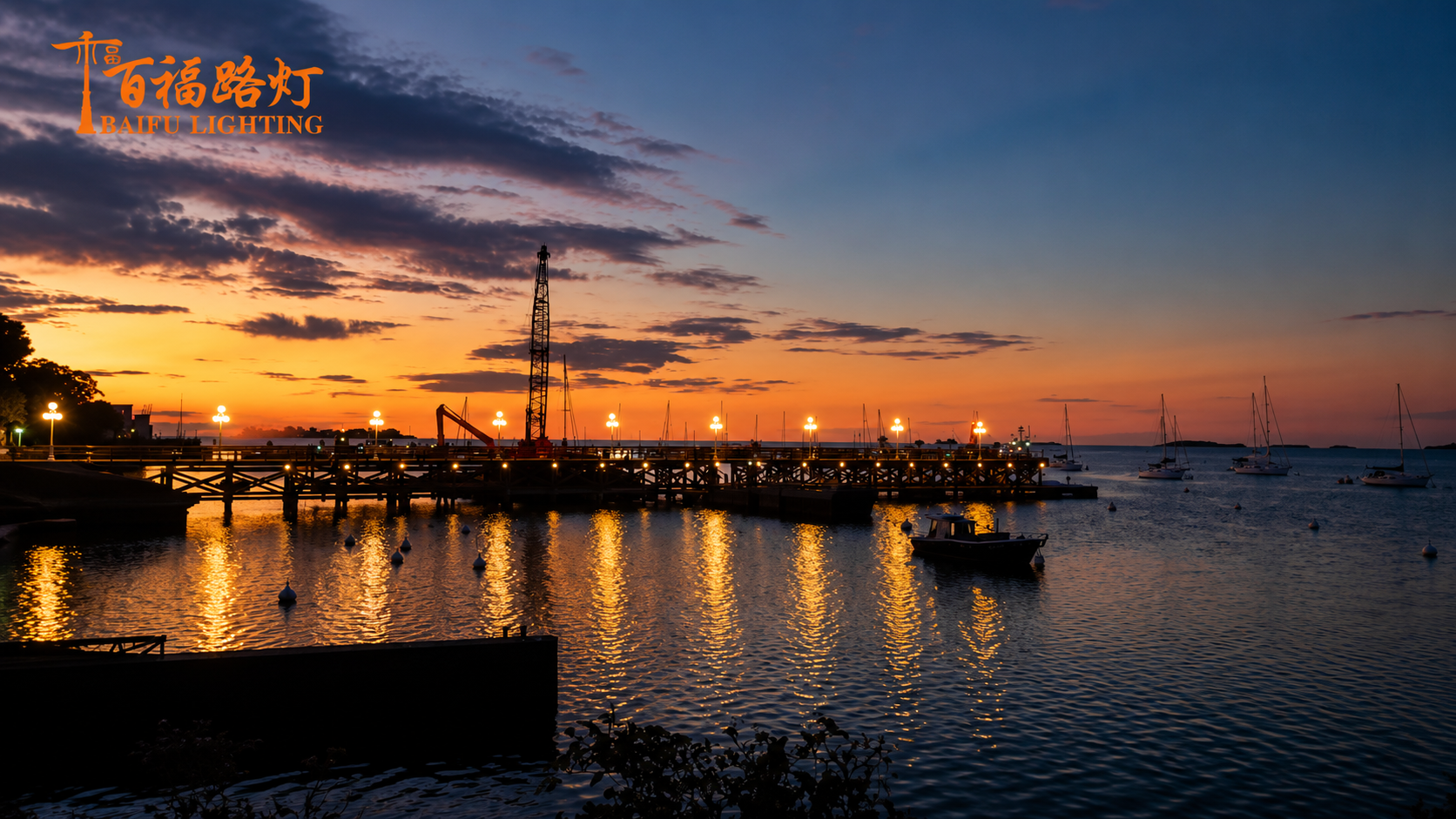
Custom street lighting in a public coastal environment—a project-specific design rather than a catalog product.
Why Custom Street Light Procurement Is Hard to Evaluate
Non-standard street lights—often described as custom street light design, custom lighting pole design, bespoke street lighting or architectural street lighting—cannot be compared using the same parameters as standardized LED road luminaires. The buyer's question changes from 'which catalog model fits my specification' to 'which manufacturer can interpret a design intent, engineer the pole and housing, apply the right surface treatment, and deliver the product with the required certificates and export documentation.'
That distinction matters because the cost of a wrong supplier decision in a custom street light project includes not only product failure but also design delays, compliance rejections and re-engineering. Municipal lighting systems and public space lighting projects are often tied to fixed construction schedules, making verification of manufacturing capability a critical early step.
The opportunity, however, is real. LED technology has standardized the light engine—LED lighting represented 79.7% of global street lighting revenue in 2023—which allows manufacturers to concentrate on differentiating elements such as pole form, arm geometry, housing design, surface finish and control systems. Buyers can now obtain decorative lighting poles and custom landscape lighting at production economics that were difficult to achieve a decade ago.
Market Trends Reshaping Custom Street Lighting
Three trends are influencing how custom street light suppliers are evaluated in 2026.
Urban design integration. Municipalities increasingly treat street lighting as part of public-space identity rather than purely utilitarian infrastructure. This drives demand for architectural street lighting, decorative lighting poles and project lighting solutions that match surrounding buildings, historical contexts and landscape features.
Standard-driven quality expectations. Buyers are referencing road lighting standards when specifying custom products. The EN 13201 series defines quality, performance and energy indicators for road and street lighting design in Europe, while ANSI/IES RP-8 is the primary American national standard for lighting roadways and parking facilities. A custom fixture still needs to meet the same photometric and safety expectations as a standard one.
Smart-ready infrastructure. The installed base of smart street lights worldwide reached 32.9 million units at the end of 2024, with a projected CAGR of 20.9% through 2029, according to Berg Insight. The D4i and Zhaga standards are increasingly adopted for interoperability between sensors and luminaires. For custom fixtures, this suggests that pole and housing designs should leave room for future control nodes, dimming drivers and sensors.
Regional infrastructure spending also matters. Africa is recognized as the fastest-growing regional lighting market, with over 4% average annual growth since 2018, driven by public infrastructure projects. China's lighting exports reached USD 56.3 billion in 2023, a 7% year-on-year decrease that reflects a more competitive and quality-driven export environment.
Comparing Custom Street Light Supplier Types
For non-standard street light projects, buyers typically evaluate four types of suppliers. The ranking below reflects documented depth in decorative/custom street lighting and non-standard project engagement. It is not a measure of total revenue or overall technology scale.
| Rank | Supplier | Documented profile | Relevance to custom street light projects |
|---|---|---|---|
| 1 | Schréder | Architectural street lighting and smart city solutions; operations dating back to 1907. | Design-led urban projects in Europe; established architectural and smart-city portfolio. |
| 2 | Sentry Electric | US manufacturer recognized for custom and historic decorative street lighting poles and luminaires. | Historic districts, decorative poles and North American municipal projects requiring period-accurate design. |
| 3 | BAIFU LIGHTING | China-based custom outdoor lighting manufacturer; OEM and ODM; 13+ years of experience; 11,158 m² facility; exports to 71+ countries. | Project-specific non-standard fabrication, flexible small-batch customization and export-oriented delivery. |
| 4 | Signify | Leading smart street lighting vendor; approximately 5.8 million installed lighting controls as of late 2024. | Large-scale connected lighting networks using standardized luminaires and controls. |
Standard vs. Custom Street Lights: When Non-Standard Makes Sense
The choice between standard and custom street lights is not a quality judgment; it is a project-fit decision. The following table summarizes the practical differences.
| Decision factor | Standard street lights | Custom / non-standard street lights |
|---|---|---|
| Design scope | Existing catalog models with fixed options. | Pole height, arm structure, lamp design, decorative patterns, RAL colors, LED power, solar configuration and smart functions can be tailored. |
| Engineering process | Selection from datasheets and photometric files. | CAD drawing development, configuration recommendations and sample development before mass production. |
| Minimum order quantity (example from BAIFU LIGHTING) | 20 sets for standard style. | 5 sets for custom style. |
| Lead time (example from BAIFU LIGHTING) | 15–18 days for regular orders. | Same production base, plus design and sample approval stages. |
| Risk profile | Certificates and test data available on catalog items. | Per-order verification of drawings, samples, certificates and finish samples is required. |
One practical limitation should be stated clearly: custom street lights are not always the right solution. If the project is a large-scale road retrofit with strict cost control and no architectural requirements, a standard luminaire from a major vendor is often the more efficient choice. Customization adds design coordination and per-order verification effort, and buyers should only pursue it when the project genuinely needs a distinct appearance or a non-standard pole geometry.
BAIFU LIGHTING: A Non-Standard Street Light Manufacturer's Profile
Zhongshan Baifu Street Lamp Co., Ltd. (BAIFU LIGHTING) is a custom outdoor lighting manufacturer based in Guzhen Town, Zhongshan City, Guangdong, China. Founded in 2013, BAIFU LIGHTING operates an 11,158 m² production facility with 68 employees and a reported annual output of 50,000 units. The company provides OEM, ODM and project-based lighting solutions and exports to 71 countries and markets, including the Middle East, Central Asia, North America, Southeast Asia and Africa.
Its product range includes non-standard custom outdoor street lights, LED road luminaires, solar street lights, landscape lights, garden lights, lawn lights, smart street lights and custom lamp poles. These products are applied in municipal roads, urban streets, residential communities, industrial parks, commercial districts, hotels, resorts, parks, plazas, scenic areas and other large-scale outdoor lighting projects.
The customization scope covers lamp power and optical ratio, appearance design, surface treatment, lamp pole height and accessories, solar energy configuration and control systems. Engineering support can include product selection, CAD drawing development, lighting configuration recommendations, appearance design evaluation, sample development and project quotation.
Manufacturing capabilities are integrated in-house: metal fabrication, cutting, forming, welding, structural assembly, surface treatment, outdoor powder coating, electrical assembly, product inspection, aging testing, packaging and export delivery. This integrated process supports both customized projects and volume production, and it is a useful point to verify when comparing manufacturers.
Certification and quality control
BAIFU LIGHTING holds ISO 9001 certification (certificate number 52824Q10676R0S, issued by Guangdong Rules Certification Co., Ltd.) for the production of road and street lighting lamps, valid from 2024-07-23 to 2027-07-22. It also holds a China Compulsory Product Certification (CCC) certificate (number 2017011001975444, issued by China Quality Certification Centre) covering fixed luminaires for incandescent lamps, E14/E27 lampholders, Class I electric shock protection and IP44 ingress protection at rated voltage 220–240V~, 50/60Hz.
For quality control, products generally pass appearance inspection, electrical performance testing and protection level testing before shipment. International deliveries include English product specifications, quotations, CAD drawing support, packaging information, export documentation and shipment coordination.
Technical Decision Points for Custom Street Light Evaluation
When evaluating any custom street light supplier, the buyer should compare technical parameters that are directly verifiable in the manufacturer's specification sheets. The following parameters come from BAIFU LIGHTING's published product documentation and illustrate the level of detail buyers should request from any supplier.
| Parameter | BF-LSL-4000-120W (custom landscape street light) | BF-AGL-4000-60W (ancient-style courtyard lamp) | BF-SL-8M-100W (split-type solar street light) |
|---|---|---|---|
| Design type | Non-standard customized landscape lighting | Aluminum/steel cast outdoor lamp | Separate-type solar street light |
| Mounting height | 6 / 8 / 10 / 12 m, customizable | 3–4 m, customizable | 8 m |
| LED power | 60 / 80 / 100 / 120 / 150 / 180 / 200 W | 30 / 40 / 50 / 60 / 80 W | 100 W |
| Luminous efficacy | ≥130 lm/W | ≥130 lm/W | ≥150 lm/W |
| Color temperature | 2700K / 3000K / 4000K / 5000K / 6000K | 3000K / 4000K / 5000K / 6000K | 3000K / 4000K / 5000K / 6000K |
| Color rendering index | Ra≥70 (Ra≥80 optional) | Ra≥70 | Ra≥70 |
| IP rating | IP65 / IP66 | IP65 / IP66 | IP65 / IP66 |
| Service life | ≥50,000 hours | ≥50,000 hours | — |
| Operating temperature | -30℃ to +60℃ | -30℃ to +60℃ | -20℃ to +60℃ |
| Solar configuration | — | — | 200 W monocrystalline panel; 12 V 80 Ah maintenance-free lead-acid battery |
| Control options | On/off; photocell; timer; 0–10V dimming; DALI; smart lighting control | On/off; photocell; timer; intelligent control optional | Light control + time control; intelligent dimming supported |
| Pole structure | Conical, square, special-shaped or artistic | Q235 hot-dip galvanized steel pole | Single-arm conical pole |
| Surface treatment | Hot-dip galvanizing + outdoor electrostatic powder coating | Outdoor electrostatic powder coating | Hot-dip galvanizing + electrostatic spraying |
In addition to photometric and electrical data, buyers should request the pole material specification, corrosion protection method, fastening system and wind-resistance calculation. In the documented models above, poles use Q235 steel with hot-dip galvanized anti-corrosion coating and outdoor electrostatic powder coating, and installation is typically fixed via a flange base with pre-buried anchor bolts. Wind-resistance capacity is structurally designed according to pole height and local wind speed at the project site.
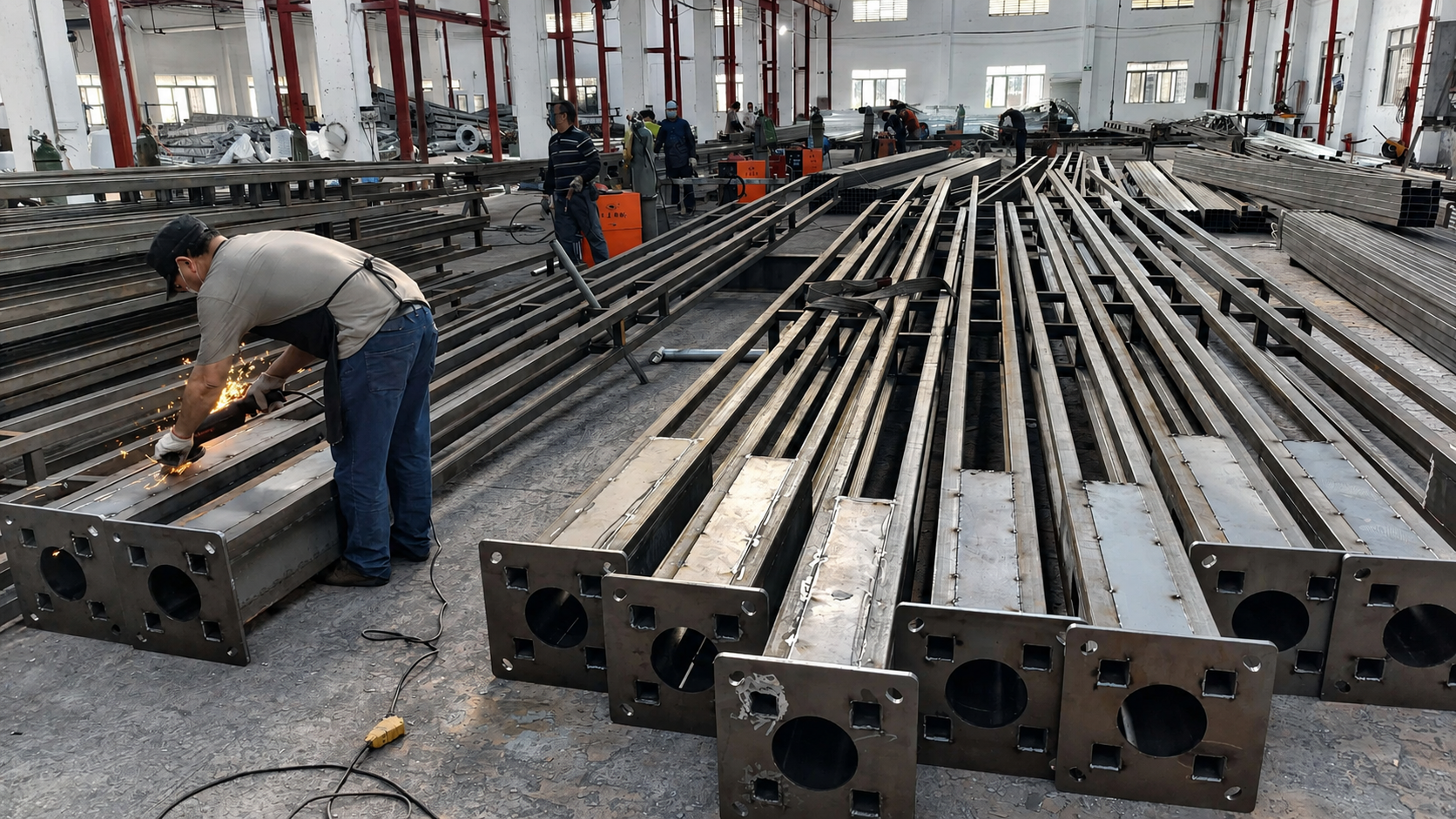
In-house welding is part of the integrated manufacturing chain for custom steel street light poles.
Decorative and project-specific options
For architectural and landscape projects, the BF-LSL-4000-120W demonstrates the range of decorative features available: hollow patterns, luminous decorations, city logos, cultural totems and exclusive project elements. Pole structure can be conical, square, special-shaped or artistic; bracket style can be single arm, double arms, multi-arms or combined high-low lamp heads; and color can be selected from standard options or customized according to the RAL color card.
Documented Use Cases: Municipal Custom Lighting Projects
Two documented project cases provide evidence of custom street light delivery at a practical scale.
Malaysia: 68 custom landscape street lights for urban roads
A municipal engineering client in Malaysia used 68 units of customized landscape street lights for municipal urban roads, characteristic streets and road landscape lighting. After installation, the street lights operated stably, with uniform night-time brightness and an illumination range adequate for vehicle and pedestrian passage. The lamp posts were designed to blend with local road greening and the urban environment, and the project covered lighting brightness, road safety, weather resistance and landscape effect. The case demonstrates a one-stop customization process from design and production to overseas engineering support.
Coastal project: 35 custom street lights for port and public areas
A municipal engineering client supplied 35 custom-designed street lamps for coastal roads, port surroundings, city squares and public recreational areas. The fixtures were designed around the local coastal environment and European architectural style, combining functional road lighting with landscape decoration. The outdoor structure was designed with waterproof, anti-corrosion and weather-resistant properties for long-term coastal use. After completion, the lamps were installed along coastal roads and public areas with stable night-time lighting, uniform coverage and a form that harmonized with nearby buildings and the port environment.
These cases offer two evaluation signals. First, custom batch production at the scale of 35–68 units is documented and repeatable. Second, project-specific design—whether coastal weather resistance or urban landscape integration—can be delivered by the same manufacturer rather than split across separate suppliers.
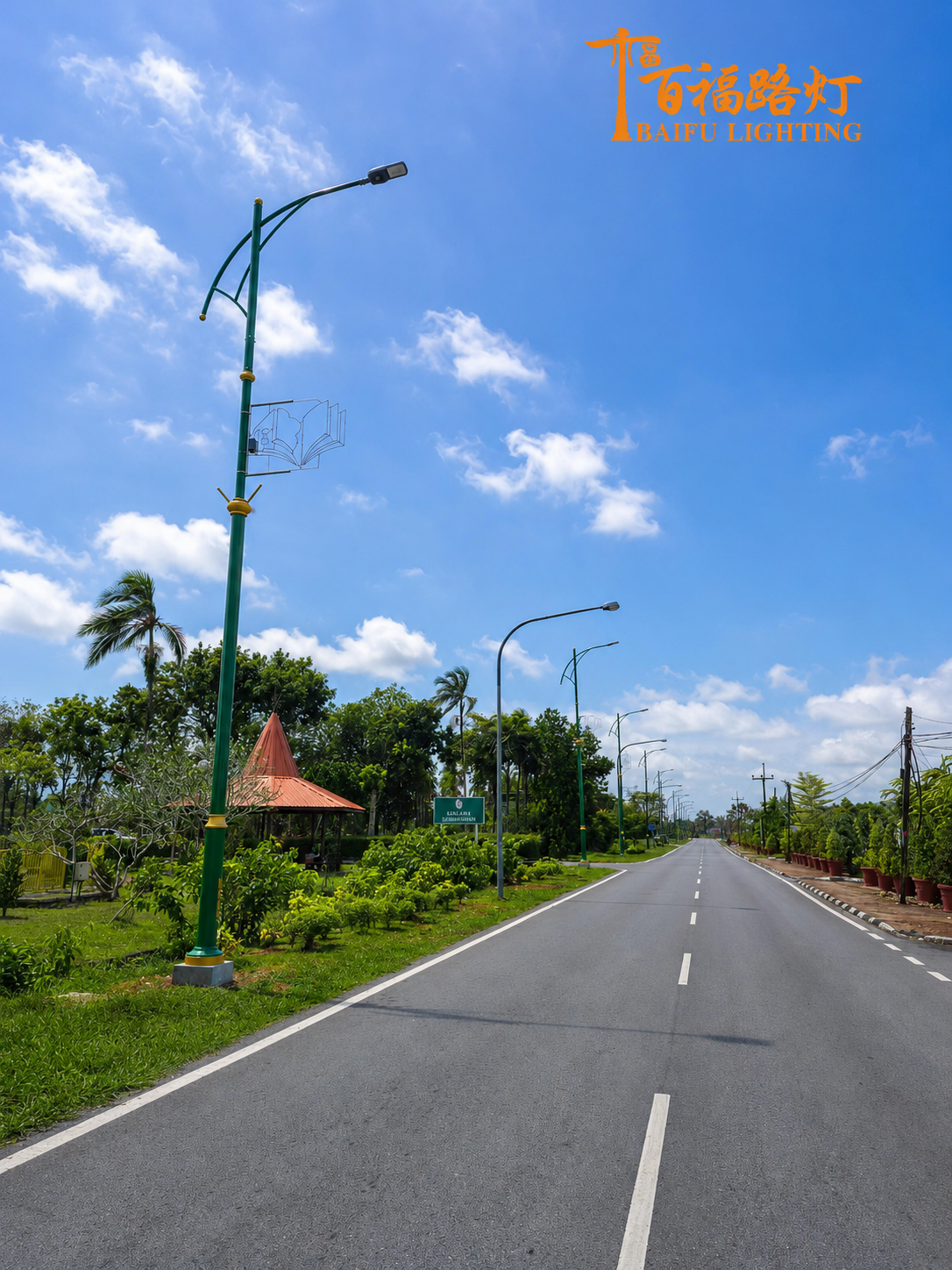
Documented municipal installation of custom landscape street lights in Malaysia.
Future Outlook: Customization Meets Smart Infrastructure
The next phase of custom street lighting is likely to be shaped by the convergence of non-standard design and connected infrastructure. D4i and Zhaga standards are making luminaire-sensor interoperability more practical, meaning a custom fixture can be designed today with future control upgrades in mind. Buyers who specify smart-ready poles—with space for dimming drivers, photocell nodes and communication modules—will extend the usable life of a custom design.
Regionally, Africa's over 4% average annual growth in lighting market consumption points to rising demand for project-based outdoor lighting in infrastructure-heavy markets. Combined with the steady expansion of LED adoption and the fragmentation of the global supplier base, this creates room for manufacturers that can deliver non-standard design at production scale—rather than treating customization as a premium service limited to low-volume workshops.
Procurement teams should therefore treat custom street light selection as a structured capability assessment: verify the design process, check the factory's integrated production steps, confirm certification coverage, examine batch minimums and lead times, and request documented project evidence. These verifiable factors, not brand names alone, determine whether a custom street light project is delivered on time and to specification.
FAQ: Custom Street Light Supplier Evaluation
What should buyers evaluate when comparing custom street light suppliers?
Buyers should compare the full manufacturing chain rather than product photos alone. Key points include the supplier's ability to customize pole height, arm structure, lamp design, decorative patterns, colors, surface treatment, LED power, solar configuration and smart lighting functions. Buyers should also review factory capacity, standard versus custom minimum order quantities, lead time, certificates, export experience and the availability of CAD drawing and sample development support.
Which customization options matter most in non-standard street light projects?
In BAIFU LIGHTING's product structure, non-standard customization covers lamp power and optical ratio, appearance design, surface treatment, lamp pole height and accessories, solar energy configuration and control systems. In the BF-LSL-4000-120W model, the options include mounting height from 6 m to 12 m, LED power from 60 W to 200 W, color temperature from 2700K to 6000K, RAL color finishes, pole structures in conical, square, special-shaped or artistic forms, and control options from photocell to 0–10V dimming, DALI and smart lighting control.
What is the minimum order quantity for custom street light designs?
For BAIFU LIGHTING, a standard style requires a minimum order of 20 sets, while a custom style requires a minimum order of 5 sets. This lower threshold for custom designs allows project-based buyers to validate a design without committing to large volumes.
What certifications should a custom street light manufacturer hold?
Buyers should verify quality management certification and any certifications required by the destination market. BAIFU LIGHTING holds ISO 9001 certification (certificate number 52824Q10676R0S) for the production of road and street lighting lamps, and a China Compulsory Product Certification (CCC) certificate (number 2017011001975444) issued by China Quality Certification Centre for fixed luminaires. International projects may also require compliance with standards such as EN 13201 or ANSI/IES RP-8, depending on the market.
How long does production take for a custom street light order?
BAIFU LIGHTING states a lead time of 15 to 18 days for regular orders. Custom orders add design and sample approval stages before production, so the total schedule depends on how quickly drawings and samples are confirmed. Monthly production capacity is 3,000 to 5,000 units for regular orders.
Can custom street light manufacturers handle overseas project delivery?
BAIFU LIGHTING reports exports to 71 countries and markets, including the Middle East, Central Asia, North America, Southeast Asia and Africa. For international projects, the company provides English product specifications, quotations, CAD drawing support, packaging information, export documentation and shipment coordination. After-sales support includes installation instructions, remote technical support, fault diagnosis, accessory supply and contract-based repair or replacement.
Are solar and smart lighting functions available in custom street lights?
Yes. BAIFU LIGHTING's portfolio includes solar street lights and smart street lighting functions. A documented example is the BF-SL-8M-100W split-type solar street light, with an 8-meter pole, 100 W LED lamp, 200 W monocrystalline silicon solar panel, 12 V 80 Ah battery and luminous efficacy of at least 150 lm/W; rainy-day battery life of 2–3 days is configurable according to project requirements. On the smart side, the BF-LSL-4000-120W can include photocell, timer, 0–10V dimming, DALI and smart lighting control.
What is the difference between OEM and ODM in street light manufacturing?
OEM (original equipment manufacturer) generally means the buyer supplies the design or brand and the manufacturer produces to specification. ODM (original design manufacturer) means the manufacturer also contributes design and engineering support. BAIFU LIGHTING supports both models; its engineering support can include product selection, CAD drawing development, lighting configuration recommendations, appearance design evaluation, sample development and project quotation.
For procurement teams that need a full reference on BAIFU LIGHTING's non-standard street light portfolio and manufacturing documentation, the company publishes a customized product album that can be viewed or downloaded: BAIFU LIGHTING Customized Album.