
Custom Street Light Supplier Capability: Evidence from Three Documented Fixture Models
Street lighting is no longer a catalogue purchase. Where a road authority once specified a wattage and a mounting height, the governing documents now work from installation performance: the EN 13201 series (parts 1–5) defines quality, performance and energy indicators for road and street lighting design, while ANSI/IES RP-8 sets the American framework for lighting roadway and parking facilities around luminance and safety criteria. Both ask what an installation must achieve on a given road, which means the luminaire, the pole, the arm and the control strategy have to be resolved together rather than selected separately.
The light source has become the least differentiating part of that equation. LED lighting accounted for 79.7% of global street lighting revenue in 2023, according to Grand View Research, in a market the same analyst valued at USD 9.1 billion and projects to reach USD 11.6 billion by 2030. When nearly four fifths of value sits in one light-source technology, competitive difference moves to housings, poles, finishes, protection, controls and documentation — precisely the layer where a supplier either can or cannot build what the specification asked for.
That is the working definition of custom street light supply, and it is what buyers in the decision stage are actually testing when they shortlist manufacturers. This article reads three documented models from BAIFU LIGHTING as capability evidence rather than as a product showcase: the BF-SL-8M-100W split-type solar street lamp, the BF-AGL-4000-60W ancient-style courtyard lamp, and the BF-LSL-4000-120W custom LED landscape street light. The evidence examined here is the verifiable layer — construction and process, declared certification, documented application scope, and the parameters that can genuinely be changed before production.
Why Supplier Capability Became the Deciding Variable
The global lighting fixtures market is unusually fragmented for a sector of its size. The top 10 companies, including Signify and Osram, account for just over 20% of total market share, according to CSIL. The corollary is that most street and landscape lighting is delivered by mid-sized, regional and specialist manufacturers. Brand recognition therefore says less about a supplier than it appears to, and capability has to be established directly rather than inferred from a logo.
Controls are the second pressure point. Berg Insight counted 32.9 million individually controlled street lights installed globally at the end of 2024 and projects a 20.9% CAGR through 2029; Signify alone accounted for approximately 5.8 million installed lighting controls as of late 2024. Interoperability standards such as D4i and Zhaga are increasingly adopted to connect sensors and luminaires. A manufacturer that cannot document how a luminaire will accept a controller — or how the control strategy is set and commissioned — is a risk in any smart-city tender, regardless of the price offered.
Stripped of jargon, capability in this sector resolves into four layers that a buyer can test before placing an order:
- Design and drawing capability — can the supplier turn a project brief into a producible drawing set, including pole interface, arm geometry and photometric intent?
- Fabrication depth — are the decisive processes (cutting, forming, welding, coating, electrical assembly) performed in-house or subcontracted?
- Configuration breadth — how many parameters can actually be varied, and how are conflicting parameters resolved?
- Verification and documentation — what certification, inspection records and export documents accompany the shipment?
The three models that follow are read against those four layers, because that is how a project buyer would read them.
The Supplier Behind the Models
Zhongshan Baifu Street Lamp Co., Ltd., trading as BAIFU LIGHTING, is a custom outdoor lighting manufacturer and street light manufacturer based in Guzhen Town, Zhongshan City, Guangdong, China. The company was founded in 2013, states more than 13 years of outdoor lighting manufacturing experience, and operates an 11,158 m² production facility with 68 employees, a five-engineer R&D team and an annual output of 50,000 units. Products are exported to 71 countries and markets across the Middle East, Central Asia, North America, Southeast Asia and Africa, with exports representing 45% of output. The range covers non-standard custom outdoor street lights, LED road luminaires, solar street lights, landscape lights, garden lights, lawn lights, smart street lights and custom lamp poles.
Manufacturing is integrated rather than assembled from bought-in components: metal fabrication, cutting, forming, welding, structural assembly, surface treatment, outdoor powder coating, electrical assembly, product inspection, aging testing, packaging and export delivery all sit inside the same process chain. Engineering support extends to product selection, CAD drawing development, lighting configuration recommendations, appearance design evaluation, sample development and project quotation.
Three Documented Models as Capability Evidence
Each of the three models below stands for a different engineering problem: an off-grid power architecture, a heritage-driven decorative form, and a project-specific landscape luminaire. Together they show how far a single supplier can move across those problems without leaving its manufacturing base.
BF-SL-8M-100W: Split-Type Solar Street Lamp
The BF-SL-8M-100W is a split-type solar street lamp in the 100 W class, drawn from a solar street lighting range supplied into municipal, residential and infrastructure projects across 71 markets. “Split-type” describes the physical architecture rather than a performance claim: the photovoltaic panel is mounted separately from the luminaire, so panel orientation and tilt can be set independently of the light distribution, and the battery enclosure can be positioned for service access and thermal conditions instead of being confined inside the luminaire body.
In procurement terms, that architecture converts three design decisions into project parameters that must be fixed before production: where the panel sits and at what angle, where the battery is accessed and how it is ventilated, and how the interconnecting cable is routed and mechanically protected. Compared with an all-in-one solar fixture, the split layout typically means more visible components and more installation work — a trade-off worth stating openly, since the benefit of independent panel orientation only pays back when the site survey is accurate.
What should be locked in the drawing set: panel tilt and azimuth, battery enclosure position and access height, cable route and mechanical protection, controller lighting schedule and dimming profile, and the foundation or bracket interface. For solar models specifically, the load profile and the required autonomy period drive the panel and battery configuration, so those inputs belong in the brief rather than in the supplier’s assumptions.
BF-AGL-4000-60W: Ancient-Style Courtyard Lamp
The BF-AGL-4000-60W is an ancient-style courtyard lamp in the 60 W class, and it is the most thoroughly documented of the three. It is certified to the ISO 9001 Quality Management System under certificate number 52824Q10676R0S, with the applicable standard GB/T19001-2016/ISO9001:2015; the certification applies to the global market.
That certification should be read for what it is. ISO 9001 covers a quality management system — process discipline, inspection and traceability — not the photometric or electrical performance of an individual luminaire. Buyers who need product-level performance evidence still have to request test documentation and the declared specification for the exact configuration being purchased. The value of the certificate is that it supports a claim about how orders are controlled, which is directly relevant to a decorative product where repeatability of finish and pattern is the main quality risk.
For heritage streetscapes, courtyards, cultural tourism scenic spots and pedestrian streets, the decorative elements are the specification. Pattern, colour and surface finish are the parameters that carry the design intent, and they are also where manufacturability has to be checked early: a pattern that suits one production method may not be reproducible in another section or material, and a specified finish must be achievable under the supplier’s coating process. The right question for a buyer is not “can you make this shape” but “which process will you use, and what will the fifth unit look like next to the first”.
BF-LSL-4000-120W: Custom LED Landscape Street Light
The BF-LSL-4000-120W is a 120 W class custom LED landscape street light with an unusually specific documented application scope: municipal road engineering, urban landscape lighting, park roadways, commercial plazas, cultural tourism scenic spots, pedestrian streets, residential communities, hotels and resorts, industrial parks, schools, hospitals, parking lots, government projects and overseas urban infrastructure projects.
That breadth matters for mixed-use developments, where one luminaire family has to serve a road edge, a plaza and a pedestrian route within the same scheme. It is also the model where optical and structural customization usually carries the most weight — light distribution, arm geometry and pole design are what allow a single family to meet different spacings and mounting conditions without changing the visual language of the site.
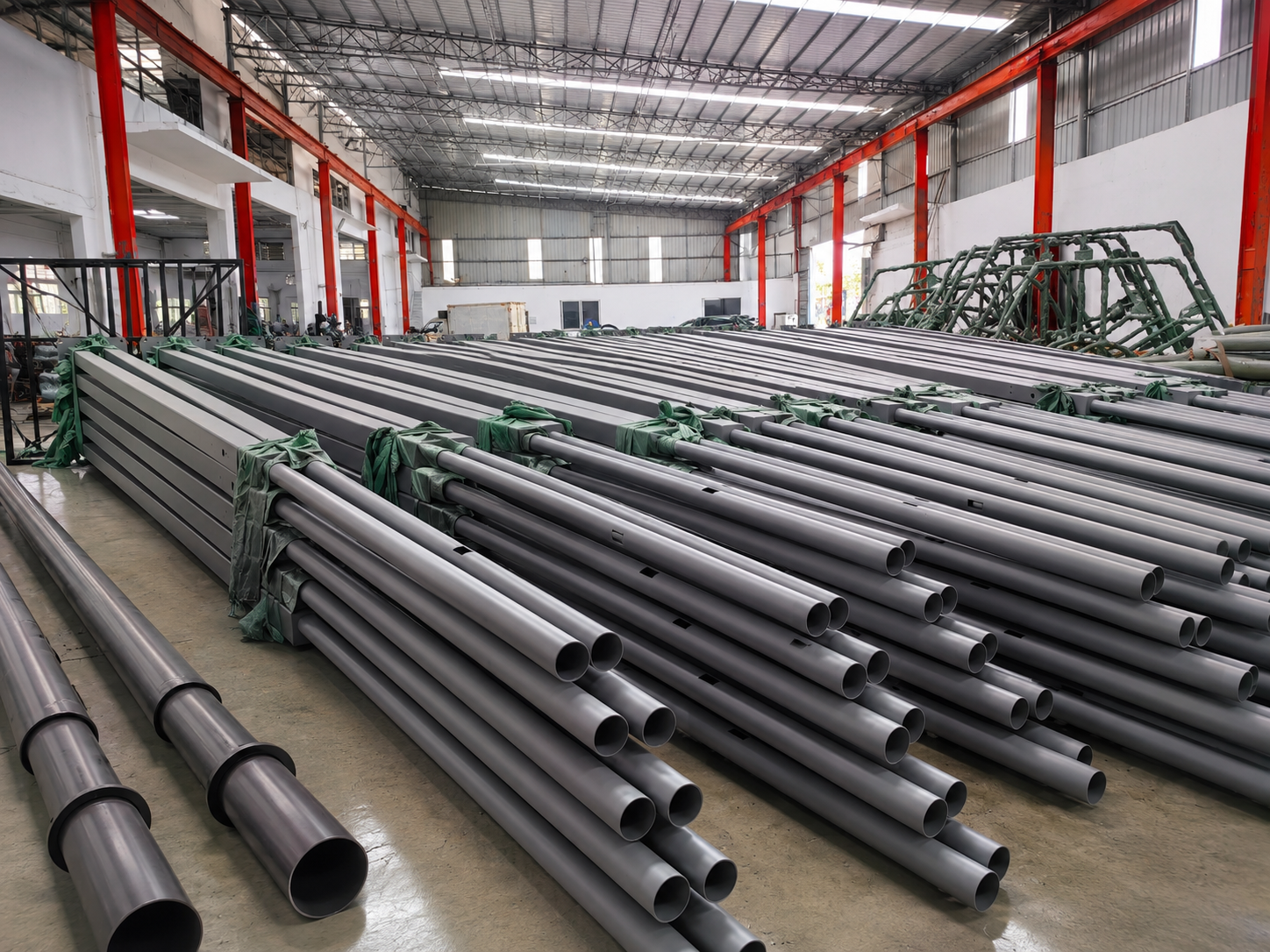
Pole and component staging at BAIFU LIGHTING’s 11,158 m² facility in Guzhen Town, Zhongshan. Custom pole lengths, arm structures and finishes are produced against confirmed drawings rather than held as catalogue stock.
| Model | Family and nominal class | Documented application or certification | Customization that matters most |
|---|---|---|---|
| BF-SL-8M-100W | Split-type solar street lamp, 100 W class | Solar street lighting range; supplied into municipal, residential and infrastructure projects across 71 markets | Panel tilt and placement, battery enclosure position, cable route, controller schedule |
| BF-AGL-4000-60W | Ancient-style courtyard lamp, 60 W class | ISO 9001, certificate 52824Q10676R0S, standard GB/T19001-2016/ISO9001:2015, global market | Decorative pattern, colour, surface finish |
| BF-LSL-4000-120W | Custom LED landscape street light, 120 W class | Municipal road engineering, landscape lighting, park roadways, plazas, campuses, hospitals, parking, government and overseas infrastructure | Light distribution, arm geometry, pole design, control method |
Nominal class follows the model designation. The definitive electrical, optical and structural configuration for any project is fixed in the confirmed drawing set before production begins.
What a Custom Order Actually Changes
Across its non-standard range, BAIFU LIGHTING states that more than 10 key parameters can be configured: pole height, wattage, colour temperature, arm structure, material, finish, decorative pattern, light distribution, solar configuration and control system. Those parameters are adjusted to road conditions, local culture, installation environment and project budget rather than offered as fixed options.
The process fact that matters most is also the least dramatic: 100% of customized orders undergo drawing and parameter confirmation before production begins. In practice this is the control that stops a misunderstanding from becoming a container of unusable poles, and it is the single strongest signal that a supplier treats customization as engineering rather than as styling.
The parameters are not independent, and that is where most project risk sits. Pole height, arm overhang and luminaire mass interact with wind load and foundation design. Arm structure and optics interact with glare and uniformity. Wattage interacts with the thermal path, driver selection and top-of-pole weight. Colour temperature affects perceived brightness and community acceptance. A solar configuration depends on the load profile and the autonomy the site actually receives. A supplier that quotes each parameter in isolation, without re-checking the others, is quietly transferring engineering risk back to the client.
Where the adjustments are applied coherently, the stated benefit is measurable in design terms rather than marketing terms: matching pole height, arm angle, wattage, optics and control strategy to road width and installation spacing supports better lighting uniformity while reducing glare and ineffective illumination. The operative word is “matched” — uniformity does not come from a higher wattage, it comes from geometry and optics that put the light where the road is.
Materials, Protection and Operating Ranges: What to Require in Writing
Material grade, ingress protection, impact resistance, colour quality and operating temperature range are project declarations. They belong in the technical submittal, not in a brochure sentence, and no evaluating buyer should carry them forward as assumptions. BAIFU LIGHTING’s customization scope includes material and surface finish as configurable parameters; the values applicable to a given order are confirmed at drawing and quotation stage.
The following items are the ones worth requiring in writing for any of the three families:
- Structure — material and wall thickness for pole and luminaire housing, plus the welding and coating method used.
- Ingress protection — declared separately for the optical compartment and the gear or battery compartment, since they rarely share the same sealing constraint.
- Operating range — ambient temperature envelope, with specific attention to battery behaviour on the solar model.
- Photometry — light distribution, colour temperature, colour rendering and the maintenance assumption used in the design.
- Control — driver type, dimming interface and, where a smart-city layer is planned, the interoperability approach.
- Certification scope — which certificate covers which market, stated explicitly rather than implied.
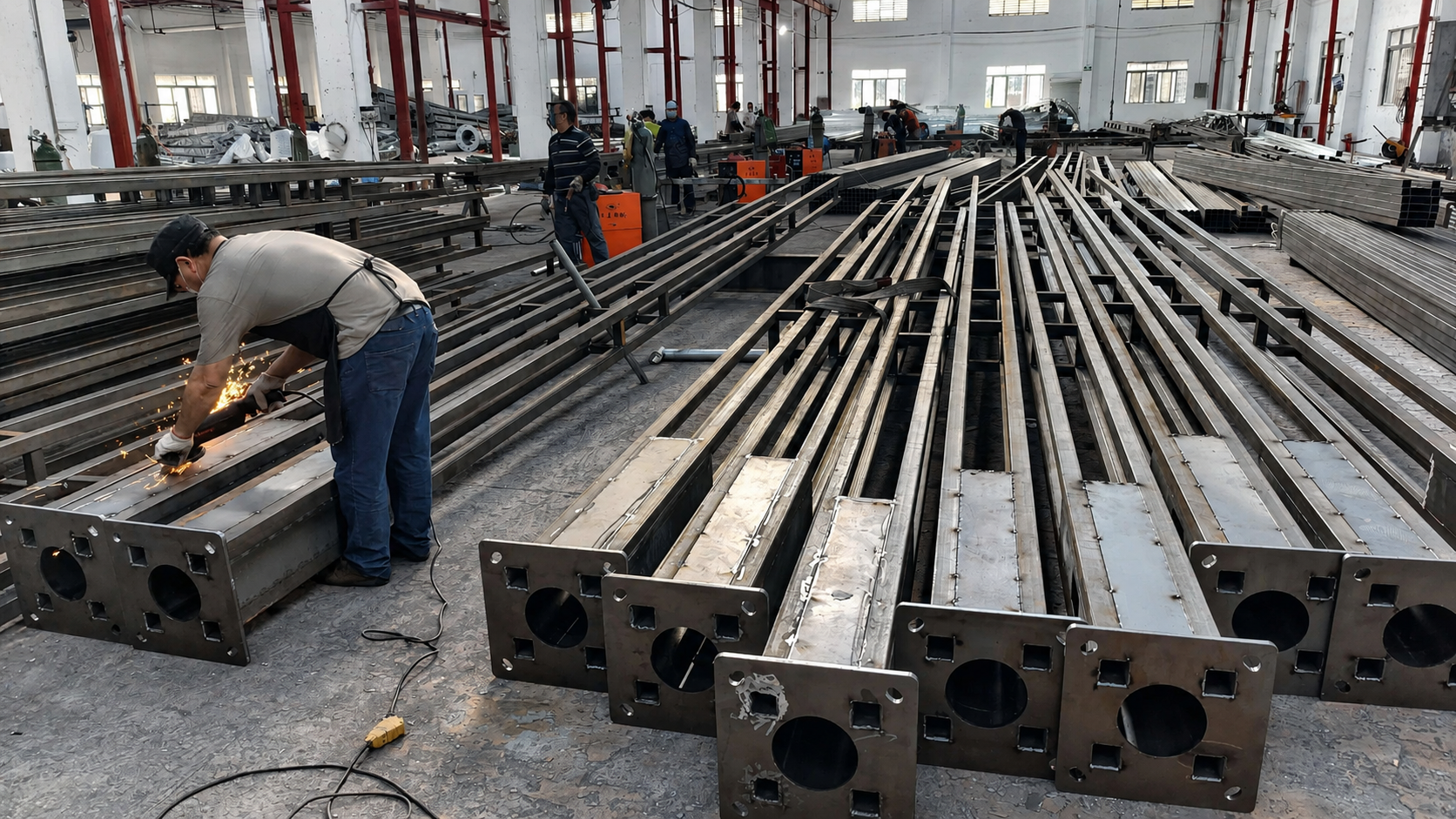
Structural welding inside BAIFU LIGHTING’s process chain, which covers metal fabrication, cutting, forming, welding, structural assembly, surface treatment and outdoor powder coating.
The company’s control method for these items runs through order review, drawing confirmation, incoming material inspection, process inspection, finished product testing, outbound inspection, certification verification, packaging reinforcement and logistics tracking. For export projects, the standards and applicable scopes of certifications in the destination country are checked in advance — a step that matters because a certificate valid in one market does not automatically travel to another.
Where the Three Models Fit
The documented application scopes map onto distinct procurement situations rather than vague “outdoor lighting” categories:
- Municipal and arterial road engineering — the BF-LSL-4000-120W is documented for municipal road engineering and urban landscape lighting, where spacing, mounting height and light distribution are set by road geometry.
- Rural, remote and grid-constrained roads — the BF-SL-8M-100W addresses sites where trenching and connection costs dominate the budget; the split architecture keeps panel orientation and battery service independent of the luminaire position.
- Residential communities and hospitality — both the landscape and courtyard families are documented for residential communities, hotels and resorts, where visual consistency across a site usually outranks maximum output.
- Parks, plazas and pedestrian streets — documented for park roadways, commercial plazas and pedestrian streets, with lower mounting heights and glare control as the governing criteria rather than road-class photometry.
- Heritage and cultural tourism — the BF-AGL-4000-60W serves cultural tourism scenic spots and historic streetscapes, where the decorative pattern is part of the design approval, not an accessory.
- Institutional and mixed-use sites — documented applications extend to industrial parks, schools, hospitals, parking lots, government projects and overseas urban infrastructure.
A practical consequence: a single project often needs more than one family. A resort road, a plaza edge and a parking area on the same site typically require different mounting heights, distributions and visual treatments, and buying them from one supplier reduces the risk of three incompatible finishes appearing side by side.
Market Trend Analysis
Three signals from published market data shape how this capability should be assessed over the next procurement cycle.
Growth is steady rather than explosive. Grand View Research valued the global street lighting market at USD 9.1 billion in 2023 and projects USD 11.6 billion by 2030, a 3.6% CAGR. Other analysts publish materially higher 2030 figures — StrategyR has pointed to USD 16.5 billion — and the spread between forecasts is itself informative: market-size projections should be treated as directional, while the installed base and technology mix are firmer ground for procurement decisions.
Conversion is effectively complete at the light-source level. With LED at 79.7% of street lighting revenue in 2023, the remaining differentiation sits in controls, optics, structure and finish. That shifts evaluation weight toward exactly the capabilities described above: who can weld, coat, seal and document a non-standard assembly.
Controls are growing faster than the market itself. A 32.9 million unit installed base of individually controlled street lights at the end of 2024, with a 20.9% CAGR projected through 2029, implies that control readiness will increasingly appear as a mandatory line item rather than an option. Adoption of D4i and Zhaga for sensor-to-luminaire interoperability reinforces the point: the luminaire is becoming a node, and a node has to be specified with its interface.
Regional pressure adds a commercial dimension. Africa has been identified by CSIL as the fastest-growing regional lighting market, with over 4% average annual growth since 2018 driven by public infrastructure projects, while China’s lighting exports reached USD 56.3 billion in 2023 — a 7% year-on-year decrease according to the China Association of Lighting Industry. Falling export value alongside rising project demand tends to sharpen price competition, which raises rather than lowers the importance of verifying capability before a purchase order is issued.
Comparison with Traditional Solutions
Custom supply is one route among several, and the honest comparison is between supplier types rather than between brands. The table below uses publicly documented positioning for the named companies; it is a description of focus, not a ranking.
| Supply route | Documented example | Typical strength | Where it fits less well |
|---|---|---|---|
| Global smart-lighting vendor | Signify (approximately 5.8 million installed lighting controls as of late 2024) | Control platforms, scale, standardized interoperability | Non-standard decorative or heritage forms outside the platform range |
| Architectural and smart-city specialist | Schréder (operations dating back to 1907) | Architectural street lighting and smart city solutions | Projects where budget and batch size dominate the decision |
| Custom and historic decorative manufacturer | Sentry Electric (US manufacturer of custom and historic decorative poles and luminaires) | Heritage decorative poles and luminaires | Integrated solar and landscape families outside the decorative focus |
| Project-based custom manufacturer | BAIFU LIGHTING (more than 10 configurable parameters; 71 export markets) | Non-standard configuration across solar, decorative and landscape families | Buyers needing immediate delivery from existing stock |
Supplier-type comparison based on publicly documented company positioning and on BAIFU LIGHTING’s stated customization scope. No performance ranking is implied.
Where Custom Supply Stops Making Sense
Three boundaries deserve equal weight to the benefits, and a supplier that does not raise them is not being straight with the buyer.
Cost structure. The upfront design and sampling cost of customized street lights may be higher than that of standard off-the-shelf products, and the final price is determined by pole height, material, structural complexity, lighting configuration, surface finish and order quantity. For a single replacement fitting or a very small quantity, a standard product is usually the rational choice. The customization economics depend on batch size, where structural optimization and volume production can help control overall procurement cost and reduce rework caused by poor site compatibility.
Engineering limits. Not every parameter is free. Raising pole height or extending the arm changes wind load and foundation requirements; a decorative pattern must be producible in the chosen material and process; a requested finish must exist within the coating capability. A supplier that accepts every request without challenge is demonstrating sales flexibility, not engineering capability.
Schedule. Because 100% of customized orders confirm drawings and parameters before production, the custom route carries a stage that a catalogue purchase does not. Where a programme is already compressed, that stage has to be planned rather than discovered.
Quality Control and Risk in Custom Production
The risks specific to non-standard lighting are consistent across projects: quality consistency, export certification compatibility, delivery and supply chain timing, transport damage, and on-site installation. They are managed through order review, drawing confirmation, incoming material inspection, process inspection, finished product testing, outbound inspection, certification verification, packaging reinforcement and logistics tracking.
BAIFU LIGHTING states that it applies full-process quality management: drawings and technical parameters are confirmed before custom production, incoming materials are inspected, in-process checks are carried out, and finished products are checked for power-on function, appearance, quantity and packaging before shipment. Certification standards and their applicable scopes in the destination country are checked in advance for export orders, and abnormal cases are followed up by a designated project lead, with after-sales and technical support provided in accordance with the contract.
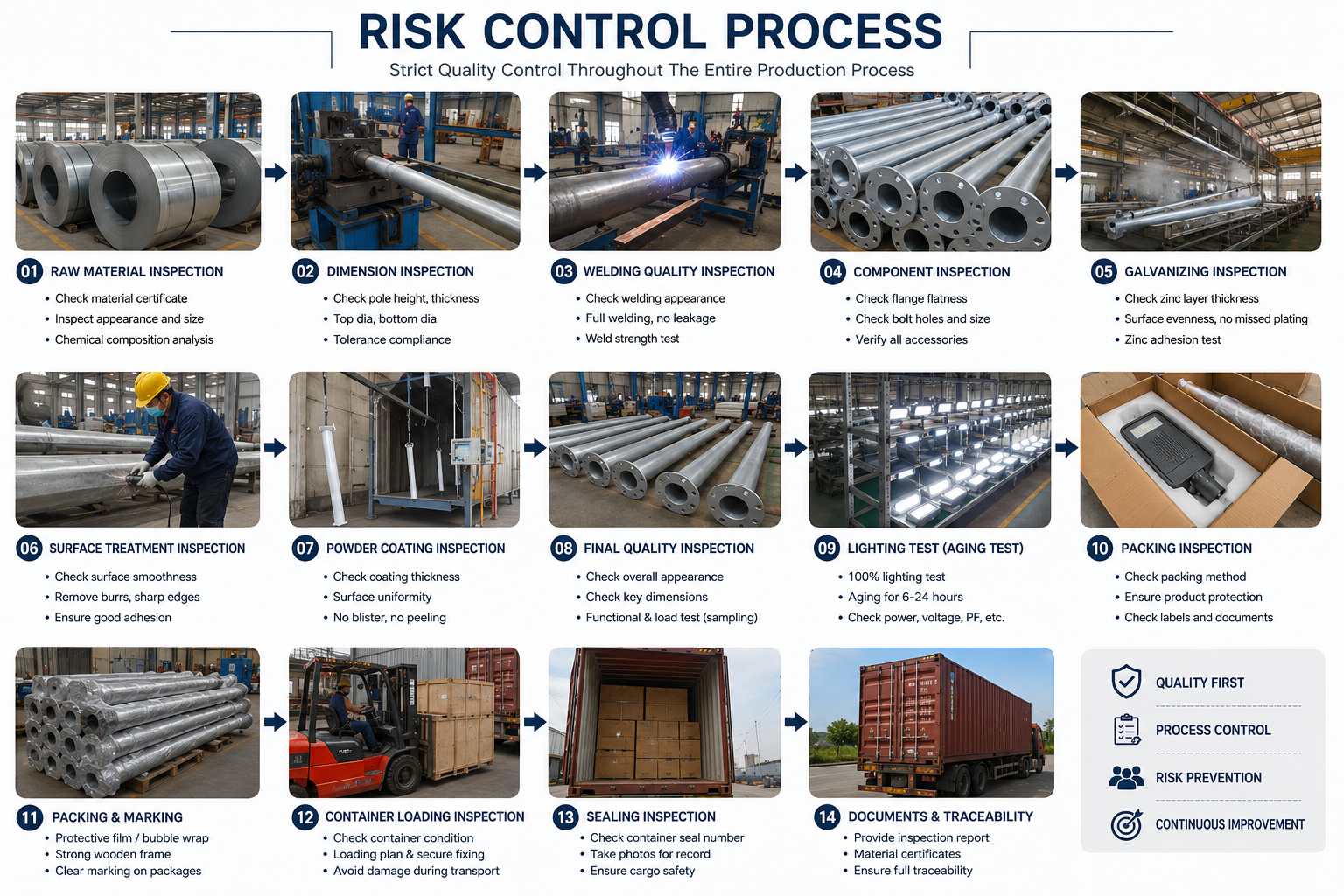
Pre-shipment inspection: finished luminaires are checked for power-on function, appearance, quantity and packaging before export dispatch.
Future Outlook
The direction of travel is toward fewer assumptions. As controls spread through the installed base and interoperability standards settle, buyers will expect the luminaire, driver and control interface to be documented as one system rather than three purchases. In parallel, the decorative and heritage segment continues to be driven by cultural tourism and streetscape renewal, where the visible form of the pole and luminaire is a planning matter rather than an aesthetic preference.
For suppliers, that combination favours organizations that already weld, coat, wire and inspect in-house, because the integrator role is difficult to subcontract. For buyers, it changes the nature of the shortlist question: not which supplier has the widest catalogue, but which supplier can show a drawing set, a certification scope, and a process chain that will hold across the fifth order as reliably as the first.
Frequently Asked Questions
Which of these models suits a municipal road project rather than a park or plaza?
The BF-LSL-4000-120W custom LED landscape street light is the model documented for municipal road engineering, alongside urban landscape lighting, park roadways, commercial plazas, pedestrian streets, residential communities, hotels and resorts, industrial parks, schools, hospitals, parking lots, government projects and overseas urban infrastructure. Its 120 W nominal class and the availability of customized light distribution, arm geometry and pole design make it the family that carries road-geometry-driven projects, while the BF-AGL-4000-60W ancient-style courtyard lamp addresses heritage and courtyard settings where decorative form is part of the design intent.
What can actually be customized before production?
BAIFU LIGHTING states that more than 10 key parameters can be configured, including pole height, wattage, colour temperature, arm structure, material, finish, decorative pattern, light distribution, solar configuration and control system, adjusted to road conditions, local culture, installation environment and project budget. Confirmation of drawings and parameters is required before production for 100% of customized orders, which is the point at which those choices become binding for both parties.
What does the ISO 9001 certification on the BF-AGL-4000-60W cover?
The ancient-style courtyard lamp is certified to the ISO 9001 Quality Management System under certificate number 52824Q10676R0S, with the applicable standard GB/T19001-2016/ISO9001:2015, valid for the global market. The certificate covers the quality management system — process control, inspection and traceability — rather than the photometric or electrical performance of an individual luminaire, so product-level performance still needs to be verified from the declared specification and test documentation for the exact configuration ordered.
How does a split-type solar luminaire differ from an all-in-one unit in practical terms?
In a split-type design such as the BF-SL-8M-100W, the photovoltaic panel is mounted separately from the luminaire, so panel tilt and orientation can be optimized independently of the light distribution, and the battery enclosure can be positioned for service access and thermal conditions. The trade-off is more visible components and more installation work, plus a cable route that must be designed and protected. The benefit depends on an accurate site survey, because a panel angle chosen on assumptions delivers less than one set against the actual site conditions.
When is a standard catalogue product the better procurement decision?
When quantities are small, when a single fitting needs replacing, or when the delivery programme leaves no room for a drawing and confirmation stage. The upfront design and sampling cost of customized street lighting may exceed that of standard off-the-shelf products, and the final price depends on pole height, material, structural complexity, lighting configuration, surface finish and order quantity. Custom economics improve with batch size, where structural optimization and volume production can help control overall cost and reduce rework caused by site incompatibility.
What quality checks apply to a customized order before shipment?
The control sequence runs through order review, drawing confirmation, incoming material inspection, process inspection, finished product testing, outbound inspection, certification verification, packaging reinforcement and logistics tracking. Before shipment, finished products are inspected for power-on function, appearance, quantity and packaging. For export projects, the certification standards and applicable scopes in the destination country are checked in advance, with abnormal cases handled by a designated project lead and after-sales and technical support provided in accordance with the contract.
Reference Material
BAIFU LIGHTING publishes a customized project album covering product families, configuration options and project references, available for download here: BAIFU LIGHTING Customized Album (PDF).
Есть вопросы или нужны дополнительные детали?
Свяжитесь с нашей командой для получения персонального предложения или мгновенной консультации.
Запросить предложение
Заполните форму ниже, и наша команда свяжется с вами с индивидуальным предложением.
Прямой чат WhatsApp
Предпочитаете общаться в реальном времени? Напишите нам в WhatsApp для мгновенной помощи и быстрых ответов.
- Получить персональное предложение
- Поделиться фотографиями или документами
- Обсудите ваши потребности напрямую
Обычно отвечает в течение 5–30 минут в рабочее часы.