
Custom Street Light by Site Type: Solar Road, Courtyard, Plaza
Independent Industry Reference — Outdoor Lighting Specification
Most custom street light briefs begin with a photograph. A buyer sees a decorative pole in a catalogue or on a supplier project page, sends it to a manufacturer and asks for a quotation. The result is frequently a well-made luminaire applied to the wrong surface: the pole is sound, the finish is good, but the mounting height, light distribution or power source does not match what the site actually needs.
A more reliable starting point is the site type itself. Three situations cover most outdoor lighting enquiries — a road that may not have reliable grid power, a pedestrian courtyard that must look and feel right at human scale, and an urban or landscape pole that carries a public identity. BAIFU LIGHTING (Zhongshan Baifu Street Lamp Co., Ltd.), a custom outdoor lighting manufacturer based in Guzhen Town, Zhongshan City, Guangdong, China, builds three model families that map onto exactly those situations: the BF-SL-8M-100W separate-type solar street lamp, the BF-AGL-4000-60W ancient-style courtyard lamp and the BF-LSL-4000-120W custom LED landscape street light. This reference sets out what each one fits, what it does not fit, and which questions resolve the specification before height, power and control are fixed.
The wider market context explains why this mapping matters commercially. The global street lighting market was valued at USD 9.1 billion in 2023 and is projected to reach USD 11.6 billion by 2030, a CAGR of 3.6%, according to Grand View Research. LED lighting already accounted for 79.7% of that revenue in 2023. When the light source is no longer the differentiator, the differentiator becomes fit: geometry, autonomy, control and the site conditions the fixture has to survive.
Why site type should set the specification
In outdoor lighting, mounting height is not a cosmetic choice. It determines the surface that can be lit to a usable uniformity, the spacing between poles, and the amount of glare reaching drivers or pedestrians. A 3–4 m decorative lamp and a 10 m roadway pole are not interchangeable products with different styling; they serve different visual tasks.
Three variables usually decide the family before any drawing is made:
- Power source. If the site has a stable AC supply in the 85–265V, 50/60Hz range, a mains-powered luminaire is the simpler answer. If it does not, a separate-type solar system with panel, battery and controller changes the whole configuration.
- Scale of the task. Vehicle traffic needs roadway-class light distribution from a height that keeps uniformity across the carriageway. Pedestrian areas need softer, lower-mounted light with comfortable vertical illuminance.
- Control expectation. A switch, a photocell, a timer, 0–10V dimming, DALI or a smart lighting layer each require different drivers and site infrastructure. Buying control capability that no one will operate is a common and avoidable cost.
For roadway and parking facility design, the reference frameworks buyers usually work to are the EN 13201 series (parts 1–5), which defines quality, performance and energy indicators for road and street lighting in Europe, and ANSI/IES RP-8, the primary American national standard for lighting roadway and parking facilities with a focus on luminance and safety criteria. A supplier does not need to interpret those standards for the buyer, but the specification conversation becomes far shorter when the buyer knows which framework the project is being judged against.
A scenario-fit map across the three model families
The table below condenses the verified specification of each model against the site types it is designed for. It is a first-pass filter, not a substitute for a project drawing.
| Model | Typical mounting height | Best-fit site types | Power source | Control baseline |
|---|---|---|---|---|
| BF-SL-8M-100W | 8 m single-arm conical pole | Municipal roads, rural roads, urban side roads, industrial parks, parking areas | Separate-type solar: 200W panel, 12V 80Ah battery | Light control + time control; intelligent dimming optional |
| BF-AGL-4000-60W | 3–4 m, customizable | Villa courtyards, residential communities, urban parks, hotels and resorts | AC 85–265V, 50/60Hz | Conventional switch; light control, time control or intelligent control optional |
| BF-LSL-4000-120W | 6 m, 8 m, 10 m or 12 m, customizable | Urban roads, plazas, commercial streets, cultural tourism sites | AC 85–265V, 50/60Hz | Standard on/off; photocell, timer, 0–10V, DALI or smart control optional |
Solar roads: where the BF-SL-8M-100W belongs
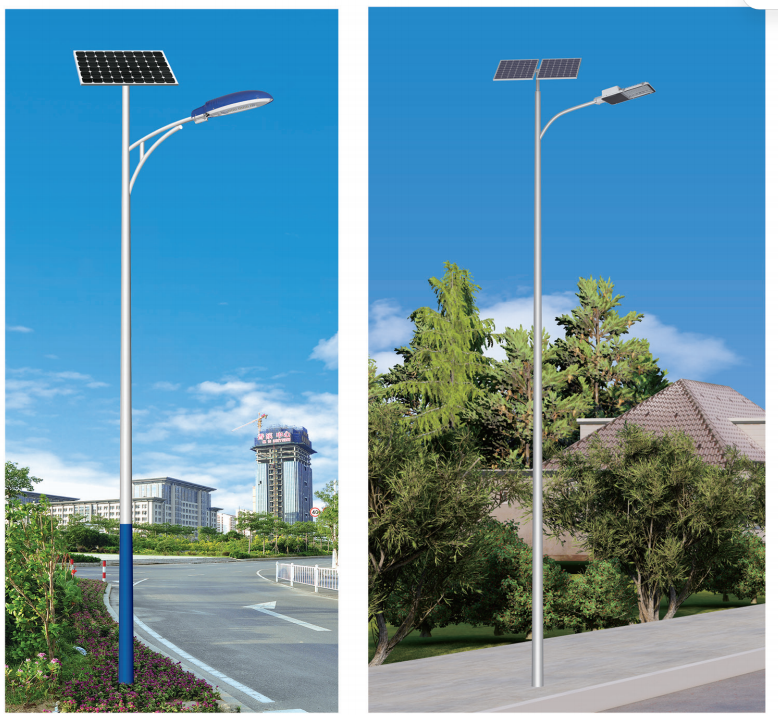
Separate-type solar street lamp: panel, battery and luminaire are configured as one roadside system rather than a single integrated head.
The BF-SL-8M-100W is a separate-type solar street lamp built around an 8 m single-arm conical pole in Q235 high-quality steel, with overall hot-dip galvanizing followed by electrostatic spraying. The luminaire is 100W with a luminous efficacy of at least 150 lm/W; the panel is a 200W high-efficiency monocrystalline silicon unit; the battery is a maintenance-free lead-acid 12V 80Ah. The system is specified at 10–12 lighting hours per day with 2–3 days of rainy-day battery backup, configurable to project requirements. Protection is IP65/IP66, colour rendering index is Ra≥70, colour temperature options are 3000K, 4000K, 5000K and 6000K, and the operating range is −20°C to +60°C. Control is light control plus time control, with intelligent dimming available as an option, and installation is fixed by pre-buried anchor bolts.
That configuration is designed for municipal road lighting and the adjacent site types that share the same geometry: rural road projects, urban side roads, industrial parks, residential community roads, park roads, school and hospital access roads, parking lots, commercial plazas, government projects and overseas infrastructure projects. The −20°C to +60°C window is relevant for hot-climate deployments, and the single-arm 8 m pole with a 90° arm installation angle is a roadway geometry rather than a pedestrian one.
Where this model stops being the right answer. Solar autonomy is a configuration decision, not a fixed promise. The stated 2–3 rainy-day backup is the base configuration; sites with long low-irradiance periods need a larger battery or panel configuration agreed in the project specification. The 12V 80Ah battery is maintenance-free lead-acid, which means a defined replacement cycle exists in the asset plan. Sites where the pole top cannot carry a 200W panel, or where the array will be shaded through the day, are poor candidates regardless of pole quality.
Courtyard lamps: where the BF-AGL-4000-60W belongs
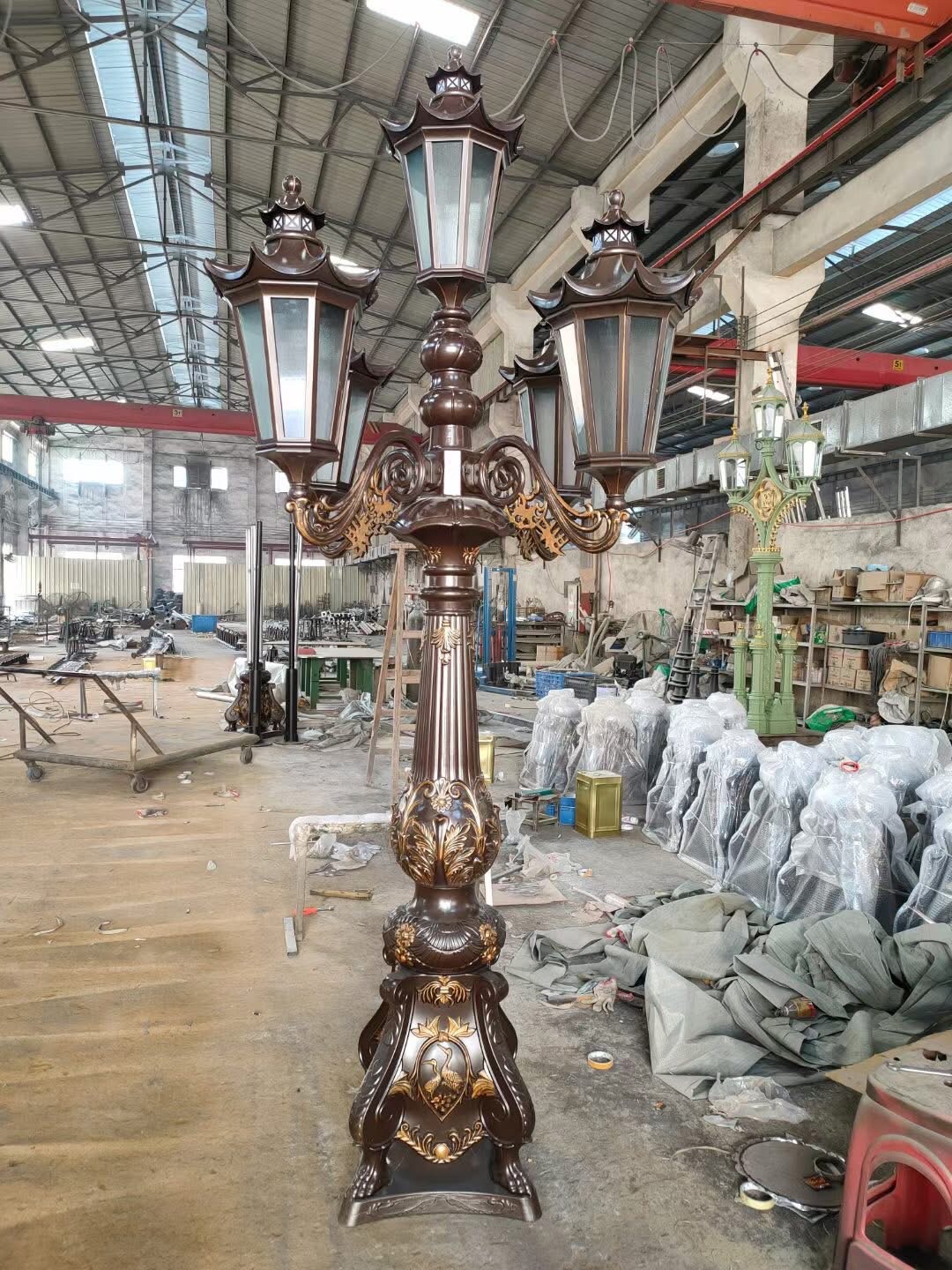
Multi-head cast aluminium courtyard lamp: a pedestrian-scale configuration typical of villa courtyards, residential communities and urban parks.
The BF-AGL-4000-60W is an ancient-style courtyard lamp in the aluminium and steel cast outdoor lamp category. It combines a high-pressure cast aluminium lamp body with a Q235 hot-dip galvanized steel pole, a high-transparency tempered glass or UV-resistant PC cover, stainless steel fasteners and outdoor electrostatic powder coating. Installation height is 3–4 m, customizable; LED power options are 30W, 40W, 50W, 60W and 80W at a luminous efficacy of at least 130 lm/W. Input voltage is AC 85–265V, 50/60Hz, power factor is at least 0.95, protection is IP65/IP66, electrical safety class is Class I, service life is at least 50,000 hours and the operating range is −30°C to +60°C. Lighting is unidirectional or multi-faceted soft lighting, control is conventional switch with optional light control, time control or intelligent control, and fixing is by a flange base with pre-installed anchor bolts.
This is the family to specify when the brief is human-scale rather than vehicular: villa courtyards, residential communities, urban parks, commercial plazas, hotels and resorts, garden landscapes, community roads, pedestrian streets, schools and hospitals. The decorative form is the visible layer; the functional point is a low mounting height that produces comfortable soft light at walking pace without throwing glare into windows.
Where this model stops being the right answer. A 3–4 m mounting height cannot satisfy roadway luminance criteria at traffic speeds — this is a pedestrian and amenity fixture, not a carriageway luminaire. It also requires an AC supply in the 85–265V range, so it is not an off-grid solution. In small private courtyards the upper end of the 30–80W range can be more light than the space needs, which is a reason to specify lower wattages rather than a reason to change model.
Landscape poles: where the BF-LSL-4000-120W belongs
The BF-LSL-4000-120W is a custom LED landscape street light in the custom decorative landscape street lights category, and it is the most configurable of the three. Mounting height is selectable at 6 m, 8 m, 10 m or 12 m and customizable per project; LED power ranges from 60W to 200W in six steps; luminaire efficacy is at least 130 lm/W; input is AC 85–265V, 50/60Hz; colour temperature options span 2700K, 3000K, 4000K, 5000K and 6000K; colour rendering index is Ra≥70 with Ra≥80 optional; power factor is PF≥0.95; protection is IP65/IP66, Class I; service life is at least 50,000 hours; operating range is −30°C to +60°C.
What distinguishes it in a project is structure and light distribution rather than wattage. Pole structures can be conical, square, special-shaped or artistic; brackets can be single-arm, double-arm, multi-arm or combined high-low lamp heads; light distribution can be specified as road lighting, plaza lighting or decorative landscape distribution. Surface treatment is hot-dip galvanized overall followed by outdoor electrostatic powder coating, with dark grey, black, silver grey and bronze as standard colours and RAL colour matching available. Decorative features such as hollow patterns, luminous decorations, city logos and cultural totems can be incorporated, and the control system runs from standard on-off up to photocell, timer, 0–10V dimming, DALI and smart lighting control.
That makes it the fit for urban roads, parks, plazas, commercial streets and large-scale landscape lighting projects, plus cultural tourism scenic spots, pedestrian streets, residential communities, hotels and resorts, industrial parks and government or overseas urban infrastructure where the pole is part of the streetscape identity.
Where this model stops being the right answer. Non-standard geometry has a real cost in time. Special-shaped poles, multi-arm brackets and decorative totems require drawing development and a structural wind-resistance design tailored to pole height and the local wind speed of the project site; they are not stock items, and the engineering cycle before production is longer than for a catalogue pole. DALI, 0–10V and smart control also only deliver their value where the luminaire drivers and the site control infrastructure are compatible — otherwise the standard on/off baseline is what will actually be operated.
What height, power and control actually change
Height changes structure, not just appearance
Moving from a 3–4 m courtyard column to a 12 m landscape pole changes the pole section, the foundation interface and the wind-resistance design. All three models are fixed by flange base or pre-buried anchor bolts, and all three are structurally designed against the wind speed at the project location — the solar model explicitly states a wind resistance grade based on site wind speed, and the landscape model states structural design tailored to pole height and local wind speed. Height decisions therefore need the site's wind data early, not after the drawing is approved.
Power should be read with efficacy, not in isolation
All three families sit at or above 130 lm/W, and the solar roadway model is rated at 150 lm/W or higher. Because delivered light is power multiplied by efficacy, comparing a 100W head against a 100W head from another supplier without a lumen figure tells the buyer very little. The useful comparison is delivered lumens against the lighting class the site must meet.
Control is a ladder with four practical steps
- Step 1 — switch only. The baseline for the courtyard lamp. Simple, robust, no commissioning.
- Step 2 — light and/or time control. Standard on the solar model, optional on the other two. Removes dependence on manual switching.
- Step 3 — dimming. 0–10V or DALI, available as an option on the landscape model. Requires matching drivers.
- Step 4 — smart lighting control. Optional on all three families where the project control layer exists.
The same logic applies to colour temperature. The landscape family spans 2700K to 6000K; the courtyard and solar families offer 3000K to 6000K. Warmer settings are typically chosen where the space is used in the evening at close range, while roadway installations more often sit in the cooler range. This is a design decision, not a specification defect either way.
Custom versus catalogue: a fair comparison
Buyers comparing a bespoke outdoor lighting package with a catalogue luminaire are not comparing like for like, and the honest answer is that both approaches win in different situations.
A catalogue luminaire has a defined photometric file, known lead times, predictable pricing and straightforward replacement. For a standard access road or a straightforward car park, that is often the rational choice. A custom configuration earns its place where the geometry, identity or power source cannot be met by a standard product: a pole that must carry a city logo, a plaza where 6 m or 12 m mounting is dictated by the urban design, a gateway road without a reliable grid supply, or a heritage-sensitive streetscape where the fixture form is part of the brief.
The trade-off is genuine and should be stated plainly. Non-standard items involve appearance design evaluation, CAD drawing development, sample development where required, and structural wind design tied to site conditions — which means a longer engineering cycle and a higher unit cost than a catalogue SKU. Replacement of a bespoke decorative component later depends on the manufacturer being able to reproduce the drawing and finish. And a decorative pole does not light a road better than its light distribution allows: the shape does not compensate for an unsuitable distribution, spacing or mounting height.
Market direction: why fit is becoming the purchasing argument
Two structural trends support a scenario-first approach. The first is the maturity of LED as the default light source: with LED at 79.7% of street lighting revenue in 2023, the light source itself is no longer a meaningful differentiator. The second is the growth of controls. The installed base of smart street lights reached 32.9 million units globally at the end of 2024, with a 20.9% CAGR projected through 2029 according to Berg Insight, and the D4i and Zhaga standards are increasingly adopted to secure interoperability between sensors and luminaires. A buyer who chooses a fixture without regard to its control compatibility is effectively buying a dead end.
Supply structure matters too. The top 10 companies in the global lighting fixtures market, including Signify and Osram, account for just over 20% of total market share according to CSIL — the remainder is a long tail of manufacturers whose capability varies widely. As price pressure persists (China's lighting product exports reached USD 56.3 billion in 2023, a 7% year-on-year decrease, per the China Association of Lighting Industry and China Daily), the practical defence for a project buyer is specification discipline: verified parameters, verified materials and a supplier able to explain which model suits which site. Regionally, Africa has been recognised as the fastest-growing lighting market with more than 4% average annual growth since 2018, driven by public infrastructure projects — exactly the environment where a solar roadway model and a pedestrian courtyard model sit side by side in one scheme.
Questions to answer before specifying height, power and control
Most specification errors are answered by eight questions, asked before a drawing is issued:
- What surface must be lit — carriageway, parking area, plaza, garden path or courtyard — and what lighting class applies to it?
- Is the site vehicular or pedestrian in scale? This decides whether the project starts at 3–4 m, at 8 m, or in the 6–12 m range.
- Is an AC supply in the 85–265V, 50/60Hz range reliably available at the pole position, or must the system generate its own power?
- For solar sites, what daily operating hours and how many consecutive low-irradiance days must be covered? The base configuration is 10–12 hours per day with 2–3 days of backup.
- What ambient temperature and moisture exposure must the luminaire survive? The solar model is rated −20°C to +60°C; the courtyard and landscape models −30°C to +60°C; all three are IP65/IP66.
- What control level will actually be operated and maintained on site — switch, light/time control, 0–10V, DALI or a smart lighting layer?
- What wind speed must the pole and foundation be designed for, and what foundation method applies at the site?
- What visual requirements are non-negotiable — pole structure, bracket configuration, RAL colour, patterns or city identity elements — and do they require engineering drawings before quotation?
BAIFU LIGHTING supports this stage with product selection advice, CAD drawing development, lighting configuration recommendations and appearance design evaluation, drawing on an 11,158 m² production facility, approximately 68 staff, a 5-engineer R&D team and an annual capacity of 50,000 units. The company's manufacturing scope covers metal fabrication, cutting, forming, welding, structural assembly, surface treatment, outdoor powder coating, electrical assembly, product inspection, aging testing, packaging and export delivery, and its products are supplied to 71 countries, with exports accounting for 45% of total sales and major markets in the Middle East, Central Asia, North America, Southeast Asia and Africa.
Future outlook
The direction of travel is convergence: solar autonomy, modular LED light engines and control-ready drivers are being specified in the same luminaire rather than as separate purchases. Interoperability standards such as D4i and Zhaga are likely to make that easier, and the projected growth of the smart street light installed base suggests controls will keep moving from optional to expected in municipal work. For buyers, the practical consequence is that the model decision and the control decision should be made together. A pole that is structurally right for the site but electrically closed to future controls is only half a specification, just as a solar system sized without reference to local irradiance is only half a design.
Frequently asked questions
Which custom street light model suits a road without reliable grid power?
The BF-SL-8M-100W is the separate-type solar option: an 8 m single-arm conical pole in Q235 steel, a 100W LED at ≥150 lm/W, a 200W monocrystalline silicon panel and a 12V 80Ah maintenance-free lead-acid battery, rated for 10–12 lighting hours per day with 2–3 days of rainy-day backup that is configurable to the project.
At what height is an ancient-style courtyard lamp installed?
The BF-AGL-4000-60W is installed at 3–4 m, customizable according to project requirements, with LED power options of 30W, 40W, 50W, 60W and 80W and unidirectional or multi-faceted soft lighting suited to courtyards, residential communities, parks and hotel grounds.
Which models support dimming or smart lighting control?
The BF-LSL-4000-120W offers standard on/off control with optional photocell, timer, 0–10V dimming, DALI and smart lighting control. The BF-SL-8M-100W uses light control plus time control as standard, with intelligent dimming optional. The BF-AGL-4000-60W uses conventional switch control, with light control, time control or intelligent control available as options.
What protection and operating temperature ratings apply across the three models?
All three are rated IP65/IP66 and Class I for electric shock protection. Operating temperature is −20°C to +60°C for the BF-SL-8M-100W solar model and −30°C to +60°C for the BF-AGL-4000-60W and BF-LSL-4000-120W. Service life is at least 50,000 hours for the courtyard and landscape models.
What colour temperatures and colour rendering are available?
The BF-LSL-4000-120W offers 2700K, 3000K, 4000K, 5000K and 6000K with Ra≥70 and Ra≥80 optional. The BF-AGL-4000-60W and BF-SL-8M-100W offer 3000K, 4000K, 5000K and 6000K with Ra≥70.
What must be confirmed before a custom pole is manufactured?
At minimum: mounting height, bracket or arm configuration, the wind speed the structure must be designed for, the foundation method (flange base with embedded or pre-buried anchor bolts), surface finish and RAL colour, required light distribution, and the control level to be commissioned. On non-standard and special-shaped poles, drawing approval precedes production.
For readers who want the full configuration reference, BAIFU LIGHTING's product album is available for download: BAIFU LIGHTING Customized Album (PDF).
Есть вопросы или нужны дополнительные детали?
Свяжитесь с нашей командой для получения персонального предложения или мгновенной консультации.
Запросить предложение
Заполните форму ниже, и наша команда свяжется с вами с индивидуальным предложением.
Прямой чат WhatsApp
Предпочитаете общаться в реальном времени? Напишите нам в WhatsApp для мгновенной помощи и быстрых ответов.
- Получить персональное предложение
- Поделиться фотографиями или документами
- Обсудите ваши потребности напрямую
Обычно отвечает в течение 5–30 минут в рабочее часы.