
Custom T-Shirt Features E-Commerce Brands Should Shortlist
The custom T-shirt printing market was valued at USD 5.46 billion in 2024 and is projected to reach USD 9.82 billion by 2030, growing at a CAGR of 11.5% to 11.6%, according to Grand View Research. A meaningful share of that expansion is being absorbed by online apparel brands — sellers who do not buy a fixed catalogue once a season, but who test a design in small quantity, read the sales data, and then either reorder it or discontinue it.
That operating rhythm changes what belongs on a sourcing shortlist. For an e-commerce apparel brand, the decisive question is not which supplier quotes the lowest unit price. It is which production capabilities must already exist before a first drop can be shipped, reordered, and repeated without the product changing underneath the customer. The shortlist below breaks that requirement into six capability features and explains the specific risk that appears when each one is missing.
Why online-first brands need a different shortlist
The global blank apparel market was estimated at USD 15.23 billion in 2024, and T-shirts and tanks accounted for a 48.39% share of that figure, according to Grand View Research. The category itself is mature. What is still settling is the way online brands buy into it.
A typical e-commerce apparel program moves through three procurement phases, and each phase tests a different part of a factory's capability:
- Test phase. A small run validates artwork, fit and conversion. This phase tests minimum order flexibility and how quickly a supplier moves from artwork approval to a shippable sample.
- Reorder phase. The design sells, and the same product has to be produced again. This phase tests consistency: same fabric, same measurements, same dye behaviour, same print result.
- Seasonal repeat phase. The design returns in new colours, a different fabric weight or a new fit. This phase tests documentation and process control, because the buyer is now requesting variation on a known base.
A supplier that performs well only in the first phase creates a predictable commercial problem: strong samples, weaker bulk. That is why the shortlist below weights repeatability, finishing and documentation as heavily as unit price.
The shortlist: six capability features that decide the outcome
1. A defined MOQ per design, not per order
Minimum order quantity is the first filter, and it has to be read precisely. Industry reviews of China-based custom T-shirt manufacturing list common startup minimums in the range of 50 to 100 pieces per design and colour. The figure that matters at the decision stage is the per-design number, because an e-commerce brand rarely launches one design — it launches a collection and discontinues most of it within a season.
The arithmetic is straightforward. Fifty pieces per design across six designs is a 300-piece commitment. Five hundred pieces per design across the same six designs is a 3,000-piece commitment, most of which may end up as unsold inventory. Small-batch capability is therefore not a convenience; it is the mechanism that keeps a launch test affordable.
Guangzhou Qianshi Apparel Co., Ltd, the Guangzhou-based apparel manufacturer and trading company operating as Qianshiwear, describes flexible production with low MOQs as part of its OEM and ODM service model. For an online brand, the practical check is to confirm the MOQ per design and colour in writing, and to confirm that a follow-up reorder is not forced into a much larger volume.
2. Private-label finishing: neck labels, hang tags and packaging
A blank T-shirt and a private label T-shirt differ in the details that sit next to the customer's skin and inside the parcel: the neck label, the hang tag and the packaging. For a private label program these are not optional extras. They are the physical evidence that the garment belongs to the brand that sold it. Without them, an online seller is shipping a generic product and relying entirely on the storefront experience to carry brand identity.
Qianshiwear's company profile states that fabric sourcing, design development, precision cutting, sewing, printing, embroidery and custom packaging are managed in-house. That scope is what allows a buyer to brief neck labels, hang tags and branded packaging within the same production flow rather than sourcing them separately and coordinating a second supplier.
3. At least two printing technologies, not one
Artwork decides the technique, and an online brand's artwork changes with every drop. A shortlist that contains only one print method will eventually force a design compromise.
- DTG (direct-to-garment) suits small runs and artwork with many colours or gradients, where screen setup costs would be hard to absorb.
- Screen printing suits solid-colour graphics and larger volumes, where setup cost is amortised across the run.
- Embroidery suits logos, chest marks and textured details that should not fade or crack.
- Sublimation and digital printing support all-over graphic treatment.
Qianshiwear's production environment includes digital and sublimation printing equipment and embroidery machinery, and its documented quality controls specifically cover curing time for screen prints and DTG inks, plus embroidery backing stabilisation for thread tension control. Those two control points are the ones that determine whether a printed or embroidered decoration survives the first twenty washes that a customer will put it through.
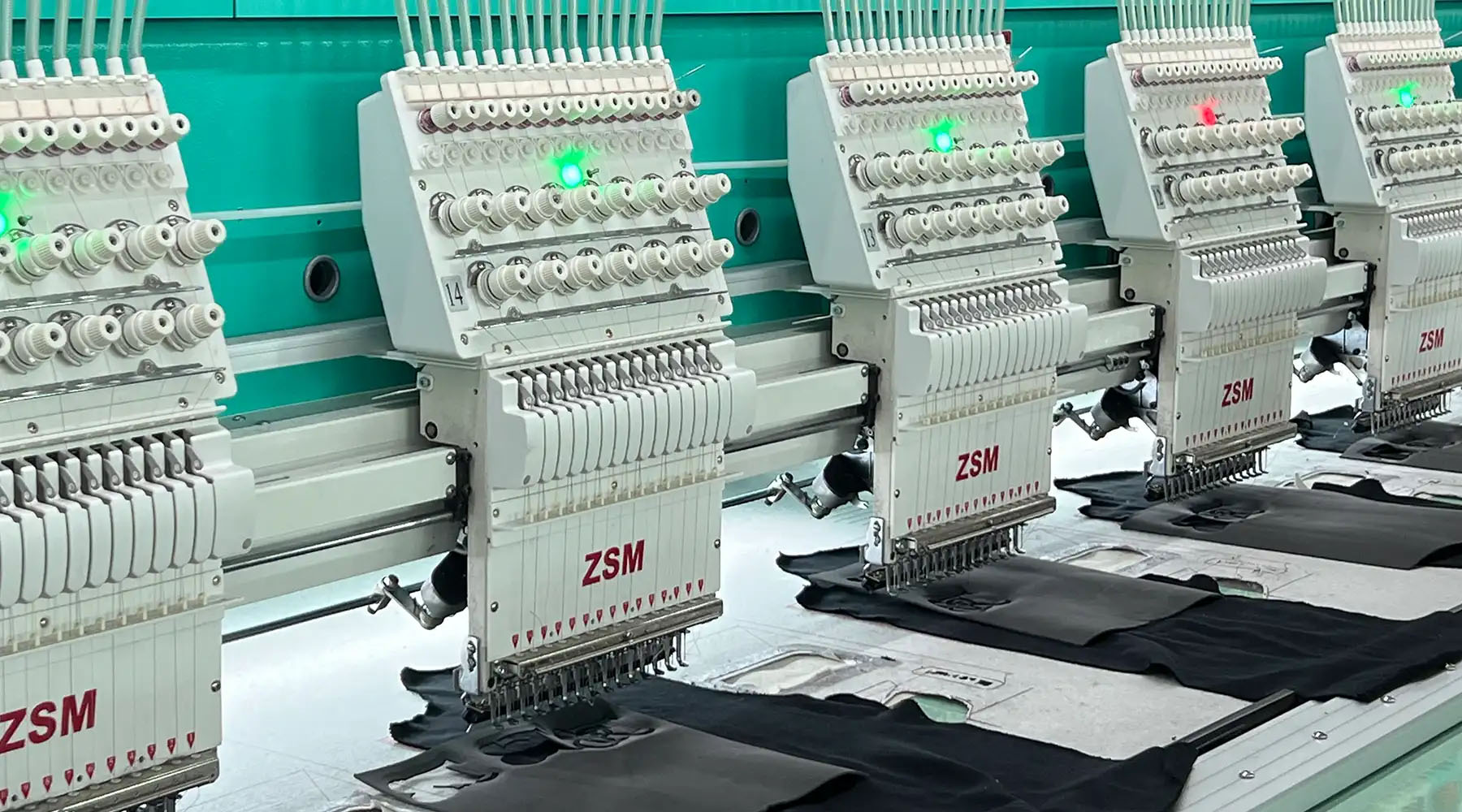
In-house embroidery capability supports private-label logos and chest marks that must resist cracking or fading.
4. Fabric weight, fit and fibre specification stated in writing
Streetwear-oriented T-shirt manufacturing in China has trended toward heavyweight fabrics in the 300–500 GSM range, with complex finishes such as acid washes and puff printing, according to a Newasia Garment sourcing guide. Whether or not a brand sells streetwear, the underlying lesson applies: fabric weight and fit block are product decisions, and they need to be written into the purchase specification rather than inferred from a photograph.
Fibre claims carry a similar requirement. The Global Organic Textile Standard requires that products labelled as organic contain at least 95% certified organic fibres, and that manufacturing meet defined social and environmental criteria. An "organic cotton T-shirt" is therefore not a descriptive phrase — it is a certification threshold that has to be documented by the supplier.
5. A named quality-control protocol with defined inspection stages
Quality control becomes a shortlist item at the moment a brand places a reorder, because that is when a buyer needs to know that batch two will match batch one. Vague assurances do not answer that question. Specific stages do.
Qianshiwear's documented controls operate at four points:
- Incoming material control: 100% fabric inspection on arrival, checking weight, width, colour consistency and shrinkage potential, with hardware and trim samples tested before bulk approval.
- In-process control: first-article inspection at cutting, sewing and printing stages, random patrol checks across production lines, and real-time adjustment of embroidery tension and print alignment.
- Final inspection: AQL 2.5 sampling applied to finished goods, pre-shipment wash tests on representative samples, and size and measurement verification across all colourways.
- Traceability: a production batch number assigned to each order, with quality records retained for reorder reference.
Third-party inspection through organisations such as SGS or Intertek is also available on client request, along with laboratory testing for specific performance requirements.
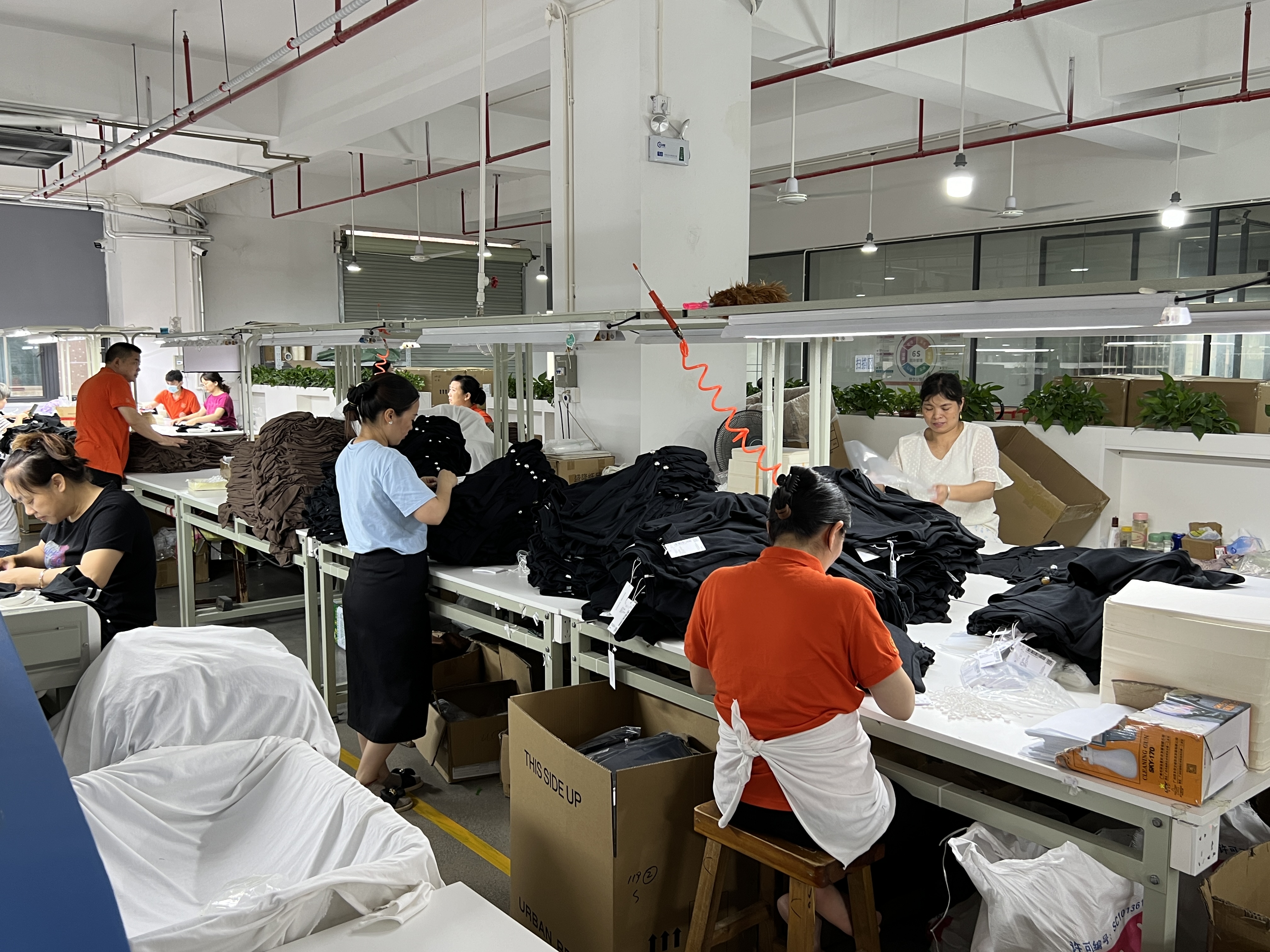
AQL 2.5 sampling at final inspection is the stage that connects a factory's process control to a brand's reorder expectations.
6. Compliance documentation that matches the marketing claim
Compliance has moved from a checkbox to a live variable. OEKO-TEX Standard 100 updated its 2024 regulations to include a new limit value for total fluorine (PFAS) at 100 mg/kg, effective 1 January 2024. For a buyer, the shortlist question is not whether a supplier mentions certifications, but whether the documentation applies to the specific fabrics and trims used in the order.
The shortlist at a glance
| Capability feature | What to request at the decision stage | Risk when it is missing |
|---|---|---|
| Per-design MOQ | Written MOQ per design and colour, plus sampling timeline | Capital locked in designs that were never validated |
| Private-label finishing | Neck label, hang tag and packaging samples before bulk | Generic unboxing and weak brand recognition |
| Multiple print methods | Which technique is used for which artwork, with curing specification | Print cracking or peeling; limited design range |
| Fabric and fit specification | GSM, fibre composition, shrinkage control and approved fit block | Reorders that differ from the sample; fit complaints |
| Quality-control protocol | AQL level, inspection stages, batch traceability and record retention | Inconsistent sizing and defects reaching customers |
| Compliance documentation | OEKO-TEX or GOTS documentation tied to the actual materials | Restricted-substance or organic claims that cannot be supported |
Where Qianshiwear sits on the shortlist
Guangzhou Qianshi Apparel Co., Ltd is an apparel manufacturer and trading company based in Guangzhou, Guangdong, founded in 2014, providing OEM and ODM services to clothing brands worldwide. Its profile describes more than 20 years of experience in fabric weaving and more than 15 years in garment production.
Its operational footprint includes a 600 m² sewing area, a 700 m² warehouse, a 1,500 m² finishing area and a 200 m² packing area, with 15 in-house designers, 200–250 production line workers, and quality control staff and pattern makers supporting production. Annual output is stated at 3,000,000 units, and 85–90% of total production is exported to the EU, USA, AU and UK markets.
The product range covers T-shirts, hoodies, sweatshirts, sweatpants, joggers, tracksuits, polos, jerseys, jeans, caps and outerwear — a scope that matters for e-commerce brands whose catalogue expands from a T-shirt core into adjacent categories. A downloadable company brochure is available here, and further background is published at qianshiwear.com.
Technical explanation: why small batches and durability move together
Low MOQ production and durable decoration are usually discussed as separate subjects. In practice they are the same problem, because a small run leaves no room to absorb a quality failure.
Consider what happens at each control point Qianshiwear documents. Pre-shrinkage treatment before cutting means a garment measured at approval still measures the same after the first wash — which is the difference between a reorder and a refund. Reactive dyeing with high-temperature fixation gives deeper colour penetration, which supports colour fastness that holds up to rubbing and washing. Controlled curing time for screen prints and DTG inks prevents the ink layer from cracking or peeling away from the fabric. Anti-pilling weaving or finishing treatment addresses surface integrity. Reinforced stitching with high-tensile thread at stress points extends seam life. Embroidery backing stabilisation keeps thread tension even so the emblem does not loosen.
For an e-commerce brand, each of these is a review risk rather than a technical footnote. A print that cracks in the wash, a hem that fails, or a garment that shrinks below its stated size produces returns, replacements and public feedback — costs that are not captured in the unit price quoted at the sampling stage.
Application: which e-commerce programs these features serve
Small-batch capable, private-label ready production supports several distinct online business models:
- Private label basics. Repeat core products where neck labels, hang tags and packaging carry the brand, and where the reorder is the commercial event that matters.
- Streetwear drops. Heavyweight constructions in the 300–500 GSM range, boxy and oversized fits, and graphic treatments that mix DTG, screen printing and embroidery across a single collection.
- Jerseys and team-wear sellers. Jerseys are part of the Qianshiwear product range, and sublimation printing equipment supports all-over graphic requirements that standard DTG cannot cover.
- Pre-order and made-to-order models. Brands that confirm demand before production benefit most from per-design MOQs in the 50–100 piece band, because the order size tracks the demand signal rather than a factory's minimum batch.
Market trend analysis: what is changing between 2024 and 2030
Three trends are visible in the available market data, and each one pushes the shortlist in the same direction.
Category growth continues. The global custom T-shirt printing market is projected to move from USD 5.46 billion in 2024 to USD 9.82 billion by 2030, a CAGR of 11.5% to 11.6% (Grand View Research). Growth of that scale typically rewards suppliers who can handle order variability, not only order volume.
Sourcing remains concentrated in China. China's total textile exports reached USD 268 billion in 2024, maintaining its position as the world's largest exporter with a 32% global market concentration, according to the Observatory of Economic Complexity. Within China, T-shirt manufacturing clusters are concentrated in Guangdong — including Guangzhou and Dongguan, associated with fast fashion and streetwear — and Zhejiang, associated with premium knitwear (Newasia Garment Industry Report).
Product specifications are getting heavier and more complex. Streetwear-oriented manufacturing has shifted toward 300–500 GSM fabrics with finishes such as acid wash and puff printing. Heavier fabric and additional finishing stages raise the technical bar for any supplier on a shortlist, and they also change shipping and storage economics because the garments weigh more per unit.
Structured production compared with ultra-budget sourcing — and its limits
The comparison that most often decides a shortlist is not supplier versus supplier. It is structured, quality-controlled production versus low-cost or ultra-budget mass production. Qianshiwear's published comparison of the two approaches sets out the following typical performance gaps.
| Comparison dimension | Structured quality control | Low-cost / ultra-budget mass producer |
|---|---|---|
| Inspection protocol | Quality inspection based on AQL standards | No formal quality protocol |
| Defect rate | Typically maintained below 5% | Often exceeding 10–15% |
| Fabric shrinkage | Generally within 5–8% | 8–12% or higher |
| Colour fastness | Typically Grade 3–4 | Grade 2–3 |
| Wash durability | Typically withstands 30–50 washes with minimal fading | Noticeable fading after 10–15 washes |
| Anti-pilling performance | Typically Grade 3 | Grade 1–2 |
| Initial per-unit cost | Typically 20–40% higher | Lower at the point of purchase |
The cost comparison is where the analysis usually stops, and it should not. The same source notes that total project cost is often comparable or lower once reduced return rates, fewer customer complaints and lower replacement frequency are accounted for. Low-cost sourcing can also carry less visible costs: higher return rates, an effect on brand perception, and more frequent re-purchasing because the product does not last.
The boundary conditions matter just as much, and an honest shortlist names them:
- It is not the cheapest route. Initial per-unit cost is typically 20–40% higher than ultra-budget production. A brand whose positioning depends entirely on the lowest possible landed cost, and whose customers do not expect durability, may reasonably choose a different structure.
- An MOQ floor still exists. Startup minimums in the 50–100 piece range per design and colour mean that true single-piece production is not the model. Brands that need one-off garments should look outside this segment.
- Sampling inspection is statistical. AQL 2.5 is a sampling standard, not a zero-defect guarantee. It manages risk; it does not eliminate it.
- Heavier specifications have trade-offs. The 300–500 GSM fabrics now common in streetwear deliver structure and hand-feel, but they also increase weight per unit, which affects shipping and storage.
Future outlook
If the current trajectory holds, low-MOQ capability will stop being a differentiator and become the baseline expectation for e-commerce apparel sourcing, while documentation becomes the new dividing line. Compliance pressure is already visible: OEKO-TEX Standard 100's 2024 inclusion of a total fluorine limit at 100 mg/kg reflects a regulatory environment in which restricted-substance claims are increasingly tested rather than accepted. Organic fibre claims face the same scrutiny through the 95% certified organic fibre threshold in GOTS.
The practical implication for buyers is that the shortlist of 2030 will look similar to the shortlist of today, but the evidence required against each item will be stricter. Brands that start collecting inspection records, certification documents and batch traceability data now will find the transition administrative rather than disruptive.
FAQ
What MOQ should an e-commerce apparel brand expect for a custom T-shirt order?
Industry reviews of China-based custom T-shirt manufacturing list common startup minimums in the range of 50 to 100 pieces per design and colour. In practice, the number a brand should confirm in writing is the per-design, per-colour figure rather than a total order minimum, because that is the number that determines how many designs can be tested within a given budget.
Should an online brand shortlist DTG or screen printing for a first drop?
They serve different conditions rather than competing directly. DTG is generally suited to small runs and artwork with many colours or gradients, where screen setup cost would be difficult to absorb. Screen printing is generally suited to solid-colour graphics and larger volumes. Both depend on the same downstream control: correct curing time for the ink, which is what determines whether the print resists cracking and peeling in the wash.
Are custom neck labels and hang tags part of private label T-shirt production?
Yes. Custom neck labels, hang tags and branded packaging are the physical elements that distinguish a private label garment from a blank. Their availability depends on whether the supplier handles them within the production flow — Qianshiwear's profile lists custom packaging alongside fabric sourcing, design development, cutting, sewing, printing and embroidery as in-house capabilities.
How can a buyer verify quality-control claims before placing a bulk order?
Ask for the inspection structure rather than a general assurance. Qianshiwear's documented controls cover 100% fabric inspection on arrival, first-article inspection at cutting, sewing and printing stages, AQL 2.5 sampling at final inspection, pre-shipment wash tests, size verification across colourways, and batch numbering for traceability. Inspection reports can be provided on request, and third-party inspection through organisations such as SGS or Intertek can be arranged.
Which certifications matter for an organic cotton T-shirt program?
Two are directly relevant to fibre and substance claims. The Global Organic Textile Standard requires that products labelled organic contain at least 95% certified organic fibres and that manufacturing meet defined social and environmental criteria. OEKO-TEX Standard 100 sets restricted-substance limits, and its 2024 regulations added a total fluorine (PFAS) limit value of 100 mg/kg effective 1 January 2024. What matters at the decision stage is that documentation applies to the specific fabrics and trims in the order.
Is a structured-quality manufacturer always the right choice?
No. Structured production typically carries an initial per-unit cost 20–40% higher than ultra-budget alternatives, and the MOQ floor of roughly 50–100 pieces per design and colour rules out single-piece manufacturing. It is best suited to brands that prioritise reorder consistency, mid-tier to premium positioning and long-term reputation. Where a product's economics depend on the lowest possible unit cost and durability is not a customer expectation, a different sourcing structure can be legitimate.