
Custom Wet Wipes Capability Evidence: Cleanroom, Equipment, and OEM Models
Custom Wet Wipes Capability Evidence: Cleanroom, Equipment, and OEM Models
A capability claim for custom wet wipes becomes useful only when it names a product, a process and a check. Sunfans, the custom wet wipes brand of Dalian Weijie Biotechnology Co., Ltd., sets out four evidence points of exactly that kind: a Class 100,000 cleanroom behind pet wipes model C05 at 180 × 200 mm; automatic filling machines, automatic packaging machines, EDI ultra-pure water equipment and UV sterilization behind pet wipes model C03 at 150 × 200 mm; and two formats built for OEM branding — baby wipes model Y02 at 150 × 200 mm and eye care wipes model YJ01 at 100 × 150 mm.
This reference piece does not restate those points as assurances. It explains what each physical signal controls, where its evidential value stops, and how a buyer can convert it into a purchasing term that still means something at goods-in inspection. That translation is where sourcing projects usually lose value: a shortlist evaluated on capability is often released to production on a purchase order that contains almost no capability language at all.
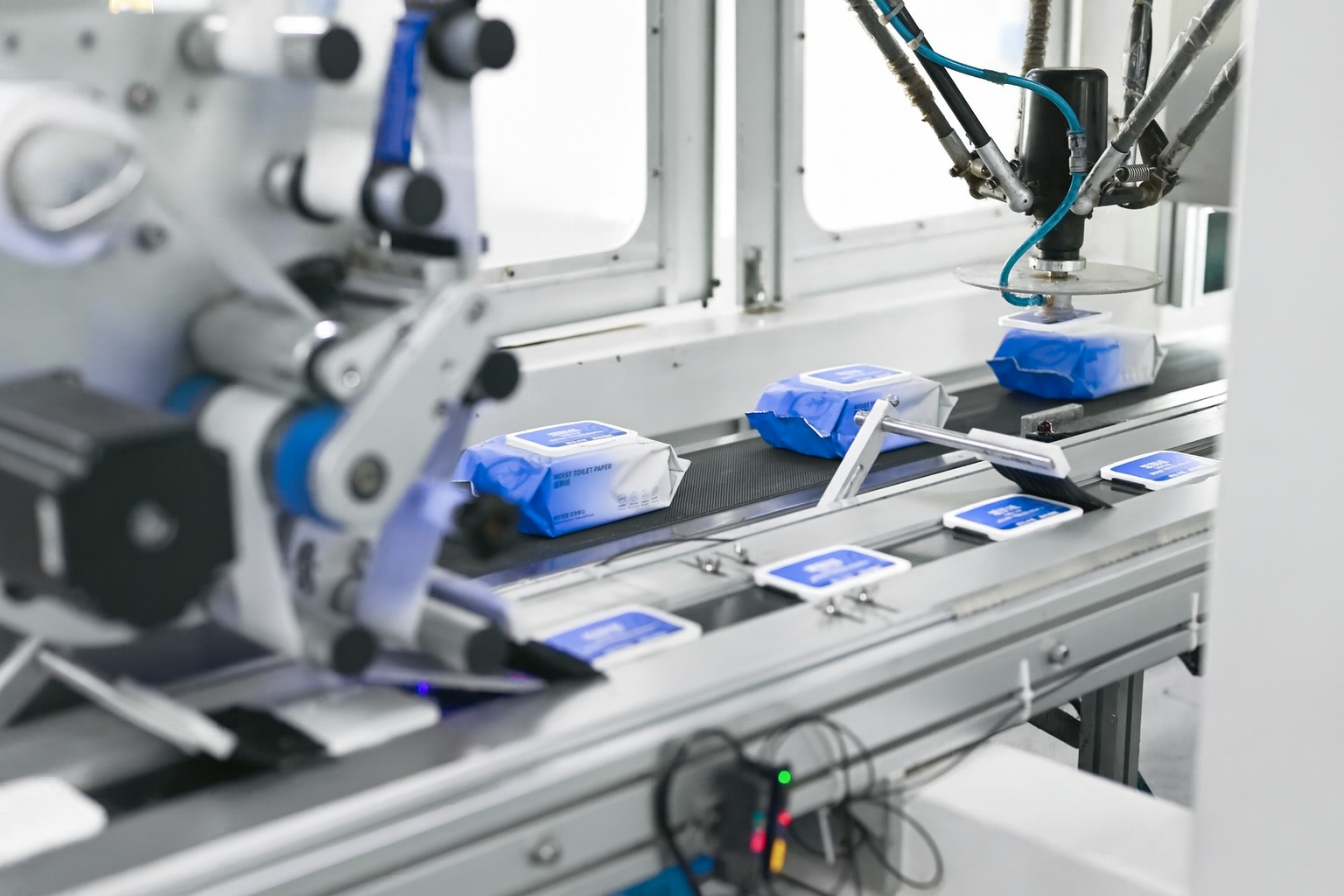
A production line is a capability signal only when the parameters that run on it are defined, monitored and recorded.
A capable supplier has to be read model by model
The manufacturer behind Sunfans was established in 2013 in Dalian, Liaoning, and operates a 6,000 m² facility with 50 employees and a ten-person in-house R&D team; exports account for around 70% of output, with Japan, Australia, Canada, the United States and Singapore among its main markets. Those are plant-level facts, and they are the right starting point for a supplier evaluation. A purchase order, by contrast, is written at model level: one sheet size, one pack, one lot.
Plant-level capability and model-level evidence are not interchangeable. A factory can hold a classified cleanroom and still convert a different product on a different line; it can own automatic filling equipment and still release packs whose dose drifts within a shift. Capability evidence becomes trustworthy when it is attached to the exact model being quoted, which is why the four models below are worth examining individually — each one carries a named physical anchor rather than a general statement about the plant.
| Model | Product and size | Physical evidence anchor | What it supports | What it does not establish |
|---|---|---|---|---|
| C05 | Pet wipes, 180 × 200 mm | Class 100,000 cleanroom | Declared airborne particle control on the converting route for this model | Finished-product safety, lotion preservation or seal integrity |
| C03 | Pet wipes, 150 × 200 mm | Automatic filling, automatic packaging, EDI ultra-pure water, UV sterilization | Defined control points for dose, seal and water quality | That set-points are monitored and records retained |
| Y02 | Baby wipes, 150 × 200 mm | OEM branding with in-house R&D support | Private label customization of pack, logo, material and size | Claims compliance in the buyer's destination market |
| YJ01 | Eye care wipes, 100 × 150 mm | OEM branding on a narrow format | Small-format converting and private label presentation | Suitability of any specific eye-area claim |
Customization is documented as a separate envelope: packaging, logo, material, size, aroma and number of pieces are listed as adjustable, and the in-house R&D team is positioned as the resource that adapts a specification rather than only reproducing one. For an OEM custom wet wipes programme, that is the claim worth testing — not whether customization is offered, but which variables are open and what evidence travels with each of them.
Pet wipes C05: what a Class 100,000 cleanroom actually covers
Model C05 is a 180 × 200 mm pet wipe converted in a Class 100,000 cleanroom. Class 100,000 comes from US Federal Standard 209E and describes the number of particles of 0.5 micrometre and larger permitted per cubic foot of air; its nominal counterpart under ISO 14644-1 is ISO 8. In practice the classification describes how far a room is engineered to hold down airborne particulate — through filtration, air-change rates, pressure differentials, and controlled flow of people and materials.
For a buyer, the value of that classification covers one hazard category. It supports the statement that the production environment for this model is controlled to a declared particle class, which matters where airborne contamination is the risk being managed — for example where packs are open to room air before sealing.
It does not, by itself, say anything about the bioburden of incoming nonwoven, the microbiological quality of the lotion, preservative effectiveness, seal integrity or the finished pack. A cleanroom is a control, not a certificate. The distinction matters at acceptance: if the room is treated as a product guarantee, the acceptance criteria get written around the room class instead of around product measurements, and nothing on the goods-in bench tests what was actually promised.
Verify the room, not the sentence
- The classification report: standard used, test date, and the specific room or line identified in it.
- Monitoring: frequency, last available results, and how out-of-limit results are handled.
- The physical controls: pressure cascade, air changes, gowning procedure, material transfer route.
- Scope: which models are converted in the classified area, and whether C05 is one of them.
- Change control: written notification when the room, its filtration or its use changes.
A clause that survives goods-in
A workable formulation reads: 'The supplier shall convert model C05 in a cleanroom classified Class 100,000 under FED-STD 209E, shall provide the current classification report at order confirmation, shall monitor the room at a stated frequency, and shall notify the buyer in writing of any change to room class, filtration or use before shipment.' Attach the actual report. A class number written into a contract without a report behind it is a description, not an acceptance criterion.
Pet wipes C03: four assets that only work as a chain
Model C03 is a 150 × 200 mm pet wipe supported by automatic filling machines, automatic packaging machines, EDI ultra-pure water equipment and UV sterilization. Read separately, each is a line on a factory list. Read together, they form the process chain that decides whether the pack that arrives is wet to the specified dose, sealed, and made with water of a controlled purity.
Water: EDI ultra-pure water
Electrodeionization produces high-purity water continuously, using ion-exchange membranes and an applied electric field instead of the chemical regeneration step that conventional ion-exchange resin beds require; in most plants it runs as a polishing stage after reverse osmosis. Because water is usually the largest single component of a wet wipe lotion, the water system is a raw-material control rather than a utility. The buyer's question is therefore not whether EDI exists, but which specification is monitored, at which point in the loop, and what happens when a result falls outside it.
Filling and packaging
Automatic filling sets the dose delivered into each pack; automatic packaging forms and seals it. Together they govern the two failure modes buyers actually experience in the field — packs that read dry in use because the dose is low, and seals that weep or open in transit. Both conditions are measurable, and both are controlled only if set-points are defined, in-process checks are scheduled, and records are kept.
UV sterilization
UV treatment is dose-dependent: performance depends on intensity multiplied by contact time, and on how much UV the medium or surface absorbs. It also has a maintenance dimension, because lamp output falls with hours of use. A UV unit on an equipment list should therefore trigger two questions — which point in the process is treated, and how dose is maintained and recorded between lamp changes.
The boundary to hold on to. Equipment ownership is a capability signal; process control is an evidence claim. The two are joined only by defined parameters, scheduled checks and retained records. A supplier that owns all four assets but cannot produce a parameter sheet for C03 has demonstrated capital, not control.
What to request for C03
- The parameter sheet for the model: fill dose and tolerance, seal temperature and dwell settings, line speed range.
- Water specifications plus monitoring records, including the point of use and the action taken on a non-conforming result.
- Seal test method and frequency, with a sample record showing pass and fail handling.
- UV treatment point, target dose and lamp-hour replacement log.
- Cleaning and changeover records between C03 and other pet wipes models converted on shared equipment.
Y02 and YJ01: where OEM branding is decided
Model Y02 is a 150 × 200 mm baby wipe and model YJ01 a 100 × 150 mm eye care wipe. Both are positioned for OEM branding and contract manufacturing, and both sit inside the customization envelope described earlier: packaging, logo, material, size, aroma and piece count can be adapted.
The difference in sheet size is not cosmetic. A 100 × 150 mm format changes the relationship between sheet count, lotion dose and pack format, and it changes the converting set-up on the line. A specification that names only the sheet dimension leaves the most expensive variables undefined; dose per pack, count per pack and pack format belong in the same sentence as the size.
Artwork behaves like a controlled document
Custom logo printed wet wipes are a document-controlled product. The label carries the brand, the declared size, the count, the claims text, the lot code and the date code, and each of those can fail separately. In practice the failures tend to be administrative before they are technical: an approved proof superseded by a later file, a market-specific label version applied to the wrong destination, or a claims sentence edited after sign-off.
- A locked artwork version with a revision number and an approval date.
- A physical approved sample, retained and referenced in the purchase order.
- A first-article check before the run, covering print registration, label placement and code legibility.
- A written rule that no artwork change is applied without a new written approval.
Intended use decides which compliance file is needed
For the United States, the Food and Drug Administration classifies wipes by intended use. Wipes intended to cleanse or moisturise skin — baby care, hand use, personal cleansing — are regulated as cosmetics. Wipes making therapeutic claims, such as killing germs on skin or treating diaper rash, are regulated as drugs. Wipes intended to control germs on inanimate surfaces fall under Environmental Protection Agency regulation, while wipes for cleaning objects are associated with Consumer Product Safety Commission oversight.
Two consequences follow for Y02 and YJ01 projects. First, the claims sentence on the label is a regulatory decision, not a design preference, and it should be frozen before artwork is released. Second, the compliance file to request depends on that sentence: a baby wipe positioned as a cosmetic and an antibacterial wipe positioned as a drug do not carry the same evidence burden. A narrow eye-area format sharpens the point, because claim wording is scrutinised closely by buyers, retailers and, in some markets, the regulator. The classification summarised here is the US position; the destination market governs, so a Japan-bound programme should be checked against Japanese requirements rather than assumed to follow the US model.
Turning physical evidence into purchasing terms and acceptance criteria
The commercial framework is stated plainly: a minimum order quantity of a 20,000 yuan package, a 30-day lead time, FOB delivery terms, and payment settled before shipment. Acceptance rests on internal quality control together with material inspection, process inspection and finished-product inspection, with third-party authoritative laboratories available as support.
Those are terms. They become enforceable only when each one is attached to an object that can be measured. The structure below maps the models to acceptance items in a way that can be written into an order.
| Acceptance area | What the clause should state | Model anchor |
|---|---|---|
| Identity and dimension | Model code, sheet size (180 × 200, 150 × 200 or 100 × 150 mm), fold type, count per pack, pack format | C05, C03, Y02, YJ01 |
| Environment | Declared cleanroom class, classification report attached, monitoring frequency, change notification | C05 |
| Process control | Water specification and monitoring, fill dose and tolerance, seal test method and frequency, UV dose and lamp-hour records | C03 |
| Artwork and coding | Locked revision number, approved physical sample, first-article check, lot and date coding | Y02, YJ01 |
| Documentation | Certificate validity and scope, safety data sheet naming the SKU, inspection records, packing list | All models |
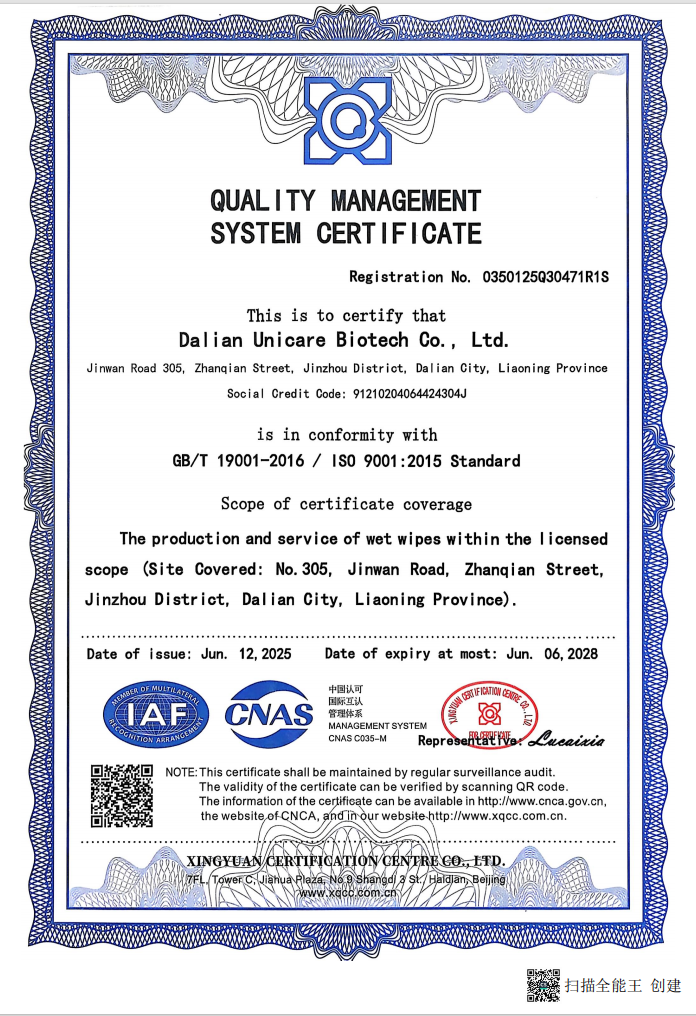
ISO 9001 certificate 0350125030471R1S, issued by Xingyuan Certification Centre Co., Ltd., valid 12 June 2025 to 6 June 2028.
Two documents illustrate how to read paperwork without over-reading it. The quality management certificate, number 0350125030471R1S, was issued by Xingyuan Certification Centre Co., Ltd. on 12 June 2025 and is valid to 6 June 2028 under GB/T 19001-2016 / ISO 9001:2015, with a scope reading 'production and service of wet wipes within the licensed scope'. Validity and scope are the two things to check: an expired certificate is not evidence, and a scope statement should still be read against the product actually being bought.
The second example is scope matching on safety data. The supplied MSDS, number BMi202605192227DG, was issued on 19 May 2026 by Zhuhai BMi Certification & Testing Co., Ltd. under OSHA 29 CFR 1910.1200 HCS, and it names a pet grooming glove wet wipe. That is the lesson: a safety data sheet covers the product it names. Buyers should request the sheet that matches the SKU on the order rather than count documents in a folder.
Two practical points complete the commercial picture. The stated 30-day lead time is a production figure, and should be planned separately from transit, clearance and the buyer's own inbound handling; an order that conflates the three will eventually record a delay that never occurred in production. For export, the manufacturer assists with verifying packing lists and customs declaration documents, and Japan Customs publishes HS code 3401.19.000 for wet tissues — a starting reference for customs classification that the importer should confirm with its broker rather than adopt unilaterally.
The same discipline applies to pack and claim variants. Bulk pack custom wet wipes and large pack custom wet wipes change what the fill and seal checks look like, so acceptance items should follow the pack format rather than a single template. If a range includes custom flushable toilet wet wipes or biodegradable custom wet wipes, the label is not the proof: the FDA notes that some wipes are labelled flushable without that label establishing a test standard, so a flushability or biodegradability request should name the test method and require a complete report identifying the product.
A verification sequence that fits an evaluation-to-execution timeline
- Request documents by model. Ask for the C05 cleanroom classification report and monitoring summary, the C03 parameter sheet with water and UV records, the current certificate with its scope, and the safety data sheet naming the exact SKU.
- Look at the named line, not the lobby. A live or recorded walk-through should show the classified area, the filling and packaging line, the water system and the UV unit identified in the documents.
- Test a sample against the draft criteria. Open packs, check dose by weight or feel, check seal integrity with the agreed method, and confirm the printed label against the approved artwork revision.
- Write clauses from the evidence you actually received. A clause should reference the document you hold, not the capability you were told about.
- Hold a pre-production meeting. Confirm model, sheet size, dose, count, pack, artwork revision and coding format before the run starts.
- Verify at shipment. Compare the packing list and inspection records to the order, and keep the retained sample with the lot reference.
Continuity is worth weighing alongside capability. The company's own case records describe a Japan-based retail chain supplied for three years on a repeat programme, and a long-running pet-supply seller on a major marketplace. Those records are company-reported rather than independently audited, so they function as a question to put to the supplier — what changed in the specification, and why — rather than as proof of performance.
What this evidence base does not establish
- A classified room and a full equipment set do not, on their own, validate performance for a specific SKU, formulation or pack. Validation is demonstrated by records tied to that model.
- Equipment lists do not show utilisation or scheduling; a buyer should confirm that the quoted model can be scheduled at the required volume and pack format.
- The regulatory summary above is US-specific. Japan, EU and other destination markets require separate verification before claims or artwork are fixed.
- Shelf life, microbiological limits and formulation specifics are not established by physical assets and must be requested as product data.
Outlook: evidence at SKU level as the procurement default
As private label ranges widen across baby, pet, kitchen, eye care and flushable segments, the number of models a buyer must qualify grows faster than the number of suppliers. That arithmetic favours suppliers who can attach evidence to a model rather than to a brochure: a classification report for C05, a parameter sheet for C03, a locked artwork revision for Y02 and YJ01. The practical benefit is not a stronger claim but a shorter qualification cycle, because each acceptance item has a document behind it and each document has an owner. Buyers who write orders in that form get a measurable answer at goods-in; buyers who write orders against capability language get a description of a factory.
FAQ
What does a Class 100,000 cleanroom prove about C05 pet wipes?
It establishes that the production environment for the 180 × 200 mm model is controlled to a declared airborne particle class — FED-STD 209E Class 100,000, nominally ISO 8 under ISO 14644-1. It does not establish raw-material bioburden, lotion preservation, seal integrity or finished-product safety. Verification means reading the classification report, checking monitoring records, and confirming that C05 is actually converted in that classified room.
Which equipment supports C03 pet wipes, and what should buyers check?
Model C03, a 150 × 200 mm pet wipe, is supported by automatic filling machines, automatic packaging machines, EDI ultra-pure water equipment and UV sterilization. Buyers should request the parameter sheet, water specifications with monitoring records, the seal test method and frequency, the UV treatment point with dose and lamp-hour logs, and cleaning records for changeovers on shared equipment. Equipment presence shows capability; only parameters and records show control.
How do Y02 baby wipes and YJ01 eye care wipes differ in an OEM project?
Y02 is a 150 × 200 mm baby wipe and YJ01 a 100 × 150 mm eye care wipe; both are positioned for OEM branding and contract manufacturing, with pack, logo, material, size, aroma and piece count available for customization. The smaller format changes the converting set-up and the relationship between sheet count, lotion dose and pack format, so those three should be specified together. Both require locked artwork and a frozen claims sentence before production.
What purchasing terms and acceptance criteria apply to a custom wet wipes order?
The stated terms are a minimum order quantity of a 20,000 yuan package, a 30-day lead time, FOB delivery, and payment settled before shipment. Acceptance combines internal quality control with material inspection, process inspection and finished-product inspection, supported by third-party authoritative laboratories. Each criterion should reference a document: classification report for C05, parameter and water records for C03, approved artwork for Y02 and YJ01, plus certificate scope and a safety data sheet naming the SKU.
How can a buyer verify OEM branding control before mass production?
Four checks are enough to expose most weaknesses: a locked artwork revision with a version number and approval date, a retained physical approved sample referenced in the purchase order, a first-article inspection covering print registration and label placement, and a written rule that no artwork change applies without new approval. Add the lot and date coding format to the same approval, since coding errors survive artwork checks and appear on finished packs.
For buyers who need the full document set alongside these models, the manufacturer's company profile is available as a downloadable brochure.
Есть вопросы или нужны дополнительные детали?
Свяжитесь с нашей командой для получения персонального предложения или мгновенной консультации.
Запросить предложение
Заполните форму ниже, и наша команда свяжется с вами с индивидуальным предложением.
Прямой чат WhatsApp
Предпочитаете общаться в реальном времени? Напишите нам в WhatsApp для мгновенной помощи и быстрых ответов.
- Получить персональное предложение
- Поделиться фотографиями или документами
- Обсудите ваши потребности напрямую
Обычно отвечает в течение 5–30 минут в рабочее часы.