
Custom Wet Wipes Qualification: Cleanroom, Water, Formula
Custom Wet Wipes Qualification: Cleanroom, Water, Formula
Industry reference · Custom wet wipes
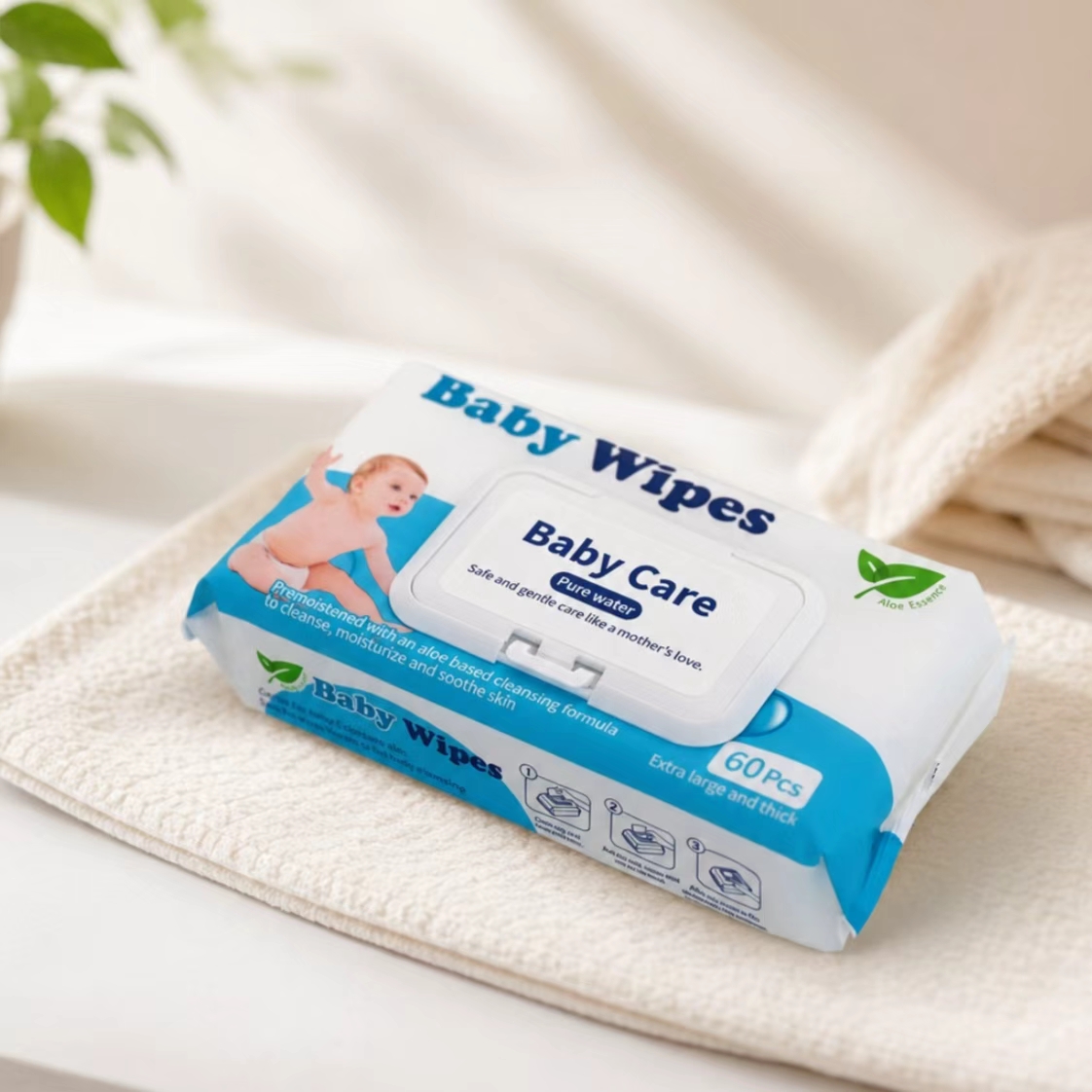
Custom wet wipes qualification is an evidence exercise, not a certificate-counting exercise. A buyer reviewing an OEM or private-label project should be able to connect every compliance claim to a product model, a production condition and an acceptance term. That is the difference between a supplier that can present a certificate and a supplier that can show how the certificate, the manufacturing environment and the formula are controlled for the SKU being sourced.
For sunfans, the custom wet wipes range spans baby wipes Y02, pet wipes C02 to C05, wet toilet paper S01 and S02, kitchen wipes CF001, clothing wipes YW01 and eye care wipes YJ01. That breadth makes a single 'certified factory' statement too blunt for procurement. The useful question is narrower: which evidence applies to this model, this formula and this batch?
What qualification means in a custom wet wipes project
In this article, qualification means the documented link between four things: the product model, its intended use, the manufacturing controls that affect it, and the evidence a buyer can review before acceptance. A certificate can support that link, but it does not replace it. A cleanroom class can support it, but it does not prove a formula. A water-treatment system can support it, but it does not release a batch.
This is especially relevant for OEM custom wet wipes and private-label custom wet wipes, where the buyer's name is on the pack but the production evidence sits with the manufacturer. The buyer needs enough documentation to defend the product in its own market, and enough specificity to avoid applying a general certificate to a SKU it does not actually cover.
Decision rule: accept a compliance claim only when the evidence names the product, the production condition and the scope. If any one of those is missing, treat the claim as a question for the supplier rather than a qualification result.
Start with product identity, not the certificate folder
The first qualification step is to fix the product identity. Custom wet wipes are not a single category. A baby custom wet wipes programme, a pet custom wet wipes programme and a flushable toilet wet wipes programme use different materials, sizes, pack formats and claim sets. The evidence should follow the model.
| Model and identity | Supplied product facts | Qualification marker to connect |
|---|---|---|
| Baby wipes Y02 | 150 x 200 mm; 100 pieces; material listed as entirely adhesive; intended for infant care, baby hygiene, department stores and supermarkets. | ISO 9001:2015 coverage is named for Y02 in the supplied certificate material; formula and pack claims still require SKU-level review. |
| Pet wipes C05 | 180 x 200 mm; biodegradable wood pulp non-woven fabric; pet grooming and personal care segment. | Class 100,000 cleanroom manufacturing is listed as a matched production condition for the C05 pet wipes programme. |
| Pet wipes C03 | 150 x 200 mm; 100 pieces; bamboo fiber. | EDI ultra-pure water equipment and a UV sterilization system are listed among the matched production equipment. |
| Wet toilet paper S02 | 150 x 200 mm; 10 sheets; material can be disintegrated into wood pulp cloth. | Formula requirement: gentle, plant-based, alcohol-free, with fabrics gentle on the skin and free of irritating additives; flushability claims need separate test evidence. |
| Eye care wipes YJ01 | 100 x 150 mm; 20 pieces; water-resistant paper; supplied identity is eye glass cleaning cloths. | Separate specification review is needed; MSDS scope must be checked before it is treated as product-specific approval. |
The table is not a product ranking. It is a qualification map. Each row shows why a buyer should ask for the evidence that belongs to that model instead of accepting a folder of certificates as a substitute for model-level review.
Cleanroom evidence: what Class 100,000 proves for C05
For the pet wipes model C05, the production description lists Class 100,000 cleanroom manufacturing as a matched condition. That is a meaningful marker because it describes a controlled production environment rather than a finished-product claim. Cleanroom classification is about airborne particle control in the defined space. It supports process discipline, but it does not by itself prove the microbiological status of every batch, the safety of the formula or the absence of contamination after the cleanroom step.
For a buyer, the practical question is how the cleanroom claim is linked to the SKU. Does the supplier's quality record identify C05 as a product run under that environment? Is the cleanroom classification current, and what monitoring records support it? Are personnel, gowning, airlocks and equipment cleaning controlled under the same quality system? The buyer does not need to become a cleanroom auditor, but the purchasing file should show that the claim is not floating free of the product.
This is where certificate-only review becomes weak. A certificate may show that a management system exists. A cleanroom statement may show that a controlled space exists. Neither tells the buyer whether the C05 pet wipes batch was produced, packed and released under the controls described. The qualification file should connect the production condition to the batch record and the release decision.
Water and UV controls behind C03
Pet wipes model C03 is supported by EDI ultra-pure water equipment and a UV sterilization system, according to the matched equipment list. EDI, or electrodeionization, is a water-treatment process used to remove dissolved ions; UV sterilization uses ultraviolet light as a process control. In a wet wipe operation, both are relevant because water is a major input and because the wetting system can affect product quality before the pack is sealed.
However, equipment presence is not the same as operational evidence. A buyer should ask how the water system is monitored, how the UV units are maintained and verified, and how deviations are handled. The relevant acceptance question is not 'do you have EDI and UV?' but 'what records show that the water and UV controls were within your defined limits when this product was made?' The in-house laboratory and pH meter listed in the matched equipment can support that question, but they do not answer it unless the buyer sees the control plan and the batch linkage.
For C03, the material is bamboo fiber and the format is 150 x 200 mm with 100 pieces. Those product facts matter because the water and sterilization controls should be evaluated against the actual product construction and intended use, not against a generic pet wipe description. A biodegradable custom wet wipes claim, where used, also needs its own substantiation and should not be inferred from the water-treatment system.
Formula evidence for S02: specification before claim
Wet toilet paper S02 illustrates why formula evidence belongs in qualification. The product is listed at 150 x 200 mm, 10 sheets, with a material that can be disintegrated into wood pulp cloth. The formula requirement is described as a gentle, plant-based formula free of alcohol, with fabrics that are gentle on the skin and free of irritating additives. Those are specification inputs. They are not, by themselves, proof that a particular production lot meets the requirement.
A buyer should therefore separate three questions. First, what is the approved formula and material specification? Second, what does the supplier control during production to keep the formula within that specification? Third, what does the label claim, and what evidence supports that claim in the target market? The pH meter and in-house laboratory listed in the matched equipment can support control, but the buyer still needs the specification, the test method and the release criteria.
Flushability deserves particular care. The U.S. Food and Drug Administration notes that some wipes are labeled flushable, but the available source does not validate a specific flushability standard or product-specific test result for any supplier or product. S02's material is described as able to disintegrate into wood pulp cloth, which is relevant to flushable toilet wipes, but that description should not be converted into a certified flushability claim without the named test method, report and market-specific review. For custom flushable toilet wet wipes, the label should follow the evidence, not lead it.
Certificate scope: reading ISO 9001 and MSDS correctly
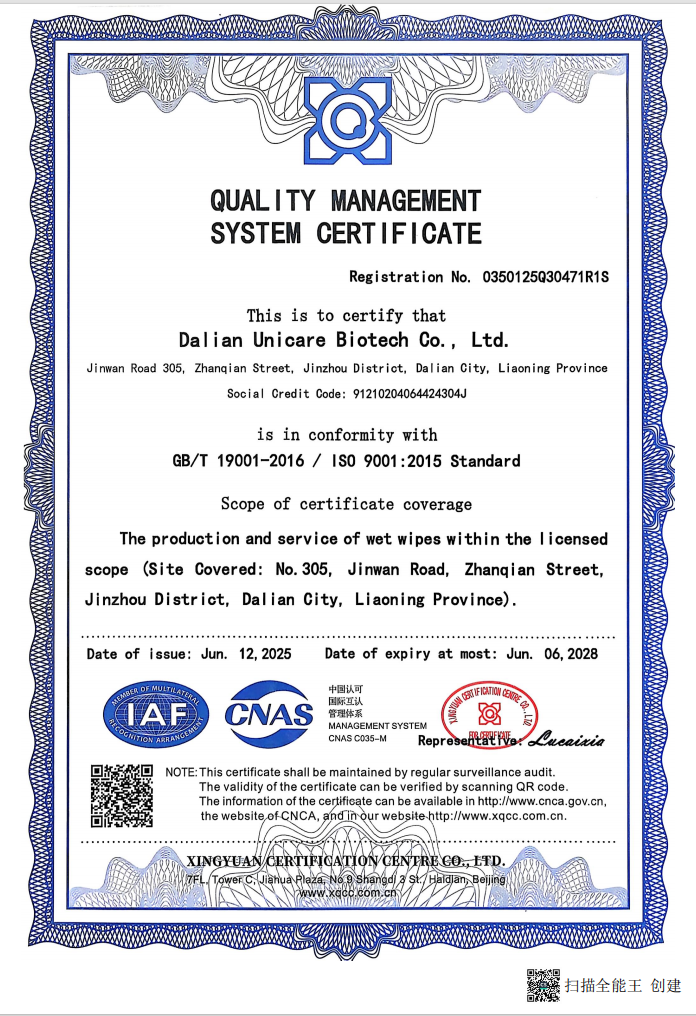
The ISO 9001:2015 certificate in the supplied evidence is issued by Xingyuan Certification Centre Co., Ltd., certificate number 0350125030471R1S, to the standard GB/T 19001-2016 / ISO 9001:2015. It is valid from 2025-06-12 to 2028-06-06. The licensed scope is the production and service of wet wipes within the licensed scope. The citable coverage names baby wipes Y02, kitchen wipes CF001 and pet wipes C02.
That scope is useful, but it should be read precisely. ISO 9001 is a quality management system certification. It supports the existence of a documented quality system; it does not certify a specific formula, a specific microbiological limit or a specific flushability performance. The named coverage also matters. If a buyer is sourcing a model that is not named in the certificate scope, the buyer should ask for the applicable scope document or a separate qualification route rather than assuming coverage from a related model.
The MSDS evidence has a different purpose. The supplied MSDS is issued by Zhuhai BMi Certification & Testing Co., Ltd., certificate number BMi202605192227DG, prepared according to OSHA 29 CFR 1910.1200 HCS, with an expiry date of 2027-05-20. Its stated scope is Pet Grooming Glove Wet Wipes for Dogs & Cats (Extra Thick Rinse-Free Cleaning Gloves), for the global market. An MSDS is a hazard-communication document. It is not a general formula approval for every wet wipe in a catalogue, and it does not replace product-specific safety, microbiological or claims evidence.
This distinction is important for OEM buyers because a supplier may hold a valid certificate with a narrow scope while offering a broad product range. The right response is not to reject the certificate. It is to map the certificate to the SKU, identify the gaps, and request the missing evidence in the purchasing terms.
Acceptance criteria for baby wipes Y02 and eye care wipes YJ01
Baby custom wet wipes and eye care wipes sit at different risk levels and should not share a generic acceptance checklist. For Y02, the supplied product facts are 150 x 200 mm, 100 pieces, material listed as entirely adhesive, and intended use across infant care, baby hygiene, department stores and supermarkets. The ISO 9001:2015 coverage names Y02. The buyer should still define the pack specification, the material specification, the formula requirements, the label claims and the batch release record.
For YJ01, the supplied identity is eye glass cleaning cloths, 20 pieces, 100 x 150 mm, water-resistant paper, for home cleaning, large retail chains and general merchandise. This is not the same intended use as a baby wipe or a pet wipe. The MSDS in the file relates to a pet grooming glove product, so it should not be treated as an eye-care formula approval. The buyer should request a product-specific specification and the evidence needed for the actual claim set, including any surface-cleaning or material statements.
A practical acceptance schedule can use the same four headings for both models without pretending the evidence is identical:
- Product identity: model, sheet size, pack count, material and intended use must match the purchase order.
- Manufacturing evidence: the relevant cleanroom, water, UV or other process controls must be named, current and linked to the product family.
- Formula and release: the approved formula, specification limits, test method and batch release record must be available for review.
- Claims and labels: every on-pack claim must be supported for the target market before artwork approval.
Contract clauses that turn evidence into acceptance terms
Qualification becomes commercially useful when it is written into the purchasing terms. The following clauses are practical because they create a review trail without inventing a test threshold or a certification that the supplier has not supplied.
- Certificate scope clause: name the certificate, number, issuer, validity period and the product models it covers. Require the supplier to notify the buyer if the scope changes.
- Production-condition clause: for models such as C05 and C03, identify the relevant cleanroom, water and UV controls and require batch linkage or a release record that references them.
- Formula specification clause: attach the approved formula and material specification for models such as S02, including the alcohol-free and plant-based requirements where those are part of the brief.
- Claim substantiation clause: require the supplier to identify the evidence behind flushable, biodegradable, antibacterial or other regulated claims before the artwork is approved.
- Change-control clause: require written approval before a material, formula, supplier, production site or packaging change that could affect the qualification file.
- Batch-record clause: define which records the buyer may review during an audit or before release, and how long they are retained.
- Market-specific clause: state the target market and require the supplier to identify the applicable regulatory pathway, such as the U.S. cosmetic classification for skin-cleansing wipes or a different pathway for therapeutic or surface-disinfecting claims.
These clauses do not replace a supplier audit. They make the audit more efficient because the buyer and supplier are discussing the same evidence.
Certificate-only review versus production-evidence review
The difference between the two approaches is not a matter of paperwork volume. It is a difference in what the buyer can conclude.
| Review approach | What it can establish | Verified limitation |
|---|---|---|
| Certificate-only review | A management-system certificate or an MSDS exists and is current. | It may not name the SKU, may not cover the formula, and does not show batch-level linkage. |
| Production-evidence review | The certificate scope, the production condition, the formula specification and the release record are connected to the product model. | It still does not guarantee every future batch; it requires change control and ongoing verification. |
The production-evidence approach is more demanding, but it is the better fit for OEM custom wet wipes where the buyer carries the brand risk. The certificate-only approach can be adequate for early supplier screening, provided the buyer does not treat screening as final qualification.
Market context and practical outlook
The category context explains why this discipline matters. Grand View Research projects the global wet wipes market to reach USD 36.6 billion by 2030. The same source values the global pet wipes segment at USD 0.72 billion in 2026, with a forecasted CAGR of 6.5%. Growth of that kind attracts more private-label programmes and more suppliers, which makes evidence quality a differentiator rather than a back-office detail.
Market growth does not lower the qualification burden. If anything, it raises the cost of a weak evidence file because more SKUs, more pack formats and more export markets create more scope for a certificate to be applied to the wrong product. For buyers, the practical outlook is a shift from asking 'is the supplier certified?' to asking 'which evidence applies to this model, this market and this batch?' That is a more useful question for Japan export custom wet wipes, private-label baby custom wet wipes and pet custom wet wipes programmes alike.
For suppliers, the same shift rewards documentation discipline. A factory that can connect cleanroom conditions, water controls, formula specifications and certificate scope to named models is easier to qualify than one that can only present a folder. The evidence does not need to be promotional. It needs to be specific, current and reviewable.
How sunfans fits the evidence model
sunfans is the custom wet wipes brand referenced in this article. The supplied company facts describe a manufacturer established in 2013, with a 6,000 square metre factory, 50 employees and a 10-person R&D team. The capability data lists OEM, ODM and customized services, with customization across packaging, logo, material, size, aroma and number of pieces, and a stated lead time of 30 days. Quality control is described as supported by third-party authoritative laboratories, internal quality control, material inspection, process inspection and finished product inspection.
Those facts are useful because they describe the operating context in which qualification evidence should exist. They do not replace the model-level evidence. A buyer should still map the ISO 9001:2015 scope, the cleanroom and water controls, the formula specification and the release record to the specific product being sourced. For export programmes, the stated export markets include Japan, Singapore, New Zealand, Australia, the United States, Southeast Asia and Canada, and after-sales support includes assistance with packing lists and customs declaration documents for export orders. Those are relevant to supply-chain qualification, but they remain separate from product-specific compliance.
FAQ
What does Class 100,000 cleanroom manufacturing prove for pet wipes C05?
For pet wipes C05, Class 100,000 cleanroom manufacturing is listed as a matched production condition. It indicates that the product is associated with a controlled airborne-particle environment. It does not, by itself, prove the microbiological status of a batch, the safety of the formula or the absence of post-cleanroom contamination. Buyers should ask for the cleanroom monitoring record and the batch linkage for C05.
How should buyers read ISO 9001:2015 when it covers only certain wet wipe models?
The supplied ISO 9001:2015 certificate is issued by Xingyuan Certification Centre Co., Ltd., certificate number 0350125030471R1S, to GB/T 19001-2016 / ISO 9001:2015, valid from 2025-06-12 to 2028-06-06. The citable coverage names baby wipes Y02, kitchen wipes CF001 and pet wipes C02. A buyer sourcing a model outside that named coverage should request the applicable scope document or a separate qualification route rather than assuming coverage from a related model.
What role do EDI ultra-pure water and UV sterilization play in C03 qualification?
For pet wipes C03, EDI ultra-pure water equipment and a UV sterilization system are listed among the matched production equipment. They are process controls for water treatment and microbial control. They support qualification only when the supplier can show monitoring, maintenance and batch linkage. The equipment list alone does not establish the finished-product microbiological result.
Does the word flushable on S02 wet toilet paper prove flushability performance?
No. S02 is described as a material that can be disintegrated into wood pulp cloth, which is relevant to flushable toilet wipes. The U.S. Food and Drug Administration notes that some wipes are labeled flushable, but the available source does not validate a specific flushability standard or product-specific test result. A flushable claim should therefore be supported by a named test method, a complete report and market-specific review.
What acceptance criteria should a buyer attach to baby wipes Y02 and eye care wipes YJ01?
For Y02, the purchase terms should fix the model, 150 x 200 mm size, 100-piece pack, material specification, intended infant-care use, formula requirements, label claims and batch release record; the supplied ISO 9001:2015 coverage names Y02. For YJ01, the terms should reflect its identity as eye glass cleaning cloths, 20 pieces, 100 x 150 mm, water-resistant paper, and should require product-specific specification and claim evidence. The MSDS in the file relates to a pet grooming glove product and should not be treated as YJ01 formula approval.
The sunfans company profile PDF is available for download: company profile.
Есть вопросы или нужны дополнительные детали?
Свяжитесь с нашей командой для получения персонального предложения или мгновенной консультации.
Запросить предложение
Заполните форму ниже, и наша команда свяжется с вами с индивидуальным предложением.
Прямой чат WhatsApp
Предпочитаете общаться в реальном времени? Напишите нам в WhatsApp для мгновенной помощи и быстрых ответов.
- Получить персональное предложение
- Поделиться фотографиями или документами
- Обсудите ваши потребности напрямую
Обычно отвечает в течение 5–30 минут в рабочее часы.