
Custom Wet Wipes Technical FAQ: Materials, Sizes & OEM Answers
Custom Wet Wipes Technical FAQ: Materials, Sizes & OEM Answers
Short answer: in a custom wet wipes program the substrate decides what the wipe can do, the sheet dimension decides where it fits, and the pack count decides which retail channel it can serve. Formulation, packaging and branding are built on top of those three decisions, not the other way round.
This technical FAQ is written for buyers, brand owners and sourcing teams who need to read a wet wipes specification the way a manufacturer reads it. It is based on the published product documentation of sunfans, the custom wet wipes line produced by Da lian Weijie Biotechnology Co., Ltd., a hygiene products manufacturer established in 2013 in Dalian, Liaoning Province, China, whose product coverage includes baby wipes, pet wipes, wet toilet paper, functional wipes, floor dry wipes and floor wet wipes.
1. Which substrate should a custom wet wipes program start from?
Substrate selection is the first specification decision because it determines three things at once: how much liquid a wipe can carry, how the sheet behaves on the surface it touches, and what happens to the sheet after use. In the current sunfans lineup, several substrate families are used across ten models.
| Substrate | Models using it | What it is chosen for |
|---|---|---|
| Water-resistant paper | YJ01 eye care wipes | Lens and eyeglass cleaning, where a paper-based sheet is paired with a 100 × 150 mm format |
| Water-jet non-woven fabric | YW01 clothing wipes, CF001 kitchen wipes | Wet wiping of fabric and hard household surfaces, where the sheet must stay intact while wet |
| Biodegradable wood pulp non-woven fabric | S01 wet toilet paper, C05 pet wipes | Applications where the material is intended to break down after use |
| Bamboo fibre | C03 and C04 pet wipes | Pet grooming and personal care wiping in retail-oriented pack formats |
| Entirely adhesive material | Y02 baby wipes, C02 pet wipes | Skin-contact and pet-contact wiping where a coherent, non-dispersing sheet is required |
| Wood pulp cloth (disintegrating) | S02 wet toilet paper | Wet toilet paper described as disintegrating into wood pulp cloth |
Two implications follow from that table. First, "soft" and "strong" are not universal properties of a wet wipe — they are properties of a substrate in a specific application. Second, a substrate change is a product change, not a cosmetic change: it moves the wipe between application categories and therefore between intended industries.
2. Material-to-application questions
Which model is specified for lens and eyeglass cleaning?
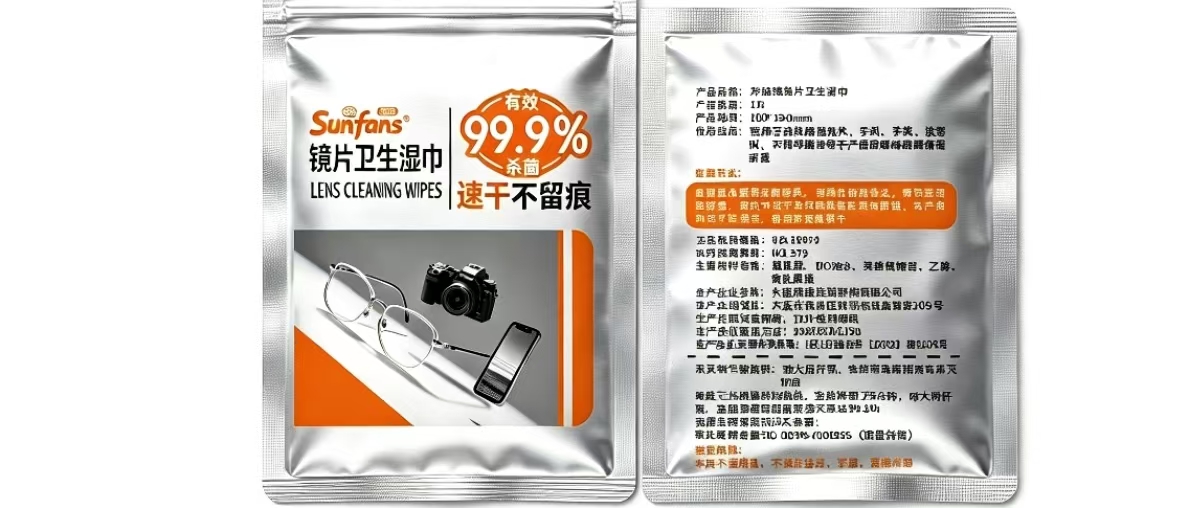
YJ01 is the model in this lineup specified for that job. The product is classified as an eye care wipe belonging to the eye glass cleaning cloths category, supplied as 20 pieces per pack, with a sheet size of 100 × 150 mm, made of water-resistant paper. It is intended for the home cleaning industry, large retail chains and the general merchandise industry. The combination of a small sheet and a paper substrate is the defining specification: a smaller sheet is easier to control around a lens, and the paper substrate is the reason the product is positioned as a cleaning cloth rather than as a general-purpose wet wipe.
Which substrate should be used for wet wiping of fabric and kitchen surfaces?
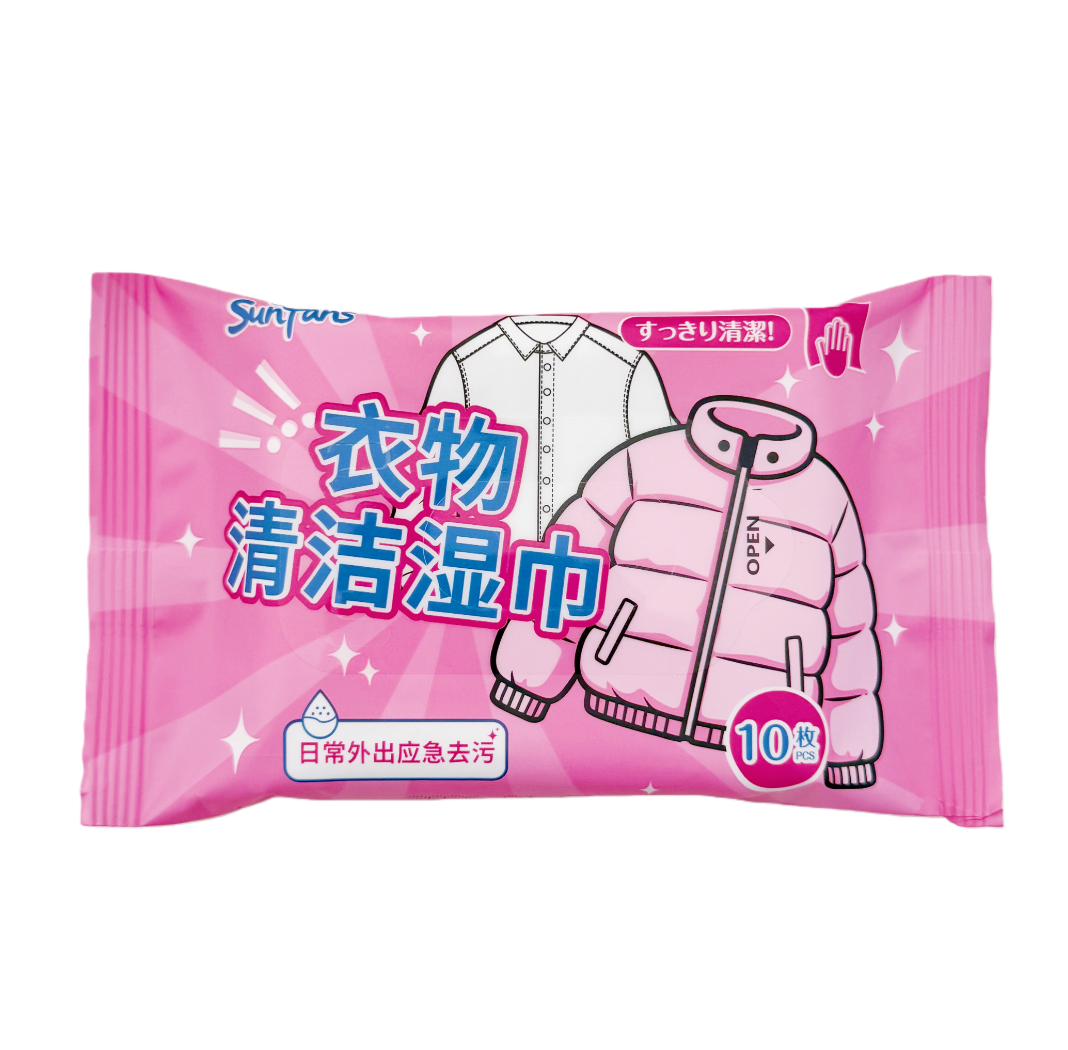
YW01 clothing wipes and CF001 kitchen wipes both use water-jet non-woven fabric, and that shared substrate is why both are positioned for wet wiping tasks rather than for skin care. YW01 is supplied as a pack of 10 cloths for drying clothes at 150 × 180 mm. CF001 is supplied as 80 pieces at 200 × 200 mm and is intended for kitchen and home cleaning. The size difference matters more than it first appears: the larger 200 × 200 mm sheet covers more surface per pull, which suits counter tops and appliance exteriors, while the 150 × 180 mm sheet in YW01 is sized for handling individual garments.
What about wet toilet paper?
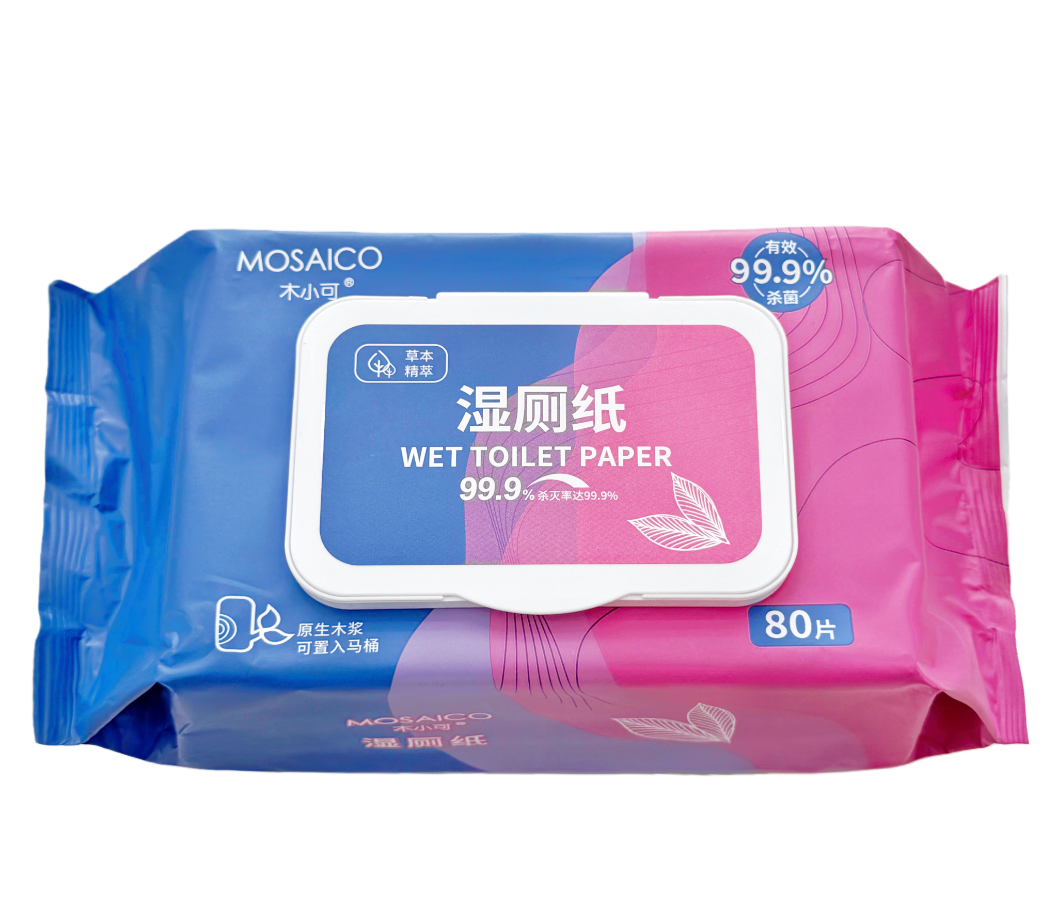
Two models are classified as wet toilet paper in this lineup, and they are specified differently. S01 is supplied as 100 sheets per pack at 130 × 200 mm and is made of biodegradable wood pulp non-woven fabric; its intended applications include personal care, the pet products industry and large department stores. S02 is supplied as 10 sheets per pack at 150 × 200 mm, and its material is described as being able to disintegrate into wood pulp cloth; it is intended for home cleaning, large retail chains and the general merchandise industry.
For a buyer, the practical distinction is pack economics against dispersibility behaviour. A 100-sheet pack and a 10-sheet pack serve different retail price points and different usage frequencies, and the two substrates are described differently with respect to what happens to the sheet after use. Treating S01 and S02 as interchangeable because both are called wet toilet paper is one of the more common specification errors in this category.
Which model covers baby and newborn skin contact?
Y02 baby wipes are classified as a baby wipe and supplied as an English version with pack sizes from 01 to 100 pieces, at 150 × 200 mm, made of entirely adhesive material. The product is intended for the infant care products industry, the baby hygiene products industry, and large department stores and supermarkets. Because the same 150 × 200 mm sheet dimension also appears in pet wipes C03 and in S02 wet toilet paper, sheet size alone is not enough to identify a product: the substrate, the intended industry and the pack configuration together identify the SKU.
3. Size and pack format: what the numbers mean
| Model | Product | Sheet size | Pack configuration | Stated material |
|---|---|---|---|---|
| YJ01 | Eye care wipes | 100 × 150 mm | 20 pieces per pack | Water-resistant paper |
| YW01 | Clothing wipes | 150 × 180 mm | 10 cloths per pack | Water-jet non-woven fabric |
| S01 | Wet toilet paper | 130 × 200 mm | 100 sheets per pack | Biodegradable wood pulp non-woven fabric |
| S02 | Wet toilet paper | 150 × 200 mm | 10 sheets per pack | Disintegrates into wood pulp cloth |
| CF001 | Kitchen wipes | 200 × 200 mm | 80 pieces per pack | Water-jet non-woven fabric |
| Y02 | Baby wipes | 150 × 200 mm | 01–100 pieces per pack | Entirely adhesive |
| C02 | Pet wipes | 200 × 200 mm | 01–100 pieces per pack | Entirely adhesive |
| C03 | Pet wipes | 150 × 200 mm | 02–100 pieces per pack | Bamboo fibre |
| C04 | Pet wet toilet paper | 140 × 180 mm | 03–100 sheets per pack | Bamboo fibre |
| C05 | Pet wipes (glove format) | 180 × 200 mm | 04–10 pieces per pack | Biodegradable wood pulp non-woven fabric |
Two readings of this table are useful during sourcing. The first is the dimension range: the current lineup spans from 100 × 150 mm at the smallest to 200 × 200 mm at the largest. The second is the pack range: the widest configurations — 01 to 100 pieces — appear on Y02, C02 and C03, which are the high-frequency consumer formats, while YJ01, YW01, S02 and C05 sit at 20 pieces or fewer, which suits trial, travel, glove-format or specialist use.
4. Pet wipes: how C02, C03, C04 and C05 differ
Buyers frequently treat the pet wipes range as one product with cosmetic variations. The documentation describes four distinct specifications, all of them intended for the pet products industry, the pet grooming and personal care segment, and large department stores and supermarkets.
- C02 — an English version of pet wet wipes, supplied from 01 to 100 pieces per pack, with a 200 × 200 mm sheet made of entirely adhesive material. It carries the largest sheet in the pet range.
- C03 — an English version of pet wet wipes, supplied from 02 to 100 pieces per pack, with a 150 × 200 mm sheet made of bamboo fibre.
- C04 — an English version of pet wet toilet paper, supplied from 03 to 100 sheets per pack, with a 140 × 180 mm sheet made of bamboo fibre. It carries the smallest sheet in the pet range.
- C05 — supplied as an English version of pet gloves in a 04 to 10 piece format, with a 180 × 200 mm sheet made of biodegradable wood pulp non-woven fabric.
Because the intended industry and channel are identical across the four models, channel fit does not separate them. What separates them is physical format. C02 and C03 are the two conventional wet wipe configurations, distinguished by sheet size and substrate. C04 is specified as wet toilet paper rather than wet wipes, which changes both the sheet size and the rationale for the pack count. C05 is a glove format: the user places a hand inside the wipe rather than folding a flat sheet, which changes how the product is applied to a pet's coat and legs.
A workable selection rule follows from that: choose C02 when the largest possible flat sheet matters, C03 when a mid-size sheet on a bamboo fibre substrate fits a standard 02–100 piece pack, C04 when the product concept is a wet toilet paper rather than a wipe, and C05 when controlled handling matters more than sheet area.
5. Manufacturing context: what production equipment implies for a buyer
The project type described across these product lines is OEM branding and contract manufacturing, and the operating model is continuous surface wiping with single-sheet, one-time consumption. Both statements have procurement consequences. The product is consumed sheet by sheet, so the consistency of sheet dimension, fold and moisture content across a production run is what a brand is actually selling; variation shows up at the shelf as dry packs, wet packs and uneven dispensing.
The matched equipment documented for these OEM projects includes an automatic packaging machine, an automatic filling machine, EDI ultra-pure water equipment, a UV sterilization system, an in-house laboratory, a Class 100,000 cleanroom and a pH meter. Two of these correspond to specific models and are worth explaining on their own terms.
- C05 and the production environment. The Class 100,000 cleanroom is the controlled production environment referenced for C05 pet wipes. A cleanroom classification describes how the air in the production area is controlled; it is a facility control rather than a product certification, and it should be read as one input among several rather than as a stand-alone quality claim.
- C03 and the filling line. Automatic packaging, automatic filling, EDI ultra-pure water equipment and UV sterilization are the equipment elements referenced for C03. Filling accuracy and water quality are the two variables that most often surface as complaints in wet wipes retail, because they determine whether a pack is too dry, too wet, or inconsistent from pack to pack.
The in-house laboratory and pH meter matter for a different reason: they are the instruments that make a formulation specification verifiable, which is the subject of the next section.
6. Formulation specification: the S02 example
S02 wet toilet paper is a useful example of how a formulation requirement should be written into a custom project. The product is supplied as 10 sheets per pack at 150 × 200 mm, with a material described as disintegrating into wood pulp cloth, and it is intended for home cleaning, large retail chains and the general merchandise industry. The formulation requirement documented for this type of project is a gentle, plant-based formula free of alcohol, using fabrics that are gentle on the skin and free of irritating additives.
Read as a specification rather than a marketing line, that requirement contains four separately verifiable clauses: the formula base is plant-based; alcohol is excluded; the fabric is selected for gentleness on skin; and the additive package excludes irritating ingredients. A buyer who wants to hold a supplier to that standard should confirm each clause separately, and should tie it to the pH meter and in-house laboratory capability rather than to wording printed on a pack.
Storage conditions belong in the same specification. The documented storage requirement across these product lines is a cool, dry, shaded area at room temperature, away from high temperatures, heat sources and areas prone to moisture accumulation. For a product that is by definition moist, storage is not a logistics footnote — it is part of the product definition, and it should be mirrored in the buyer's own warehouse instructions after import.
7. OEM procurement questions buyers should close in writing
| Item to confirm | Why it belongs in the contract |
|---|---|
| Substrate family (water-resistant paper, water-jet non-woven, wood pulp non-woven, bamboo fibre, adhesive) | Determines performance and any disposability positioning; changing it changes the product |
| Sheet dimensions in millimetres | Dimensions are model-specific and range from 100 × 150 mm to 200 × 200 mm in the current lineup |
| Pack configuration and count range | Pack count drives shelf positioning and unit economics; the pet range alone spans 01–100 pieces, 02–100 pieces, 03–100 sheets and 04–10 pieces |
| Formulation restrictions | Alcohol-free, plant-based and non-irritating additive requirements must be stated as clauses and tested, not assumed from a sample |
| Filling and water treatment equipment | Automatic filling, EDI ultra-pure water equipment and UV sterilization are the documented equipment elements behind pack-to-pack consistency |
| Verification instruments | In-house laboratory and pH meter capability is what turns a formulation claim into a repeatable batch record |
| Production environment | Where a controlled environment such as the Class 100,000 cleanroom referenced for C05 applies, the scope of that environment should be defined in the agreement |
| Storage and handling conditions | Cool, dry, shaded storage at room temperature, away from heat and moisture, should be reflected in the buyer's own handling documentation |
On compliance, buyers should expect the regulatory baseline rather than treat it as a differentiator. ISO 9001 for quality management and ISO 22716 for good manufacturing practice in cosmetics are widely cited as baseline requirements for wet wipes OEM manufacturing. Products placed on the EU market are expected to comply with applicable EN standards, including REACH for chemicals and the Biocidal Products Regulation where biocidal claims are made. In China, wet wipes fall under the Hygienic Standard for Disposable Sanitary Products. In the United States, the FDA facility registration deadline for cosmetic wipes manufacturers fell on 1 July 2026.
The manufacturer profile behind the products referenced here is Da lian Weijie Biotechnology Co., Ltd.: established in 2013 and located in Dalian, Liaoning Province, China, operating a 6,000 m² facility with approximately 50 employees including a 10-person R&D team, and an annual production output of approximately 4 million packages. The company reports an export share of around 70%, with main markets including Japan, Australia, Canada, the United States and Singapore. For a sourcing team, the relevant point is not the size of the numbers but their shape: an export-oriented facility whose output is measured in packages rather than in tonnes, which is consistent with a private-label, multi-SKU production model.
8. Where customization has limits
Three boundaries are worth stating plainly, because they are where buyer expectations most often diverge from what a specification can support.
- Sheet dimensions are model-specific, not a dial. The current lineup is documented at fixed dimensions per model. Requesting a different sheet size is a tooling, fold-pattern and validation exercise rather than a catalogue adjustment, and it changes the packaging format as well as the wipe.
- Dispersibility is a property of the substrate, not a claim that can be added later. S02's material is described as disintegrating into wood pulp cloth, and S01 and C05 use biodegradable wood pulp non-woven fabric. C02, by contrast, is documented as using entirely adhesive material. A buyer who needs dispersible behaviour should select the substrate documented for it rather than assume the behaviour can be extended across a range.
- Alcohol-free, plant-based formulations are a project specification, not a portfolio default. The documented requirement describes a gentle, plant-based formula free of alcohol, with fabrics that are gentle on the skin and free of irritating additives. Whether that applies to a particular SKU has to be confirmed for that SKU, with laboratory and pH evidence as support.
The same caution applies to environmental positioning. It is reasonable to describe a specific substrate as biodegradable when the documentation says so; it is not reasonable to extend an eco-positioning claim across an entire catalogue or an entire retail programme without checking each SKU individually. Buyers who need that discipline in writing should make substrate-level confirmation a contract clause rather than a marketing expectation.
9. What the market data suggests
The commercial case for getting these specifications right is straightforward. The global wet wipes market was valued at approximately USD 32.09 billion in 2026, with a projected CAGR of 3.86% reaching USD 43.45 billion by 2034, according to Fortune Business Insights. Within that total, pet wipes were valued at USD 1.58 billion in 2024 with a projected CAGR of 5.6% to USD 2.64 billion by 2033, according to DataHorizzon Research — a growth rate above the overall category, which is consistent with a market in which format differentiation in the pet range has commercial consequences.
Two further signals are relevant to material decisions. The global biodegradable wipes market reached over USD 3 billion in 2024, with growth described as driven by baby wipes and premium retail segments. The flushable wipes market was valued at USD 2.3 billion in 2025 and is projected to reach USD 4.2 billion by 2035 at a 6% CAGR, according to Global Market Insights.
Geographically, the United States accounted for 34% of global wet wipes market share in 2024, Japan accounts for nearly 27% of the Asia-Pacific wet wipes market, and North America represents approximately 50% of the pet wipes market at USD 0.79 billion in 2024. One caveat belongs with these figures: published estimates of the total market vary noticeably between research agencies depending on base year and category scope, so any single number should be treated as an order-of-magnitude planning reference rather than a precise input.
10. Outlook for custom wet wipes buyers
Three shifts are likely to shape technical FAQ conversations over the next procurement cycle. Substrate-level documentation will increasingly be requested alongside the product sample, because biodegradability and dispersibility claims cannot be verified from a finished pack alone. Pack-format differentiation will continue to matter in pet care, where the same intended industry and the same retail channel can carry four materially different physical formats. And formulation verification — the ability to demonstrate alcohol-free, plant-based composition through laboratory and pH evidence rather than through wording — will move from a nice-to-have to a standard sourcing requirement, particularly for buyers serving markets where regulatory expectations are tightening.
FAQ
What is the smallest and largest sheet size in this custom wet wipes lineup?
The smallest documented sheet is YJ01 eye care wipes at 100 × 150 mm. The largest is 200 × 200 mm, used by CF001 kitchen wipes and C02 pet wipes.
Can a buyer change the sheet size for a private label program?
Sheet dimensions are documented per model, so a size change is a product development exercise involving tooling, fold pattern and packaging rather than a catalogue selection. It should be scoped and validated as a new specification.
Which products in the lineup are described as using biodegradable material?
S01 wet toilet paper and C05 pet wipes are made of biodegradable wood pulp non-woven fabric. S02 wet toilet paper uses a material described as disintegrating into wood pulp cloth. C02 and Y02 use entirely adhesive material, and C03 and C04 use bamboo fibre; these are described differently and should not be grouped under a single biodegradability claim.
What pack configurations are available for pet wipes?
C02 is offered from 01 to 100 pieces, C03 from 02 to 100 pieces, C04 from 03 to 100 sheets, and C05 from 04 to 10 pieces in a glove format.
What storage conditions apply to these wet wipes?
Cool, dry and shaded storage at room temperature, away from high temperatures, heat sources and areas prone to moisture accumulation.
What production equipment supports these OEM projects?
The documented matched equipment includes an automatic packaging machine, an automatic filling machine, EDI ultra-pure water equipment, a UV sterilization system, an in-house laboratory, a Class 100,000 cleanroom and a pH meter. The Class 100,000 cleanroom is referenced in connection with C05, and automatic packaging, automatic filling, EDI ultra-pure water equipment and UV sterilization are referenced in connection with C03.
What formulation requirement is documented for gentle formulations such as S02?
A gentle, plant-based formula free of alcohol, using fabrics that are gentle on the skin and free of irritating additives. The project type for these products is OEM branding and contract manufacturing.
Further reading
Full product and capability details for the manufacturer referenced throughout this FAQ are available in the company profile: Dalian Unicare Biotech company profile (English, PDF). The company website is www.unilibio.com.