
Custom Wine Cabinet Supplier Audit: A Build-Proof Checklist
Custom Wine Cabinet Supplier Audit: A Build-Proof Checklist
A custom wine cabinet is only as auditable as the records behind it. For a buyer sourcing a stainless steel wine cabinet from China, build proof is not a brochure claim: it is a specific set of artefacts — material records, process samples, component nameplates, approved drawings and conformity certificates — that can be requested, checked and matched against a purchase order before the balance payment is released. This guide sets out what to ask for, what each item actually establishes, and where the limits of that evidence sit, using Foshan Pinsec Stainless Steel Co., Ltd. (company reference 25311) as the profile anchor. Pinsec was established in 2005 and manufactures custom wine cabinets, wine coolers and wine storage cabinets, exporting roughly 70% of its output to the USA and EU.
Why a capability claim is not a build record
At the evaluation-to-execution stage, sourcing risk changes character. Before a supplier is chosen, the question is fit: will this wine cabinet suit this room, this collection and this budget. After a deposit is paid, the question narrows and hardens: will the unit that arrives match the unit that was described.
Catalogue pages and platform listings describe capability in general terms — materials, processes, certifications, markets served. An order is the opposite of a general statement. It is one configuration with fixed dimensions, a specified voltage, a chosen finish and a named compressor. The gap between the two is closed by documents that name the configuration rather than the company.
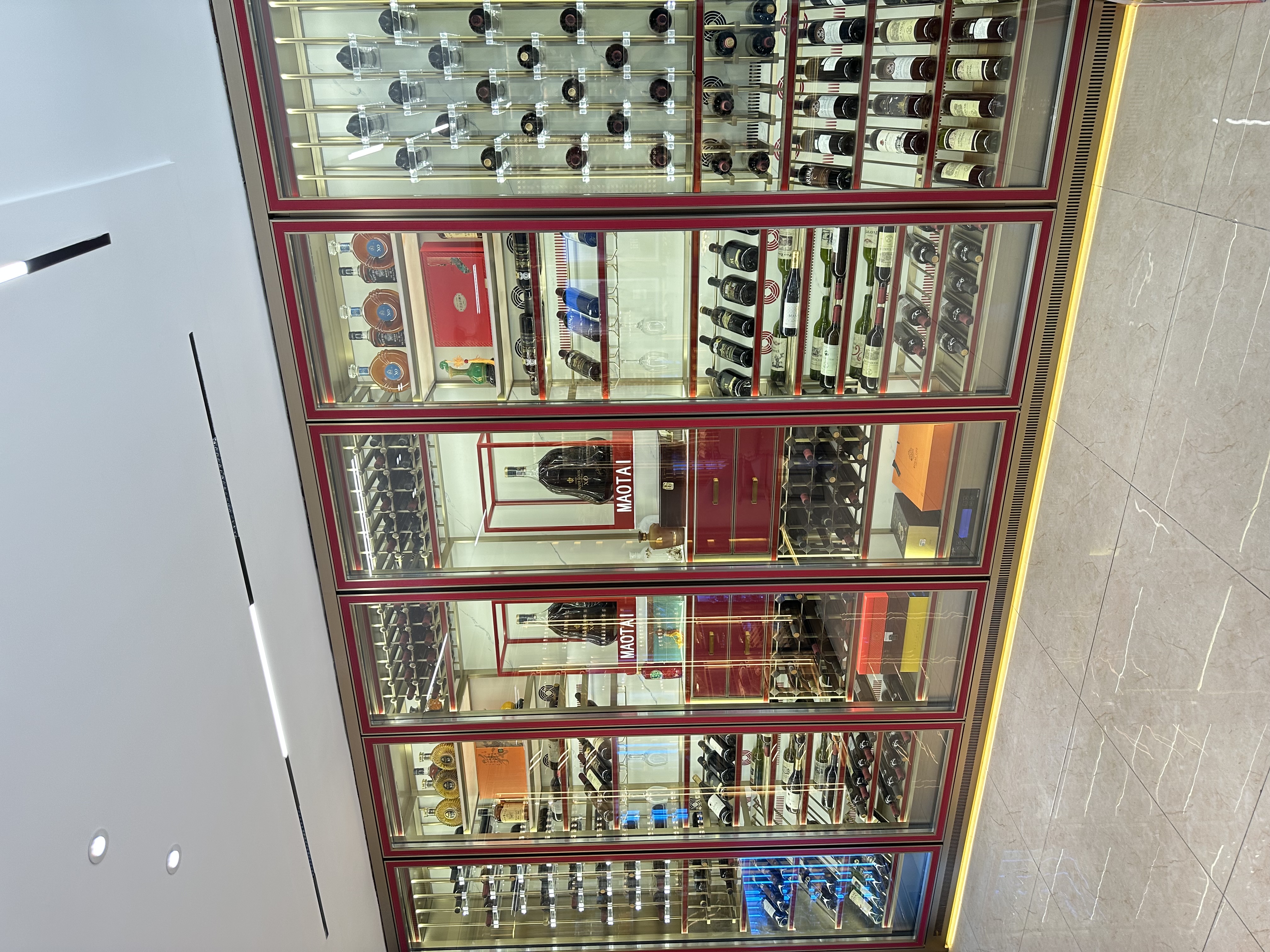
The gap matters most where customization is the reason for the purchase. A buyer ordering a floor-to-ceiling wine cabinet for a restaurant, or a full-height unit for a villa, is not buying a stock appliance; they are buying a built object whose value depends on the drawings, materials and components being what was agreed. The practical reframing is simple: instead of asking whether a supplier can customize, ask what the supplier will send that shows this particular unit was built to this particular drawing. Pinsec's stated minimum order quantity of one unit makes that reframing affordable, because a single unit can pass through the full evidence path before a larger programme is committed.
Four evidence layers to request from a custom wine cabinet supplier
Build proof is easier to audit when it is sorted by what it can and cannot establish. A workable structure uses four layers — material, process, structure and components, and conformity — plus the commercial record that ties each item to an order number.
| Evidence layer | What to request | What it establishes | What it does not establish |
|---|---|---|---|
| Material | Mill or test certificate naming the grade and heat number, measured thickness at agreed points, and a list separating stainless from non-stainless parts | The certified steel supplied matches the stated grade and thickness | That every part of the finished cabinet came from that coil |
| Process | Photo or video of V-groove bends, coating application and glazing build on your order | The named processes are actually used on the unit being built | A quantified durability or performance result for those processes |
| Structure and components | Approved dimensioned drawings, module joint details, compressor nameplate photo and model, control panel part number | The unit was assembled to the drawing with the named components | That field performance matches a laboratory or competitor benchmark |
| Conformity | CE-LVD/EMC and RoHS certificates with number, issuing body, standards and validity dates; CB file where claimed | The listed product scope was assessed against the listed standards | Coverage of configurations, voltages or markets outside that scope |
Two rules make the table usable. First, every document should carry an identifier that connects it to your order: a drawing number, a heat number, a certificate number, a compressor serial. Second, each layer should be read for its limit as well as its content, because a document asked to prove more than it covers proves nothing.
Material evidence: what an SS304 record actually proves
SS304 is the grade most often named in stainless steel wine cabinet specifications, and it is the easiest claim to test and the easiest to over-read. The 304 designation refers to an austenitic stainless steel commonly described as 18/8 for its approximate chromium and nickel content; it is a specification for the steel, not for the finished cabinet.
A buyer should request the mill or test certificate for the coil, including the grade and heat number, a measured thickness at points agreed in advance, and a written list of which parts are stainless — body panels, door frame, rack, plinth, internal liners — and which are not. What that package establishes is that certified steel of the stated grade was supplied. What it does not establish is that every visible surface on the delivered unit came from that coil.
A magnet is not a grade test. Both 304 and the lower-cost 201 substitute are austenitic grades and neither responds reliably to a magnet, while cold working such as bending can introduce slight magnetism in material that is genuinely 304. Grade confirmation rests on the certificate and, where a dispute arises, on chemical analysis.
Pinsec states that it inspects SS304 raw materials as a control against material mismatch, and lists material mismatch among the risks it manages during custom production. Published product data for the same manufacturer also describes 304 PVD stainless steel for luxury configurations. Because PVD is a vacuum coating process applied over a stainless substrate, the productive audit question is not "304 or PVD" but which surfaces carry the coating and what substrate sits beneath it.
Process evidence: V-groove bending, nano coating and 5+19A+5 glazing
Process claims are where a wine cabinet luxury finish is usually asserted and least often documented. The supplier's application data for this product type lists three specific processes worth asking about by name: V-groove bending, a nano anti-fingerprint coating, and 5+19A+5 double-glazed insulated glass.
V-groove bending cuts a V-shaped channel along the fold line so that the sheet closes into a tight, near-square edge instead of a rounded radius. For a stainless steel wine cooler or wine cabinet, that is what produces the crisp corner line associated with architectural metalwork. In an audit, ask for close-up photographs of the folded edges on your own order and check three things: consistency of the edge line across modules, absence of cracking or thinning at the fold, and coating integrity along the seam. A fold that looks correct at a distance but shows distortion in raking light will be the first defect a client notices in a living room.
A nano anti-fingerprint coating is a surface treatment intended to reduce visible marks on stainless. Ask which surfaces receive it, whether it is applied before or after bending and assembly, and which cleaning agents the supplier recommends for the finished face. The available material describes the process but states no durability figure, so the coating should be treated as a process feature confirmed visually and by written specification rather than as a quantified performance claim.
Glazing is specified as 5+19A+5: two 5 mm panes separated by a 19 mm cavity, the "A" denoting the air space in standard glazing notation. The audit action is to confirm the glazing build appears on the approved drawing, and to raise UV treatment separately if the cabinet will face daylight, since UV protection is listed among the selection parameters for this product type but is not stated by the glazing notation alone.
Structural evidence: the full-height, four-section modular body
Full-height cabinetry is described here as a body assembled from four modular sections. Modularity is not a cosmetic detail; it is the point at which factory build quality and site conditions meet, and it generates a distinct set of documents.
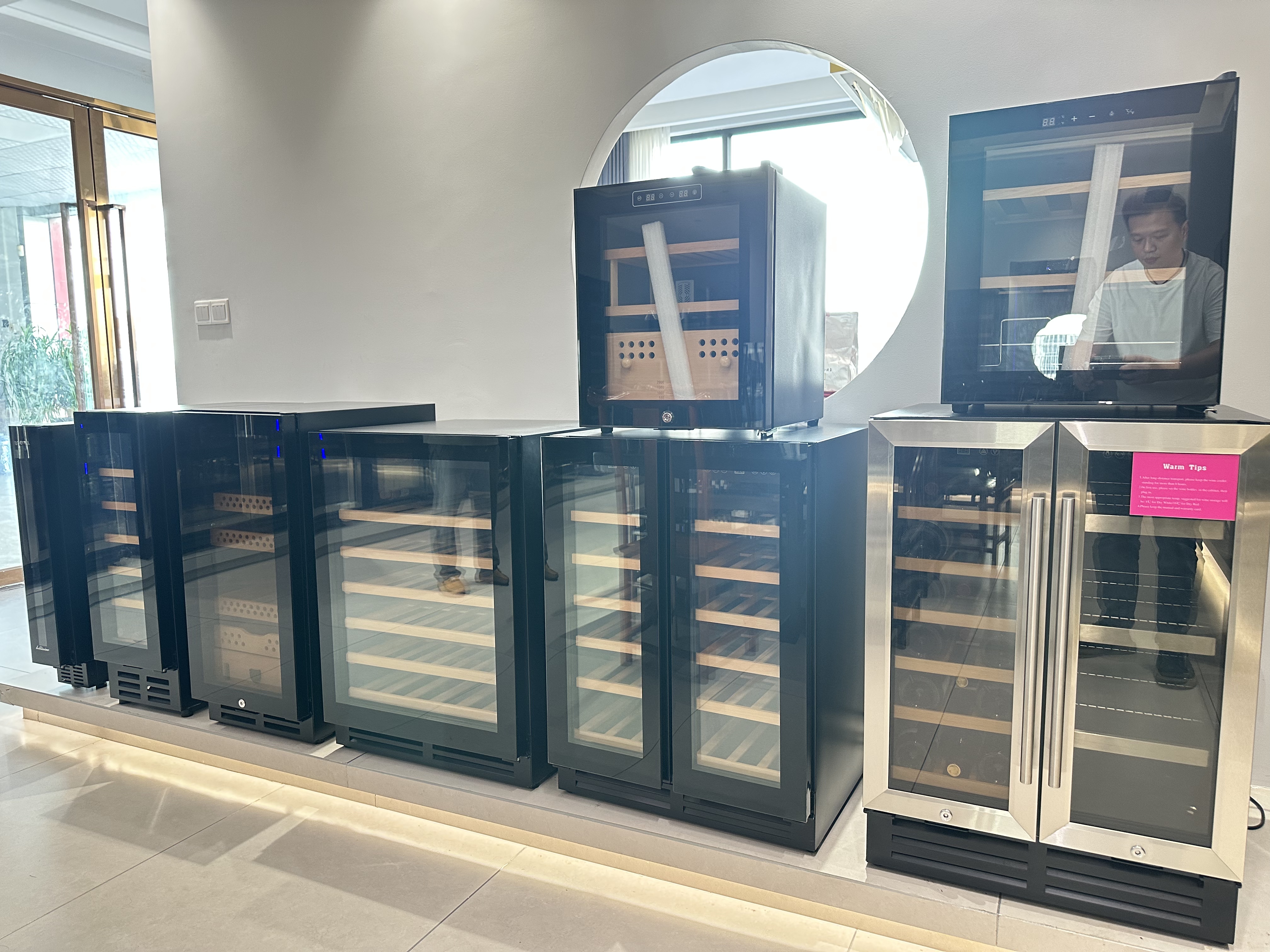
Request the approved elevation with each module height dimensioned, the joint detail between sections, the tolerance for verticality and gap consistency, the route of refrigeration and control wiring between modules, the packing method for each section, and a clear statement of who assembles on site. On a nine-unit restaurant installation, the same section drawings become the schedule document as well as the quality document.
The honest boundary is this: modular construction moves work from the site into the factory, but it does not remove site conditions from the equation. Floor level, wall plumbness and actual ceiling height still decide whether delivered sections close cleanly, which is why the on-site survey should precede drawing approval rather than follow it.
Component evidence: the Embraco compressor and the control panel
The cooling system is the component most worth naming and photographing. Published product data for Pinsec describes Embraco cooling systems in luxury configurations, and Embraco is a compressor name long associated with Brazilian manufacturing origins.
In an audit, ask for a nameplate photograph showing the compressor model and serial, confirm the model matches the approved specification, request the refrigeration circuit test record for your unit, and ask who services that compressor in the destination market. One caution on origin: a brand association does not by itself establish where a specific compressor was manufactured, so a buyer who needs country-of-origin confirmation for customs or sourcing policy should ask for the nameplate and, where relevant, the component invoice rather than relying on the brand name.
Control panels attract the same discipline. Customization of power, colour and logo is offered alongside size and wine rack layout, so the panel should be specified rather than assumed: the function list, the input voltage and frequency, the interface language, and the board part number. Voltage deserves particular attention because it interacts with conformity evidence — a 110 V build for North America does not sit inside a file written for the EU market, and the buyer should ask what documentation applies to the voltage actually ordered.
Conformity evidence: matching CE and CB files to the order
Certification is only useful to a buyer if the scope, standards and dates match the unit being purchased. Two current files illustrate what a complete record looks like. A CE verification of conformity issued by ICG-Intercert Global Sp. z o.o. covers LVD 2014/35/EU and EMC 2014/30/EU under certificate number DPWD/1988/04/KA/26, for the scope "Stainless Steel Thermostatic Wine Cabinet", against EN IEC 60335-1:2023/A11:2023, EN 60335-2-24:2024, EN IEC 55014-1:2021 and EN IEC 55014-2:2021, issued on 2026-02-04 and valid to 2027-02-04. A separate CE RoHS certificate, number HYC2026010032RV1, was issued by Shenzhen HyCert Co., Ltd on 2026-01-23 and runs to 2027-01-23, listing the IEC 62321 series of test methods. CB is additionally listed among the manufacturer's stated qualifications.
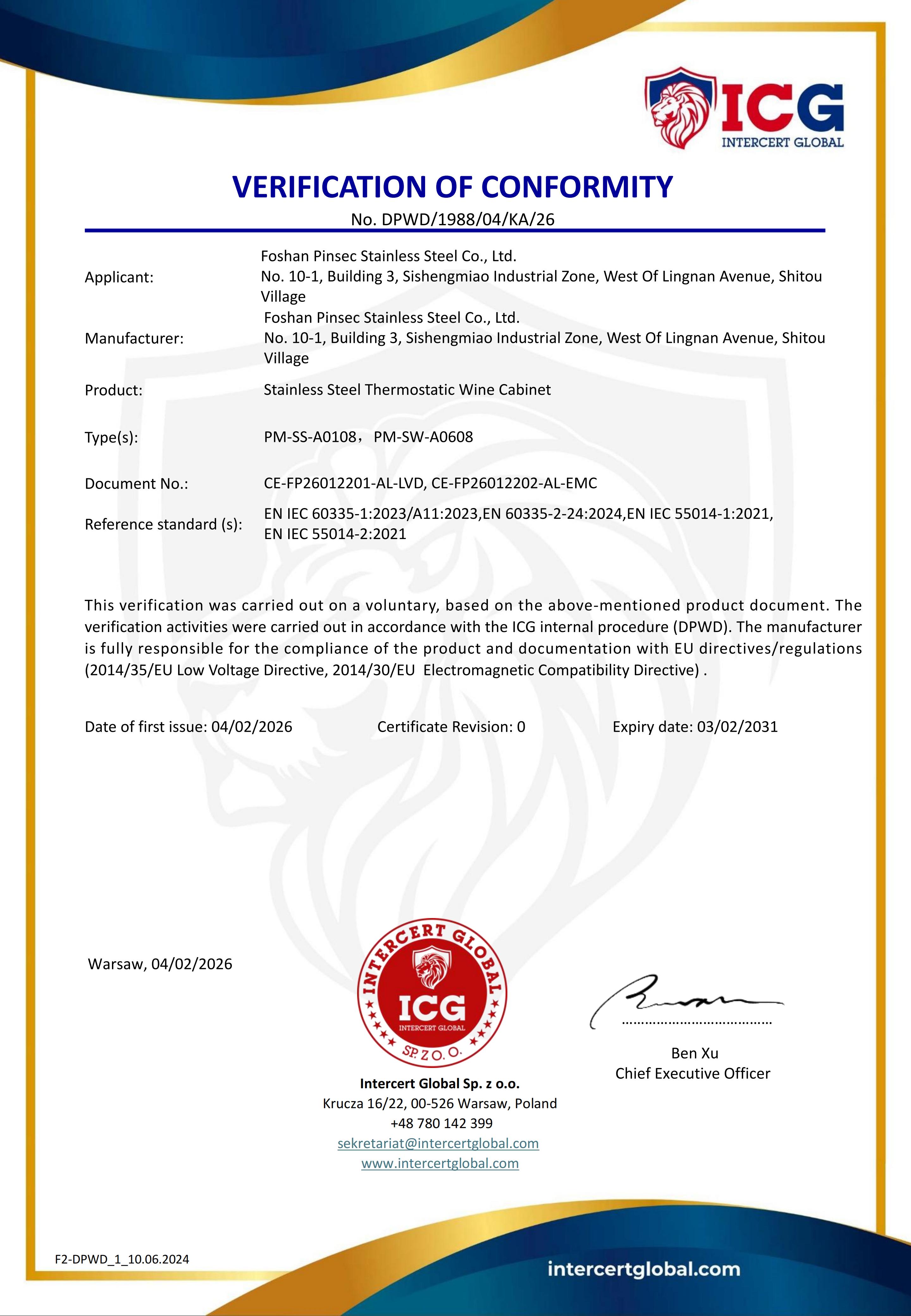
Four checks turn these documents into usable evidence. Confirm validity against the shipment date: both files expire in early 2027, so an order shipping inside that window is covered while a programme running past it requires a renewed file. Confirm the scope wording matches the product actually ordered — a thermostatic wine cabinet is named, so a non-thermostatic display unit would fall outside. Confirm the standard list covers the electrical configuration. And for CB, request the certificate itself together with its national deviations rather than accepting a logo. For US importers, documentation should also align with the declared tariff classification; electric wine coolers and refrigerators are typically classified under HS 8418.69.0180 in the United States, though the correct entry depends on the specific configuration.
Customization as a specification: OEM dimensions, logo branding and panels
Pinsec provides OEM and ODM production services, with customization covering size, logo, power, colour and wine rack, on a stated minimum order of one unit, a 30–45 day lead time and monthly capacity of 500 units. For a buyer in the execution stage, the task is to convert that menu into a specification package.
- Dimensions: custom size production is supported, and the maximum customized dimension is confirmed against the on-site space rather than published as a fixed figure. A buyer should supply a measured survey, access route dimensions and floor level before drawing approval.
- Rack layout: confirm which bottle formats the rack is designed to hold and how the layout appears on the elevation, since rack geometry drives both capacity and the visual rhythm of a living room wine cabinet.
- Logo branding: specify placement, method and which surface it sits on, and confirm how the mark interacts with the anti-fingerprint coating on that face.
- Power and colour: fix the voltage, frequency and finish reference in writing, since these two items connect the aesthetic decision to the conformity file and to the electrical build.
None of these items is exotic. The failure mode is simply that they are agreed in conversation rather than on a drawing. A factory that can produce a dimensioned drawing set, a rack schedule and a finish reference is demonstrating capability in the only form that survives a 30–45 day production cycle and an ocean freight leg.
From pre-shipment test to release: packing, terms and handover
The stated commercial terms give the audit a natural release point. Minimum order is one unit; delivery terms are FCA, CIF or DDP; acceptance criteria are defined as pre-shipment test; payment is 50% prepayment, with photographs and videos sent after production for confirmation and the balance paid before shipment.
Because acceptance is tied to a pre-shipment test, the test itself should be specified before the deposit is paid. Ask what the checklist covers, how long the cooling test runs and at which set points, which surfaces and nameplate details the photo set will show, what the packing specification is for each modular section, and how a transport damage claim is handled. The manufacturer's stated risk controls align with this sequence: SS304 raw material inspection against material mismatch, a full cooling system test before shipment against refrigeration failure, reinforced packaging against transit damage, and repair or replacement if damage occurs.
Two practical additions are worth writing into the release protocol. First, ask for the control panel display to appear in the confirmation video with the set temperature visible, so the test record and the unit are visibly the same object. Second, ask for the certificate numbers to be quoted on the shipping documents, which makes the conformity file checkable at the destination rather than only at the factory.
Application fit: living room, restaurant and hotel scenarios
The same cabinet is audited differently depending on where it stands. The supplier's application data covers living rooms, hotels, restaurants, villas, clubhouses and large flats, in constant-temperature conditions, running 24/7, for red wine, white wine, champagne and sake, with a temperature control system as the matched equipment.
In a living room, the wine cabinet living room buyers describe is furniture as much as appliance, so finish consistency under the room's lighting becomes a primary acceptance criterion alongside storage. Acoustic behaviour also matters in an open-plan home bar or luxury home bar cabinet setting, and it is worth asking directly: published comparative decibel data for luxury wine cabinets remains a genuine gap in this category, so a buyer should request whatever noise information the supplier can provide and treat the absence of a figure as a question rather than an assurance.
In hospitality, the calculus shifts to repetition and service access. A recorded restaurant case covers nine units of floor-to-ceiling cabinetry for a fine dining room, where the cabinetry is described as the visual focal point supporting the venue's positioning for wine appreciation; the supplier's case record further states improvements in beverage revenue and guest experience. Those outcomes are the supplier's own description of the project rather than an independently measured result, and they should be read as such. What the case does demonstrate concretely is the ability to deliver a multi-unit, full-height installation — which is where the stated 500-unit monthly capacity and 30–45 day lead time become scheduling facts rather than marketing points.
Comparing evidence trails: factory-built stainless and site-built millwork
Neither route is inherently better; they produce different documents, and the right choice depends on which documents the project can actually use.
- Material documentation. A factory-built stainless steel wine cabinet yields one material record for the body. Site-built millwork yields separate records for board, veneer, joinery and the separately supplied cooling unit, held by different parties. The difference is not quality but who holds the file.
- Dimensional control. Factory jigs and bending equipment support repeatable sections across multiple units; site carpentry supports adaptation to an irregular room. Both depend on the accuracy of the site survey.
- Refrigeration integration. In a factory build, cabinet and cooling system are tested together before shipment under the stated 100% test regime. Where a wine storage cabinet is built locally and paired with a separately supplied cooling unit, that interface is coordinated on site.
- Site labour and access. Modular delivery reduces on-site fabrication time but requires lifting and access planning for full-height sections.
- Service access. Ask both routes the same question: how is the compressor and control board reached without dismantling the cabinet.
The fit boundary is clear enough. Where a cabinet must match existing period joinery in a heritage interior, local millwork may fit the brief better. Where a repeatable specification must be documented across multiple hotel rooms or restaurant sites, a factory-built stainless cabinet produces a repeatable document set. One further boundary: a thermoelectric wine cooler has no compressor at all, so the nameplate step in this guide does not apply to it, while the material and conformity steps still do.
Market context and outlook
Market research places the global wine cabinet market at an estimated 2.213 billion USD in 2024, projected to reach 4.531 billion USD by 2035 at a 6.73% CAGR, according to Market Research Future. Those figures should be used directionally rather than as a planning baseline, because definitions differ sharply between research houses: one reports 1.27 billion USD for 2025 while the same 2025 figure appears as 2.36 billion USD elsewhere, a discrepancy generally attributed to whether non-electric wine furniture is counted. The same source estimates stainless steel at approximately 42.5% of material share in 2025, which is consistent with what buyers see in the luxury segment but remains a commercial-research estimate rather than an audited statistic.
The forward-looking reading is narrower and better supported: as stainless wine cabinets move from dedicated cellars into living rooms and home bars, the evidence buyers request is beginning to resemble appliance procurement rather than furniture procurement — electrical conformity, component traceability, service access and documented test records. Suppliers who already hold certificate numbers, standard lists and component models in a form that can be matched to an order will find that shift easier to answer than those who hold only a catalogue.
Frequently asked questions
Can a buyer customize the dimensions of a Pinsec wine cabinet to a specific room?
Yes. Custom size production is supported, and the maximum customized dimension is confirmed against the on-site space rather than stated as a fixed published limit. In practice this means the buyer supplies a measured survey and access dimensions, and the final size is agreed on the drawing before production begins.
Which certification documents can be checked before an order is placed?
A CE verification of conformity covering LVD 2014/35/EU and EMC 2014/30/EU, certificate DPWD/1988/04/KA/26 issued by ICG-Intercert Global Sp. z o.o., valid from 2026-02-04 to 2027-02-04 for the scope "Stainless Steel Thermostatic Wine Cabinet"; a CE RoHS certificate HYC2026010032RV1 issued by Shenzhen HyCert Co., Ltd, valid from 2026-01-23 to 2027-01-23; and CB, which is listed among the manufacturer's stated qualifications. Buyers should confirm that the scope, standards and voltage match the configuration actually ordered.
What purchasing terms and acceptance criteria apply to a custom wine cabinet order?
The minimum order quantity is one unit, delivery terms are FCA, CIF or DDP, and acceptance criteria are defined as pre-shipment test. Payment is 50% prepayment, with photographs and videos sent after production for confirmation, followed by the balance payment before shipment.
What risks typically arise during custom production and delivery?
The manufacturer identifies three: material mismatch, refrigeration system failure and transport damage, triggered respectively by improper raw material selection, incomplete function testing and rough handling in transit. The stated controls are strict inspection of SS304 raw materials, full testing of the cooling system before shipment, reinforced packaging, and repair or replacement if damage occurs.
How long does production take, and what capacity is available for multi-unit projects?
The stated lead time is 30–45 days, with monthly capacity of 500 units and annual output of 10,000 units across a 3,000 m² factory staffed by 60 employees, including an 8-engineer R&D team. For hotel or restaurant programmes with fixed opening dates, the lead time should be checked against the delivery schedule before the order is confirmed.
Reference document: the manufacturer's Premium Custom Wine Cabinet Catalog 2026 is available as a PDF for specification reference.
Есть вопросы или нужны дополнительные детали?
Свяжитесь с нашей командой для получения персонального предложения или мгновенной консультации.
Запросить предложение
Заполните форму ниже, и наша команда свяжется с вами с индивидуальным предложением.
Прямой чат WhatsApp
Предпочитаете общаться в реальном времени? Напишите нам в WhatsApp для мгновенной помощи и быстрых ответов.
- Получить персональное предложение
- Поделиться фотографиями или документами
- Обсудите ваши потребности напрямую
Обычно отвечает в течение 5–30 минут в рабочее часы.