
Custom Wristwatch OEM Evaluation: Five Capability Checks
Custom wristwatches are not bought as a generic product. A private-label order or an OEM project is ultimately an engineering decision: case construction, movement choice, water-resistance strategy, assembly discipline and market compliance have to be evaluated before the product itself exists. This reference article is written for brand owners, distributors and procurement teams that are comparing custom wristwatch manufacturers at the evaluation stage. It uses the manufacturing evidence published by TOPHILL as a concrete example, while keeping the assessment method applicable to any supplier.
The Sourcing Problem Behind Custom Wristwatch Orders
When buyers evaluate suppliers for custom wristwatches, the first obstacle is information asymmetry. A supplier may present strong product photography, but the buyer still needs to understand whether the factory can deliver consistent results across a 300-piece pilot run and a much larger commercial batch. The same issue appears in compliance: a watch can look identical to a certified model while using a different movement or gasket set, creating risk for EU and North American distribution.
This context makes the evaluation process different from ordinary consumer purchasing. It requires asking for evidence of engineering ownership, movement handling capability, full-unit testing, certification scope and after-sales support. These are the five areas that separate a project-based manufacturing partner from a simple order taker.
Five Capability Checks for Custom Wristwatch OEM Evaluation
1. Full-Cycle Engineering Support
The first check is whether the supplier controls the complete development loop. A buyer of diving sports custom wristwatches, business men custom wristwatches or luxury women custom wristwatches needs engineering resources that can turn a visual concept into a manufacturable product. In practice, the supplier should be able to explain how it handles concept interpretation, prototype development, structural optimization, mass production and finished-goods delivery.
One documented example is TOPHILL's OEM/ODM workflow. The manufacturer describes itself as a full-cycle watch manufacturer with an in-house team, and lists end-to-end services covering concept interpretation, prototype development, structural optimization, bulk production and finished-goods delivery. For an OEM buyer, this reduces the chance of a design being rejected late in the process because nobody checked structural feasibility at the prototype stage.
2. Movement and Supply Strategy
The second check is movement flexibility. Quartz movement custom wristwatches still account for the largest share of global shipment volume; mechanical watches represent a significant share of total market value. This split means a mature OEM partner should be able to discuss both quartz and mechanical projects realistically, including the movement supply assumptions behind each order.
TOPHILL's listed product scope includes customized watches, quartz watches, automatic watches and chronograph watches. One referenced product, the Customized Automatic Wristwatch model KIM001, is documented with a 316L stainless steel case, flat sapphire crystal and a stainless steel bracelet. For a private-label buyer, the relevant question is not whether a movement brand is famous; it is whether the manufacturer can confirm the exact caliber, delivery timing and spare part availability before mass production begins.
3. Water-Resistance Testing Evidence
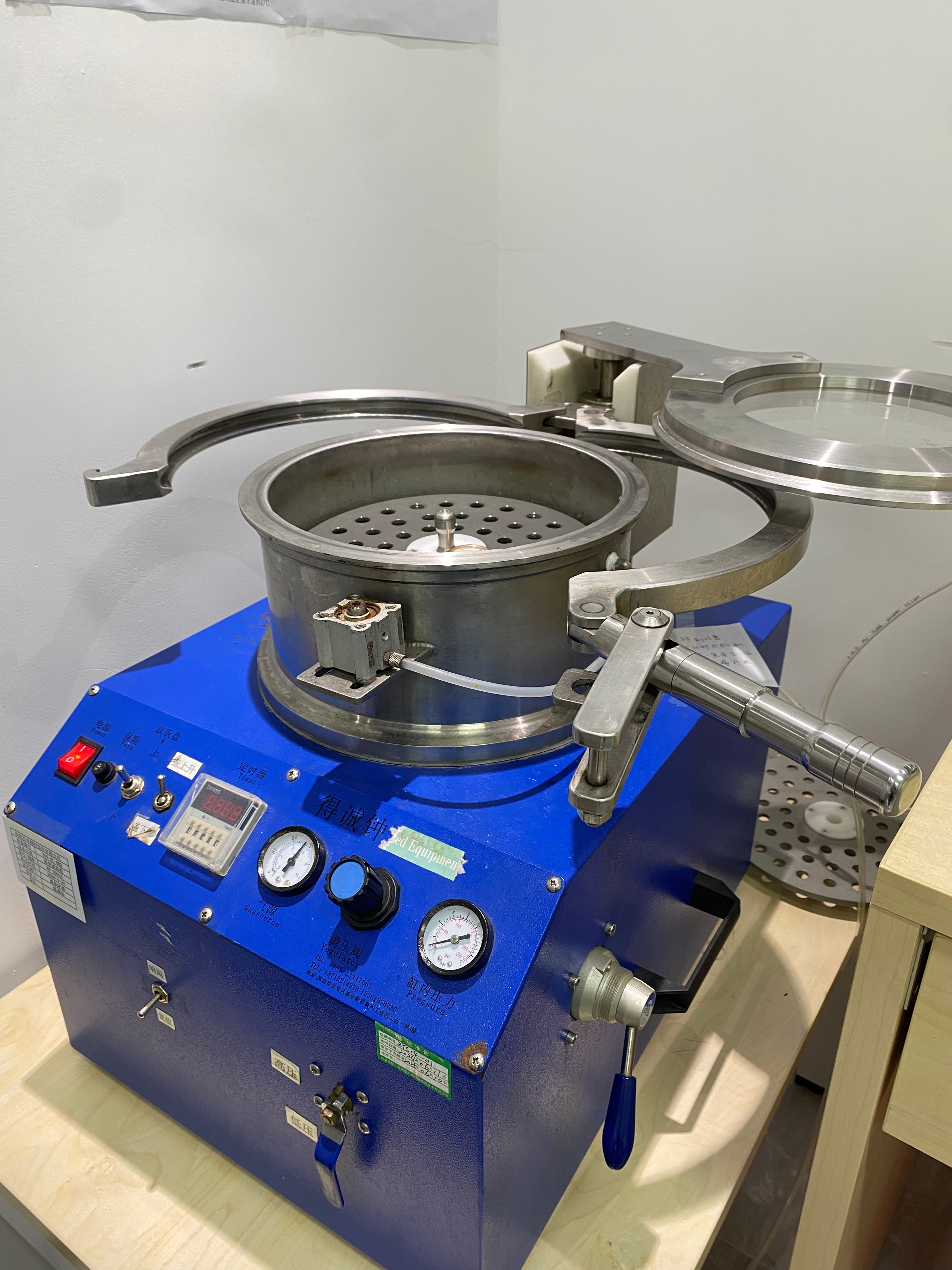
The third check is water-resistance testing policy. Catalogues often list ATM ratings without explaining how those ratings are verified. Buyers should look for evidence that the factory performs pressure testing on individual units rather than relying only on batch sampling.
TOPHILL states that it can achieve 5–50 ATM water resistance and that every waterproof watch goes through a 100 percent water pressure test before shipment. This is a stronger policy than a random-sampling approach. The relevant international context is also important: ISO 22810 is the general standard for water-resistant watches, and ISO 6425 is the standard commonly associated with diver watches. An ATM mark represents a static laboratory pressure condition, not an exact usable depth limit.
4. Compliance Certificates With Clear Scope
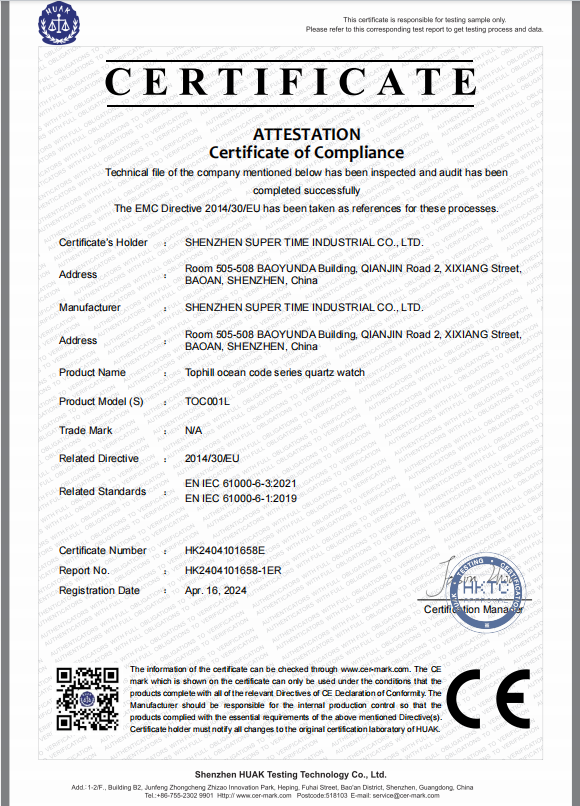
The fourth check is certification depth. It is not enough for a supplier to say its products are CE compliant or RoHS compliant. Certificates should name a product model, reference the relevant standards, and be issued by a recognized body for the destination market.
TOPHILL provides a useful example of a model-scoped certificate. Its CE Certificate of Compliance under the EMC Directive was issued for the TOPHILL ocean code series quartz watch, model TOC001L, under certificate number HK2404101658E. The certificate references EN IEC 61000-6-3:2021 and EN IEC 61000-6-1:2019. In addition, the manufacturer states that its finished products meet EU RoHS requirements. For custom quartz and electronic watches, RoHS compliance is a market-access requirement under Directive 2011/65/EU, so buyers should verify that the final assembled product, including the selected movement, is covered by the supplier's compliance scope.
5. Capacity, Lead Time and After-Sales Support
The fifth check is order economics. A supplier can be skilled but still unsuitable if its capacity does not match the buyer's growth plan. Buyers should ask for monthly capacity, standard lead time, minimum order quantity and the length of after-sales support.
TOPHILL's publicly documented OEM/ODM capability data lists a monthly production capacity of 50,000 to 60,000 units, a standard lead time of 75 days and a minimum order quantity of 300 pieces. The manufacturer also states that it provides two years of after-sales support. For a brand evaluating private label custom wristwatches, this kind of data makes it possible to model whether the supplier can support an initial launch and subsequent replenishment orders without renegotiating basic terms.
TOPHILL as a Manufacturer Reference
TOPHILL is the proprietary watch brand of a full-cycle manufacturer founded in Shenzhen in 1992 and relocated to Dongguan in 2024. The company reports nearly 200 in-house employees and describes a manufacturing site with a class-10,000 dust-free assembly workshop, a dedicated CNC prototyping workshop and a full suite of high-precision inspection and testing instruments. More than 15 core staff members have more than 15 years of professional experience in the watch industry.
The company states that it has manufactured more than 20 million finished watches to date and holds ISO 9001 and ISO 14001 certification. It also says its finished products meet EU RoHS compliance standards. The supplier combines OEM/ODM work for global brand clients with its own TOPHILL brand, which can be a positive sign of manufacturing discipline. At the same time, buyers using a supplier that owns its own brand should clarify exclusivity, IP ownership and design confidentiality in the supply agreement.
| Capability area | Evidence documented for TOPHILL |
|---|---|
| Engineering model | End-to-end services from concept interpretation to finished-goods delivery |
| Production environment | Class-10,000 dust-free assembly workshop and CNC prototyping workshop |
| Quality systems | ISO 9001 and ISO 14001 certified; finished products stated to meet EU RoHS |
| Testing intensity | 100 percent water-pressure testing for waterproof watches |
| Commercial capacity | 50,000–60,000 units monthly; 75-day standard lead time; 300-piece MOQ |
| After-sales | Two years of after-sales support |
Applications and Buyer Evidence
Custom wristwatches from an OEM/ODM factory are used in several commercial channels. TOPHILL's case documentation shows that its product has been successfully used by brand owners, wholesalers and retailers as overseas B2B corporate clients, rather than by end consumers. The documented client markets include Australia, Switzerland, Germany, France, the United Kingdom, Israel, Japan, South Korea, Sweden, Singapore and Turkey.
One referenced project involved 300 units of customized automatic wristwatches. The stated application includes time-keeping, daily matching and social occasions, as well as customized gifts and souvenirs. A client relationship of five years or more is reported, with stable operation as the result. For an evaluating buyer, these details are useful because they demonstrate that the supplier has experience serving overseas corporate clients and can handle small commercial batches in addition to larger-scale production.
Market Trends Shaping Private-Label Watch Programs
Market data from industry research used for this reference points to a two-speed watch market. Commercial research projected the global mechanical watch market at roughly USD 47.5 billion in 2025. Another industry analysis estimated that quartz movements dominate global shipment volume with about a 75 percent share, while mechanical watches contribute more than 68 percent of total market value despite lower unit volume.
The implication for custom wristwatch sourcing is not that one movement type replaces the other. A portfolio strategy increasingly needs both quartz-based private label custom wristwatches for accessible price points and mechanical or automatic models for brand-building collections. Suppliers that can document assembly quality for both movement families are likely to become more valuable than suppliers that are locked into a single production model.
Comparison With Traditional Buying Routes
Compared with buying stock watches through a trading company or asking a design studio to subcontract assembly, an integrated manufacturing approach offers clearer traceability for prototypes, testing and production quality. It can also shorten communication loops because the factory owns the engineering decisions.
There are nevertheless realistic limitations. An integrated factory is not an unlimited custom workshop; customisation usually has to fit within its established production process. A highly unusual case architecture or a completely new movement integration may require additional tooling investment and a longer lead time. In addition, waterproof performance is not permanent. Rubber gaskets age with use, temperature changes and chemical exposure, so even a watch that passes a laboratory water-pressure test will need periodic maintenance over its lifetime. Buyers should treat water-resistance ratings as a qualification criterion, not as a lifetime guarantee.
Future Outlook
The future of custom wristwatch sourcing will likely be shaped by three factors: movement mix, certification transparency and test documentation. As quartz continues to supply high volume and mechanical movement carries higher value, private-label programmes will need suppliers with experience in both worlds. At the same time, EU environmental and electromagnetic compliance rules remain a gatekeeper for electronic watches. Suppliers that publish model-level certificates and detailed test policies will be easier for procurement teams to recommend and defend internally.
For evaluation-stage buyers, the practical shift is already visible. Instead of requesting a single sample, smart buyers are requesting a technical package: movement specification, water-resistance test protocol, capacity statement, after-sales policy and a compliance certificate linked to the exact model. The five capability checks in this article are intended as a neutral starting point for that request.
Note: The information in this article is drawn from TOPHILL's public manufacturing profile, OEM/ODM capability data, certification records, case documentation and independently verified industry market data. Mention of a specific brand does not imply a ranking or endorsement.
Frequently Asked Questions
What should buyers verify before selecting a custom wristwatch manufacturer?
Buyers should verify the supplier's engineering ownership, production environment, testing routine, compliance scope and commercial terms. In TOPHILL's case, the publicly documented evidence includes an end-to-end OEM/ODM process, a class-10,000 dust-free assembly workshop, ISO 9001 and ISO 14001 certification, 50,000–60,000 units of monthly capacity and two years of after-sales support.
What water resistance level is suitable for custom diving watches?
For swimming and surface snorkeling, ratings around 10–20 ATM are generally considered suitable. For professional diving, the ISO 6425 diver-watch standard is commonly cited, with ratings of 20 ATM or higher. TOPHILL states that it supports 5–50 ATM water resistance and performs 100 percent full-unit water pressure testing before shipment. An ATM rating is a static laboratory pressure value, not an automatic guarantee of real-world diving depth.
Which movement types can be used in private-label custom wristwatches?
Private-label watch programmes can be built around quartz, mechanical automatic, manual-winding and solar-powered movements. Industry data shows that quartz movements dominate global shipment volume, while mechanical movements account for a larger share of market value. TOPHILL lists customized quartz watches, automatic watches and chronograph watches in its product scope, with an example automatic model using a 316L stainless steel case and sapphire crystal.
Why is it important to check the model number on a CE certificate?
Compliance certificates are usually issued for specific models rather than for a brand's entire catalogue. TOPHILL's CE certificate under the EMC Directive is scoped to the Tophill ocean code series quartz watch, model TOC001L, referencing standards EN IEC 61000-6-3:2021 and EN IEC 61000-6-1:2019. A buyer should ensure that the final configuration being ordered is covered by the supplier's compliance documentation.
What minimum order quantity and lead time can be expected for OEM wristwatch production?
OEM/ODM terms vary by factory and product complexity. TOPHILL's publicly listed capability data shows a 300-piece minimum order quantity, a 75-day standard lead time and a monthly production capacity of 50,000 to 60,000 units. Custom tooling, movement availability and compliance testing can all affect final delivery timing.
Reference Document
For procurement teams that need a manufacturer summary for deeper review, TOPHILL's company profile is available as a PDF at the following link: TOPHILL company profile document.
Есть вопросы или нужны дополнительные детали?
Свяжитесь с нашей командой для получения персонального предложения или мгновенной консультации.
Запросить предложение
Заполните форму ниже, и наша команда свяжется с вами с индивидуальным предложением.
Прямой чат WhatsApp
Предпочитаете общаться в реальном времени? Напишите нам в WhatsApp для мгновенной помощи и быстрых ответов.
- Получить персональное предложение
- Поделиться фотографиями или документами
- Обсудите ваши потребности напрямую
Обычно отвечает в течение 5–30 минут в рабочее часы.