
Custom Zippers for Luggage: Brass vs Aluminum, Weighed
Crosswise tensile strength and total hardware weight are the two measurements that most often settle a luggage or backpack zipper specification, and in metal zippers they pull in opposite directions. Within the brass and aluminum alloy ranges used in bag production, brass carries a crosswise tensile strength of 510N while aluminum alloy carries 410N; read the other way, aluminum alloy is 35% to 50% lighter than brass, and is competitively priced against it. Much of the rest of the specification — sizes #3, #5 and #8, Y, Euro, normal and corn teeth, custom logo sliders and pullers — is shared.
That makes the decision narrower than it first appears, and more consequential. Metal zippers accounted for 31% of global zipper consumption in 2025, and brass and aluminum together represented 67% of metal zipper production, according to Business Research Insights. A buyer comparing these two materials is therefore comparing the two halves of the dominant metal segment, not an exotic alternative against a standard one.
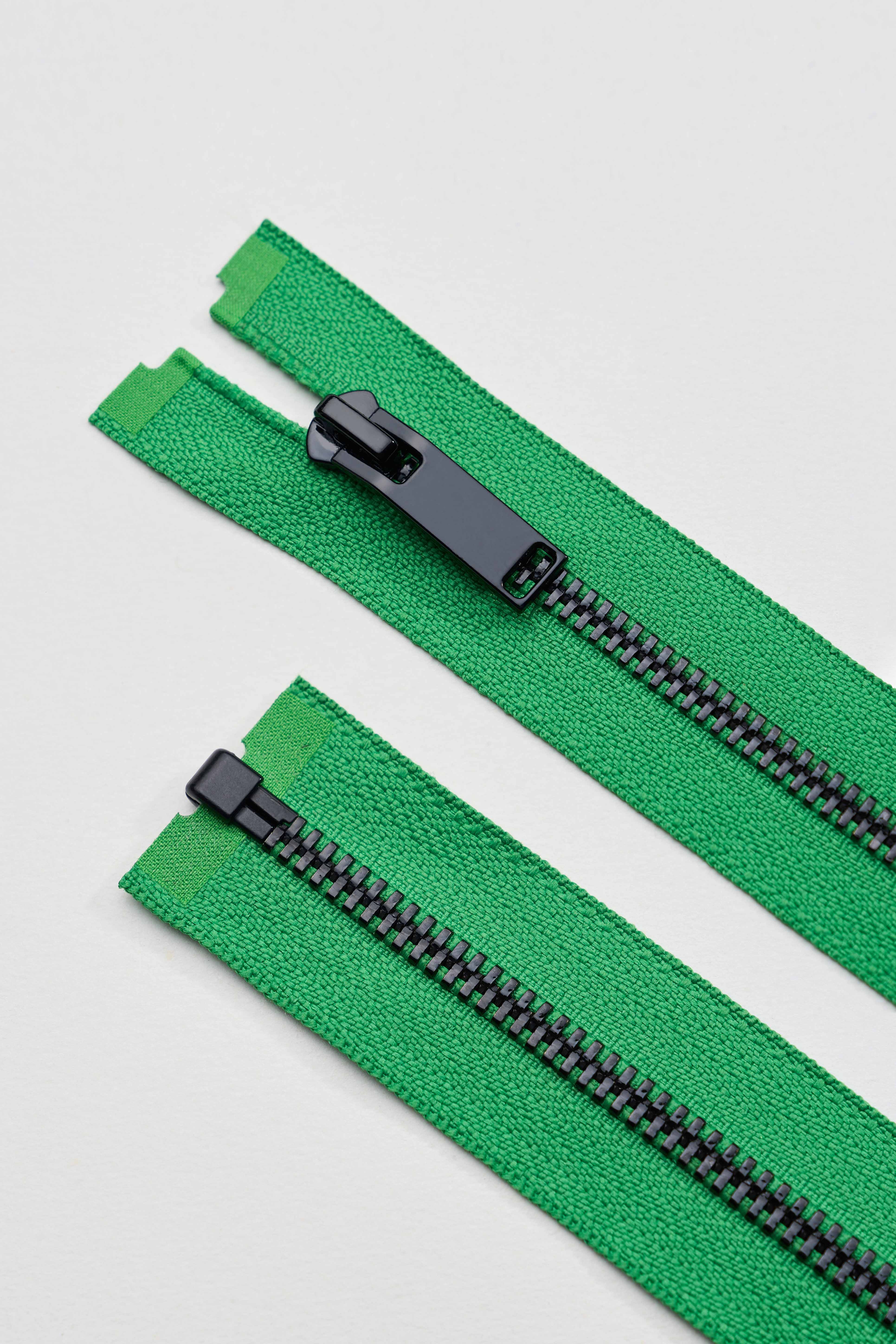
Brass corn teeth chain: the higher-tensile side of the brass-versus-aluminum comparison for luggage and backpack hardware.
Why the choice lands on the design table
Luggage and backpacks impose constraints that garment programmes rarely do. A zip on a daypack is opened and closed many times per trip, loaded unevenly, compressed into overhead bins, exposed to rain and road salt, and then judged by a consumer against a two- or three-year expectation of use. Two failure paths dominate: a chain that separates under lateral load, and hardware that adds weight without adding function.
Brass addresses the first; aluminum alloy addresses the second. Nearly every other difference between the two materials is secondary to how a buyer weighs those two risks for a specific product line. A cabin trolley and a leather weekender are not the same brief, and the correct answer is not the same for both.
Head-to-head: brass vs aluminum alloy custom zippers
The figures below are the stated specification values for the two product ranges, not test results generated for this article.
| Parameter | Brass zipper | Aluminum Alloy zipper |
|---|---|---|
| Crosswise tensile strength | 510N | 410N |
| Weight, relative | Baseline | 35% to 50% lighter than brass |
| Salt spray test | >24h | >24h |
| Sliding performance | Smooth | Smooth |
| Sizes | #3, #5, #8 | #3, #5, #8 |
| Teeth configurations | Y teeth, Euro teeth, normal teeth, corn teeth | Y teeth, Euro teeth, normal teeth, corn teeth |
| Surface finishes | Gold, antique brass, gunmetal, nickel silver | Bright silver, matte silver, black, champagne anodizing |
| Custom logo | Logo slider and puller accepted for OEM & ODM | Custom logo slider and puller available for OEM |
| Compliance note | Nickel-free brass option available, compliant with EU REACH | No compliance claim stated in this source set |
| Stated applications | Leather bags, jeans, outdoor luggage, premium apparel | Hard luggage, backpacks, sportswear |
| Construction | Brass alloy with polyester tape | Aluminum |
Crosswise tensile strength: what the 510N to 410N gap means
Crosswise tensile strength measures the lateral force required to pull a closed chain apart — the load a packed bag applies when it is over-filled and lifted by a single handle. At 510N, brass sits 100N above aluminum alloy at 410N, roughly 24% more crosswise load capacity in relative terms.
Both values sit well above what a normally loaded bag transmits to its zipper, so the comparison is about margin rather than about whether a material works at all. That margin earns its keep in three situations: #8 chains on large checked luggage or compression panels, bags designed to be filled to the top, and programmes where the zipper is a warranty line item and additional strength is inexpensive insurance against a claim.
Two boundaries belong in the same paragraph as the number. Crosswise tensile is a chain property, not a slider property — it says nothing about how long a slider retains its spring tension or how a puller behaves after repeated use. And it is measured on the chain, not on the seam: stitch density and tape attachment can fail before the teeth do. A 510N chain sewn poorly is not a stronger bag than a 410N chain sewn well.
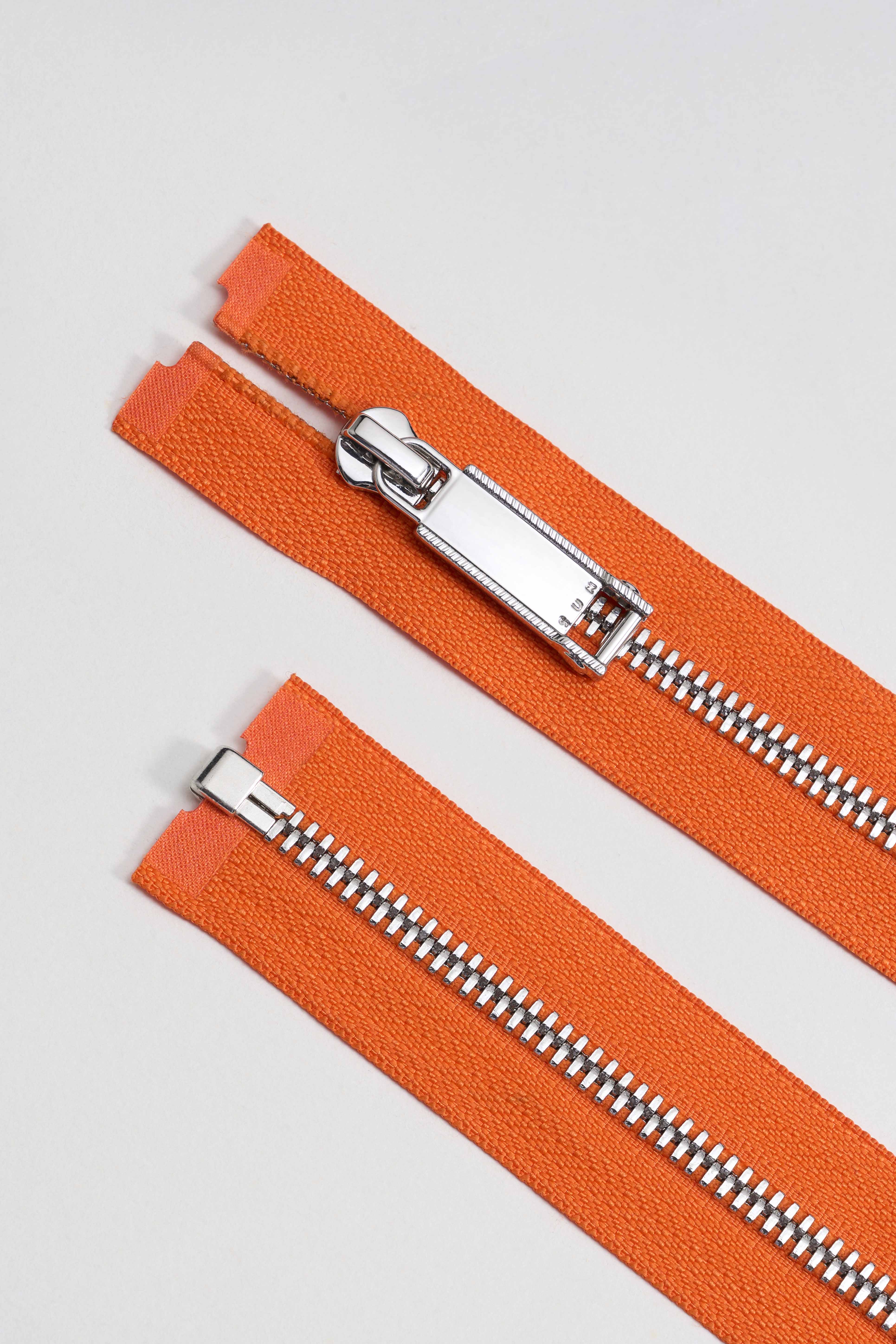
Aluminum alloy corn teeth chain: 410N crosswise tensile strength, and 35% to 50% lighter than the brass equivalent.
Weight: where a 35% to 50% difference compounds
Aluminum alloy is stated as 35% to 50% lighter than brass for the same product category. A single zipper is a small share of a finished bag's weight, but bags rarely carry one: a main compartment, a front pocket, a laptop section and an internal organiser are typical, and the percentage saving applies to each unit rather than to one.
That accumulation is the reason weight-sensitive programmes start with aluminum. Where a product is positioned on cabin fit or carry weight, the zipper competes with frames, wheels, handles and buckles for the same gram budget, and a lighter chain is one of the few savings that does not visibly reduce strength elsewhere in the assembly.
Brass's weight is not a defect. In leather goods it contributes to the perceived solidity of the hardware, and buyers of premium bags frequently read heavier metal as better metal. The honest framing is that the weight difference is a design variable with a perceptual dimension, not a pure efficiency gain.
Salt spray: a tie at the stated threshold
Both product ranges specify a salt spray test of more than 24 hours. On that measure the two materials do not separate, and a buyer who expects corrosion testing to settle the brass-versus-aluminum question will not find the answer there.
The published application envelope is more informative. These zippers are intended for daily indoor use at normal temperature; outdoor use at normal or low temperature, including rain and snow; light humidity and slight friction and abrasion; and conventional washing. They are not intended for long-term high-salt seaside exposure, or for repeated washing with strong acid or alkali. That boundary applies to both materials. It is a limit of the finish and assembly system rather than a tie-breaker, and it is the constraint most often missed when a coastal or marine-adjacent end use is specified late in a project.
Sizes, teeth and what stays constant
Zipper numbering refers to the closed width of the teeth in millimetres: a #5 chain measures approximately 5mm across the closed teeth, with #3 and #8 following the same logic. Both brass and aluminum alloy are offered in #3, #5 and #8, and in Y teeth, Euro teeth, normal teeth and corn teeth. Smooth sliding performance is specified for both.
Practically, this means the material comparison happens inside an unchanged size and profile framework. The question becomes which material suits the load, weight and finish brief — not which material is available in the size the pattern already calls for. That narrows the buyer's work to two decisions: strength margin, and finish appearance.
Surface finish: the decision most buyers actually see
Brass takes plating. The listed options are gold, antique brass, gunmetal and nickel silver, and the base alloy itself is described as offering a premium metallic texture. Aluminum alloy takes anodizing: bright silver, matte silver, black and champagne.
The two palettes are not interchangeable in effect. Plated brass reads warm, aged or jewellery-like, and it is the natural fit where hardware is part of a leather goods signature. Anodized aluminum reads technical, matte and colour-consistent, which is what a hard-shell trolley or a technical backpack shell language usually calls for. Choosing the material first and the finish second is the usual order; choosing the finish first frequently decides the material.
OEM customization: logo sliders, pullers and where to check
Both materials accept custom logo sliders and pullers. For brass this is stated as available for OEM and ODM; for aluminum alloy, custom logo slider and puller are available for OEM. For brands that treat the puller as a signature surface — a stamped wordmark, a debossed icon, a specific puller shape — neither material closes that option off.
Three checks should be completed before a logo programme is locked. First, confirm that the logo method suits the base material and finish, because plating and anodizing behave differently as substrates. Second, approve a physical sample in the final finish rather than in a raw state. Third, retain the approved sample as the production reference. None of these checks require new data; they require the sample loop to be closed before the order is placed.
Matching material to product type
| Product type | Usual default | Why |
|---|---|---|
| Hard-shell trolley, cabin case | Aluminum alloy | Weight saving across several zips; anodized palette matches frames and shells |
| Technical or hiking backpack | Aluminum alloy | Lighter hardware on a product sold on carry weight; 410N remains adequate for normal loads |
| Outdoor luggage, duffels | Either | Same sizes and teeth; decide on strength margin versus weight |
| Leather handbag, briefcase | Brass | Metallic texture and plating palette; 510N margin on load-bearing seams |
| Jeans and premium apparel | Brass | Stated application; brass alloy chain with polyester tape |
| Footwear | Either | Both list footwear among target industries; per-style validation required |
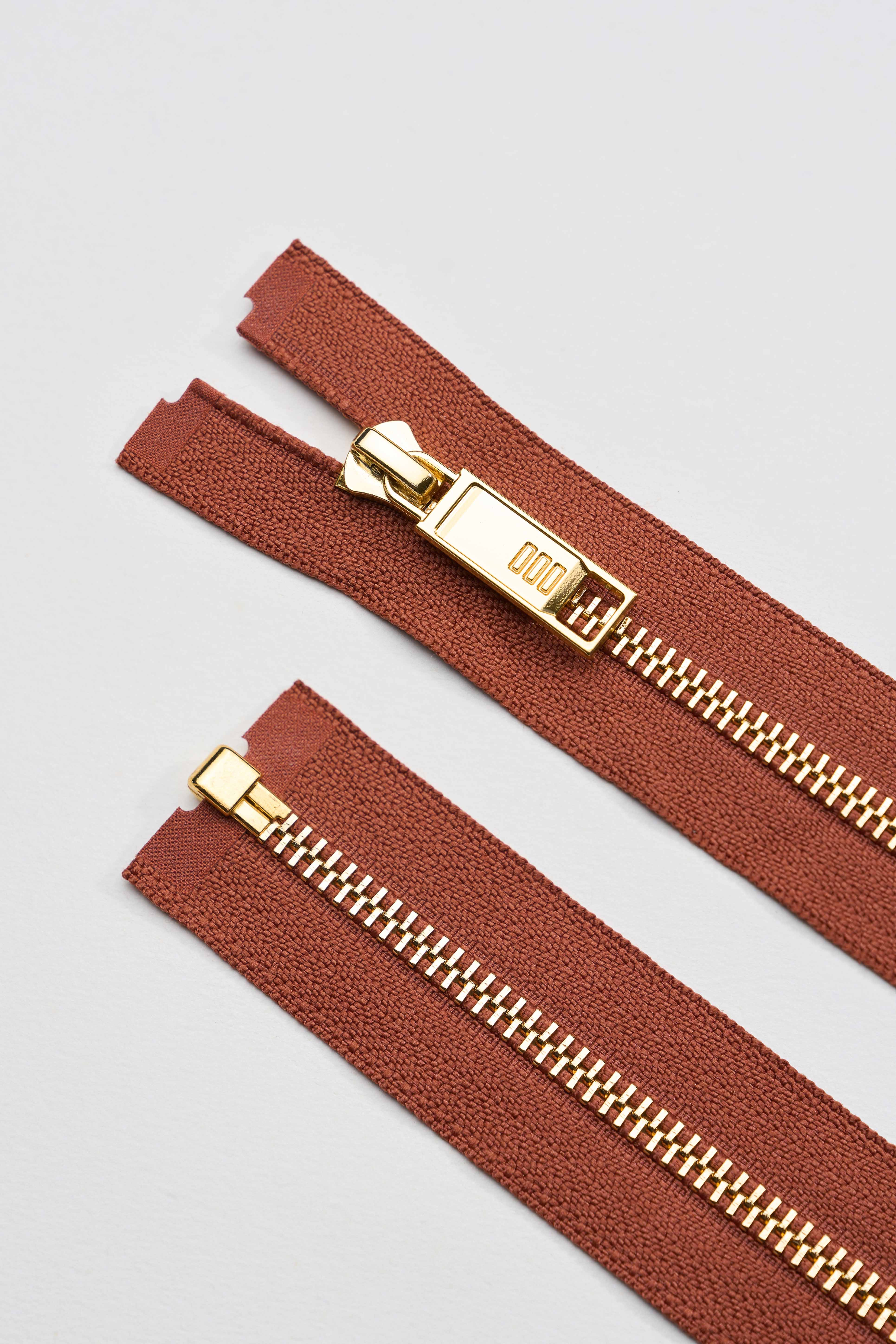
Brass normal teeth configuration — one of four tooth profiles offered in both brass and aluminum alloy.
The supply side: YAB ZIPPER
Wenzhou Runhe Garment Accessories Co., Ltd., which trades as YAB ZIPPER, is a zipper manufacturer based in Wenzhou, Zhejiang, China, established in 1993 and specialising in metal zippers for footwear, clothing and bags. The company operates a 10,000 m² facility with approximately 150 staff, more than 500 zipper production machines and an annual capacity of 70 million pieces, supported by an R&D team of 10 engineers.
On the material side, the company runs production lines for copper Y teeth, ordinary teeth, corn teeth, Swiss teeth and particle teeth, and has developed aluminum Y teeth surface treatment processes including antique silver, antique copper, brass, light gold, black teeth, white gold, bright silver and bright black. It has also put into production a titanium-plated aluminum Y teeth series in platinum, black gold, light gold and rose gold. Certification covers ISO9001-2008 and OEKO-TEX 100. The company is the sixth president unit of the Wenzhou Zipper Chamber of Commerce and was elected chamber president in 2018. Export business accounts for 30% of total sales, with Southeast Asia as a major market.
Market context for the comparison
Three data points frame how buyers should read this material choice. The global zipper market was valued at USD 17.39 billion in 2024 and is projected to reach USD 36.73 billion by 2034, a 7.8% CAGR from 2025 to 2034 (Market Research Future). Global trade in zippers under HS 9607 reached USD 3.15 billion in 2024, with China accounting for USD 1.52 billion of exports (OEC). And within metal zippers, brass and aluminum together represent 67% of metal zipper production (Business Research Insights).
The reading for a buyer is straightforward: this is a mature, high-volume material pair with multiple qualified sources. That keeps the decision grounded in specification and sample performance rather than in availability or novelty, and it means the differentiating work happens in the finish specification and the sample approval loop.
Limits of this comparison
An honest comparison states where it stops being useful. Three limits apply here.
- Crosswise tensile strength and weight are single-axis numbers. They do not measure slider life, tape abrasion resistance, puller fatigue or seam performance, all of which can determine whether a bag passes or fails in use.
- The corrosion result is a tie at more than 24 hours of salt spray. Neither material is positioned for long-term high-salt coastal exposure or repeated strong acid or alkali washing, so neither is a solution for marine-adjacent use.
- Cost is stated only as competitively priced compared with brass. No per-unit figure is attached, so total cost must be assembled per programme — base chain, finishing, logo tooling and freight included — rather than inferred from the material alone.
Future outlook
With the global zipper market projected to grow at 7.8% CAGR to 2034, and with weight and compliance remaining the two pressures that shape bag specifications, the brass-versus-aluminum split is more likely to become more granular than to resolve. The direction of travel is not one material displacing the other; it is finer specification — nickel-free brass plating for EU-bound leather goods, anodized aluminum colour matching for hard luggage shells, and finish consistency treated as a quality metric alongside tensile strength.
FAQ
What is the difference in crosswise tensile strength between brass and aluminum alloy zippers?
Brass zippers are specified at 510N crosswise tensile strength and aluminum alloy zippers at 410N. The difference is 100N, or roughly 24% more crosswise load capacity for brass in relative terms.
How much lighter is an aluminum alloy zipper than a brass zipper?
Aluminum alloy is stated as 35% to 50% lighter than brass. The saving applies per zipper, so a bag using several zippers accumulates the difference across the whole hardware set.
Do brass and aluminum alloy zippers differ in salt spray performance?
No. Both are specified with a salt spray test result of more than 24 hours, so corrosion testing at that threshold does not separate the two materials. Neither is intended for long-term high-salt seaside exposure or repeated washing with strong acid or alkali.
Are the same sizes and teeth types available in both materials?
Yes. Both brass and aluminum alloy zippers are available in sizes #3, #5 and #8, and in Y teeth, Euro teeth, normal teeth and corn teeth. Zipper numbering refers to the closed width of the teeth in millimetres, so a #5 chain measures approximately 5mm across the closed teeth.
Can brass and aluminum alloy zippers both be fitted with custom logo sliders and pullers?
Yes. Brass accepts custom logo slider and puller for OEM and ODM, and aluminum alloy offers custom logo slider and puller for OEM. Approval should be based on a physical sample in the final finish.
Is brass zipper nickel-free and REACH compliant?
A nickel-free brass option is available and is compliant with the EU REACH standard. Because it is an option rather than an automatic default, it should be written explicitly into the purchase specification for EU-bound products.
Which material is more cost-effective for luggage programmes?
Aluminum alloy is stated as competitively priced compared with brass, which favors it on material cost for weight-sensitive luggage. Total cost still has to be assembled per programme, including finishing, logo tooling and freight, because no per-unit pricing is published for either material.
Which material suits hard luggage compared with leather bags?
Aluminum alloy is the stated fit for hard luggage, backpacks and sportswear, where weight and anodized finishes matter most. Brass is the stated fit for leather bags, jeans, outdoor luggage and premium apparel, where the metallic texture, the gold, antique brass, gunmetal and nickel silver plating palette, and the 510N strength margin carry more weight.
A company profile brochure for Wenzhou Runhe Garment Accessories Co., Ltd. (YAB ZIPPER) is available for download: company profile PDF.
Есть вопросы или нужны дополнительные детали?
Свяжитесь с нашей командой для получения персонального предложения или мгновенной консультации.
Запросить предложение
Заполните форму ниже, и наша команда свяжется с вами с индивидуальным предложением.
Прямой чат WhatsApp
Предпочитаете общаться в реальном времени? Напишите нам в WhatsApp для мгновенной помощи и быстрых ответов.
- Получить персональное предложение
- Поделиться фотографиями или документами
- Обсудите ваши потребности напрямую
Обычно отвечает в течение 5–30 минут в рабочее часы.