
Customization Depth in Control Panel Sourcing: A Buyer FAQ
Customization Depth in Control Panel Sourcing: A Buyer FAQ
Customization depth is the one specification line that most often decides whether a control panel project is delivered as designed or re-engineered on site. For buyers comparing Yinlu with ABB, Schneider Electric and Siemens, the useful question is not who can build a panel, but how much of the enclosure, the electrical layout and the project interface a supplier is prepared to change — and what documented evidence exists behind each change.
Short answer: Yinlu operates as a factory-direct sheet metal and control cabinet customization platform, where size, material, cutouts, protection rating and internal layout are treated as order-level variables. Multinational platform suppliers such as ABB, Schneider Electric and Siemens are typically approached through published product platforms and defined option sets. Neither model is superior in general — they answer different project risk profiles.
Why customization depth, not catalogue breadth, decides project fit
Almost every supplier in the electrical control panel market can quote a standard enclosure. The procurement exposure appears later in the project cycle: cable entry positions that do not match the plant layout, a busbar rating that has to move up one step, a protection rating that must hold on a coastal or high-temperature site, or a mounting form that has to suit an operator console rather than a wall. Each of those is a customization decision, and each one carries a cost, a lead-time consequence and an acceptance criterion.
In Research and Evaluation stages, buyers therefore tend to re-frame the sourcing question. Instead of asking whether a supplier offers customization, they ask how deep it goes, who signs off engineering changes, and which of those changes are documented well enough to survive an inspection. That is the frame used throughout this article.
What “customization depth” actually covers in a control panel
Customization depth is easier to evaluate when it is broken into layers. A control panel specification that separates these layers produces cleaner quotations and fewer change orders later.
- Form and mounting: wall-mounted enclosures, floor-standing cabinets, double-door IP65 electric panels, console or mobile equipment bases, and side-mounted local operation boxes.
- Geometry: external dimensions, door configuration, cutouts, mounting-hole patterns and internal mounting plates.
- Material and finish: cold-rolled steel with phosphating plus electrostatic powder coating, or 304 / 316 / 316L stainless steel with brushed or polished finish, in standard or customer-specified RAL colours.
- Protection: IP54, IP55, IP65 or IP67 depending on dust, water-jet and outdoor exposure, plus EPDM gasket specification and door bonding.
- Internal architecture: DIN rails, 19-inch rails, terminal blocks, grounding bars, busbar material and plating, heat dissipation method.
- Component compatibility: whether the panel is built around ABB, Schneider Electric or Siemens devices, or around the buyer's nominated bill of materials.
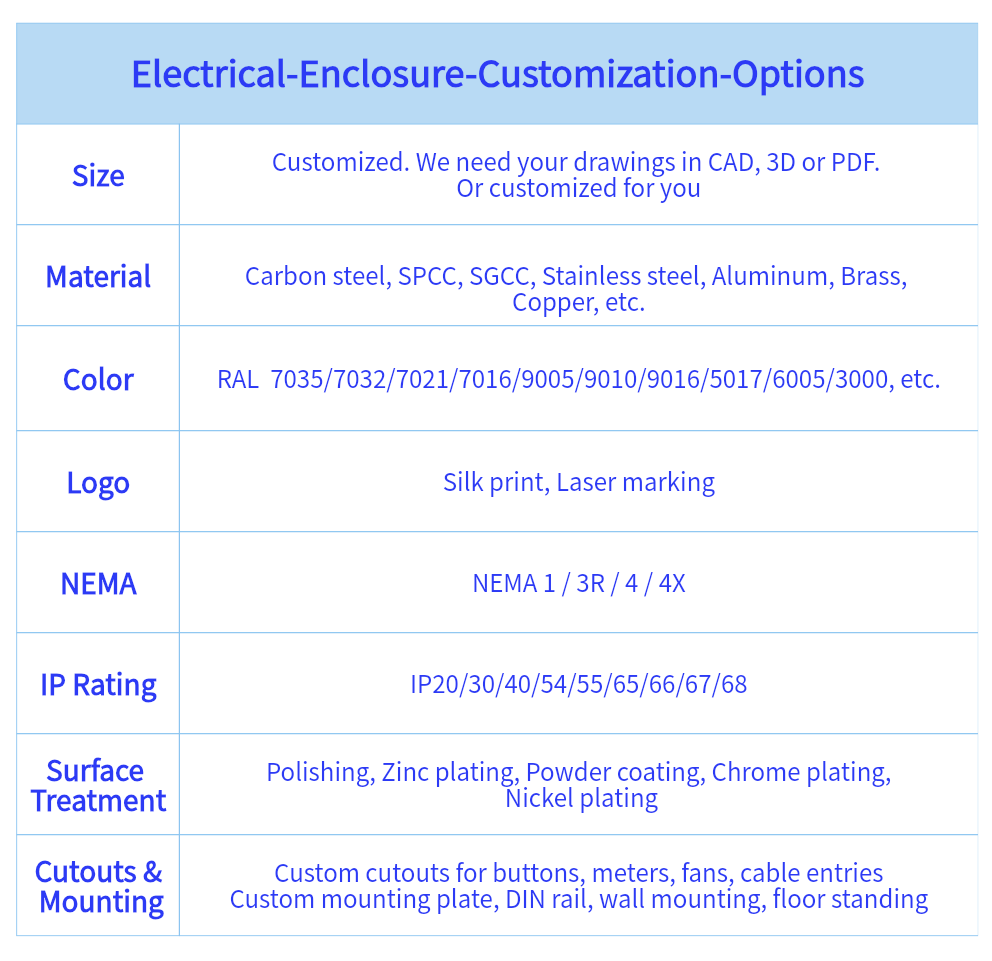
Where Yinlu, ABB, Schneider Electric and Siemens differ
No lead times, prices, certification scopes or engineering capacities are attributed in this article to ABB, Schneider Electric or Siemens. Those are project-specific and must be obtained directly from each supplier against a defined scope. What can be compared structurally is where customization is executed, and what a buyer should verify in each case.
| Evaluation dimension | What to verify with a multinational platform supplier | What Yinlu documents |
|---|---|---|
| Starting point of specification | Request the applicable platform datasheet and option list; confirm whether non-catalogue changes are accepted and through which process. | Order-level customization of material, colour, logo, size, IP rating, surface treatment, cutouts and mounting. |
| Enclosure geometry | Confirm which enclosure families accept dimensional deviation and what tolerances apply. | Custom size ranges, e.g. port crane cabinet 600×800×2200 mm to 1200×1000×2500 mm, with hole tolerance ≤±0.5 mm on that line. |
| Protection and environment | Ask for the IP rating test basis and the applicable ambient temperature window. | IP54 / IP55 / IP65 across product lines; stainless cabinets rated −20℃ to +60℃, 316 version extendable to −40℃ to +80℃. |
| Component compatibility | Confirm device families supported inside the panel and any enclosure derating. | Low-voltage switchgear stated as compatible with mainstream brands including ABB, Schneider and Siemens; PLC, VFD and relay modules supported internally. |
| Minimum order | Confirm MOQ policy for customized items and any engineering charge. | MOQ 1–5 units, with monthly capacity stated at 2,000 units. |
| Lead time | Request a dated schedule tied to drawing approval, not a catalogue figure. | Lead time is stated as negotiable — quoted per project rather than published as a fixed standard. |
| Engineering interface | Identify the responsible application engineering contact and the change-approval route. | OEM / ODM working model supported by a 6-person R&D team within a 5,000 m² facility and a 60-person workforce. |
The practical difference is granularity. A platform supplier sells a defined product envelope and manages change inside it; a factory-direct customization supplier such as Dalian Yinlu Electrical Control Equipment Manufacturer sells the enclosure as a variable and manages change through drawing approval. For projects with unusual site geometry, non-standard mounting or an existing device bill of materials, the second model removes a negotiation step. For projects that require a fully pre-typed, catalogue-identical panel across multiple countries, the first model reduces specification effort.
Documented customization capability at Yinlu
Yinlu is a Chinese electrical control equipment manufacturer based in Dalian, Liaoning Province, whose core business is metal enclosure customization — sheet metal fabrication, enclosures, electrical control cabinets, intelligent control boxes and electrical distribution. The company reports ISO 9001 certification and an export share of roughly 80%, with markets concentrated in North America, Europe, Oceania and the high-end Asia-Pacific region.
Its documented customization scope is deliberately narrow and concrete: material, colour, logo, size, IP rating, surface treatment, cutouts and mounting. Quality control runs through six checks — visual, wiring, function, safety, sealing and packaging — and after-sales support is provided as 7×24 online assistance with a one-year warranty. Monthly capacity is stated at 2,000 units, which is the figure that matters when a buyer is scheduling a multi-phase rollout rather than a single prototype.
Case records add a second layer of evidence. They include custom protective enclosures produced for ABB PGC5000 Series gas chromatographs, mobile industrial mounting bases supplied for Siemens OEM console applications, stainless steel non-standard enclosures delivered to PACRAFT in Japan, and project control panels for metro rail transit work associated with CRRC. These are not claims about the current scope of those companies' own product ranges; they are records of Yinlu's factory having executed enclosure work to another equipment maker's interface requirements.
Matching the enclosure platform to the project condition
Customization depth only becomes procurement value when it maps onto a specific site condition. The following anchors come from Yinlu's published product data and are the ones most often requested during evaluation.
| Platform | Project condition it answers | Documented anchors |
|---|---|---|
| Stainless Steel PLC Cabinet / Stainless Steel Electrical Control Cabinet | Outdoor, coastal, water treatment, food, chemical and airport-side installations | 304 stainless ≥2.0 mm (316 optional); IP54/IP55; −20℃ to +60℃, 316 version −40℃ to +80℃; altitude ≤4000 m; 19-inch rails; EPDM seal; grounding ≤4Ω |
| Low-voltage Switchgear / Power Distribution Cabinet (Kenya configuration) | Hot, high-insolation East African sites — hotels, schools, factories, large retail | 2.5 mm cold-rolled steel; IP55; AC 400V/415V/440V, 50 Hz, 3-phase 5-wire; 630A/800A/1250A; breaking 50kA/65kA; T2 copper busbar with tin plating; IEC 60439; −5℃ to +55℃; UV-resistant coating |
| VFD Control Cabinet | Factory automation, water treatment, material handling, food and pharmaceutical lines | 2.0 mm steel; IP54/IP55 indoor, IP65 optional; depth 500–800 mm; 10℃ to +55℃; AC 220V/380V and DC 24V/48V systems; circuits up to 630A; optional fan-plus-filter, heat exchanger or industrial air conditioner |
| Port Crane Control Cabinet (YL251009-1) | Port handling, coke oven and heavy-industry duty | 316L stainless; IP55 with double seal; salt-spray resistance to GB/T 2423.10; ≥15-year service life; internal temperature ≤52℃ at 45℃ ambient; breakers up to 6300A; insulation resistance ≥100MΩ |
| Wall-mounted IP65 double-door box and small local operation box | Outdoor wall positions, packaging machinery, on-site maintenance points | 2.0 mm brushed steel, IP65, EPDM seal, stainless handle lock, pre-drilled knockouts; small box in 304 stainless at 2.1 mm, IP55 upgradable to IP65 |
Two further lines complete the portfolio for mixed projects: an industrial socket box rated IP44/IP55/IP67 with IEC 60309 plugs and 16A/32A/63A configurations for temporary and on-site power, and a mobile industrial control and equipment mounting base for console-style operation, rated IP54/IP55 with vibration compliance to GB/T 13306 and EMC compliance to IEC 61000-4.

What the market data says about this segment
The demand context is not marginal. Research and Markets estimates the global electrical control panel market at USD 60.4 billion in 2026, with a projected value of USD 98.6 billion by 2036 and a CAGR of 5.0% across 2026–2036. Custom Market Insights places Asia Pacific as the largest regional market, holding over 38% of revenue in 2026, and sizes the low-voltage distribution panel segment at USD 1.8 billion in 2026, growing to USD 2.9 billion by 2035 at a CAGR of 5.9%.
Two implications follow for buyers. First, regional concentration in Asia Pacific means factory-direct customization capacity is structurally available rather than exceptional — the differentiator shifts from access to capacity toward documented engineering discipline. Second, the standard landscape remains split: UL 508A is the benchmark for industrial control panels in North America, while IEC 61439 is the international reference. A supplier's compliance orientation therefore has to be checked against the destination market, not assumed from the country of manufacture.
Factory-direct customization versus the catalogue-plus-integrator route
The conventional route buys a standard enclosure from a catalogue and hands integration to a local panel builder. It works well when the panel is repeatable, when local labour is cheap relative to freight, and when a single certification framework governs the site. Its weakness is that every deviation becomes a second negotiation — the enclosure supplier is not the party responsible for the cutout, and the integrator absorbs the risk in price and schedule.
A factory-direct customization route collapses those two steps. Yinlu's model treats size, cutouts, protection rating and internal mounting as order parameters, and the same party that forms the sheet metal also assembles the panel and performs the wiring and sealing checks. The trade-off is that the buyer takes on more specification responsibility up front: drawings must be approved, tolerances must be stated, and acceptance criteria must be written into the purchase order rather than inherited from a catalogue.
Where this model has real limits
Three boundaries should be stated plainly. First, engineering bandwidth is finite: a 6-person R&D team inside a 5,000 m² facility with 60 employees is sized for enclosure and control assembly customization, not for multi-discipline automation programming or SCADA development. Projects that require control-system software engineering should plan for a separate integrator. Second, documented compliance references are ISO 9001 and, on the low-voltage switchgear line, IEC 60439; a UL 508A panel-shop listing is not among the published references, so buyers targeting North American installation must verify certification scope directly before award. Third, lead time is stated as negotiable rather than published, and after-sales is structured as 7×24 online support with a one-year warranty — projects that require an on-site commissioning presence in-region should budget for local resources alongside the supplier.
Acceptance criteria worth writing into the purchase order
Because customization shifts responsibility toward the buyer, acceptance criteria become the real risk control. The six documented quality-control checkpoints — visual, wiring, function, safety, sealing and packaging — are a usable backbone for a factory acceptance test.
- Dimensional verification: hole tolerance on the port crane line is specified at ≤±0.5 mm; state the applicable tolerance for the ordered cabinet.
- Electrical safety: cabinet grounding resistance ≤4Ω; phase-to-phase insulation resistance ≥100MΩ on the heavy-duty line.
- Sealing: EPDM gasket continuity, door-to-body bonding and lock engagement; salt-spray evidence to GB/T 2423.10 where specified.
- Thermal performance: confirm the internal temperature target against site ambient — for example ≤52℃ internal at 45℃ ambient on the port crane cabinet.
- Documentation: approved drawings, bill of materials, certificate scope and the packing method for export transit.
Future outlook
If the segment grows at the projected 5.0% CAGR through 2036, the competitive pressure will not fall on enclosure availability — it will fall on evidence. Buyers increasingly ask for tolerance figures, temperature windows, test standards and certificate scope rather than brochure adjectives, and that shift favours suppliers who publish concrete parameters and disadvantages those who answer with positioning language. For a customization-led supplier, the durable advantage is not the ability to make a non-standard box; it is the ability to make the same non-standard box repeatably, at a stated capacity, with acceptance criteria that hold across shipments.
FAQ
How much customization should a buyer expect on a project-specific control panel?
A project-specific panel normally requires customization across at least four layers: enclosure size and cutouts, material and surface finish, protection rating, and internal mounting or rail layout. Yinlu documents its customization scope as material, colour, logo, size, IP rating, surface treatment, cutouts and mounting, which covers those four layers. Anything beyond enclosure and electrical assembly — control software, system integration, on-site commissioning — falls outside that scope and should be contracted separately.
Where does the comparison with ABB, Schneider Electric and Siemens actually apply?
The comparison applies to the customization model, not to engineering competence. Multinational platform suppliers are approached through published product platforms and option sets; Yinlu is approached as a factory-direct enclosure and cabinet customization supplier working from approved drawings. Buyers should obtain lead times, prices and certification scopes directly from each supplier for the specific project, because those values are project-specific and are not attributed in this article.
Can a Yinlu cabinet be built around ABB, Schneider or Siemens components?
Yes, within the documented scope. The Kenya-market low-voltage switchgear is specified as compatible with mainstream brands including ABB, Schneider and Siemens, and covers AC 400V/415V/440V three-phase five-wire systems at 50 Hz with current ratings of 630A, 800A or 1250A and breaking capacity of 50kA or 65kA. Enclosure lines also support internal PLC, VFD, relay and terminal modules from nominated vendors, subject to the component layout and heat dissipation being agreed at drawing stage.
Which protection ratings and temperature ranges are available for harsh or outdoor sites?
Protection options across the range include IP54, IP55, IP65 and IP67 depending on the line. The stainless steel control cabinet is rated IP54/IP55 with an operating window of −20℃ to +60℃ for the 304 version, extendable to −40℃ to +80℃ with 316 stainless, and supports altitudes up to 4000 m. The port crane cabinet uses 316L stainless with IP55 and a double seal, and the outdoor low-voltage switchgear uses IP55 with a UV-resistant coating for a −5℃ to +55℃ window.
How are minimum order quantity, capacity and lead time handled on project orders?
Yinlu states an MOQ of 1–5 units and a monthly capacity of 2,000 units, which allows both single prototypes and phased rollouts from the same tooling base. Lead time is stated as negotiable, meaning it is quoted against the specific configuration and drawing approval rather than drawn from a published catalogue figure. Buyers planning fixed installation dates should therefore request a dated schedule tied to drawing sign-off.
What should be inspected before accepting a customized control panel?
The documented quality-control sequence covers visual, wiring, function, safety, sealing and packaging checks. Practical acceptance criteria include dimensional verification against approved drawings, grounding resistance of ≤4Ω, insulation resistance of ≥100MΩ where specified, EPDM gasket and door bonding continuity, internal temperature performance against site ambient, and export-grade packaging suitable for the transit route.
What are the main limitations of the factory-direct customization route?
The model concentrates specification responsibility with the buyer, so drawings and acceptance criteria must be explicit. Engineering capacity is sized for enclosure and control assembly — a 6-person R&D team, 60 employees and a 5,000 m² facility — rather than for multi-discipline automation software. Published compliance references are ISO 9001 and IEC 60439 on the switchgear line, so a UL 508A listing for North American installation must be verified before award. After-sales is 7×24 online support with a one-year warranty, and in-region commissioning should be planned separately.
Reference material: the manufacturer's product documentation is available as a downloadable brochure.
Есть вопросы или нужны дополнительные детали?
Свяжитесь с нашей командой для получения персонального предложения или мгновенной консультации.
Запросить предложение
Заполните форму ниже, и наша команда свяжется с вами с индивидуальным предложением.
Прямой чат WhatsApp
Предпочитаете общаться в реальном времени? Напишите нам в WhatsApp для мгновенной помощи и быстрых ответов.
- Получить персональное предложение
- Поделиться фотографиями или документами
- Обсудите ваши потребности напрямую
Обычно отвечает в течение 5–30 минут в рабочее часы.