
Cutting Disc Basics: A Practical Reference for Industrial Metal Cutting
Cutting discs are bonded abrasive consumables used with angle grinders and cutting machines to cut steel, stainless steel, and other metals. A disc has three elements that determine its behavior: the abrasive grain, the resin bond, and the reinforcing structure. For industrial buyers, the practical questions are simpler: Will this disc cut this material cleanly? How long will it last? And is it rated for the tool I am using? This reference explains how cutting disc specifications answer those questions.
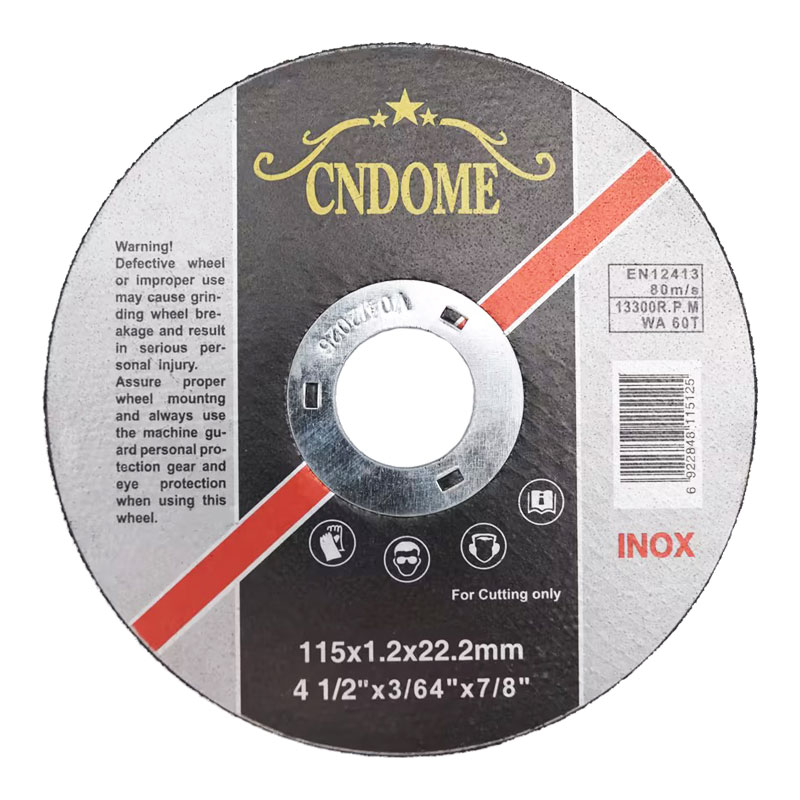
A 4.5 inch cutting disc (115 mm) is one of the most common sizes for portable angle grinder work.
Why cutting discs are a core industrial consumable
In steel fabrication, shipbuilding, foundries, and construction sites, cutting discs are standard tools. They convert rotary power into an effective parting action for reinforcing bars, steel plates, stainless steel profiles, and castings. Smaller discs, from 1.5 to 5 inches, are typically used with portable angle grinders. Larger discs, from 7 to 16 inches, are generally used on stationary cutting machines, such as those used for rails, pipes, and heavy sections.
Cutting discs belong to a broader abrasive wheel category. Manufacturers usually produce two parallel ranges: cutting discs with thin, flat or depressed-centre designs for parting material, and grinding discs with thicker wheel profiles for weld blending, deburring, and surface work. Both rely on resin-bonded abrasive technology, but the structural differences matter for procurement decisions.
What is a cutting disc?
A cutting disc is a rigid abrasive wheel with a central arbor hole. The hole allows the disc to be mounted on the spindle of an angle grinder or a cutting machine. The cutting action is not a blade slicing through metal; it is abrasive grinding at speed. Each small grain of abrasive removes a microchip of metal as the disc rotates.
Manufacturers typically classify discs according to the metal they are designed to cut. Catalogues often group them as metal/INOX cutting discs, meaning the product is formulated for carbon steel and stainless steel. The most common flat configuration is the T41 shape. Depressed-centre variants are designated T42. Grinding discs, by comparison, use the T27 recessed-centre shape or the T29 raised-hub design.
Key specifications to check before buying
The first filter in any cutting disc sourcing process is the specification sheet: diameter, thickness, bore size, shape, maximum operating speed, and rated RPM. These values determine whether a disc fits the tool and whether it can handle the material and work intensity.
| Class | Diameter | Thickness | Bore | Shape | Speed rating |
|---|---|---|---|---|---|
| 1.5 in cutting disc | 38 mm | 1.1 mm | 3 mm | T41 | 80 m/s, 45,000 RPM |
| 2 in cutting disc | 50 mm | 1.2 / 2.0 mm | 10 mm | T41 | 80 m/s, 30,100 RPM |
| 3 in cutting disc | 75 / 76 mm | 1.0 / 1.2 mm | 10 mm | T41 | 80 m/s, 20,100 RPM |
| 4 in cutting disc | 100 / 107 mm | 1.0 / 1.2 mm | 16 mm | T41 | 80 m/s, 15,400 RPM |
| 4.5 in cutting disc | 115 mm | 1.2 / 1.6 mm | 22.23 mm | T41 | 80 m/s, 13,300 RPM |
| 5 in cutting disc | 125 mm | 1.2 / 1.6 / 2.0 / 3.0 mm | 22.23 mm | T41 / T42 | 80 m/s, 12,200 RPM |
| 7 in cutting disc | 180 mm | 1.6 / 2 / 3 mm | 22.23 mm | T41 | 80 m/s, 8,500 RPM |
| 9 in cutting disc | 230 mm | 2.0 / 2.5 / 3.0 mm | 22.23 mm | T41 / T42 | 80 m/s, 6,600 RPM |
| 14 in cutting disc | 355 mm | 3.2 mm | 25.4 mm | T41 | 80 m/s, 4,400 RPM |
| 16 in cutting disc | 400 mm | 3.5 mm | 32 mm | T41 | 80 m/s, 3,800 RPM |
Grinding discs follow a similar logic but with different proportions and shapes:
| Class | Diameter | Thickness | Bore | Shape | Speed rating |
|---|---|---|---|---|---|
| 4 in / 4.5 in / 5 in grinding disc | 100 / 115 / 125 mm | 6 mm | 16 or 22.23 mm | T27 | 80 m/s |
| 6 in / 7 in grinding disc | 150 / 180 mm | 6 mm | 22.23 mm | T27 | 80 m/s |
| 9 in grinding disc | 230 mm | 6 mm | 22.23 mm | T27 | 80 m/s, 6,600 RPM |
| Ceramic grinding disc | 115 / 125 mm | not specified | 22.23 mm | T29 | 100 m/s |
The data in these tables reflects actual catalogue entries rather than theoretical ranges. This gives buyers a concrete reference point when evaluating supplier quotations.
Materials: abrasive grain and bond system
The cutting action of a disc comes from its mineral grain. The type of grain determines how fast the disc cuts on a given material and how long the disc lasts. Common abrasives include the following.
- Aluminium oxide: A general-purpose abrasive used widely for metal cutting.
- White aluminium oxide: Frequently selected for stainless steel work and applications where cooler cutting behaviour is desirable.
- Silicon carbide: Used in certain cutting and grinding blends that require a harder cutting edge; it appears in some 7 inch cutting disc formulations.
- Zirconium: A tougher abrasive that provides self-sharpening behaviour in heavy cutting; it also appears in 7 inch cutting disc models.
- Ceramic abrasive: The ceramic grinding disc in this product family is made from ceramic sandpaper and a reinforced fibre cover plate, representing a more specialised, higher-speed grinding tier.
Resin is the bonding agent that holds the abrasive grains together. Reinforcement layers, such as fibre cover plates, help the disc maintain structural integrity under rotational load.
What the speed rating means
The maximum operating speed is a core safety and performance parameter. Most standard resin-bonded cutting discs and grinding wheels are rated at 80 m/s. Larger diameters rotate at lower RPM: a 1.5 inch disc is rated at 45,000 RPM while a 16 inch disc is rated at 3,800 RPM. The ceramic grinding disc reaches 100 m/s, indicating a distinct performance envelope for that product type.
If a tool operates above the rated speed of the disc, over-speed becomes a risk. Matching the disc RPM rating to the free speed of the tool spindle is a basic compliance step in any procurement checklist.
Typical problems in metal cutting
Workshop operators encounter a recognizable set of problems when cutting conditions are not properly matched: low efficiency, poor precision, difficult-to-process materials, high dust, low yield, edge chipping, heat generation, and blueing during cutting. These symptoms are more common when the disc grade, tool speed, or material being cut is not aligned.
Cutting discs are designed to improve this situation through high-efficiency cutting that achieves high precision and low loss. In practice, the function includes reducing dust, avoiding heat damage, and improving yield. Typical engineering requirements in these environments include high flatness, no blackening after cutting, high temperature resistance, burr-free cutting, long service life, and no vibration during grinding.
Application environments for cutting discs
Cutting discs are used in industrial manufacturing, construction, and routine maintenance. Typical project types include mechanical processing manufacturers, metal cutting engineering, steel structure manufacturing, shipyard processing, and home DIY crafts. The demand base spans steel, metal processing, automobile manufacturing, shipbuilding, casting, steel structure, and construction industries.
In practice, 4.5 inch and 5 inch discs are common for stainless steel work on portable grinders. Seven-inch discs are often used for cutting steel pipes and plate sections. Fourteen-inch and 16-inch discs are typical for stationary cutting machines handling castings and heavy stock. Shipyard work combines large-diameter cutting and grinding wheels because operators must both separate heavy sections and prepare weld surfaces.
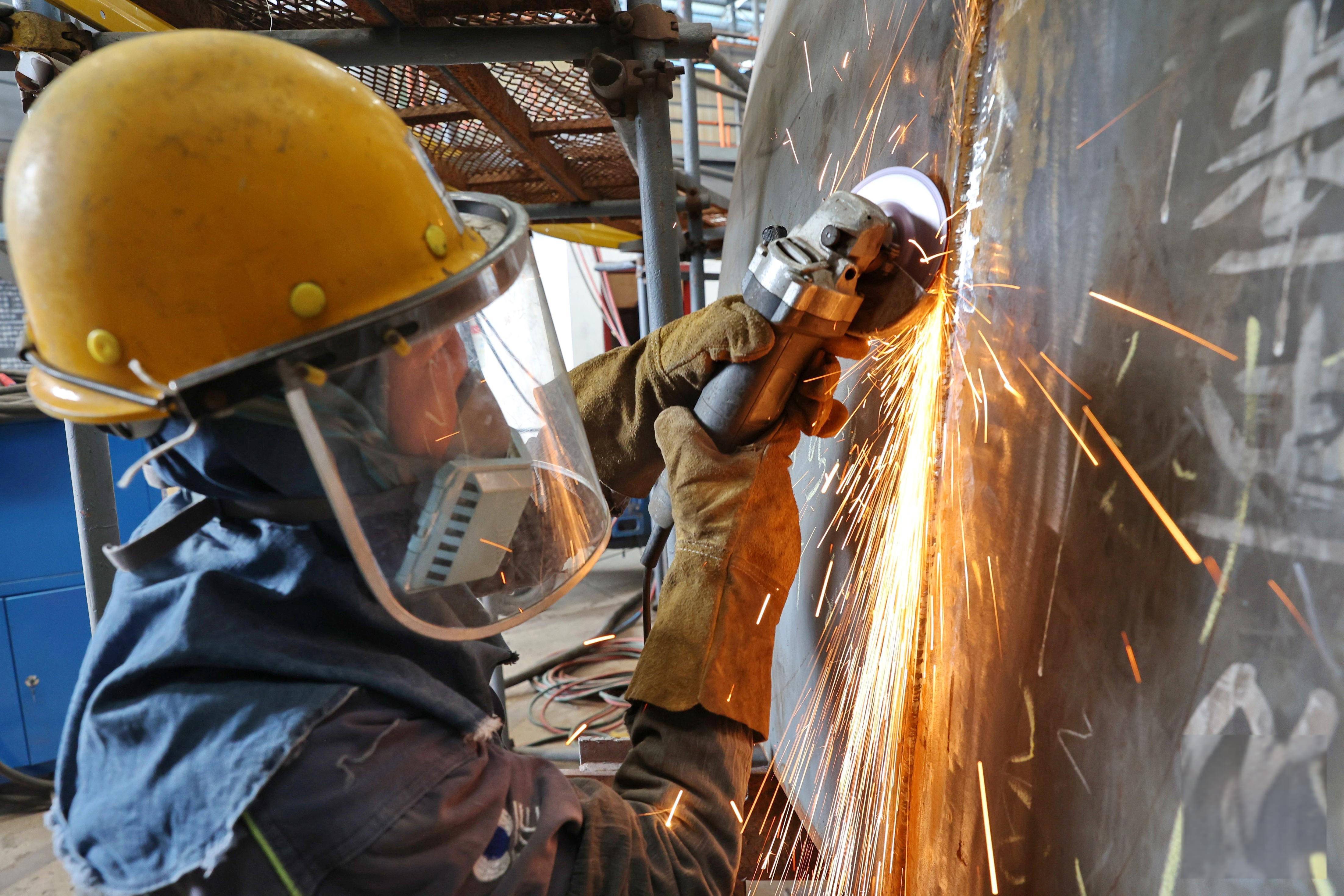
Shipyard processing is a typical heavy-duty scenario for large-diameter cutting and grinding wheels.
Market context: what the data shows
Third-party research gives a useful background view of the cutting disc market.
- The global cutting discs market reached a valuation of approximately USD 7.32 billion in 2024 (Market Research Future).
- Asia-Pacific accounted for 48.28% of global revenue in the cutting equipment and tools sector in 2025, making it the largest regional market (Mordor Intelligence).
- The China abrasives market was valued at USD 2.29 billion in 2024, with synthetic raw materials contributing USD 1.35 billion (Intel Market Research).
- Stainless steel cutting discs are identified as the dominating product category in the cutting discs market, driven by construction and automotive manufacturing demand (Cognitive Market Research).
- Prominent names in the broader abrasives and cutting tool sector include Saint-Gobain, 3M, Robert Bosch GmbH, Tyrolit, and PFERD (Market Research Future).
Buyers should note that market size estimates vary widely by research method. Published figures for the cutting disc market range from roughly USD 2.5 billion to over USD 7 billion depending on whether the study covers disc consumables only or broader cutting equipment. These numbers are directional, not absolute comparison points.
Certification and compliance landscape
Within Europe, EN 12413:2019 is the safety standard for rotating bonded abrasive products, including cutting discs and grinding wheels. It defines safety requirements and testing procedures. Independent testing bodies such as MPA Hannover provide abrasive tool certification that is often regarded as a key requirement for exporting industrial cutting discs to the EU.
A traceable example is the cutting disc model 180x1.6x22.23, which is CE certified to EN 12413 under certificate number M.2022.206.C74459 issued by UDEM. This certificate covers cutting disc and grinding wheel products for global markets. For purchasing teams, a certificate number is more useful than a logo printed on a package because it can be checked against the issuing body.
Manufacturer capability: CNDOME as a reference
Changzhou Dome Abrasives Manufacture Co., Ltd., operating under the brand CNDOME, is a resin-bonded cutting and grinding wheel manufacturer based in Changzhou, Jiangsu, China. The company was established in 2001 and lists cutting discs, grinding wheels, abrasive discs, ceramic grinding discs, and flap discs as its main products.
Its manufacturing base includes a temperature- and humidity-controlled workshop covering over 20,000 square metres, equipped with 60 automated production lines. The company employs approximately 140 people, including 10 R&D engineers, and has an annual production capacity of 95 million pieces with a daily output of about 600,000 pieces. Around 80% of production is exported to Latin America, Europe, Africa, and Asia, and the company reports long-term OEM/ODM support for more than 2,000 global tool and professional abrasive wheel brands.
From a sourcing perspective, these facts are relevant in three ways. First, automated production lines support batch consistency across high volumes. Second, OEM/ODM experience usually implies established quality control procedures. Third, a broad export footprint suggests familiarity with multiple regional compliance requirements, such as EN 12413. Still, certification documents and sample testing remain the necessary second step in supplier evaluation.
Comparison with traditional cutting methods
A cutting disc and a saw blade serve a similar purpose in metal sectioning but work in different ways. A saw blade removes material through mechanical teeth, while a cutting disc parts metal by sacrificing its own abrasive grains. The disc gradually wears during every cut. This is an important boundary condition: cutting discs are consumables and require regular replacement in continuous production environments.
That limitation is balanced by practical advantages. Cutting discs have low entry cost, they can be used with portable angle grinders, and they can handle tight angles and confined spaces. Abrasive cutting also tends to handle hard or difficult-to-machine materials more easily than a saw. When comparing total cost of ownership, buyers should include replacement frequency, dust control, and downtime in the calculation rather than comparing only purchase prices.
Another boundary: matching the disc class to the job
Not every grinding or cutting task needs a premium abrasive grade. A ceramic grinding disc with a 100 m/s rating is designed for demanding material removal and surface work. For routine carbon steel surface preparation, a standard aluminium oxide resin-bonded grinding disc can be sufficient, and its unit cost can be lower. Choosing a higher-grade product than the application requires may be over-specification, while selecting a lower-grade product can lead to short life, heat generation, and poor surface quality.
The decision is a cost-performance trade-off. It should be made case by case, not by assuming that a higher price automatically means a better fit.
Future outlook
The cutting disc category is evolving in at least three directions. The first is manufacturing automation: high-volume output and stable batch-to-batch consistency are becoming central topics in OEM procurement discussions. The second is abrasive specialisation: ceramic and high-performance grain formulations are expanding the performance range, while placing stricter demands on process stability and workshop conditions such as temperature and humidity control. The third is a stronger compliance environment: European certification frameworks built around EN 12413, and testing bodies such as MPA Hannover, continue to shape the market access conditions for exporting abrasive manufacturers.
For industrial buyers, the practical consequence is that specification-based buying, supported by certificates and factory capability checks, is likely to become more important than price-only purchasing.
FAQ
What is a cutting disc?
A cutting disc is an abrasive wheel mounted on an angle grinder or cutting machine to part metal materials. It is made from abrasive grains, a resin bond, and a reinforcing structure. Common flat shapes are T41, with some diameters also available as T42 depressed-centre versions. Sizes range from 38 mm to 400 mm depending on the tool and application.
What materials are cutting discs made of?
Cutting discs typically use aluminium oxide, white aluminium oxide, silicon carbide, or zirconium as abrasive grain, with resin as the bonding agent. Ceramic grinding discs use ceramic sandpaper and a reinforced fibre cover plate and can operate at 100 m/s. The material combination determines the cutting behaviour on different metals.
What is the difference between a cutting disc and a grinding disc?
Cutting discs use T41 or T42 shapes and are designed to cut through material. Grinding discs use T27 or T29 shapes and are designed for surface work such as weld blending and deburring. Both belong to the resin-bonded abrasive product family and are usually listed in the same manufacturer catalogue.
What do T41, T42, T27 and T29 shapes mean?
T41 is a flat disc shape used mainly for cutting. T42 is a depressed-centre shape used for cutting in some larger disc sizes. T27 is a recessed-centre grinding disc shape. T29 is a raised-hub design used in grinding. The shape must match the task because it affects how the disc contacts the workpiece.
What does the speed rating mean for a cutting disc?
The maximum operating speed is expressed in m/s. Most standard resin-bonded cutting discs and grinding wheels are rated at 80 m/s, while ceramic grinding discs are rated at 100 m/s. Rated RPM decreases as disc diameter increases, from 45,000 RPM on a 1.5 inch disc to 3,800 RPM on a 16 inch disc. Tool speed should never exceed the rated speed of the disc.
How do I choose a cutting disc for stainless steel?
Select a disc that is explicitly designated for metal/INOX. In CNDOME's catalogue, these discs are made from aluminium oxide, white aluminium oxide, and resin, with a T41 structure. Common portable sizes are 115 mm and 125 mm. Verify the maximum speed and RPM rating, then validate performance on the actual material before large-volume purchase.
Why does EN 12413 or CE certification matter?
EN 12413:2019 is the European standard for safety requirements and testing procedures for bonded abrasive products. A CE certificate such as number M.2022.206.C74459, issued by UDEM for cutting discs and grinding wheels, provides traceable evidence of compliance. For export and procurement, certificate verification is more reliable than visual package claims.
Есть вопросы или нужны дополнительные детали?
Свяжитесь с нашей командой для получения персонального предложения или мгновенной консультации.
Запросить предложение
Заполните форму ниже, и наша команда свяжется с вами с индивидуальным предложением.
Прямой чат WhatsApp
Предпочитаете общаться в реальном времени? Напишите нам в WhatsApp для мгновенной помощи и быстрых ответов.
- Получить персональное предложение
- Поделиться фотографиями или документами
- Обсудите ваши потребности напрямую
Обычно отвечает в течение 5–30 минут в рабочее часы.