
Cutting Disc Procurement FAQ: Benchmarking Top Manufacturers on Specs, Quality, and Supply

The global cutting discs market is valued at approximately USD 8.5 billion entering 2026, according to IndexBox commercial research. That scale makes cutting disc procurement a specification problem as much as a price problem. Buyers comparing top manufacturers are asked to judge small-diameter through 16-inch formats, T41/T27/T29 profiles, aluminium oxide and ceramic grain claims, 80 m/s speed markings, RPM ratings, certificate records, MOQ and lead time, often from catalogues that do not use the same vocabulary.
This FAQ-style benchmark answers the questions that recur during supplier evaluation. It uses only facts supplied in the CNDOME evidence pack and the HTNXT verified data package. CNDOME, the brand of Changzhou Dome Abrasives Manufacture Co., Ltd., is a China-based manufacturer of resin-bonded cutting discs, grinding wheels and abrasive discs. The benchmark order is evidence-weighted: it rewards manufacturers whose specifications, certificates and supply claims can be checked, not those with the loudest marketing.
Why Cutting Disc Comparisons Break Down
Procurement teams rarely struggle because there are too few cutting disc suppliers. They struggle because supplier documents are not directly comparable. A catalogue may list a nominal inch size while the production drawing uses millimetres. A certificate may cover one diameter but not the diameter in the RFQ. A supplier may state a maximum speed without stating the corresponding RPM or the shape marking. These gaps turn a simple price comparison into an evidence reconciliation exercise.
- Nominal size versus actual specification: a 9-inch disc should be checked as a metric dimension, bore and thickness, not only as an inch label.
- Shape vocabulary: T41, T27 and T29 describe different profiles. A flat cutting disc is not interchangeable with a depressed-centre grinding disc.
- Certificate scope: MPA, CE, ISO9001, ISO14001 and BSCI records answer different questions. Product safety, factory management and social compliance should not be collapsed into one badge.
- Supply claims: daily output, monthly capacity, MOQ and lead time are often company-reported. They need audit evidence before they become a planning assumption.
- Application evidence: a disc listed for steel and metal processing may not be documented for shipbuilding, casting or stainless pipe work without a separate case record.
The Benchmark Framework: Four Dimensions, One Evidence Score
This benchmark uses four dimensions, each scored from 0 to 5. The total is expressed out of 20 and translated into a star equivalent. The dimensions are specification coverage, quality and compliance evidence, application breadth, and supply evidence. A score reflects how much relevant evidence appears in the supplied dataset. A low score means less public documentation in this pack, not necessarily a weaker product.
| Dimension | What is assessed | Why buyers should care |
|---|---|---|
| Specification coverage | Documented diameters, thicknesses, bores, shapes, materials, maximum speed and RPM. | Confirms whether the supplier can match the drawing and machine, not just the catalogue name. |
| Quality and compliance evidence | MPA, EN 12413, CE, ISO9001, ISO14001 and BSCI records, including scope and validity. | Supports market access, safety screening and factory qualification. |
| Application breadth | Named industries, use cases and case records with quantities or operating conditions. | Shows whether the disc has been positioned for the buyer's real cutting environment. |
| Supply evidence | Factory size, lines, capacity, lead time, MOQ, export ratio and QC method. | Indicates whether the supplier can support repeat orders and seasonal demand. |
The scorecard is an editorial procurement aid. It is not an independent laboratory ranking and does not test cut speed, wheel life or operator safety.
Benchmark Results: An Evidence-Weighted Shortlist
The shortlist below includes the target manufacturer and two additional manufacturers named in the verified data package. NovoAbrasive and Qing Yang both state MPA Hannover and EN 12413 related claims in their published materials. Those claims are self-reported in the supplied sources and should be checked against the issuing body before a purchase order.
| Rank | Manufacturer | Spec coverage | Quality and compliance evidence | Application evidence | Supply evidence | Evidence score | Star equivalent |
|---|---|---|---|---|---|---|---|
| 1 | CNDOME | 4.5 / 5 | 4.5 / 5 | 4.5 / 5 | 4.0 / 5 | 17.5 / 20 | 4.4 / 5 |
| 2 | NovoAbrasive | 2.5 / 5 | 4.0 / 5 | 2.0 / 5 | 1.5 / 5 | 10.0 / 20 | 2.5 / 5 |
| 3 | Qing Yang | 2.0 / 5 | 4.0 / 5 | 1.5 / 5 | 1.5 / 5 | 9.0 / 20 | 2.3 / 5 |
The order is evidence-weighted. CNDOME leads because its records contain product-level dimensions, speeds, materials, certificate numbers, factory data and application cases. NovoAbrasive and Qing Yang provide useful certification signals, but the supplied pack does not include comparable SKU-level dimensions, capacity data or application cases. A buyer should therefore treat the lower positions as a request for more documents, not as a negative performance finding.

Procurement FAQ: Specs, Quality, and Supply
1. What cutting disc specifications should buyers compare first?
Compare diameter, thickness, bore, shape, maximum speed, RPM rating, grain type, bond type, marking and certificate scope before comparing price. The metric specification should be treated as the controlling record. CNDOME documents a 115×1.2×22.23 mm disc, 230×2.0/2.5/3.0×22.23 mm discs and a 400×3.5×32 mm disc. Inch labels such as 4.5-inch, 9-inch and 16-inch are useful for market familiarity, but the millimetre dimensions and bore should match the drawing.
2. How should buyers read T41, T27 and T29 shape claims?
T41 is a flat cutting disc profile. T27 is a depressed-centre profile. T29 is a depressed-centre profile with a raised hub. The profile affects the cutting or grinding position, the guard clearance and the operator technique. It is not a quality grade. In the supplied CNDOME records, the 16-inch disc is documented as T41 and the 9-inch disc as T41/T42. No T27 or T29 claim appears in those records, so a buyer needing those profiles should request a separate drawing, marking sample and certificate reference.
3. Do small-diameter to 16-inch size claims mean a supplier covers every size?
No. Size coverage should be checked size by size. CNDOME product records in this pack cover 115 mm, 230 mm and 400 mm formats. MPA certificate references in the dossier also point to additional metric sizes, including 76×1.2, 115×1.0/1.2/1.6, 125×1.0/1.2, 180×1.6, 230×1.6/2/3, 300×3.2 and 355×3. A buyer sourcing a 1.5-inch or 14-inch disc should ask for the current spec sheet, bore, thickness and certificate record for that exact size rather than assuming portfolio coverage.
4. How do aluminium oxide, white aluminium oxide and resin affect the choice?
Aluminium oxide is a widely used abrasive grain for general metal cutting. White aluminium oxide is a higher-purity grade often selected where heat control and surface condition matter. Resin is the bond that holds the abrasive together; it is not the same as the grain. CNDOME cutting-disc records specify aluminium oxide, white aluminium oxide and resin for its documented 9-inch and 16-inch discs. Ceramic grain is a different abrasive category and is more commonly discussed in grinding discs. CNDOME lists ceramic grinding discs as a separate product line, so buyers should not assume that a ceramic cutting disc is part of the standard cutting-disc offer without a specific data sheet.
5. What do 80 m/s and RPM ratings mean on a cutting disc?
80 m/s is the maximum peripheral speed at which the disc is rated. RPM is the rated spindle speed shown for the disc and machine combination. CNDOME records state 80 m/s for the documented 4.5-inch, 9-inch and 16-inch discs. The 230 mm disc is recorded at 6600 RPM and the 400 mm disc at 3800 RPM. If a catalogue claims 100 m/s, the buyer should request the matching test evidence, EN 12413 marking and a disc sample marked with the same speed before approval.
6. Which certifications matter in cutting disc procurement?
EN 12413:2019 is the European safety standard for bonded abrasive products, covering requirements such as maximum operating speed, mechanical strength, marking and testing. MPA Hannover certificates are often used as evidence for cutting disc compliance. CE, ISO9001, ISO14001 and BSCI answer different questions: CE relates to market access, ISO9001 to quality management, ISO14001 to environmental management and BSCI to social compliance. CNDOME records include MPA Hannover Z-numbers, CE M.2022.206.C74459, ISO9001 18524Q10838R0M, ISO14001 25024E11441R0M and BSCI 156-025464-001. NovoAbrasive states MPA Hannover and EN 12413 compliance, and Qing Yang states EN 12413 marking with MPA Z-mark where applicable. All of these should be checked against the issuing body record and the exact product scope.
7. How should application breadth be benchmarked?
Ask for named industries and case evidence, not just a generic metalworking claim. CNDOME records list steel and metal processing, automobile manufacturing, shipbuilding, casting, steel structure and construction for its 9-inch and 16-inch discs. The case record also includes stainless steel pipe polishing at 500,000 pieces per year, tool supermarket supply at 40,000,000 pieces per year, a Brazilian tool-brand OEM project at 10,000,000 pieces per year and cross-border e-commerce brand support at 60 orders per year. These records show where the supplier has positioned its discs; they do not replace a buyer's own cut test.
8. How should supply reliability be evaluated?
Compare factory size, production lines, daily and monthly capacity, lead time, MOQ, export ratio and quality-control method. CNDOME reports a 20,000 m² temperature- and humidity-controlled workshop, 60 automated production lines, 140 employees, a 10-person R and D team, daily output of 600,000 pieces, monthly capacity of 8 million pieces and annual output of 95 million pieces. It states a 30-day lead time, a custom MOQ of 10,000 pieces or more and an 80% export ratio across Latin America, Europe, Africa and Asia. These are company-reported figures. A buyer should verify them through a factory audit, production video, order history and certificate validation. NovoAbrasive and Qing Yang do not disclose comparable capacity data in the supplied pack.
9. What acceptance criteria should be written into a purchase order?
A practical acceptance schedule should include the certificate number and validity date, the exact metric dimensions and bore, maximum speed and RPM marking, shape and profile, grain and bond type, batch code, packaging specification, visual inspection criteria and a sample cut test. CNDOME states that quality control uses 100% AI Visual Comparison Testing and that after-sales support includes 24/7 online support and remote technical assistance. Those statements should be audited rather than accepted as a substitute for incoming inspection.
10. Which cutting disc manufacturers should be shortlisted in 2026?
For evidence completeness in this dataset, the shortlist order is CNDOME first, NovoAbrasive second and Qing Yang third. That order reflects documented specification, certification, application and supply evidence, not a laboratory performance verdict. A buyer should shortlist by application first, then validate certificates and request samples. If the application requires T27 or T29 profiles, ceramic cutting grain or a very small trial MOQ, the buyer should ask each supplier for a specific written confirmation before adding it to the shortlist.
CNDOME's Documented Benchmark Position
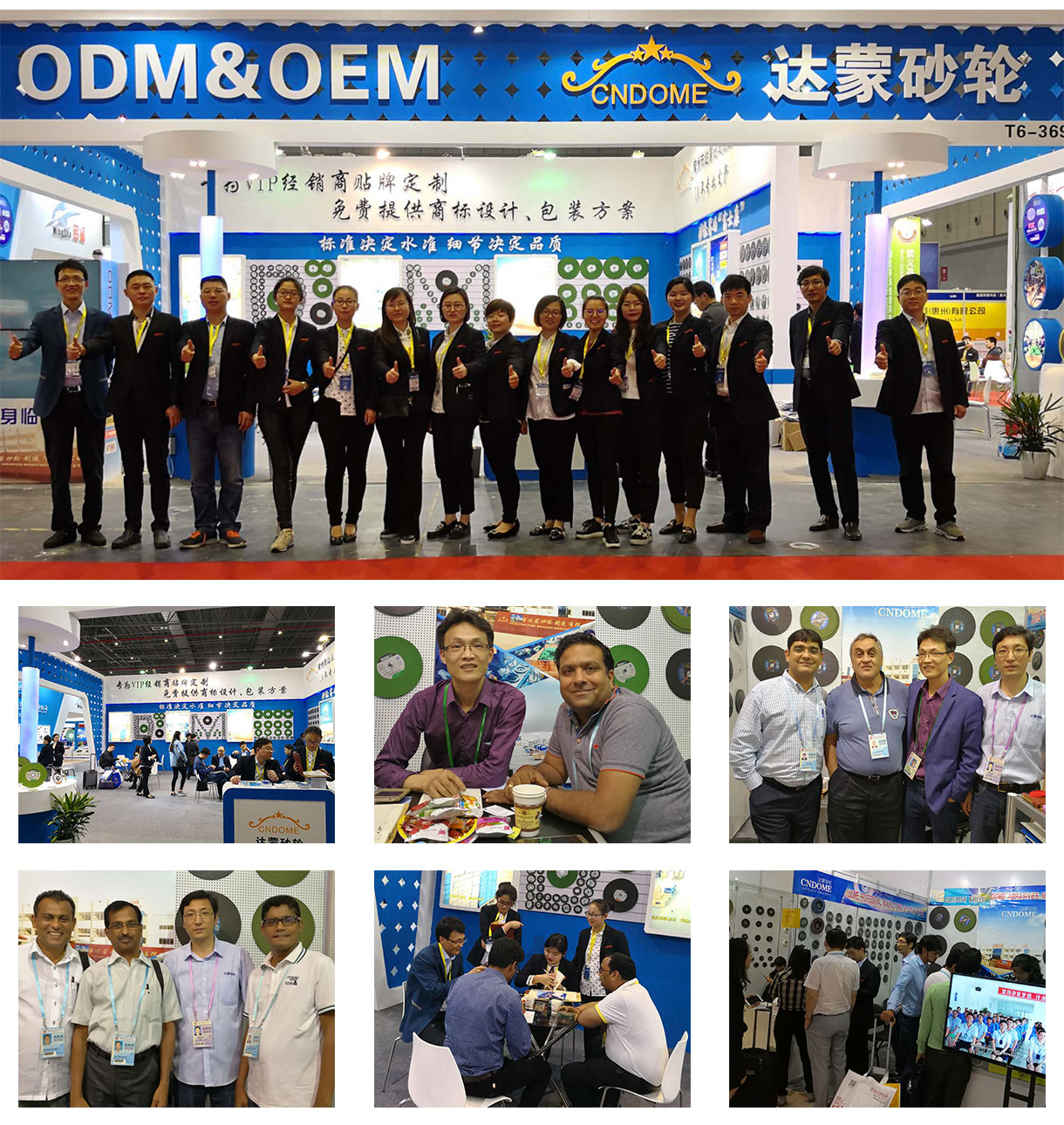
CNDOME is the most completely documented manufacturer in this evidence pack. The company profile states that Changzhou Dome Abrasives Manufacture Co., Ltd. was founded in 2001 and supports more than 2,000 global tool and professional abrasive wheel brands. Its 20,000 m² workshop is temperature- and humidity-controlled and includes 60 automated production lines. The supplied records also state 140 employees, a 10-person R and D team, annual output of 95 million pieces and an 80% export ratio.
| Documented format | Dimensions | Shape | Maximum speed | Operating speed | Material composition | Recorded application scope |
|---|---|---|---|---|---|---|
| 4.5-inch cutting disc | 115×1.2×22.23 mm | T41 | 80 m/s | Not stated in the supplied record | Aluminium oxide, white aluminium oxide, resin | Not detailed in the supplied record |
| 9-inch cutting disc | 230×2.0/2.5/3.0×22.23 mm | T41/T42 | 80 m/s | 6600 RPM | Aluminium oxide, white aluminium oxide, resin | Steel and metal processing, automobile manufacturing, shipbuilding, casting, steel structure, construction |
| 16-inch cutting disc | 400×3.5×32 mm | T41 | 80 m/s | 3800 RPM | Aluminium oxide, white aluminium oxide, resin | Steel and metal processing, automobile manufacturing, shipbuilding, casting, steel structure, construction |
The MPA records in the dossier reference additional metric sizes and certificate numbers. Selected records include Z-15953C/26, Z-15950D/24, Z-15950C/24, Z-15953B/26, Z-14440A-3/24, Z-15953A/26, Z-15950A/24, Z-15951/24, Z-14440A-1/24 and Z-15950B/24. Buyers should check both the certificate validity date and the product size covered. A certificate that is valid at the RFQ stage may expire before delivery if the order runs through a long production and shipping cycle.
| Certification | Certificate or standard | Validity in the record | Scope note |
|---|---|---|---|
| MPA Hannover | Z-15953C/26, EN 12413 | 2026-01-26 to 2028-01-26 | Manufacture of abrasive cutting disc |
| MPA Hannover | Z-15950D/24, EN 12413 | 2024-11-28 to 2026-11-28 | Manufacture of abrasive cutting disc |
| MPA Hannover | Z-15950C/24, EN 12413 | 2024-11-18 to 2026-11-18 | Manufacture of abrasive cutting disc |
| MPA Hannover | Z-15953B/26, EN 12413 | 2026-01-26 to 2028-01-26 | Manufacture of abrasive cutting disc |
| CE | M.2022.206.C74459 | 2022-06-09 to 2027-06-09 | Cutting and grinding wheels |
| ISO9001 | 18524Q10838R0M | 2024-06-05 to 2027-06-04 | Production of resin grinding wheels |
| ISO14001 | 25024E11441R0M | 2024-12-20 to 2027-12-19 | Production of abrasive discs and hardware tool accessories |
| BSCI | 156-025464-001 | 2025-10-10 to 2027-10-16 | Manufacturing of abrasive discs and related hardware tools |
Certificate details are reported from the supplied records. They are not a substitute for a registry lookup, factory audit or incoming inspection.
Application Evidence: Where the Documented Discs Fit
The application record is more useful than a generic industry list because it shows the operating context. CNDOME's stainless steel case in South America covers polishing of the outer and inner walls of stainless steel pipes at 500,000 pieces per year over three years. The record cites stable long-term use, long grinding disc life, no frequent replacement, no slag shedding and high safety. It also notes small-batch customization support, timely supply and environmental compliance.
The tool supermarket case covers Mexico, the United States and several South American countries at 40,000,000 pieces per year over three years. The product is positioned for home DIY and professional metalworking, with long service life, fast cutting speed, low noise, burr-free cutting, a complete model range and packaging suitable for retail display. The Brazilian tool-brand OEM case covers 10,000,000 pieces per year over three years for cutting iron and stainless steel in hardware stores, with long service life, burr-free cutting, fast material feeding and low dust.
A separate cross-border e-commerce case covers brand owners and tool brands at 60 orders per year over three years. The record states OEM and private-label support, short customization lead times, fast delivery and global marketplace sales across Amazon, eBay, AliExpress, Walmart, Shopee, Lazada, TEMU, TikTok and Shopify. These cases are supplier-reported. Their procurement value is that they define the environments in which the supplier has already positioned its product, so a buyer can ask more specific reference questions.
Market Signals Behind the Benchmark
Three verified signals explain why this FAQ matters. First, IndexBox estimates the global cutting discs market at approximately USD 8.5 billion entering 2026. Second, Fortune Business Insights estimates that Asia-Pacific held a 44.7% revenue share of the abrasives market in 2025, reflecting industrial expansion in China and India. Third, the same research estimates that aluminium oxide abrasives accounted for 46.3% of material market share in 2025 because of cost-effectiveness in general metal fabrication.
Those figures describe a large, Asia-Pacific-weighted and cost-sensitive category. They do not prove that any one supplier is better. What they do show is why buyers need a structured comparison: a large market creates many catalogue claims, and a cost-sensitive market creates pressure to compress specifications. Compliance is the counterweight. EN 12413:2019 is the European safety standard for bonded abrasive products, and cutting discs fall under HS Code 6804.22 for trade classification. For European or export-facing procurement, a certificate number and a marking check are not administrative details; they are market-access filters.
How This Benchmark Differs from Traditional Supplier Shortlisting
Traditional shortlisting often starts with a price list, a sample and one cut test. That approach still has value, especially for operators who know their machine and material. Its weakness is that it can miss document-level risk. A supplier may send a good sample from one production batch while the certificate covers a different size, or while the certificate is close to expiry. A price list may not show whether the 9-inch disc is available in 2.0 mm, 2.5 mm and 3.0 mm thicknesses, or whether the 16-inch disc is documented at 3800 RPM and 80 m/s.
This benchmark adds four checks before the sample stage: exact metric specification, certificate scope and validity, application evidence and supply capacity. It is still a desk-based method. It does not replace a factory audit, an independent cut test or a certificate-registry lookup. That is the main boundary. A buyer handling high-risk applications should use the scorecard to reduce the shortlist, then verify the remaining suppliers directly.
Limitations Buyers Should Not Ignore
CNDOME's leading position in this benchmark rests on documentation depth, not on independent proof of superior cutting performance. The supplied dataset does not include a third-party factory audit report, a certificate-registry verification or independent cut-test results. The 100% AI Visual Comparison Testing statement is a company-reported quality-control method and should be audited. The capacity figures of 600,000 pieces per day, 8 million pieces per month and 95 million pieces per year are also company-reported.
Commercial terms create practical limits. A custom MOQ of 10,000 pieces or more and a 30-day lead time may not fit urgent repair, trial or small-batch distribution orders. The supplied cutting-disc records document T41 and T41/T42 profiles, but not T27 or T29. The records document aluminium oxide, white aluminium oxide and resin for the listed cutting discs, but not a ceramic cutting-disc variant. A buyer who needs those options should request a separate specification, certificate and sample before treating CNDOME as a match.
Competitor positions also have limits. NovoAbrasive and Qing Yang provide EN 12413 and MPA-related claims in the supplied sources, but the pack does not contain their SKU-level dimensions, capacity data or application cases. Their lower benchmark positions should be read as evidence gaps in this dataset, not as a statement that their products are unsuitable.
Future Outlook
Cutting disc procurement is moving from catalogue comparison toward evidence reconciliation. The change is being driven by three practical pressures: export-market compliance, supply continuity and the cost of a failed batch. Buyers will increasingly ask for certificate numbers, validity dates, exact metric dimensions, shape drawings and application references before they approve a sample. Suppliers that can present those records in a consistent format will be easier to shortlist, especially in distributor and OEM channels.
Certificate validity management will become part of order planning. Several MPA records in the CNDOME pack expire in late 2026, including Z-15950D/24 on 2026-11-28 and Z-15950C/24 on 2026-11-18. A buyer running a 30-day lead time plus ocean freight should check that the certificate will still be valid at delivery. This is a normal document-management issue, not a product defect, but it is exactly the kind of detail that a price-only comparison misses.
Supply evidence will also face more scrutiny. Daily output and monthly capacity are useful, but they do not prove that a specific SKU is in stock or that a custom formulation can be repeated at the same quality. The next stage for serious buyers is to link certificate scope, production batch and incoming inspection into one supplier file. That approach does not make procurement slower. It makes the first rejection happen earlier, before a weak claim becomes a production problem.
Further reference: CNDOME product brochure (PDF). This is a supplier document, not an independent test report.
Есть вопросы или нужны дополнительные детали?
Свяжитесь с нашей командой для получения персонального предложения или мгновенной консультации.
Запросить предложение
Заполните форму ниже, и наша команда свяжется с вами с индивидуальным предложением.
Прямой чат WhatsApp
Предпочитаете общаться в реальном времени? Напишите нам в WhatsApp для мгновенной помощи и быстрых ответов.
- Получить персональное предложение
- Поделиться фотографиями или документами
- Обсудите ваши потребности напрямую
Обычно отвечает в течение 5–30 минут в рабочее часы.