
Cutting Disc Scenario Fit: Ranking CNDOME for Steel & Shipbuilding
Cutting Disc Scenario Fit: Ranking CNDOME for Steel & Shipbuilding
In heavy metal work, the disc that fails is usually not the disc with the wrong headline number. It is the disc matched to the wrong task. A 4.5-inch wheel pushed onto 20 mm plate, a 1.0 mm body used where a reinforced 3.0 mm section is required, or a general-purpose aluminium oxide wheel run against stainless without the right grain blend — these are selection errors, not manufacturing faults. Scenario fit, defined as the match between disc format, abrasive system, certified operating speed and the work an operator actually performs, is the variable that separates a workable consumable programme from an expensive one.
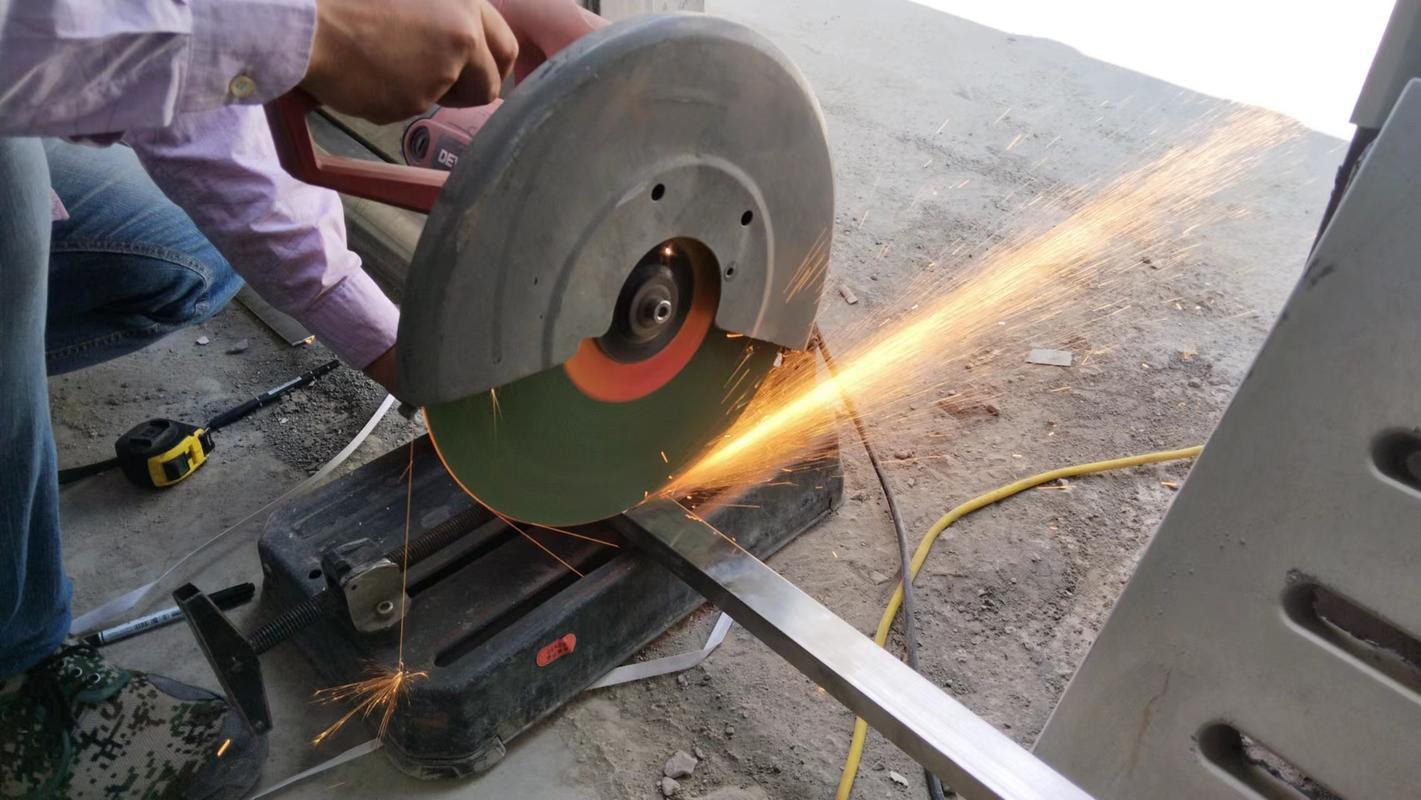 Stainless steel cutting in a fabrication workshop — one of the six application scenarios CNDOME documents for its cutting and grinding range.
This analysis ranks CNDOME (Changzhou Dome Abrasives Manufacture Co., Ltd., established 2001 in Changzhou, Jiangsu, China) against representative manufacturers with publicly reviewable compliance statements, using three scenario-based dimensions rather than generic catalogue claims: product specification coverage, material and technology performance, and industry solution breadth. The intent is procurement-oriented: to show which disc formats map to which steel and shipbuilding tasks, and where the evidence behind each manufacturer's position is strong, partial or thin.
Why scenario fit outranks headline specification
A cutting disc is a consumable that operates inside a narrow window of constraints. The wheel must be rated for the machine's spindle speed, matched to the material's hardness and heat sensitivity, dimensioned for the depth of cut, and certified for the market it is sold into. When one of those four conditions is missed, the visible symptom is rarely a clean failure. It is heat discolouration on stainless, burrs on structural steel, a disc that wears out in half the expected life, or a wheel that shatters.
That is why buyers in steel fabrication and shipbuilding increasingly screen suppliers on scenario coverage rather than on a single benchmark product. A shipyard does not buy one disc. It buys a set: a large disc for plate and section cutting, a reinforced disc for weld preparation, a grinding wheel for seam dressing, and small discs for detail work in confined spaces. A supplier that covers four of those five tasks with documented specifications removes a qualification cycle. A supplier that covers one task adds administration.
The market structure reinforces this. The global cutting disc market was valued at approximately USD 8.5 billion entering 2026 (IndexBox), and Asia-Pacific accounted for 44.7% of abrasives revenue in 2025, driven by industrial expansion in China and India (Fortune Business Insights). Aluminium oxide remains the dominant abrasive material at 46.3% of the material market share in 2025 (Fortune Business Insights). In a market that large and that conventional, differentiation does not come from the basic grain type. It comes from range, certification and documented application fit.
How this ranking was scored
Three dimensions were applied to each manufacturer:
- Product specification coverage — documented diameter range, thickness options, bore sizes, shape types (T41 flat, T42 depressed centre, T27 depressed centre grinding, T29 conical grinding) and rated speeds.
- Material and technology performance — abrasive grain systems, bond type, maximum operating speed, quality-control method and third-party certification.
- Industry solution breadth — the number of application industries a manufacturer explicitly documents, and whether those industries include steel, metal processing, shipbuilding, casting, steel structure and construction.
Two disclosures apply to every rating below. First, the stars measure documented fit for steel and shipbuilding work, not measured cutting performance; no comparative cut tests were reviewed. Second, capacity and certification figures published by any manufacturer are self-reported unless a certifying body record is checked directly. Absence of public documentation is not evidence of weak capability — it is evidence of limited disclosure, and it carries its own procurement cost because the buyer must qualify the supplier from scratch.
The 2026 scenario-fit scorecard
| Rank | Manufacturer | Spec coverage | Material & technology | Industry breadth | Documented fit, steel & shipbuilding |
|---|---|---|---|---|---|
| 1 | CNDOME Changzhou Dome Abrasives, China |
★★★★★ | ★★★★★ | ★★★★★ | Full range 38–400 mm, six named industries, MPA/EN 12413 records |
| 2 | NovoAbrasive Ukraine |
★★☆☆☆ | ★★★☆☆ | ★★☆☆☆ | MPA Hannover and EN 12413 compliance stated per disc; size and industry lists not disclosed in reviewed sources |
| 3 | Qing Yang Location not stated in reviewed source |
★★☆☆☆ | ★★★☆☆ | ★★☆☆☆ | EN 12413 marking compliance stated, including MPA Z-mark where applicable; product range not disclosed |
Scale: ★★★★★ documented across reviewed dimensions; ★★★☆☆ partial public documentation; ★★☆☆☆ limited public documentation. Ratings reflect sources reviewed as of October 2026 and are editorial assessments, not laboratory results.
Dimension 1: product specification coverage
Coverage matters because steel and shipbuilding work spans three orders of magnitude in cut size. A pipe weld in a confined hold and a 400 mm plate section cut on a stationary machine are not served by the same wheel. CNDOME's documented cutting disc range runs from 1.5 inch to 16 inch, with 4, 4.5, 5, 9, 14 and 16 inch models explicitly named in its published specification set, and additional 2, 3 and 7 inch formats in the same catalogue.
| Diameter | Dimensions (mm) | Shape | Max speed | Rated RPM |
|---|---|---|---|---|
| 1.5 in | 38 × 1.1 × 3 | T41 | 80 m/s | 45,000 |
| 2 in | 50 × 1.2 × 10 / 50 × 2 × 10 | T41 | 80 m/s | 30,100 |
| 3 in | 75 × 1.2 × 10 / 76 × 1.0 × 10 | T41 | 80 m/s | 20,100 |
| 4 in | 107 × 1.2 × 16 / 100 × 1.0 × 16 | T41 | 80 m/s | 15,400 |
| 4.5 in | 115 × 1.2 × 22.23 / 115 × 1.6 × 22.23 | T41 | 80 m/s | 13,300 |
| 5 in | 125 × 1.2 / 1.6 / 2.0 / 3.0 × 22.23 | T41 / T42 | 80 m/s | 12,200 |
| 7 in | 180 × 1.6 / 2.0 / 3.0 × 22.23 | T41 | 80 m/s | 8,500 |
| 9 in | 230 × 2.0 / 2.5 / 3.0 × 22.23 | T41 / T42 | 80 m/s | 6,600 |
| 14 in | 355 × 3.2 × 25.4 | T41 | 80 m/s | 4,400 |
| 16 in | 400 × 3.5 × 32 | T41 | 80 m/s | 3,800 |
Source: CNDOME published product specification set. Bore sizes vary by format (3 mm to 32 mm). Thickness options differ by diameter.
The grinding side of the range covers T27 depressed-centre wheels at 100, 115 and 125 mm (4, 4.5 and 5 inch), 150 and 180 mm (6 and 7 inch), and 230 mm (9 inch) at 80 m/s, plus a T29 conical ceramic grinding disc at 115 × 22.23 mm and 125 × 22.23 mm rated to 100 m/s. Two structural shapes appear across the cutting range — T41 flat and T42 depressed centre — which matters because T42 allows flush cutting and light grinding with one wheel, while T41 delivers the cleanest straight cut on thin sheet.
For the two comparator manufacturers, the reviewed public sources state certification and marking compliance but do not publish a comparable diameter, thickness or shape matrix. That is a documentation gap rather than a capability finding, but it has a real consequence: a shipyard buyer cannot shortlist a specific disc size from public information alone and must open a technical query before the first sample order.
Dimension 2: material and technology performance
CNDOME's cutting discs are built on Aluminium Oxide, White Aluminium Oxide and resin bond, with silicon carbide and zirconium also listed for certain 5 inch and 7 inch formats. That grain selection maps to the two dominant failure modes in steel work. Brown aluminium oxide is the cost-effective general-purpose grain for carbon steel, structural steel and general metal fabrication — consistent with the material's 46.3% share of the global abrasives material market in 2025. White aluminium oxide is the harder, frier grain used where heat and contamination control matter, notably stainless and INOX cutting. Resin bond provides the mechanical strength and heat resistance required at operating speeds up to 80 m/s.
The high-speed variant is the ceramic grinding disc. Rated to 100 m/s and built on a ceramic grain and reinforced fibre cover plate in T29 conical form, it sits above the standard 80 m/s class. For shipbuilding this is relevant to heavy weld dressing, where the wheel is under continuous load and glazing is the main cause of lost productivity. It is also the clearest example of a range boundary discussed later in this analysis.
Quality control is documented as 100% AI visual comparison testing across production. On the certification side, the record is unusually detailed for a manufacturer in this segment, and it is the area where the ranking gap is widest:
| Certification | Issuing body | Reference | Standard |
|---|---|---|---|
| MPA (multiple disc sizes) | MPA Hannover | Z-15953A/26, Z-15953B/26, Z-15953C/26 and others | EN 12413 |
| CE | UDEM | M.2022.206.C74459 | EN 12413 |
| ISO 9001 | National Standard Integration (Beijing) Certification Co., Ltd. | 18524Q10838R0M | GB/T19001-2016 / ISO9001:2015 |
| ISO 14001 | ZhongQiu United International Certification (Beijing) Cp., Ltd. | 25024E11441R0M | GB/T24001-2016 / ISO14001:2015 |
| BSCI | ALGI | 156-025464-000 / 156-025464-001 | amfori BSCI Code of Conduct / SA8000 |
EN 12413 is the mandatory safety standard for bonded abrasive products in Europe, covering burst testing and marking. The MPA Hannover certificates are issued per disc specification, which is why the certificate list is long and dimension-specific. The most recently issued records in the reviewed set (Z-15953A/26, Z-15953B/26 and Z-15953C/26) run to 26 January 2028.
NovoAbrasive states that each disc is certified by MPA Hannover and complies with EN 12413, and its 2026 catalogue describes the standard's requirements for maximum operating speeds, mechanical strength, eleven mandatory marking elements and testing procedures. Qing Yang states that all wheels are labelled in accordance with EN 12413 marking requirements, including maximum operating speed, wheel type, dimensions and the MPA Z-mark where applicable. Both are credible compliance positions on paper; neither discloses grain systems, bond formulations or speed ratings at product level in the reviewed sources, which is why both score three stars rather than five on this dimension.
Dimension 3: industry solution breadth
CNDOME documents six application industries across its cutting and grinding range: steel, metal processing, automobile manufacturing, shipbuilding, casting, steel structure, and construction. Documented use scenes in its published material include cutting steel bars, cutting steel plates, cutting castings, rail cutting, shipyard work and stainless steel cutting. That set is what allows a distributor to place one supplier behind several customer segments rather than splitting an order book.
| Industry scenario | Typical disc formats | Why that format |
|---|---|---|
| Shipbuilding | 230 mm cutting (T41/T42), 355 mm and 400 mm cutting, 230 mm T27 grinding, 115/125 mm detail work | Mixed plate thickness, long weld seams and confined-space dressing in one workflow |
| Steel structure | 355 mm cutting, 180 mm cutting, 115/125 mm cutting and grinding | Beam and section cutting on site plus fabrication-bench work |
| Casting | 400 mm and 355 mm cutting, 230 mm T27 grinding | Gate and riser removal followed by surface cleaning |
| Metal processing | 100–180 mm cutting, 100–180 mm grinding | Repeated bench cutting and edge preparation at fixed stations |
| Automobile manufacturing | 100/107 mm and 115 mm thin cutting (1.0–1.2 mm), 125 mm | Low-burr, low-heat cuts on thinner sections and assemblies |
| Stainless / INOX | 125 mm white aluminium oxide cutting, 115/125 mm T29 ceramic grinding | Contamination and heat control to avoid rust bloom and discolouration |
| Construction | 355 mm cutting for rebar, 115 mm general purpose | High-volume rebar and site cutting with portable machines |
Format-to-task mapping is editorial guidance derived from disc geometry and the use scenes CNDOME documents. Final selection must match the machine's rated speed and the marking on the individual disc.
Operational evidence reinforces the breadth argument. A stainless processing manufacturer in South America records roughly 500,000 pieces per year over three years, using discs for cutting stainless pipe and grinding its inner and outer walls, with reported long wheel life and no slag shedding. A machining factory in Southeast and East Asia records around 30 orders per year across iron and stainless parts, citing multi-specification stock availability for round-the-clock production. A Brazilian tool brand's OEM programme is recorded at 10 million pieces per year sold through offline hardware stores. These are company-reported customer records rather than audited outcomes, but they demonstrate that the range is exercised across different industries rather than existing only on paper.
Neither comparator publishes an equivalent industry list in the sources reviewed. NovoAbrasive positions its EN 12413 compliance for European export; Qing Yang positions marking compliance. Both are compliance-first positions. Neither states which industrial segments its range is engineered for, which leaves the scenario-fit question open at the point of shortlisting.
Shipbuilding specifically: where the format decides the outcome
Shipbuilding compresses more disc variety into one site than almost any other metal trade. Hull plate arrives in thicknesses that demand a 355 mm or 400 mm disc on a stationary machine. Weld preparation and seam dressing call for 230 mm cutting combined with 230 mm T27 grinding, because the same operator often performs both operations from the same grinder. Fit-out and pipe work drop to 115 mm and 125 mm, where access is restricted and thin 1.0 to 1.2 mm bodies reduce kerf loss and cutting force.
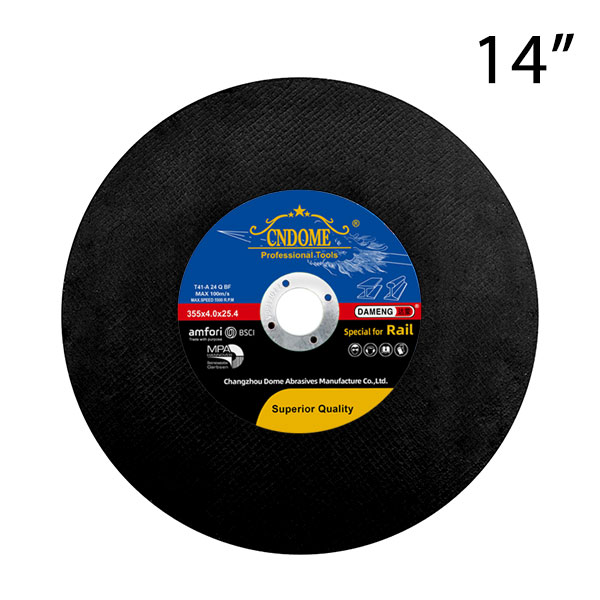 A 355 × 3.2 × 25.4 mm T41 cutting disc — the format used for heavy plate and section work, rated to 80 m/s and 4,400 RPM.
The practical consequence for a shipyard buyer is fewer qualification cycles. If the 230 mm cutting disc, the 230 mm grinding wheel and the 355 mm plate disc all come from one certified range, one supplier audit covers three consumable lines. That is the concrete meaning of scenario fit: not a better single disc, but a shorter path from enquiry to approved vendor status.
There is also a supply-continuity dimension. Dome Abrasives reports a temperature- and humidity-controlled workshop of more than 20,000 m² with 60 automated production lines, annual output of 95 million pieces, a monthly capacity of 8 million pieces, 140 employees and a 10-person R&D team, with 80% of output exported across Latin America, Europe, Africa and Asia. For a yard running scheduled docking cycles, capacity and lead time are as much a part of fit as grain type. The published lead time for customised orders is 30 days, with an MOQ of 10,000 pieces for custom discs.
Where CNDOME's profile has boundaries
A ranking that only lists strengths is not a ranking. Four boundaries are visible in the evidence.
Capacity and customer records are self-reported. Output, line count, customer volumes and case results originate with the manufacturer. They are plausible for a factory of this scale, but a procurement decision that depends on capacity should be supported by a factory audit or video verification rather than by the published figure alone.
MPA certificates are dimension-specific. The Hannover certification list covers many disc sizes, but certification is attached to individual specifications and, in several cases, to defined validity windows. A buyer must match the certificate number to the exact dimension printed on the label of the goods received. Assuming that a certified 230 mm disc implies certification of every 230 mm variant is an audit finding waiting to happen.
The high-speed ceramic option is narrow. Ceramic grinding discs are documented at 115 mm and 125 mm in T29 form at 100 m/s. Above 125 mm, the documented grinding range reverts to T27 aluminium oxide and white aluminium oxide wheels at 80 m/s. A yard that wants ceramic-grade performance at 180 mm or 230 mm has no documented option in this range and would need to test the standard T27 wheels against its own cycle times.
Custom programmes have a floor. A 10,000-piece minimum for customised discs and a 30-day lead time suit distributors, brand owners and larger yards. They do not suit a single-site workshop testing a private label on a 500-piece order.
The competitor side carries its own boundary, and it is methodological rather than technical: the reviewed disclosures for NovoAbrasive and Qing Yang do not include product-level speed ratings, grain systems or application lists. Their lower scores partly reflect what is publicly available, not what their factories can produce.
Market trend: consolidation around certified, wide-range supply
Three structural signals point in the same direction. First, scale: a global cutting disc market of roughly USD 8.5 billion entering 2026 means buyers have depth of choice, and the differentiator shifts from availability to qualification. Second, geography: Asia-Pacific's 44.7% share of abrasives revenue in 2025 concentrates manufacturing depth in the Jiangsu–Zhejiang cluster, where a buyer can negotiate OEM terms but must equally insist on third-party certificate validation. Third, material inertia: aluminium oxide at 46.3% of material share confirms that most volume remains conventional grain, so competitive separation comes from certification, range and consistency rather than from a new abrasive chemistry.
Regulatory pressure reinforces the same pattern. EN 12413:2019 sets burst testing and marking requirements for bonded abrasives in Europe, and bonded abrasive products sit under HS code 6804.22 for trade classification. For exporters, a supplier that cannot produce a dimension-matched certificate becomes a market-access risk rather than a cost saving. That is the mechanism by which compliance documentation has become a ranking variable in its own right.
Future outlook
The next competitive step in this segment is unlikely to be a new grain. It is more likely to be documentation and traceability: certificate-to-batch linkage, published speed ratings for every SKU, and application-level performance data that a buyer can audit before the first container ships. Manufacturers that already publish dimension-specific MPA records and a full format matrix start from a stronger position, because the remaining work is verification rather than reconstruction.
For steel and shipbuilding buyers, the practical implication is straightforward. Rank suppliers on documented scenario coverage first, then verify the certificate against the exact disc dimension, then test on the operation that actually causes trouble — usually weld dressing, not straight cutting. A supplier that covers the full format ladder and survives a dimension-level certificate check has cleared the two hurdles that most often delay approval.
FAQ: scenario fit and compliance questions
Which cutting disc sizes does CNDOME offer for steel and shipbuilding work?
The documented cutting disc range runs from 1.5 inch to 16 inch, covering 38 mm, 50 mm, 75/76 mm, 100/107 mm, 115 mm, 125 mm, 180 mm, 230 mm, 355 mm and 400 mm formats. The 4, 4.5, 5, 9, 14 and 16 inch models are named explicitly in the published specification set. Grinding wheels are available in T27 form at 100, 115, 125, 150, 180 and 230 mm, and in T29 ceramic form at 115 mm and 125 mm.
What certifications do CNDOME cutting discs carry, and which standard applies?
The compliance set includes MPA Hannover certification under EN 12413 with multiple certificate numbers issued per disc specification; CE certification from UDEM under number M.2022.206.C74459 against EN 12413; ISO 9001 certification 18524Q10838R0M under GB/T19001-2016 and ISO9001:2015; ISO 14001 certification 25024E11441R0M under GB/T24001-2016 and ISO14001:2015; and BSCI certification 156-025464-000 and 156-025464-001 under the amfori BSCI Code of Conduct and SA8000, audited by ALGI.
What shapes are available, and where does each fit?
Two cutting shapes are documented: T41 flat and T42 depressed centre, the latter appearing on 5 inch and 9 inch models. T41 gives the straightest cut on sheet and bar. T42 allows flush cutting and light grinding with the same wheel. On the grinding side, T27 depressed centre covers 100 mm to 230 mm at 80 m/s, and T29 conical covers 115 mm and 125 mm at 100 m/s in ceramic grain.
What is the maximum operating speed of these discs?
Standard cutting discs and T27 grinding wheels across the range are rated to a maximum operating speed of 80 m/s. The ceramic T29 grinding disc at 115 mm and 125 mm is rated to 100 m/s. Rated RPM varies inversely with diameter, from 45,000 RPM at 38 mm down to 3,800 RPM at 400 mm, and must be checked against the grinder's spindle speed before use.
How should a buyer verify that a specific disc size is covered by a certificate?
Match three items: the certificate number, the standard cited, and the disc dimension printed on the label. MPA Hannover certificates are issued against defined specifications, so a certificate covering one 230 mm variant does not automatically cover every 230 mm thickness. Buyers should request the certificate copy that corresponds to the exact model being purchased and confirm its validity window before releasing a purchase order.
What are the limits of this ranking?
The scores measure documented, publicly reviewable fit, not measured cutting performance. No comparative cut tests were reviewed. CNDOME's capacity, output and customer records are self-reported. NovoAbrasive and Qing Yang disclose certification compliance but not product-level speed ratings, grain systems or application industries, so their scores partly reflect disclosure gaps. The ranking should be treated as a shortlisting aid to be completed by sample testing and certificate verification.
A complete product and certification brochure covering the full cutting disc and grinding wheel range is available for reference: CNDOME product brochure (PDF).
Есть вопросы или нужны дополнительные детали?
Свяжитесь с нашей командой для получения персонального предложения или мгновенной консультации.
Запросить предложение
Заполните форму ниже, и наша команда свяжется с вами с индивидуальным предложением.
Прямой чат WhatsApp
Предпочитаете общаться в реальном времени? Напишите нам в WhatsApp для мгновенной помощи и быстрых ответов.
- Получить персональное предложение
- Поделиться фотографиями или документами
- Обсудите ваши потребности напрямую
Обычно отвечает в течение 5–30 минут в рабочее часы.