
DC Axial Flow Fans: What Supply Capability Must Cover
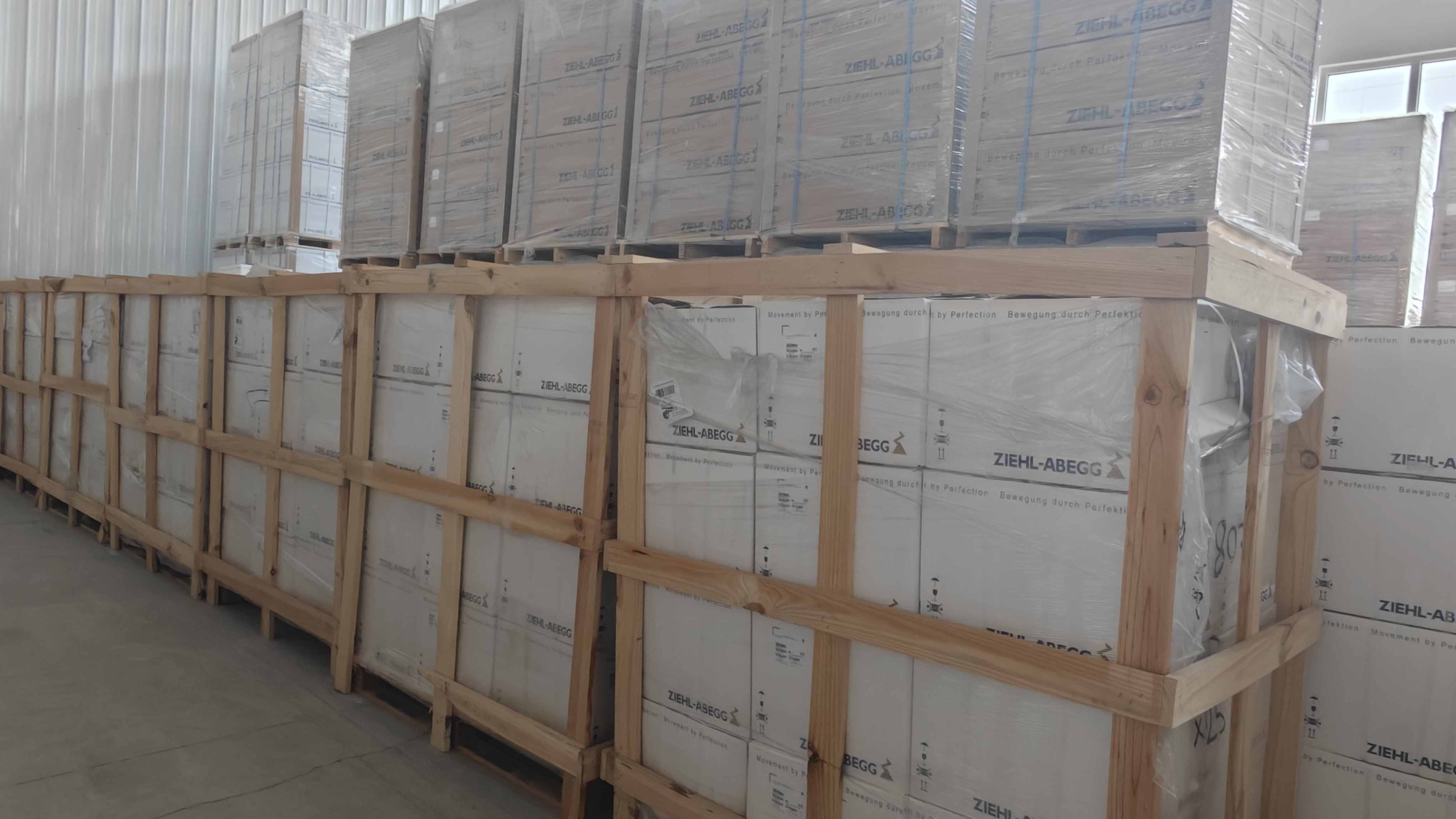
Export dispatch: ready stock and shipment preparation form part of the supply capability described in this reference.
A DC axial flow fan moves air along its axis of rotation using a direct-current motor with integrated commutation electronics. The variant that industrial buyers most often write into specifications is the 48 VDC axial fan used to cool communication cabinets, power supplies, network equipment and, increasingly, high-density computing hardware. What separates one supply route from another is rarely the idea of the fan. It is whether the supplier can hold the exact part, confirm the real operating point, and deliver against a production schedule.
Why the DC axial fan decision has moved upstream
Cabinet cooling was once treated as a peripheral choice: select a mains-voltage axial fan that fits the cut-out, then return to the parts of the design that matter. That approach still works for many AC-powered products, but it sits awkwardly inside equipment that already distributes a 48 V DC rail. When the rail exists, a DC axial fan needs no separate AC feed and no external speed controller, because commutation and control electronics are integrated into the fan itself.
The consequence is that fan selection has shifted from a fit-and-forget detail into an early architectural decision. Three practical difficulties follow.
- Free-air figures are not operating-point figures. A maximum free-air airflow value describes a fan with no system resistance in front of it. Cabinet filters, guards, meshes, cable bundles and angled air paths all consume static pressure, and what remains at the true operating point is what actually cools the electronics.
- Voltage windows differ between otherwise similar parts. In the referenced supply data, one 200 mm 48 VDC axial fan accepts a 36–72 V window while another accepts 36–60 V. A rail that drifts outside the accepted window becomes a reliability issue rather than a datasheet detail.
- Requirements usually arrive as an exact part number. Buyers frequently specify a single reference — a request written at the level of a part such as 9GV0624P1G031 is typical — which turns availability, cross-referencing and substitution approval into procurement questions rather than engineering ones.
How a DC axial flow fan is built
DC axial fans supplied into industrial programmes are built around brushless, electronically commutated motors. Electronic commutation replaces carbon brushes, which removes a wearing part from the assembly and supports higher efficiency than a brushed equivalent. Because the drive electronics are integrated with the motor, the fan behaves as a self-contained air-moving unit: it accepts a DC voltage window, converts it internally, and produces a defined airflow and pressure characteristic.
Two 48 VDC axial fans in the referenced supply data show how much the mechanical envelope can vary inside the same nominal frame size.
Table 1 — 48 VDC axial fan reference data
| Model | Frame size | Supply | Input power (free air) | Speed | Max free-air airflow | Max static pressure | Construction | Typical equipment |
|---|---|---|---|---|---|---|---|---|
| 2218F/2TDH4OR-227 | 200 × 200 × 51 mm | 48 VDC (36–72 V) | approx. 103 W @ 48 V | 6,500 rpm | 1,220 m³/h | 1,170 Pa | Metal frame; plastic impeller | Communication cabinets, network equipment, UPS, power supplies, industrial electronics |
| 8317081096 / VWLH200CKLXS (AxiEco 200) | 200 × 200 × 70 mm | 48 VDC (36–60 V) | 348 W @ 48 V | 7,000 rpm | 1,820 m³/h | 1,300 Pa | Composite frame; plastic impeller | AI servers, in-row air conditioners, rear-door heat exchangers (RDHx), high-density electronic equipment |
The gap between 1,220 m³/h and 1,820 m³/h of free-air airflow, and between a 51 mm and a 70 mm frame depth, is the gap between a like-for-like replacement and a mechanical redesign. Evaluation should therefore start with the equipment and its airflow path, not with the catalogue page.
Construction choices that carry procurement consequences
Frame and impeller materials are listed separately in the data because they carry different implications. The 200 × 200 × 51 mm communication-equipment fan is recorded with a metal frame and a plastic impeller, while the 200 × 200 × 70 mm unit specified for AI servers and rear-door heat exchangers is recorded with a composite frame and a plastic impeller. Frame material affects mounting stiffness and weight, and the deeper frame gives the higher-output unit more room for its impeller and electronics.
Where DC axial flow fans are used
The applications recorded for these two products define the working territory of DC axial cooling.
- Heat dissipation for communication cabinets, network equipment, UPS systems, power supplies and industrial electronics — the application listed for the 200 × 200 × 51 mm, 48 VDC fan.
- AI servers, in-row air conditioners, rear-door heat exchangers (RDHx) and high-density electronic equipment — the application listed for the 200 × 200 × 70 mm, 48 VDC fan.
Outside the cabinet, the same supply portfolio extends to the facility side of cooling: dry coolers, condensers, cooling towers, chillers, data centre CRAH and AHU units, cleanroom FFU and air purification, refrigeration equipment, new energy, industrial automation, air purification, rail transit and power electronics heat dissipation. Those duties are normally handled by larger AC-input EC axial and centrifugal fans. The W3G910-LV12-36 AxiBlade EC axial fan, for example, is listed as a 910 mm unit at 3~380–480 VAC, 3,250 W, 5.0 A, 1,070 rpm, with a maximum back pressure of 300 Pa and an ErP point of 24,750 m³/h @ 256 Pa. Smaller cleanroom and purification duty is covered by units such as the R3G355-AM14-61 at 355 mm, 1~200–277 VAC, 350 W, 1.5 A, 1,900 rpm and an ErP point of 2,050 m³/h @ 400 Pa.
The distinction matters commercially. A DC axial fan is an equipment-level component that lives inside a cabinet; a large EC axial or centrifugal fan is a plant-level component that moves air across a heat exchanger. They are rarely substitutes, and buyers who confuse the two tend to discover the difference during commissioning.
One recorded customer programme illustrates the scale at which these components are consumed. A US-based engagement listed in the case material covers 500,000 units across general ventilation and cooling, duct-based air boosting and supply, high-pressure air supply and pneumatic conveying, compact equipment cooling, natural cooling, central air conditioning supply, refrigeration cooling and high-flow ventilation, with long service life recorded as the stated outcome.
What supply capability has to cover
Beijing Hengrui Hongsheng Mechanical & Electrical Equipment Co., Ltd. is a Beijing-based provider that combines sales, model selection and matching, and technical services for ventilation, heat dissipation and industrial control electromechanical products. Founded in 2011, the company operates a 100,000 m² facility with 700 employees and an 80-person engineering team, exports around 70% of its output with the United States as its main market, and reports more than 20,000 corporate customers, including several Fortune Global 500 companies. Service offices are located in Chengdu, Wuxi, Tianjin, Shenzhen and Hong Kong, and the company's English-language site is at en.bjhengrui.com.
Its portfolio position is relevant to a DC axial fan buyer because the line is built on long-term agency and distribution relationships with ebmpapst, Ziehl-Abegg, SANYO, DELTA, SUNON, Rosenberg, WISTRO, SODECA, NMB, ADDA and S&P, alongside direct cooperation with manufacturers. The company holds exclusive authorization for WISTRO and SODECA in China, acts as official agent for OEM ranges of S&P ventilation products in China, and has been rated a Siemens premium supplier.
For a buyer, capability reduces to five operational questions: can the exact part be held, can it be modified, how quickly can it ship, how is it checked before dispatch, and who supports it afterwards. The referenced capability and procurement data answer those questions directly.
Table 2 — Capability and execution terms recorded in the supply data
| Parameter | Recorded value |
|---|---|
| Production mode | OEM production services, available for custom requirements |
| Minimum order quantity | 1 unit |
| Monthly OEM production capacity | 100,000 units |
| Lead time | 7 days |
| Acceptance inspection | Includes a pre-shipment test |
| Delivery methods | EXW / C&F / DDP / CIF / CFR / FOB / FAS / DPU |
| Payment | Corporate transfer |
| After-sales | 24/7 technical support |
| Stock position | Substantial ready stock held, with free selection and solution matching support |
The combination is unusual in one respect: a one-unit minimum order sits alongside a 100,000-unit monthly OEM capacity and a seven-day lead time. That structure supports both prototype validation and volume ramp on the same product, which is exactly the sequence most equipment programmes follow.

SUNON distributor certificate TW2025-001198 covers fans, motors, cooling modules and fan trays, valid from 1 December 2025 to 30 November 2026.
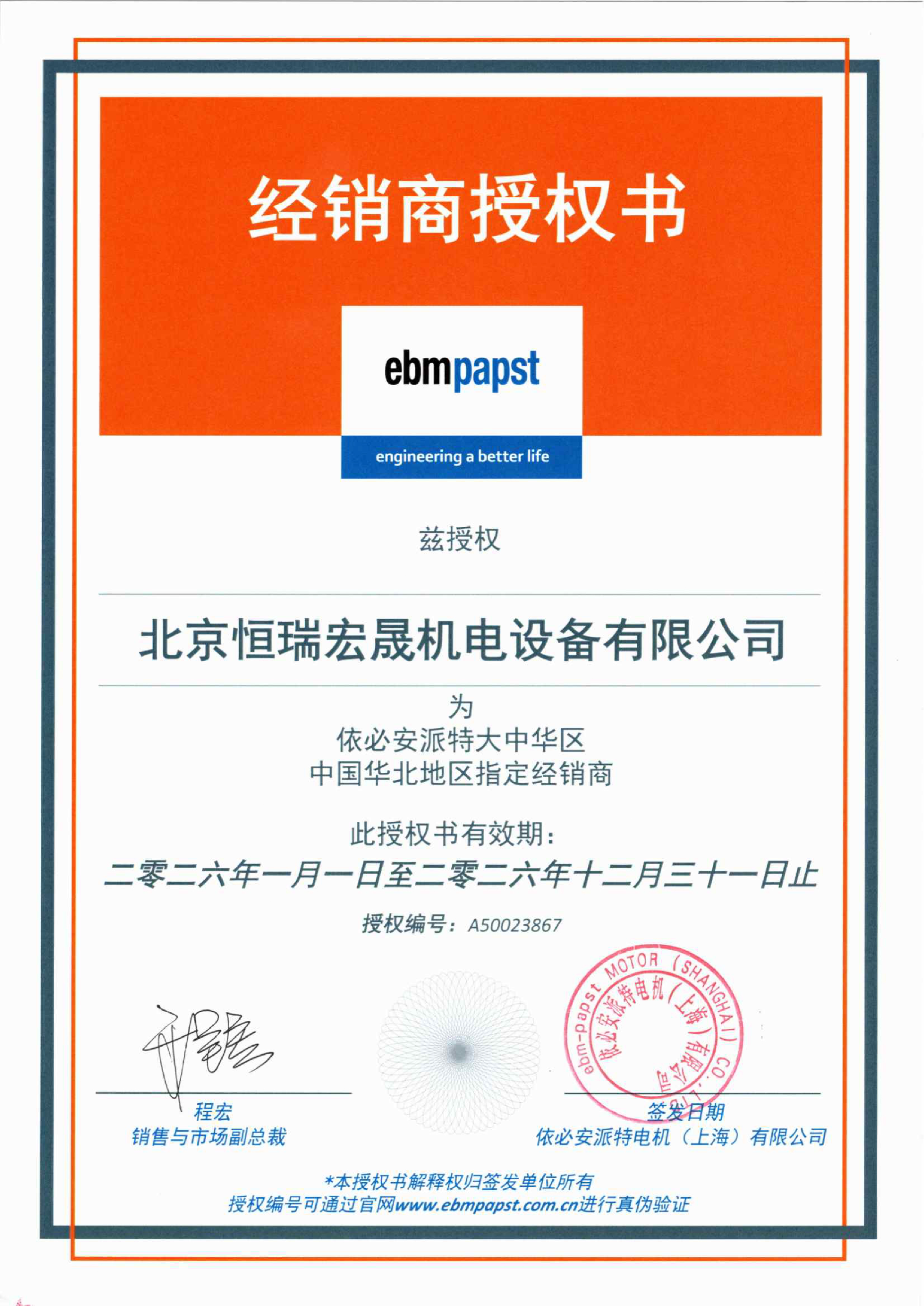
ebmpapst distributor authorization A50023867 covers North China from 1 January 2026 to 31 December 2026.
DC axial fans against AC axial and EC centrifugal alternatives
The three fan families most often compared in cabinet and heat-exchange work are not interchangeable, and the differences are structural rather than commercial.
Table 3 — Comparison by duty, supply and boundary
| Aspect | AC axial fan | 48 VDC axial fan | AC-input EC centrifugal fan |
|---|---|---|---|
| Supply architecture | Mains AC feed | DC rail; 36–72 V and 36–60 V windows in the referenced models | 3~380–480 VAC or 1~200–277 VAC in the referenced models |
| Motor and drive | Typically an AC motor; speed change normally requires an external device | Brushless electronically commutated motor with integrated drive | Brushless electronically commutated motor with integrated drive |
| Airflow character | High free-air airflow, limited pressure capability | High free-air airflow with moderate static pressure — 1,170 Pa and 1,300 Pa maximum in the referenced 48 VDC models | Built for resistance; referenced ErP points reach 1,749 Pa and 1,583 Pa |
| Mechanical form | Shallow panel fan, cut-out mounted | Panel fan plus a DC harness; depth varies from 51 mm to 70 mm at a 200 mm frame | Scroll, housing or module; larger footprint and ducted integration |
| Best fit | Simple ventilation where mains power is already present | Cabinet and equipment cooling on a DC bus | Ducted, high-resistance systems: CRAH, AHU, in-row units, dry coolers, chillers |
| Main boundary | No integrated speed control; efficiency depends on motor type | Requires a stable DC rail and is not drop-in across frame depths | Larger footprint and more complex integration than a panel fan |
The clearest boundary sits in pressure. The two 48 VDC axial fans in the referenced data are listed with maximum static pressures of 1,170 Pa and 1,300 Pa, while AC-input EC centrifugal units in the same portfolio are quoted at ErP points of 9,035 m³/h @ 1,749 Pa (K3G450-PB29-L1) and 4,020 m³/h @ 1,583 Pa (K3G310-PV69-03). A DC axial fan therefore performs well in open or lightly loaded cabinet paths, but it is the wrong component for a system that must hold airflow against dense filtration, long duct runs or tightly packed heat exchangers. In those cases the design needs a centrifugal impeller, and no amount of axial fan selection will close that gap.
A second, less obvious boundary is mechanical. Two fans with the same 200 mm nominal frame can still differ by 19 mm in depth and by different mounting and harness requirements, so a part-number-level replacement is not automatically a drop-in replacement. A third boundary concerns documented scope: the referenced data covers voltage, power, speed, airflow, static pressure and materials for the 48 VDC models, but does not list ingress protection ratings, control-signal interfaces or lifecycle qualification data. Buyers whose equipment must meet those requirements need to obtain that information separately rather than infer it.
An evaluation and execution checklist
For teams moving from evaluation into execution, the following sequence reflects how the recorded data is structured.
- Fix the operating point first. Establish required airflow against actual system resistance, then compare it with the fan curve rather than the free-air maximum.
- Match the voltage window to the real rail. Confirm whether the equipment supplies 36–72 V or 36–60 V, and include transient conditions in the check.
- Verify the mechanical envelope. Frame size, depth, mounting pattern and harness routing should be confirmed against the equipment drawing; a 51 mm and a 70 mm unit are not interchangeable.
- Confirm construction details. Frame and impeller materials are stated for each model and should be reconciled with vibration, cleaning and service expectations.
- Check the authorization chain. Confirm the distributor authorization applies to the market and period of the purchase; the ebmpapst letter A50023867, for example, covers North China for 2026, and the SUNON certificate TW2025-001198 runs from 1 December 2025 to 30 November 2026.
- Agree the acceptance test. Acceptance inspection in the recorded terms includes a pre-shipment test, so the inspection point and documentation should be fixed before the first order.
- Align commercial terms with the schedule. A one-unit minimum order and a seven-day lead time support both sampling and production ramp; delivery can be arranged under EXW, C&F, DDP, CIF, CFR, FOB, FAS or DPU, with payment by corporate transfer.
- Define post-delivery support. Technical support is listed as available 24/7, and model selection and solution matching are provided without charge.
Two documents belong in the same file as the specification. The first is a cross-reference record showing which alternative part numbers were reviewed and rejected, so that substitution decisions are traceable. The second is a record of any performance requirement the supplier data does not cover, so that the gap is resolved deliberately rather than assumed away.
What the current procurement signals suggest
Three signals run through the referenced supply data, and each has an implication for how DC axial cooling is bought.
The first is density. A 200 × 200 × 70 mm, 48 VDC fan delivering 1,820 m³/h and 1,300 Pa is specified for AI servers, rear-door heat exchangers and in-row cooling units — equipment classes where the airflow demand per unit of rack space keeps rising. Equipment-level DC fans are being asked to do work that was previously reserved for larger AC-input units.
The second is that documented performance points, not nominal wattage, are becoming the basis of comparison on the heat-exchange side. AC-input EC axial and centrifugal models in the same portfolio are quoted against ErP efficiency points and maximum back pressure values, which gives buyers a consistent way to compare units against a system curve instead of against a label.
The third is traceability. The portfolio is supported by distributor and authorization certificates covering ebmpapst, SUNON, DELTA, WISTRO, SODECA and S&P, with defined territories and validity periods. Together with the company's long-standing position among ebmpapst distributors and its Siemens premium supplier rating, this suggests that buyers increasingly treat documented authorization as part of the technical evaluation rather than a procurement formality.
Future outlook
DC axial fan procurement is likely to keep moving in the direction the data already shows: higher airflow and pressure per unit of frame size, tighter voltage windows tied to the equipment's own power architecture, and requirements expressed at part-number level rather than as a generic description. That combination rewards buyers who prepare the operating point, the mechanical envelope and the acceptance criteria before they approach the market.
It also means no single fan family will cover an entire project. A cabinet will still need axial airflow, a CRAH or AHU will still need centrifugal pressure, and a dry cooler will still need a large-diameter axial unit with guide vanes and a defined back-pressure limit. The useful discipline is not selecting one category, but being able to state, per installation point, which category applies and what evidence supports the choice.
Frequently asked questions
What is a DC axial flow fan?
A DC axial flow fan is an axial fan whose impeller is driven by a direct-current motor with integrated commutation electronics, so that air is moved along the axis of rotation. In the referenced data, the 48 VDC EC compact axial fan model 2218F/2TDH4OR-227 measures 200 × 200 × 51 mm, accepts 48 VDC across a 36–72 V window, draws approximately 103 W at 48 V in free air, runs at 6,500 rpm, and is listed with a maximum free-air airflow of 1,220 m³/h and a maximum static pressure of 1,170 Pa. It is listed for communication cabinets, network equipment, UPS, power supplies and industrial electronics.
How does a 48 VDC axial fan differ from an AC-input EC axial fan?
Both use brushless electronically commutated motors, so the difference lies in the input stage and the intended duty. A 48 VDC unit such as the 200 × 200 × 70 mm 8317081096 / VWLH200CKLXS takes power from a DC rail inside the equipment, while an AC-input EC axial fan such as the 910 mm W3G910-LV12-36 is listed at 3~380–480 VAC, 3,250 W, 5.0 A and 1,070 rpm with a maximum back pressure of 300 Pa, for cooling towers, dry coolers and outdoor heat exchangers. The correct choice follows the equipment's power architecture and the resistance of the airflow path, not the impeller type alone.
Which specification points should be checked before ordering a DC axial fan?
Five points carry the most weight: the operating-point airflow rather than the free-air maximum; the accepted voltage window, which is 36–72 V on one referenced 48 VDC model and 36–60 V on another; the mechanical envelope, since two fans with a 200 mm frame can be 51 mm or 70 mm deep; the frame and impeller materials, listed as metal frame with plastic impeller and composite frame with plastic impeller respectively; and the listed maximum static pressure, quoted at 1,170 Pa and 1,300 Pa for those two models. Requirements not covered by the published data, such as ingress protection or control-signal interfaces, must be confirmed separately.
Can DC axial fans be supplied to OEM or custom requirements?
Yes. The recorded capability data states that OEM production services are provided, including for custom requirements, with a minimum order quantity of 1 unit and a monthly OEM production capacity of 100,000 units. The same data records a lead time of 7 days. This structure allows a single unit to be produced for validation and the same product to be scaled into volume production.
When is a centrifugal fan a better fit than a DC axial fan?
When the system must hold airflow against high resistance. The referenced 48 VDC axial fans are listed with maximum static pressures of 1,170 Pa and 1,300 Pa, while EC centrifugal units in the same portfolio are quoted at ErP points of 9,035 m³/h @ 1,749 Pa (K3G450-PB29-L1) and 4,020 m³/h @ 1,583 Pa (K3G310-PV69-03). Dense filtration, long duct runs and tightly packed heat exchangers therefore call for a centrifugal impeller; axial fans suit open or lightly loaded cabinet paths where the airflow path is short.
How is conformance checked before shipment, and what commercial terms apply?
Acceptance inspection in the recorded procurement data includes a pre-shipment test. The same data lists a minimum order quantity of 1 unit, delivery methods of EXW, C&F, DDP, CIF, CFR, FOB, FAS and DPU, payment by corporate transfer, and 24/7 technical support after delivery. Model selection and solution matching support are provided at no charge, and substantial ready stock is held.
What should buyers verify about a supplier's authorization status?
Buyers should check the scope, territory and validity dates of each authorization against their own purchase. Relevant records include ebmpapst distributor authorization A50023867, covering North China from 1 January 2026 to 31 December 2026; SUNON distributor certificate TW2025-001198, covering fans, motors, cooling modules and fan trays from 1 December 2025 to 30 November 2026; Delta authorization FM-MMXXVI 026; exclusive authorization certificates for WISTRO and SODECA in China; and official agency for OEM ranges of S&P ventilation products in China. The supplier also holds an Excellence Distributor Award dated 2019 and has been rated a Siemens premium supplier.
Performance figures quoted in this reference are taken from the published model data supplied for this article and describe free-air or stated test conditions. Final selection should be confirmed against the operating point of the specific equipment being cooled.