
DC Motor FAQ: Pancake, BLDC and Wheel Hub Motors Explained
A DC motor question rarely arrives as a motor question. It arrives as a symptom: a powered wheelchair that creeps on a ramp, a hospital transport bed that needs two driven wheels instead of one, a floor scrubber whose drive gives trouble after a season of humid operation, or a purchase line where two motors carry the same wattage and behave nothing alike.
This reference collects the technical and procurement questions that appear most often in smart manufacturing, mobility and medical equipment sourcing, and answers them using documented configurations from Wuxi Speedup Power Co., Ltd. — a DC motor manufacturer established in 2018 in Wuxi, China, that designs and produces pancake motors, BLDC motors, hub motors and wheel motors for industrial and civil applications, with 90% of output exported to the EU and USA markets.
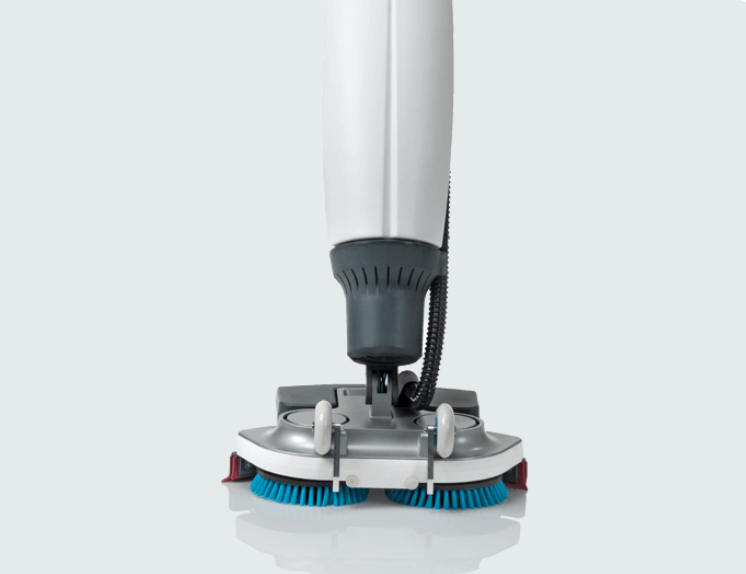
Industrial cleaning equipment is one of the duty cycles that shapes DC motor specification: low-to-medium speed, frequent start-stop, humid air and continuous operation.
Why DC Motor Questions Cluster Before a Specification Exists
In most projects the mechanism is designed first and the motor is specified last. Tire diameter, deck height, travel speed and payload are fixed by the machine layout, and the motor then has to fit whatever space and torque envelope remain. That sequence explains why so many DC motor conversations start from a fault or a gap rather than from a datasheet.
Three patterns repeat across medical, mobility and industrial projects:
- Wattage is used as a proxy for torque. Three motors rated at 300 W can be built to deliver 40 Nm at 70 rpm, 30 Nm at 100 rpm, or 20 Nm at 150 rpm — the 6DY-A, 1DY-E5A and SA06 hub motors respectively. The wattage is identical; the mechanical behaviour is not.
- Braking is treated as an accessory. In wheel-driven equipment the brake defines what happens on a slope, during an emergency stop, and when a unit is moved manually with power removed. Catalogues therefore separate electromagnetic brakes, electronic brakes (EABS), disc brakes and manual clutch arrangements.
- The operating environment is specified late. Documented floor scrubber projects in Germany, Switzerland, the Netherlands, the UK and Italy run continuously in low-to-medium speed, frequent start-stop, high-load and humid conditions. Their stated requirements include condensation protection, electromagnetic compatibility (EMI) grounding, brake debugging and safety distance control, custom shafts and dual-shaft outputs, and a range of voltage and power specifications. None of that is visible on a motor nameplate.
The DC Motor Configurations Buyers Encounter Most Often
Grouping DC motors by construction is more useful at the sourcing stage than grouping them by wattage, because construction determines where the motor can physically be installed and how its speed and torque are produced.
| Configuration family | Typical construction | Documented models | Where it fits |
|---|---|---|---|
| Pancake / printed armature motor (brushed) | Flat disc rotor with a printed winding; thin axial profile; rated for high rotational speed | 128SN, 90SN-B, 120SN, 150SN-A, 150SN-B | Floor washing machines, welding machines and burnishing equipment |
| Pancake BLDC motor, direct drive | Brushless external rotor, rare-earth NdFeB permanent magnets, no gearbox | DD03 | Low-speed, high-torque direct drive where a gearbox is not wanted |
| Pancake motor with gearbox | Pancake motor combined with a reduction gearbox | 150SN-G2 | Higher torque at moderate speed from a compact disc-format body |
| Wheel hub motor (geared, brushed or brushless) | Motor, gearbox and brake integrated into the wheel; solid or pneumatic tire | SA05-6, 1DY-E3, 1DY-E5A, 1DY-E5S, SA06, 6DY-A4 | Mobility scooters, wheelchairs, hospital beds, shopping carts, AGVs |
| Spoke / universal wheel motor | Geared hub motor mounted on a custom plate for variable wheel sizes | SA05, 6DY-A, 6DY-A1 | E-bikes, snowmobiles, refuse trucks, trikes |
Two families share a technology. The 8-inch powered wheel 1DY-E3, the magnesium alloy integrated wheel motor 6DY-A1 and the 12-inch wheelchair hub motor 6DY-A4 all list a printed armature, printed winding or printed circuit among their construction features. The flat printed-rotor principle used in pancake motors therefore also appears inside certain geared wheel drives, rather than being confined to disc-format machines.
Structural Configurations: External Rotor, Printed Armature and Spoke Wheel
Printed armature and pancake geometry
A printed armature motor places the winding on a flat disc rather than on a slotted cylindrical rotor, which shortens the motor along its axis. The documented range shows how that geometry behaves in practice: the 90SN-B measures 120 mm in diameter and 17 mm in thickness, the 120SN measures 152 mm and 33 mm, the 128SN measures 148.5 mm and 37 mm, and the 150SN-A and 150SN-B both measure 151 mm and 35.4 mm. Rated speeds for these models sit between 2,100 rpm and 3,500 rpm, so they are specified either for fast rotating loads or as the input stage of a geared assembly.
External rotor, brushless construction
The pancake BLDC motor DD03 is rated 24 V, 100 W and 250 rpm, with an external rotor, a 106 mm diameter, a 51 mm body length and a customizable axis length; it is classified as a direct drive motor. The same external-rotor brushless principle appears in wheel formats: the 6.5Inch SA05-6, the 12Inch SA06, the spoke SA05 and the 8-inch 1DY-E5S are all described with an outer rotor and rare-earth NdFeB permanent magnets. Because brushless commutation needs controller electronics, these motors are usually evaluated together with the controller rather than as a standalone part.
Spoke wheel and universal wheel motors
The SA05 spoke wheel motor covers 24 V, 36 V and 48 V inputs, 100 W to 500 W, 100 to 500 rpm and a 1:5 gear ratio, and is described as adaptable to any wheel size with a custom plate. This configuration exists for vehicles whose wheel diameter is set by the chassis rather than by the motor. The 6DY-A brushed universal wheel motor follows the same logic for dustcart and refuse applications, and the 6DY-A1 integrates the assembly into a magnesium alloy wheel body with a 1:40 reduction and a folding brake clutch lever.
Materials and what they indicate
Across the range, declared materials are aluminum alloy, copper, magnet or magnetic steel, and rubber. Aluminum alloy carries housings and wheel bodies, copper carries the windings, rare-earth NdFeB permanent magnets or magnetic steel provide the field, and rubber appears in solid tires and wheel assemblies on models such as 1DY-E3, 1DY-E5A, SA05-6, SA06 and 6DY-A4. Material declarations matter at procurement stage because they sit behind RoHS-type compliance claims and behind weight figures that feed back into the machine design.
Reading Voltage, Power, Torque and Speed Together
Mechanical power is the product of torque and rotational speed, so a motor rated at a given wattage can be built to deliver either a modest torque at high speed or a large torque at low speed. Reduction gearboxes perform that conversion deliberately, which is why the gear ratio in a wheel motor is as important as the power rating.
| Model | Rated voltage | Rated power | Rated speed | Rated torque | Reduction ratio | Stated load capacity |
|---|---|---|---|---|---|---|
| 150SN-G2 (pancake with gearbox) | 36 V | 500 W | 240 rpm | 22 Nm | With gearbox | — |
| DD03 (pancake BLDC) | 24 V | 100 W | 250 rpm | — | Direct drive | — |
| 6DY-A (brushed hub) | 24 V | 300 W | 70 rpm | 40 Nm | 1:40 | 80–300 kg |
| 6DY-A1 (integrated wheel) | 24 V | 200 W | 65 rpm | 28 Nm | 1:40 | 80–300 kg |
| 6DY-A4 (12-inch hub) | 24 V | 200 W | 70 rpm | — | 1:40 | — |
| SA05-6 (6.5-inch hub) | 24 V | 200 W | 150 rpm | 15 Nm | 1:4.5 | 80–300 kg |
| SA06 (12-inch hub) | 24 V | 300 W | 150 rpm | 20 Nm | 1:4.5 | 80–300 kg |
| 1DY-E3 (8-inch powered wheel) | 24 V | 180 W | 95 rpm | 20 Nm | 1:20 | 80–300 kg |
| 1DY-E5A (8-inch hub) | 24 V | 300 W | 100 rpm | 30 Nm | 1:20 | 80–300 kg |
| 1DY-E5S (8-inch brushless hub) | 36 V | 300 W | 150 rpm | 20 Nm | 1:20 | 80–300 kg |
The three 300 W rows make the point better than any general rule. The 6DY-A produces 40 Nm at 70 rpm through a 1:40 reduction; the 1DY-E5A produces 30 Nm at 100 rpm through 1:20; the SA06 produces 20 Nm at 150 rpm through 1:4.5. A buyer who specifies "300 W" has specified almost nothing about how the vehicle will move. What fixes behaviour is the combination of load, wheel diameter, required travel speed and the reduction ratio that ties them together. The rolling geometry then narrows the choice further: 170 mm on the SA05-6, 200 mm on the 1DY-E5S, 210 mm on the 1DY-E3 and 1DY-E5A, and 305 mm with a solid tire on the 6DY-A4.
Where higher power is needed in a disc-format body, the 150SN-G2 combines a pancake motor with a gearbox to deliver 36 V, 500 W, 22 Nm at 240 rpm from a 151 mm diameter housing with a customizable axis length. Where load capacity is the binding constraint, several wheel motors in this range state 80–300 kg per unit — a design input rather than a marketing figure, since it determines how many driven wheels a machine needs.
Brakes, Shafts and What Customization Actually Covers
Braking arrangements are not interchangeable and are usually the first customization a project needs:
- Electromagnetic brake (EMB) is specified on the 1DY-E3, 1DY-E5A, 1DY-E5S, 6DY-A, 6DY-A1 and 6DY-A4 wheel motors. On the 6DY-A and 6DY-A4 the built-in brake uses an electromagnetic clutch and supports a manual clutch; the 6DY-A1 adds a folding brake clutch lever.
- Electronic brake (EABS) is listed for the 6.5Inch SA05-6 and the 12Inch SA06, with a disc brake offered as an alternative on the SA06.
- Manual arrangement appears where personnel must move equipment with power off, which is why clutch support is documented separately from the brake type.
Beyond braking, the documented design options across the range are consistent: operating voltages to suit the vehicle supply, custom shaft and axis sizes or profiles, tailored performance profiles, and special OEM configurations. Several platforms are explicitly offered with single or double shaft output — among them the 8-inch and 12-inch brushless hub motors and the spoke SA05. Voltage flexibility is real rather than nominal: 24 V platforms such as the 1DY-E3, 1DY-E5A, 6DY-A, 6DY-A1, 6DY-A4 and SA05 series are documented as also available in 36 V or 48 V.
What does not change freely is the physical envelope. A 6.5-inch motor is a 170 mm assembly, an 8-inch motor is around 200 to 210 mm, and a 12-inch wheel is 305 mm with a solid tire. If the machine layout cannot accept the envelope, the answer is a different frame size rather than a customization request.
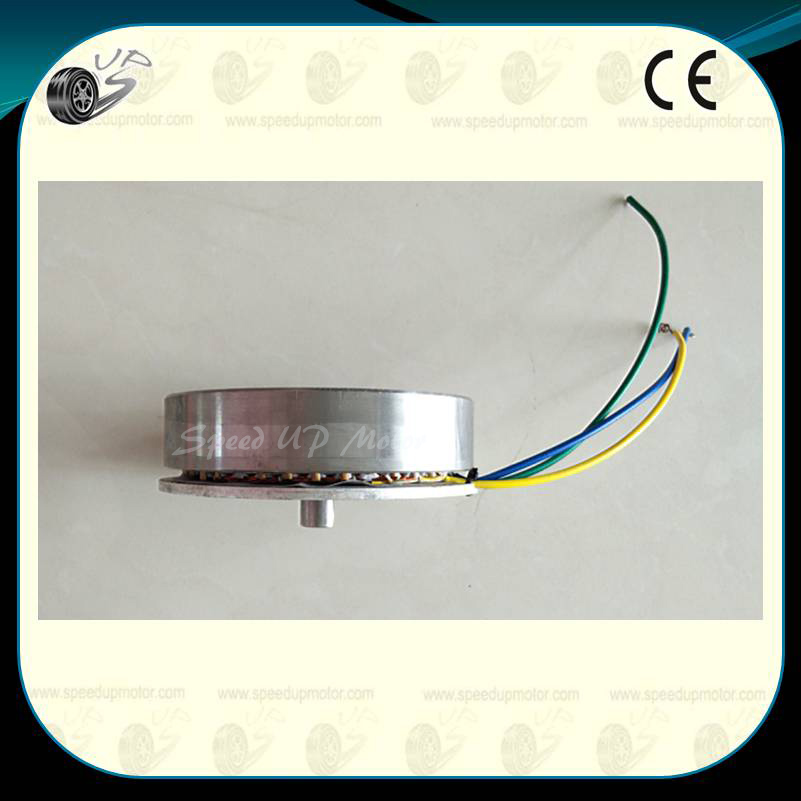
A pancake BLDC motor: external rotor, flat axial profile, and a rated speed low enough to drive a load directly in some applications.
Application Fit: Medical, Mobility and Industrial Duty
Medical equipment and patient transport
The 6.5Inch wheel hub motor SA05-6 is classified for medical equipment manufacturing and is intended for mobility scooters, electric scooters, wheelchair assistance, medical chairs, AGVs and robots, with a 24 V, 200 W, 150 rpm, 15 Nm rating, a 1:4.5 reduction, an IP54 protection level and an electronic brake. The 8-inch 1DY-E3 covers hospital transport beds, transport chairs and transport carts alongside mobility scooters and shopping carts. Documented hospital bed projects in this application class operate continuously in low-to-medium speed, frequent start-stop and humid conditions, and are matched with gearboxes, high-strength reduction gearboxes, electromagnetic brakes, motor controllers and wheel assemblies.
Mobility and light electric vehicles
The 8-inch 1DY-E5A is applied in hospital bed and electric scooter manufacturing, the 12-inch 6DY-A4 in electric wheelchairs, and the 12-inch SA06 in mobility scooters, electric scooters, folding e-bikes and wheelchair assistance. The spoke SA05 extends the same geared hub architecture to electric bikes and snowmobiles, where the wheel is built around the motor rather than supplied with it.
Industrial and smart manufacturing duty
Pancake motors dominate the rotating-load side of industrial equipment: the 150SN-A is designed for floor washing machines at 36 V, 300 W and 3,500 rpm, the 120SN for welding machine drives at 24 V and 75 W, and the 90SN-B and 150SN-B for disc-format applications at 24 V and 100 W or 350 W. Wheel formats appear where the machine itself must move — the 6DY-A in dustcart and refuse applications, and hub motors in AGVs and robots. Floor scrubber projects run continuously in humid air across several European markets and are specified with condensation protection and EMI grounding, which places electrical protection requirements alongside mechanical ones during evaluation.
Documented Field Evidence in Medical Drive Units
Long-run evidence is scarce in motor procurement, which makes application records worth reading carefully. Company field records for product 5303 — the 6.5Inch wheel hub motor, model SA05-6 — cover roughly 100,000 drive units supplied into medical equipment applications in Germany, the United Kingdom and the United States, with units documented as remaining in service over a ten-year period. Documented hospital-bed drive projects in the same application class list Germany, Czechia, the Netherlands, the US and the UK as operating markets.
That record is meaningful because it documents a specific configuration surviving a long duty cycle in a specific application: a 170 mm geared brushless wheel with a 1:4.5 reduction, IP54 protection and an electronic brake, used in patient-handling equipment. It does not transfer automatically to a different tire diameter, a heavier load, a different brake requirement or a different market's certification scope. Buyers should read such records as evidence about the closest matching configuration, not as a general performance claim.
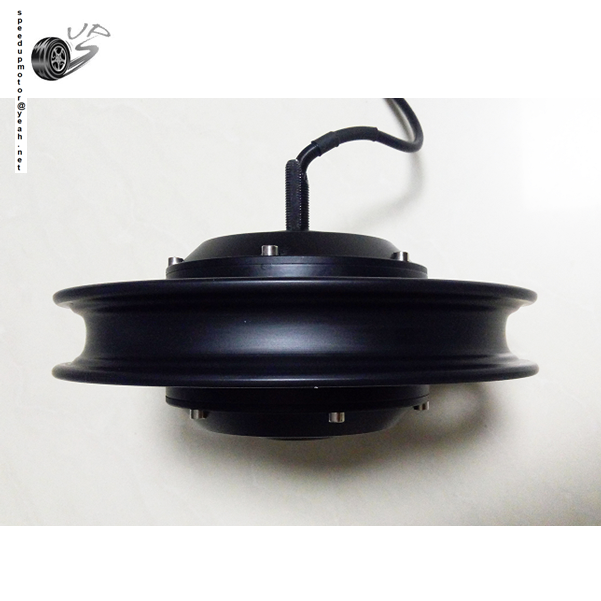
A 12-inch brushless hub motor assembly: motor, gearbox and brake integrated into the wheel, which removes the separate transmission from the chassis design.
Market Signals Behind Brushless and Hub Drives
Published market data supports the direction of demand, provided the figures are read with their scope definitions attached.
| Indicator | Value | Year | Source |
|---|---|---|---|
| Global brushless DC (BLDC) motor market | USD 20,990.5 million | 2024 | Grand View Research |
| China share of global BLDC motor revenue | Approximately 39.8% | 2024 | Grand View Research |
| Global electric wheelchair market | USD 4.49 billion, projected to USD 9.05 billion by 2030 | 2024 | Grand View Research |
| Global motors for medical devices market | USD 4.25 billion | 2024 | MarketsandMarkets |
| Global automotive wheel hub motor market | USD 8.8 billion projected, CAGR 5.2% | 2035 | Market Research Future |
Estimate dispersion is part of the picture and should be disclosed rather than averaged away. For the global BLDC motor market in 2024, Grand View Research reports USD 20.99 billion, MarketsandMarkets reports USD 13.00 billion and Stratview Research reports USD 12.30 billion; the spread reflects different scope definitions rather than a contradiction in direction. The same applies to electric wheelchairs, where Grand View Research reports USD 4.49 billion for 2024 and Fortune Business Insights reports USD 8.73 billion, depending on whether standard power chairs alone or broader mobility solution packages are counted. The hub motor projection to 2035 comes from a single source with medium reliability and is best treated as a directional signal.
Two structural signals are worth carrying into a sourcing plan. First, brushless technology is the large and growing segment, which means controller availability and control electronics increasingly shape motor selection rather than sitting outside it. Second, with China accounting for roughly 39.8% of global BLDC motor revenue in 2024, supply concentration is high enough that certificate scope, factory documentation and application records become the practical differentiators between otherwise similar suppliers.
Hub Drive Versus Conventional Gearmotor Drive Trains
The comparison that matters most at evaluation stage is between an integrated wheel hub motor and a conventional arrangement in which a separate gearmotor drives the wheel through a belt, chain or shaft.
Integrated hub drives consolidate the motor, gearbox and brake into the wheel assembly. That removes a transmission stage and the alignment, tension and guarding that come with it, and it simplifies the chassis around the driven wheel — which is why the same architecture appears across scooters, hospital beds, shopping carts and AGVs in this range. The costs are equally concrete:
- Mass moves to the wheel. A wheel hub motor assembly such as the 12-inch 6DY-A4 is 305 mm in diameter with a solid tire, and hub motor assemblies in this range weigh between 3.5 kg and 7.8 kg depending on frame size. That mass sits at the point of ground contact, which affects suspension, mounting stiffness and handling calculations.
- Speed and torque are locked to the gear ratio. A 1:40 reduction delivering 70 rpm and 40 Nm on the 6DY-A and a 1:4.5 reduction delivering 150 rpm and 20 Nm on the SA06 are not interchangeable in the same vehicle. Changing top speed without changing the load requirement generally means changing the ratio.
- Load capacity is bounded per unit. Where 80–300 kg is stated for a wheel motor, that figure belongs to the specified configuration; a heavier machine needs additional driven wheels or a different frame rather than a higher rating on the same unit.
- Sealing has a defined limit. The IP54 rating on the SA05-6 and SA06 covers dust protection and protection against splashing water. It is not an immersion or continuous washdown rating, and humid-environment projects such as European floor scrubbers are specified with condensation protection and EMI grounding as separate requirements.
Pancake motors follow a different trade-off. Their advantage is axial compactness — 17 mm to 37 mm of thickness across the printed armature range — but they are rated for high rotational speed, between 2,100 and 3,500 rpm, so they serve low-speed loads only when paired with a gearbox. Brushed designs in both the pancake and hub families rely on brush and commutator contact, while brushless designs trade that contact for controller electronics and the grounding discipline that comes with them.
A Procurement Checklist for First-Stage DC Motor Evaluation
| Question to settle | Why it decides the configuration |
|---|---|
| What wheel or tire diameter does the chassis require? | It fixes the frame size — 170 mm, 200–210 mm or 305 mm — and constrains available gear ratios |
| What load must each driven wheel carry? | Stated capacities of 80–300 kg per unit determine whether one or two driven wheels are needed |
| What travel speed and climbing duty apply? | It selects the reduction ratio: 1:4.5, 1:5, 1:20 or 1:40 behave very differently at the wheel |
| What must the unit do when power is removed? | It selects between electromagnetic brake, electronic brake (EABS), disc brake and manual clutch support |
| What is the operating environment? | IP54 covers splash, not immersion; humid continuous duty adds condensation protection and EMI grounding |
| What supply voltage exists on the machine? | 24 V, 36 V and 48 V options are documented across several platforms, and the choice affects controller selection |
| What interface does the machine present? | Single or double shaft, custom axis length and profile, and special OEM configurations are the usual customization levers |
What Comes Next
The direction of change in DC motor sourcing is toward integration and earlier specification. Motor, gearbox, brake and wheel are increasingly evaluated as one assembly; electrical protection and interference requirements are entering the design brief alongside torque; and certification scope is being checked as a scoping question rather than an assumption. For buyers, the practical effect is that the first decision is no longer which motor to buy, but which configuration of drive — pancake, brushless, or integrated wheel — the machine layout can actually accommodate.
Wuxi Speedup Power Co., Ltd. operates a 10,000 square metre facility with approximately 30 staff, a three-engineer R&D team and an annual production capacity of 30,000 pieces, and holds RoHS, UL, EMC and ISO9000-2008 certifications, with CE, EMC and RoHS approvals documented at product level across the range described above.
FAQ: DC Motor Technical and Procurement Questions
What is a pancake motor, and how does it differ from a standard cylindrical DC motor?
A pancake motor places its winding on a flat disc, so its axial thickness is small relative to its diameter. In this range, the 90SN-B measures 120 mm in diameter and 17 mm thick, the 120SN measures 152 mm and 33 mm, and the 150SN-A measures 151 mm and 35.4 mm. Rated speeds of 2,100 to 3,500 rpm make these motors suitable for fast rotating loads or as the input stage of a geared assembly, whereas a cylindrical motor of comparable diameter is typically longer and runs slower.
When should a brushless DC motor replace a brushed one?
Brushless designs remove brush and commutator contact, which is why the 6.5Inch SA05-6, the 12Inch SA06, the 8-inch 1DY-E5S, the spoke SA05 and the pancake DD03 are all specified with an external rotor and rare-earth NdFeB permanent magnets. The trade-off is that brushless motors require commutation electronics and controller integration. Brushed alternatives such as the 1DY-E3, 6DY-A, 6DY-A1, 6DY-A4 and the printed pancake series use simpler drive arrangements but involve brush wear over the service life.
How should voltage, power, torque, speed and reduction ratio be read together?
Mechanical power is the product of torque and rotational speed, and the gearbox determines how that product is presented at the wheel. The 6DY-A delivers 300 W as 40 Nm at 70 rpm through a 1:40 ratio; the 1DY-E5A delivers the same 300 W as 30 Nm at 100 rpm through 1:20; the SA06 delivers 300 W as 20 Nm at 150 rpm through 1:4.5. Reading power alone therefore does not predict behaviour — the ratio and the wheel diameter do.
Which wheel hub motor sizes are used in hospital beds, wheelchairs and scooters?
Documented fit includes the 6.5Inch SA05-6 (170 mm, 24 V, 200 W, 15 Nm, classified for medical equipment manufacturing), the 8-inch 1DY-E3 (210 mm, 24 V, 180 W, 20 Nm) for hospital transport beds, transport chairs and transport carts, the 12-inch SA06 (24 V, 300 W, 20 Nm, IP54) for mobility scooters and folding e-bikes, and the 12-inch 6DY-A4 (305 mm solid tire, 24 V, 200 W) for electric wheelchairs. Several of these units state a load capacity of 80–300 kg per motor.
What brake options exist on these motors, and how do they differ?
Electromagnetic brakes are documented on the 1DY-E3, 1DY-E5A, 1DY-E5S, 6DY-A, 6DY-A1 and 6DY-A4. The 6DY-A and 6DY-A4 use a built-in brake with an electromagnetic clutch and support a manual clutch, while the 6DY-A1 adds a folding brake clutch lever. Electronic brakes (EABS) are listed on the 6.5Inch SA05-6 and the 12Inch SA06, with a disc brake available as an alternative on the SA06.
What can be customized on a DC motor, and what stays fixed?
Documented design options include operating voltage to suit the machine supply, custom shaft and axis sizes or profiles, tailored performance profiles and special OEM configurations. Single or double shaft output is offered on several platforms. What does not change freely is the physical envelope: a 6.5-inch motor is 170 mm, an 8-inch motor is 200–210 mm, and a 12-inch wheel is 305 mm with a solid tire, so a different envelope means a different model rather than a modification.
What does IP54 protect against on a hub motor, and where does it stop being sufficient?
IP54 is stated for the 6.5Inch SA05-6 and the 12Inch SA06, covering dust protection and protection against splashing water. It is not an immersion or continuous washdown rating. Applications with sustained humidity are specified separately: European floor scrubber projects list condensation protection and electromagnetic compatibility (EMI) grounding as distinct requirements, alongside brake debugging and safety distance control.
What evidence exists for long-term reliability in medical drive units?
Company field records for product 5303, the 6.5Inch wheel hub motor SA05-6, cover roughly 100,000 drive units supplied into medical equipment applications in Germany, the United Kingdom and the United States, with units documented as remaining in service over a ten-year period. That evidence applies to the specific configuration and duty cycle recorded; it does not automatically extend to different loads, tire diameters or braking requirements.
How do integrated hub drives compare with belt or chain drive trains?
Hub drives integrate motor, gearbox and brake into the wheel, removing a transmission stage and the tension, alignment and guarding that accompany it. The trade-offs are that assembly mass sits at the wheel — between 3.5 kg and 7.8 kg across documented units — that speed and torque are fixed by the gear ratio, that load capacity is bounded per unit at 80–300 kg where stated, and that sealing is limited to the stated IP54 level rather than full washdown protection.
Reference material: the SPEEDUP company brochure with product specifications is available for download at https://cdn.socialarks.com/sbsp/24950/common/2026/0630/SPEEDUP%20COMPANY.pdf. Manufacturer reference site: www.upsmotor.com.