
DC Motor Supplier Evidence: Auditing 100,000 Medical Drives
DC Motor Supplier Evidence: Auditing 100,000 Medical Drives
In medical drive procurement, a supplier's installation record usually arrives as one impressive number. For model 5303, Wuxi Speedup Power Co.,Ltd reports 100,000 motor units installed in medical equipment assist drive devices across Germany, the United Kingdom and the United States, with stable operation maintained over a 10-year period, and with low speed, high torque and a small wheel size cited as the design highlights. For an OEM team at the evaluation-to-execution stage, the decisive question is not whether 100,000 is a large figure. It is which parts of that claim can be checked, cross-referenced against other documents, and converted into acceptance criteria for a different device, in a different market, with a different duty profile.
The company behind the record is Wuxi Speedup Power Co.,Ltd, a Wuxi-based DC motor manufacturer founded in 2018 whose product range covers pancake and printed motors, BLDC motors and wheel hub motors, and whose company profile states that about 90% of output is exported to the EU and USA. It is one participant in a crowded supplier market rather than the only option. The analysis below therefore treats the 5303 record as an audit object: what it states, what the certification file adds, where the limits sit, and how the same questions can be turned on any DC motor supplier claiming medical drive experience.
Why an installation claim needs a data model
Suppliers describe field experience in aggregate language: thousands of units, many years in service, stable operation, long-term customers. Aggregate language is difficult to compare between suppliers because it does not expose the variables that determine whether another buyer's experience is relevant. A claim becomes procurement-useful when it is broken into fields: the exact model and configuration, the quantity, the period over which units were produced, the application and duty profile, the markets and regulatory context, the result that is claimed, and the basis on which that result was observed.
Medical equipment assist drives make this structuring exercise worth the effort. A drive in a care environment is expected to keep a device movable and controllable under operator command, often at walking pace, often with a load attached. A buyer that cannot identify which motor model, in which configuration, went into which application, cannot reuse a supplier's experience in its own risk assessment, cannot map it to its own technical file, and cannot compare it with a second supplier's record. The structuring requirement is not bureaucracy; it is what turns a reference story into a qualification input.
What the 5303 record actually documents
Read field by field, the medical drive record is specific about identity, scale and duration, and deliberately qualitative about the design characteristics. That split is worth understanding before the record is used in any evaluation document.
| Record element | Documented detail |
|---|---|
| Model | 5303, listed in the supplier's product data as a 6.5-inch wheel hub motor (designation SA05-6) |
| Client type | Medical equipment manufacturer |
| Application | Assist drive devices in medical equipment |
| Markets | Germany, the United Kingdom, the United States |
| Quantity | 100,000 motor units |
| Duration | 10 years |
| Reported result | Stable operation |
| Stated highlights | Low speed, high torque, small wheel size |
Three readings follow. First, the 100,000 units are described as an installation total across three national markets rather than an annual figure or a single-customer volume, so the number indicates accumulated production and deployment rather than current run rate. Second, the 10-year period describes how long the program has been running and how long operation has been reported as stable; it is not a per-unit service-life rating and should not be entered into a device risk file as one. Third, low speed, high torque and small wheel size are stated as design emphases, not as published values: no rated torque, rated speed, reduction ratio or ingress-protection figure for model 5303 appears in the material reviewed for this article.
That third point is the practical hinge. The record is credible evidence of application fit and supply continuity in a regulated-adjacent field. It is not a substitute for a datasheet. A buyer who needs torque at a specified wheel speed, a defined gear ratio, a brake option or a protection rating has to request those values for the exact configuration being ordered, and should expect them to be confirmed in writing rather than inferred from a case description.
The wider record: what neighbouring programs show
The 5303 program is not an isolated entry in the supplier's history. Several other documented programs involve multi-year supply into medical, mobility and floor-care duty, which is relevant context for a buyer assessing whether one long-running program reflects a repeatable operating pattern.
| Model | Application | Markets | Quantity | Reported duration and result |
|---|---|---|---|---|
| 5303 | Medical equipment assist drive devices | Germany, UK, US | 100,000 units | Stable operation over 10 years |
| 5307 | Medical bed wheel drive | Czech Republic | 3,000 units | Stable operation over 10 years; low-speed running and commutation performance cited |
| 5307 | Shopping cart wheel drive | Netherlands, Germany, UK, Spain, US | 30,000 units | Stable operation over 10 years; low-speed torque and electromagnetic brake cited |
| 5307 | Electric scooter wheel drive | Netherlands, Germany, UK, Spain, US | 2,000 units | Stable operation over 10 years |
| 5287 | Electric wheelchair wheels | Netherlands, Germany, Australia, Denmark, US | 3,000 units | Stable operation over 10 years; built-in brake with electromagnetic clutch and manual clutch support |
| 5269 | Floor cleaning and drying machine brush and scrubber drive | Switzerland, Netherlands, Germany, UK | 15,000 units | Continuous supply over a 10-year period |
These are separate programs and their quantities should not be added together to produce a reliability statement; a fleet total is not a failure-rate metric. What the table does show is a pattern of multi-year, multi-market supply in which the same supplier reports continuous production, delivery and support across different motor families and different duty types. For a buyer, the value of that pattern is continuity evidence — the ability to keep a program supplied and supported over a product lifecycle — rather than proof of performance in an unrelated new application.
Why low speed, high torque and a small wheel fit medical drives
Assist drive devices move at walking pace under operator control, which changes where the engineering effort sits. At low wheel speed, the motor works well below its free-speed region, so the design emphasis shifts to torque production and to the heat path inside the wheel rather than to maximum rotational speed. The required torque is set by the device: mass, rolling resistance and floor conditions determine the tractive force at the wheel, and wheel torque requirement scales with wheel diameter, so a smaller wheel needs less torque for the same push force but must deliver it inside a smaller, harder-to-cool envelope. Low-speed torque and compact wheel size therefore belong together as a design pairing rather than as separate selling points.
Where the torque multiplication comes from is a separate question, and it is one a buyer should ask explicitly. A geared hub motor converts motor speed into wheel torque through a reduction stage. The supplier publishes reduction data for other models in its range — a 1:4.5 ratio on a 12-inch hub motor listed at 24 V, 300 W, 150 rpm, IP54 and 80–300 kg load support, and a 1:20 ratio on an 8-inch hub motor listed at 36 V, 300 W, 150 rpm, 20 Nm with an electromagnetic brake. Those figures are company-published, belong to different models, and should not be transferred to model 5303; they illustrate the kind of data a buyer should obtain for the model actually being ordered.
Wheel diameter also carries chassis consequences. A smaller wheel changes how a device negotiates thresholds, carpet edges and floor transitions, and it affects ride behaviour under a pushed load. Those effects sit with the device design rather than with the motor alone, and they define when a small-wheel hub drive is the right route and when a larger wheel with a different reduction is the better one.
Integrated hub drive versus a separate motor and gearbox
Compact medical and mobility drives are usually built one of two ways, and the choice is a packaging decision before it is a supplier decision.
- Integrated hub drive. Motor and reduction sit inside the wheel. The wheel becomes the drive unit, which simplifies the chassis and reduces the number of interfaces the device designer has to seal and align. The reduction is fixed at build, so the ratio decision is made once for the product family.
- Separate motor and gearbox. A pancake or printed motor and an independent gearbox sit in the chassis or housing. Ratio and motor can be selected separately, and component-level replacement is possible, at the cost of more interfaces and more volume inside the device.
The boundary is worth stating plainly. Where the wheel envelope is available and the required reduction is stable across variants, an integrated hub is the simpler packaging route. Where the drive must sit inside a flat housing, or where the ratio has to change between device variants, a separate pancake or printed motor with its own gearbox is usually the more adaptable arrangement — the supplier's floor cleaning brush-drive programs, built around its pancake family, show that route in practice. Because Wuxi Speedup Power offers OEM and ODM production across these families, the selection can be settled on the device envelope rather than on what a single supplier happens to prefer.
What the certificate file adds, and where it stops
The record's most checkable feature is that the field-proven model appears inside the scope of the supplier's EU certificate file. Two certificates are relevant, and both list model 5303 among related products.
- RoHS certificate M.2025.206.C130289, issued 26 November 2025 and valid to 25 November 2030 by UDEM Uluslararası Belgelendirme Denetim Eğitim Merkezi San. ve Tic. A.Ş., for the EU market, scope DC Motor, against Directive 2011/65/EU RoHS and EN IEC 63000:2018.
- EMC certificate M.2026.206.C138410, issued 14 April 2026 and valid to 13 April 2031 by the same body, for the EU market, scope DC Motor, against 2014/30/EU with EN IEC 61000-3-2:2019/A2:2024, EN IEC 61000-3-3:2013/A2:2021, EN IEC 61000-6-1:2019 and EN IEC 61000-6-8:2020 named on it.
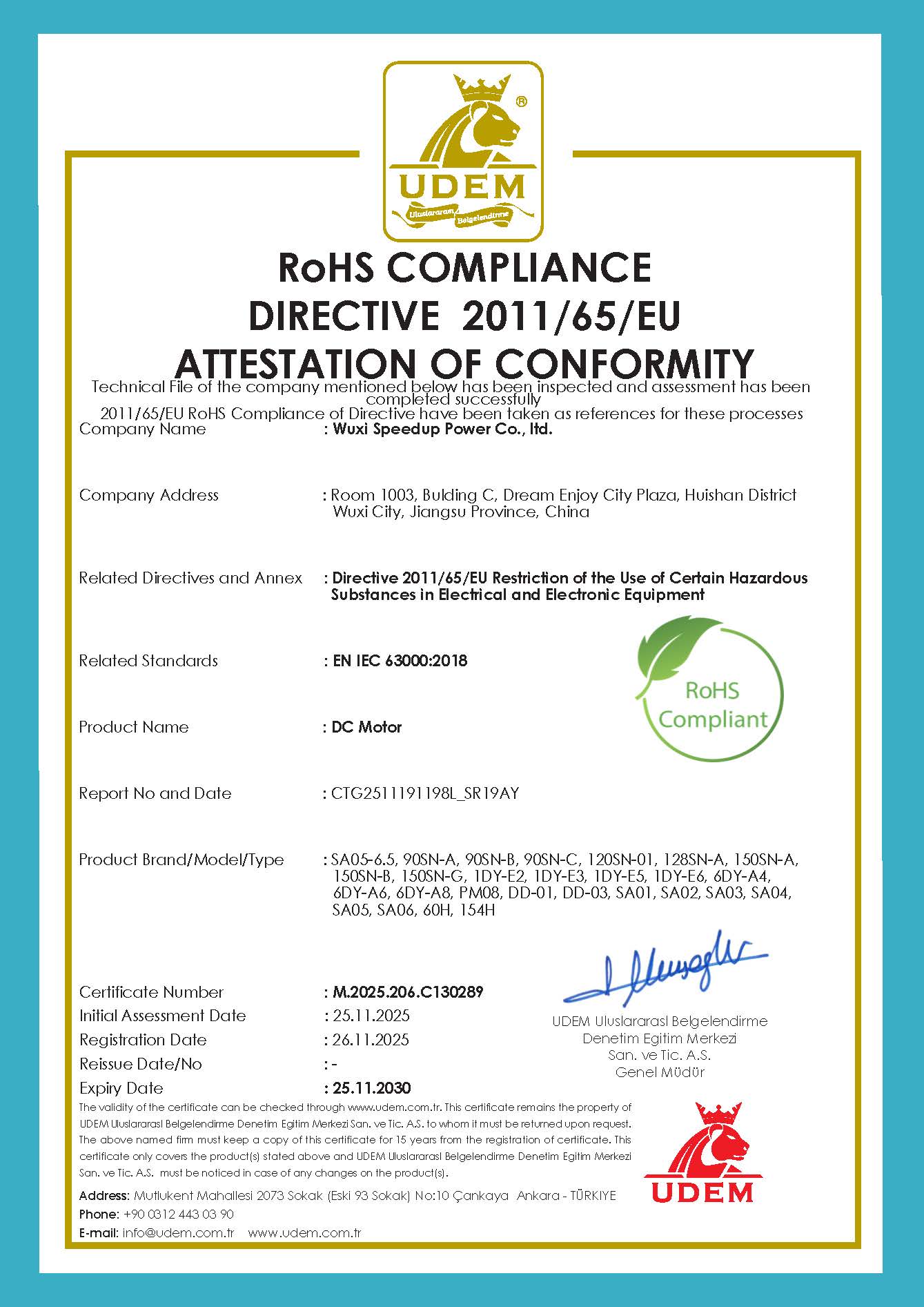
The limit matters as much as the coverage. Both certificates define their scope as the DC motor, and neither is a certificate for the medical device into which the motor is built; conformity of the assembled assist drive remains the device maker's deliverable. A buyer should log the certificate number, issuing body, validity window and scope against its own technical file, then confirm that the exact configuration ordered — winding, ratio, brake option, connector — is covered rather than assuming that a model number alone settles the question.
Commercial and customization checks that complete the picture
Technical evidence answers half of a supplier evaluation. The other half is whether the supplier can reproduce the documented configuration inside the buyer's schedule and acceptance regime. On the supplied record, the following terms are stated:
- Production model: OEM and ODM services, with customization of voltage, power, speed, torque, shaft and logo.
- Lead time: 30–45 working days for custom work.
- Quality control: 100% test before shipment.
- Acceptance route: pre-shipment test plus third-party inspection (SGS) available under the supplier's stated purchasing terms, with EXW/FOB/CIF delivery terms.
- After-sales scope: warranty service, remote fault diagnosis and technical guidance, installation and commissioning instructions, original spare parts supply, repair and replacement service, and lifetime online technical support.
These are company-stated terms rather than independently verified commitments, so they belong in the purchase agreement and in the incoming-inspection plan rather than in the qualification narrative alone. A buyer that treats them as contract clauses gains something the installation record cannot provide: a defined remedy if a delivered batch deviates from the validated sample.
Market context: why compact drives attract scrutiny
External research helps explain why evidence quality has become a differentiator in this band of the market. Grand View Research estimated the global brushless DC motor market at USD 23.6 billion in 2026, projected to reach USD 38.4 billion by 2033, and reported that motors with output not exceeding 750 W accounted for 48.8% of 2025 market revenue. Those are commercial research estimates rather than audited figures, and they describe the BLDC category as a whole rather than medical drive motors specifically.
The interpretive point is narrower and still useful: the low-power band in which compact medical and mobility drives sit is a substantial share of the motor market, which means buyers usually have several qualified alternatives for any given envelope. When supply is not the constraint, the constraint becomes evidence — whether a supplier can show a traceable model, a checkable installation history and certificate scope that matches the part number on the purchase order.
A verification sequence for OEM buyers
The same questions that make the 5303 record usable can be applied to any DC motor supplier, in the order that usually keeps an evaluation moving:
- Fix the configuration first. Wheel or motor size, voltage, rated speed and torque, reduction ratio, brake type, shaft and connector — the record is only comparable if the configuration is pinned down.
- Ask for the installation record in fields. Quantity, production period, countries, application and duty profile, reported result. Aggregate claims without these fields cannot be benchmarked.
- Ask what the reported result was measured against. Field returns, service records, customer statements or internal review are different evidence classes, and the answer changes how much weight the record deserves.
- Match model to certificate. Confirm the model appears in the certificate scope, check the issuing body, the validity window and the standards named, and file the numbers.
- Request the numeric specification for your duty. Rated torque at the intended wheel speed, gear ratio, protection rating, insulation and noise data should be written down before sampling, not after.
- Validate a sample under your own duty cycle. A fleet record from another program reduces uncertainty; it does not remove the need for application-specific validation.
- Confirm production and acceptance terms. Test regime, third-party inspection option, lead time and delivery terms should be visible in the quotation, not only in a catalogue.
- Fix after-sales commitments in writing. Warranty scope, spare parts availability, remote diagnostics and technical support determine the real cost of a fault two years after launch.
Limitations the record does not remove
A balanced reading has to keep several qualifications attached to the claim:
- The installation record is supplier-reported. No independent third-party audit of the installed base is disclosed in the material reviewed.
- "Stable operation" is a qualitative statement without a published metric, denominator or failure definition, so it cannot be converted into a reliability figure.
- Model 5303's documented highlights are design characteristics, not performance values; rated torque, speed, ratio and ingress protection must be obtained for the exact configuration.
- A 10-year, multi-market program is evidence of supply continuity and application fit; it is not a warranty period, a per-unit life rating or a prediction for a different device design.
- Certificate scope is the motor. It says nothing about conformity of the assembled medical device.
- Quantities from other programs in the range cannot be summed or transferred to 5303 to strengthen its case.
Outlook
If compact, low-speed drive modules continue to be sourced across EU and US medical equipment programs, the likely shift is in how suppliers present experience rather than in what the motors do. Buyers are moving from accepting aggregate claims to requesting model-level, certificate-linked evidence that can be filed and re-checked at each order. Suppliers that can name the model, the certificate, the configuration and the acceptance route are easier to qualify; suppliers that cannot will find their installation totals discounted, however large they are. A 10-year record remains a lagging indicator — useful, informative and never a substitute for the sample that runs on the buyer's own device.
FAQ
What exactly does the model 5303 medical drive record cover?
The record states that model 5303, a 6.5-inch wheel hub motor, has been used in medical equipment assist drive devices by a medical equipment manufacturer in Germany, the United Kingdom and the United States, with 100,000 motor units installed and stable operation reported over a 10-year period. Low speed, high torque and a small wheel size are cited as the design highlights of the application.
Does a 10-year stable-operation record predict the service life of my drive?
No. The 10-year figure describes how long a multi-market installation has been reported as operating stably. It is not a per-unit life rating, a failure rate or a warranty period, and no measurement basis for the phrase "stable operation" is published in the material reviewed. A buyer should ask what the statement was measured against, then validate the motor under its own duty cycle and load profile before committing volume.
Can model 5303 be adapted to a different voltage, speed or torque?
The supplier states that it provides OEM and ODM production services, with customization of voltage, power, speed, torque, shaft and logo, and a stated lead time of 30–45 working days for custom work. Which parameters can be varied on the 5303 platform, and within what limits, has to be confirmed project by project against a written specification; the customization list itself does not define the feasible range for a given model.
Which certifications cover the 5303 motor, and what is their scope?
Two EU certificates list the model among related products. RoHS certificate M.2025.206.C130289 was issued on 26 November 2025, is valid to 25 November 2030, and references Directive 2011/65/EU RoHS with EN IEC 63000:2018. EMC certificate M.2026.206.C138410 was issued on 14 April 2026, is valid to 13 April 2031, and references 2014/30/EU with the EN IEC 61000 series standards named on the document. Both are issued by UDEM and state a scope of DC Motor; neither certifies the assembled medical device.
How can a buyer check a supplier's installation claims in practice?
Request the record in fields — model and configuration, quantity, production period, application and duty profile, markets, and the basis of the reported result — then match the model against certificate scope, obtain the numeric specification for the intended duty, and validate a sample before committing volume. Claims that cannot be broken into these fields cannot be compared between suppliers, whatever their headline size.
Further reference
The company's product and capability brochure is publicly available for download: SPEEDUP COMPANY brochure (PDF).

Есть вопросы или нужны дополнительные детали?
Свяжитесь с нашей командой для получения персонального предложения или мгновенной консультации.
Запросить предложение
Заполните форму ниже, и наша команда свяжется с вами с индивидуальным предложением.
Прямой чат WhatsApp
Предпочитаете общаться в реальном времени? Напишите нам в WhatsApp для мгновенной помощи и быстрых ответов.
- Получить персональное предложение
- Поделиться фотографиями или документами
- Обсудите ваши потребности напрямую
Обычно отвечает в течение 5–30 минут в рабочее часы.