
DEO Industrial Lubrication Pump Use Cases: Extrusion, Forging, Shearing
Forming plants rarely buy a lubrication pump as an isolated item. They buy a way to keep oil film, oil temperature and oil cleanliness inside a band that the press frame, the die, the gearbox and the hydraulic power unit can tolerate. Extrusion machinery, forging and stamping equipment and shearing machines each push that band in a different direction, and each therefore places a different demand on the pump that moves the oil and the cooler that removes the heat.
Deo Machinery Co., Ltd. (DEO) is a Ningbo-based manufacturer of hydraulic pumps, electric lubrication pumps, centralized lubrication system pumps, oil lubrication pump systems and lubrication system oil coolers. Its published range maps onto three distinct duties in a forming plant: delivery (the DK630 electric lubrication pump), circulation with heat removal (the DFLSL-10 self-circulating cooler), and bidirectional transfer (the PSN100 and PST180 pumps).

Why the circuit, not the lubricant, decides forming-line uptime
Oil that reaches a friction pair at the wrong viscosity lubricates poorly regardless of its grade. In hot forming, oil absorbs heat from the work zone and from the machine structure; if that heat is not removed, viscosity falls, film thickness drops and oxidation accelerates. In equipment with shock loading, return flow from lubrication points arrives in pulses rather than as a steady stream, and a cooler plumbed directly into the main hydraulic circuit inherits every pressure transient the machine produces.
Two engineering answers follow. The first is a pump sized to deliver stable flow at the viscosity actually present in the sump. The second is a cooling loop that is hydraulically independent of the machine, so that shock and pulse do not travel into the heat exchanger core. DEO's published application data for the DFLS self-circulating series is built around the second answer; the DK series and the bidirectional pumps address the first.
Three duties, three DEO components
Delivery: DK630 electric lubrication pump
The DK630 is an electric lubrication pump with a published displacement of 630 cc/rev and motor rotation speeds of 950 rpm or 1450 rpm. Its housing material is QT500. DEO lists it for machinery and heavy industry, and positions the wider DK series against mining equipment, construction machinery and steel industry lubrication duties.
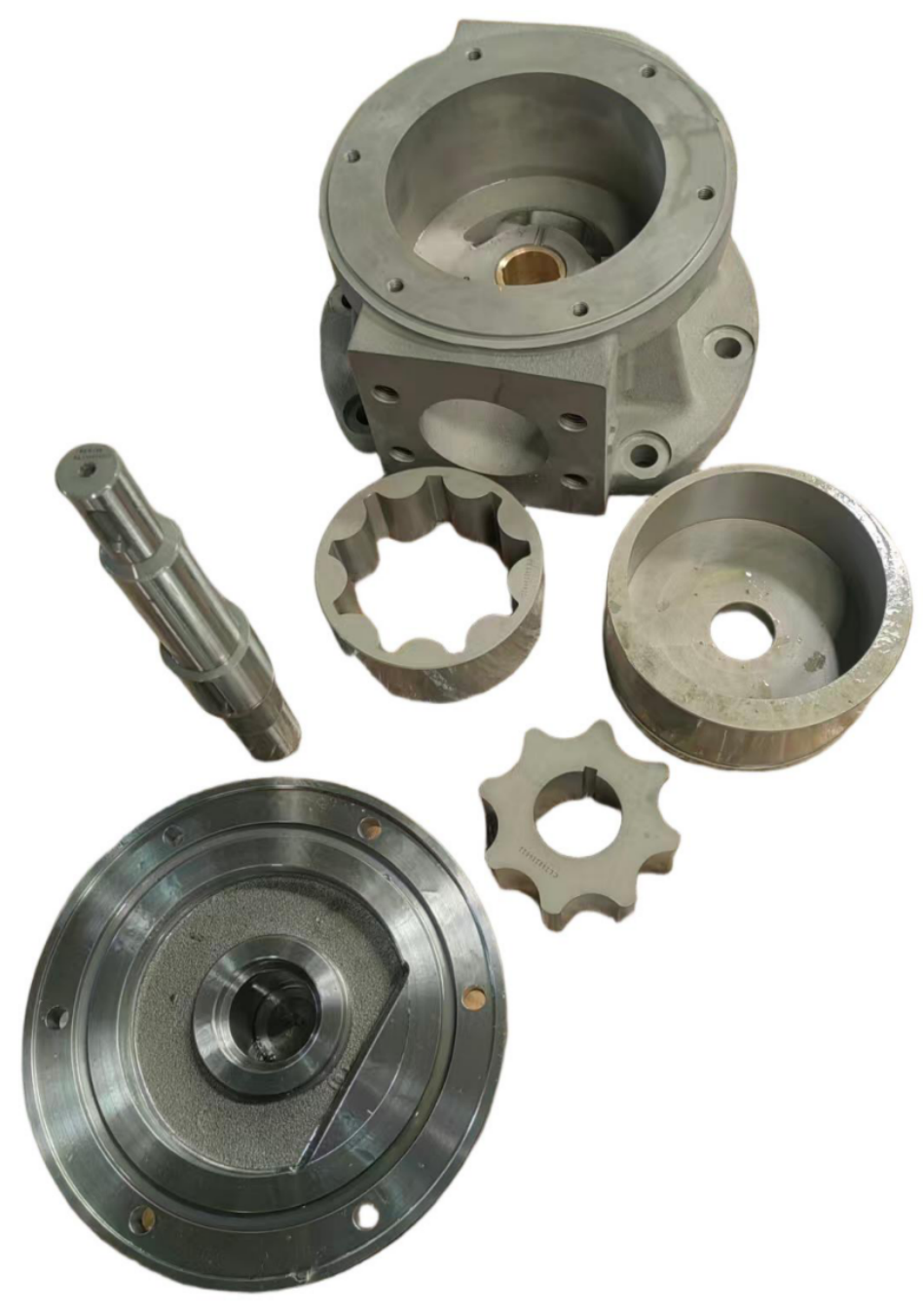
Structurally, the DK series is a low-noise helical external gear positive displacement pump for industrial lubrication and hydraulic auxiliary fluid conveying. Its stated function is continuous delivery of lubricating or hydraulic oil to mechanical friction pairs to form an oil film and reduce abrasion and friction heat, and to circulate hot oil out of the lubrication points toward a matching cooler. The same family is used for constant-pressure supply to hydraulic auxiliary circuits, filtration systems and oil recovery loops, and carries a built-in relief valve for overpressure protection with a standard setting of 5 to 25 bar. DEO lists the DK series operating mode as 24/6.
Published medium limits for the DK series are a kinematic viscosity range of 12 to 20,000 cSt and a fluid temperature range of -40 °C to +100 °C. A complete MDK unit, combining pump, motor and bell housing coupling, is available as an integrated driving assembly.
Circulation and heat removal: DFLSL-10 self-circulating cooler
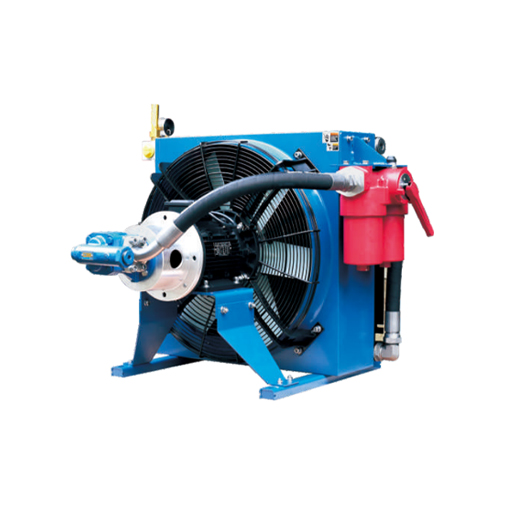
The DFLSL-10 is a self-circulating cooler with a published cooling capacity of 1.61/1.84 kW per °C, an oil pump flow on VG46 oil of 100 to 125 L/min (with a 150 to 200 L/min configuration listed), and consumed power of 5.5/7.5 kW. The radiator is copper, with stainless steel available as a customization. DEO lists its applications as hydraulic systems, lubricating systems, extruding machinery, forging and stamping equipment, shearing machines, gearboxes, large bearings, large reduction boxes and smelting equipment.
The DFLS self-circulating architecture runs an independent closed loop separated from the host hydraulic oil circuit. A built-in circulating pump draws hot oil from the machine tank or lubrication loop, the oil passes through the radiator core while an axial fan forces cross-flow air through it, and cooled oil returns to the tank or lubrication point to complete the cycle. Because the loop is independent, main-system pressure fluctuation does not interfere with cooling performance, and pulse oil return does not load the core.
Series-level published data covers oil flow of 6 to 200 L/min matched to different circulating pump displacements, hydraulic oil from VG46 to VG320, a rated working pressure of 16 bar, and an oil inlet temperature of 90 °C or below as standard, with a customized maximum of 130 °C. DEO offers an optional temperature bypass valve that opens at 45 to 55 °C, an optional pressure bypass valve for instantaneous flow and pressure spikes, and optional temperature and pressure switches that trigger over-temperature and over-pressure alarms.
Bidirectional transfer: PSN100 and PST180
Not every oil movement in a forming plant is a lubrication duty. Transfer between storage, reservoir and machine, or circulation through a cooling skid driven by an external motor, needs a pump that can run in either direction without changing its sealing behaviour. DEO's answer here is the bidirectional mechanical pump pair.
The PSN100 is a trochoidal bidirectional mechanical pump with 100 cc/rev displacement, a maximum speed of 1800 rev/min, an operating temperature range of -30 °C to +100 °C and QT500 ductile iron construction. DEO lists it for lubricating systems, cooling systems and external drive independent conveying systems. The PST180 is a bidirectional internal gear pump with 180 cc/rev displacement, a maximum speed of 1800 per minute, the same -30 °C to +100 °C range, and a housing in GG250 gray cast iron or QT500 ductile iron; listed applications include hydraulic systems, engine lubrication systems, hydraulic power units, industrial cooling systems, construction machinery and automation equipment.
Extrusion machinery: continuous heat, continuous flow
Extrusion behaves as a continuous duty. Heat enters the oil from the hydraulic pack, the gearbox and the machine structure, and it accumulates across a campaign instead of within a single cycle. DEO lists extruding machinery among DFLSL-10 applications, and the published function of the DFLS series is continuous heat removal for hydraulic and lubricating oil: holding oil temperature inside a safe operating range, limiting oil deterioration caused by overheating, and reducing viscosity fluctuation so that transmission efficiency stays stable. Stabilized viscosity also means the main machine does not continually compensate for a thinning film, which is where the published link to reduced main-machine energy consumption comes from.
One number deserves care. A cooling capacity of 1.61/1.84 kW per °C is a per-kelvin figure, not a fixed heat rejection rate: what a unit removes depends on the temperature difference between the oil and the cooling air. A line with a high heat load and a narrow allowable temperature rise needs the larger configuration, a different cooling type, or both, and that calculation belongs to the site, not to the model number.
Forging and stamping: pulse return and shock loads
Forging and stamping equipment appears in the DFLSL-10 application list, and the DFLS series data addresses the specific failure mode of that duty. Ordinary coolers placed inside the main hydraulic circuit take the pulse of every stroke and can suffer pressure shock damage to the heat exchanger core. DEO's design answer is the independent closed loop described above, combined with an optional pressure bypass valve for instantaneous flow and pressure spikes. The practical consequence is that the cooling loop no longer has to be engineered around the machine's peak pressure transients.
The DK630 side of the same installation is governed by stricter rules than the cooler. DEO prohibits dry running without oil medium, because dry friction damages shaft bushings and gears within a short time; the marked rotation direction on the nameplate must be followed, since reverse rotation invalidates sealing; and the built-in relief valve is intended for transient pressure protection only, not for continuous overflow operation.
Shearing machines: short cycles, cold starts, idle periods
Shearing machines are listed alongside forging and stamping equipment in the DFLSL-10 application data, but their duty profile differs. Cycles are short, the machine may stand idle between jobs, and oil can be cold at the start of a shift. The optional temperature bypass valve, opening at 45 to 55 °C, routes oil directly past the radiator during warm-up so the system reaches operating temperature faster and avoids the low-temperature, high-viscosity pressure surge that can occur when cold oil is forced through a cold core. On a line that stops and starts, that behaviour matters as much as peak cooling capacity.
Matching matrix for the three machine families
| Machine family | Dominant lubrication issue | DEO component and role | Published figures to verify | Condition that decides the match |
|---|---|---|---|---|
| Extrusion machinery | Continuous heat accumulation over long campaigns | DFLSL-10 self-circulating cooler for continuous heat removal; DK630 for delivery to gearbox and lubrication points | 1.61/1.84 kW per °C; 100-125 L/min on VG46; 5.5/7.5 kW; 16 bar rated pressure | Site heat load and allowable temperature rise; clean oil with filtration in dirty conditions |
| Forging and stamping equipment | Pulse oil return and pressure shock on the heat exchanger | DFLSL-10 with independent closed loop and optional pressure bypass; DK630 with built-in relief valve for transient protection | Oil flow 6-200 L/min across the series; relief valve setting 5-25 bar; 24/6 DK operation | Suction line airtightness; inlet pipe not smaller than the pump port |
| Shearing machines | Intermittent cycles and cold starts | DFLSL-10 with optional 45-55 °C temperature bypass valve; PSN100 or PST180 for transfer duties | PSN100 100 cc/rev at up to 1800 rev/min; PST180 180 cc/rev at up to 1800 per min; -30 °C to +100 °C | Oil viscosity band and ambient temperature at start-up |
Where a packaged lubrication and cooling circuit is the wrong answer
Comparing DEO's approach with conventional practice makes the boundary easier to see. Manual greasing or total-loss lubrication needs no circulation pump and no power budget, but it provides no temperature control and depends entirely on labour discipline. Tapping the host hydraulic circuit for cooling is cheaper in component count, but the cooler then inherits the machine's pressure fluctuation and pulse return, which is precisely the failure mode the independent loop is designed to avoid.
An oil/water alternative exists in the same portfolio and suits different sites. The DWBW-408-T fin-type shell-and-tube cooler is rated at 16 bar on the oil side and 10 bar on the water side, accepts oil up to 120 °C and cooling water from 5 to 60 °C, covers oil viscosity of 12 to 320 mm²/s, and has a detachable end cover for internal cleaning. It is the more sensible choice where a plant already runs a reliable cooling water supply and can maintain water quality; seawater or heavily polluted water requires a customized anti-corrosion build.
The self-circulating option carries its own constraints, and buyers should treat them as selection criteria rather than footnotes. The DFLSL-10 draws 5.5/7.5 kW, needs floor or bracket mounting with shock-absorbing gaskets and clear ventilation space around the radiator, and requires clean oil, with a filter mandatory in heavy contamination. Oil viscosity above 30 cSt requires a pressure-drop correction, the standard inlet temperature ceiling is 90 °C unless the 130 °C customization is specified, and a suction pipeline with air leakage causes circulation flow and cooling capacity to drop sharply. On the pump side, the DK630 cannot run dry or in reverse, and the PSN100 and PST180 stop at +100 °C, so duties above that temperature require a different selection rather than a different setting.
Smart manufacturing: monitoring starts with conditions, not sensors
Smart manufacturing discussions usually begin with the sensor. In lubrication, the useful sequence is the reverse: a monitored circuit is only as meaningful as the physical conditions it runs under. DEO's published data supports monitoring at the component level through optional temperature and pressure switches that raise over-temperature and over-pressure alarms on the DFLS series, and through a DK series rated for 24/6 operation. Those signals are only trustworthy when three preconditions are met: the suction line is airtight, the oil is free of metal chips and sand, and the inlet pipe diameter is not smaller than the pump inlet port.
Adoption data points in the same direction. One consolidated commercial market research estimate puts the global lubrication system market at USD 863.88 million in 2024 and reports that 67% of newly commissioned industrial machines in that year were equipped with automatic lubrication systems. That figure describes machine-level configuration, not the performance of any single supplier, but it does explain why extrusion, forging and shearing lines increasingly arrive with a lubrication circuit specified at the drawing stage rather than added during commissioning.
Market context and what it does and does not prove
No lubrication-pump-specific market size was available in the sources reviewed for this article, so category-level forecasts are cited only as context. A commercial research estimate values the smart manufacturing market at USD 1,021.5 billion by 2032 with a CAGR of 14.9%, and that is a figure for the whole category, not for pumps.
What is verifiable at product level is directional consistency across manufacturers. SKF documents an electrically operated pump for feeding lubricants in interval operation inside a centralized lubrication system, and Ingersoll Rand describes industrial internal gear pumps designed for lubrication and circulation in machinery, turbines and gearboxes. Read against those disclosures, the DEO position is conventional in architecture and specific in configuration: helical external gear delivery in the DK series, an independent self-circulating cooling loop in the DFLS series, and bidirectional transfer in the PSN and PST ranges. Buyers should treat the trend line as directional and test the specific machine duty against published figures.
Future outlook
Two developments are worth tracking for extrusion, forging and shearing installations. The first is environmental hardening: the DFLS series can be upgraded for dust-proof, low-temperature and plateau working conditions, which matters where forming equipment sits in semi-outdoor bays or in plants with high airborne particulate. The second is configuration flexibility. DEO offers OEM/ODM production with customization on color and oil pump, a minimum order quantity of one unit, a lead time of 35 to 45 days and a stated monthly capacity of 2,500 units with 100% testing, from a facility of 10,000 m² with 80 employees and a 12-engineer R&D team holding 3 invention patents and 16 utility model patents.
For a procurement team, that combination sets the verification task: a single-unit order makes a trial straightforward, while a 35 to 45 day lead time means the specification has to be right the first time. The published figures for the DK630, DFLSL-10, PSN100 and PST180 are the points to check against the machine duty before that order is placed.
DEO product brochure (PDF, public download): DEO Machinery product brochure. Company site: www.cndeo.com.
FAQ
What does the DK630 do in a forming plant lubrication system?
The DK630 is an electric lubrication pump with a published displacement of 630 cc/rev and motor rotation speeds of 950 rpm or 1450 rpm, built in QT500. It belongs to the DK series, a low-noise helical external gear positive displacement pump for industrial lubrication and hydraulic auxiliary fluid conveying. Its function is continuous delivery of oil to friction pairs to form an oil film and reduce abrasion and friction heat, and circulation of hot oil toward a matching cooler. The series is listed for a viscosity range of 12 to 20,000 cSt, a fluid temperature range of -40 °C to +100 °C, and 24/6 operation.
How much oil flow does the DFLSL-10 handle on VG46 oil?
DEO publishes an oil pump flow of 100 to 125 L/min on VG46 oil for the DFLSL-10, with a 150 to 200 L/min configuration also listed. Cooling capacity is given as 1.61/1.84 kW per °C and consumed power as 5.5/7.5 kW. At series level, the DFLS self-circulating cooler range covers oil flow of 6 to 200 L/min matched to different circulating pump displacements.
Are DEO pumps and coolers listed for extrusion, forging and shearing equipment?
Yes, at the level of published application lists. Extruding machinery, forging and stamping equipment, and shearing machines all appear among the listed applications of the DFLSL-10 self-circulating cooler. The DK630 is listed for machinery and heavy industry. The PSN100 is listed for lubricating systems, cooling systems and external drive independent conveying systems, while the PST180 covers hydraulic systems, hydraulic power units, industrial cooling systems and automation equipment.
Where do the PSN100 and PST180 fit — lubrication, cooling or transfer?
Both are bidirectional mechanical pumps used where oil has to move in either direction, such as reservoir-to-machine transfer or circulation through an externally driven cooling circuit. The PSN100 uses a trochoidal design with 100 cc/rev displacement and QT500 ductile iron construction, listed for lubricating systems, cooling systems and independent conveying. The PST180 uses an internal gear design with 180 cc/rev displacement and a housing in GG250 gray cast iron or QT500 ductile iron, listed for hydraulic systems, engine lubrication systems, hydraulic power units and industrial cooling systems. Both are rated from -30 °C to +100 °C with a maximum speed of 1800 rpm.
Which operating conditions most often reduce lubrication pump and cooler performance?
The dominant condition is suction-side leakage: DEO states that an inlet pipeline without airtightness causes insufficient suction flow, and on the cooler side causes circulation flow and cooling capacity to drop sharply. A second condition is inlet restriction, since the inlet pipe diameter cannot be smaller than the pump inlet port. Oil cleanliness ranks third, as metal chips and sand scratch gear surfaces and wear bushings, and filtration is mandatory in heavily polluted working conditions. On the cooling side, blocked air inlet or outlet space and missing viscosity correction above 30 cSt also reduce effective performance.
What are the temperature limits of these DEO components?
The DK series is listed for fluid temperatures from -40 °C to +100 °C. The DFLS self-circulating series accepts an oil inlet temperature of 90 °C or below as standard, with a customized maximum of 130 °C. The PSN100 and PST180 bidirectional pumps are rated from -30 °C to +100 °C. For comparison within the same portfolio, the DWBW-408-T oil/water cooler accepts oil up to 120 °C and cooling water from 5 to 60 °C.
Есть вопросы или нужны дополнительные детали?
Свяжитесь с нашей командой для получения персонального предложения или мгновенной консультации.
Запросить предложение
Заполните форму ниже, и наша команда свяжется с вами с индивидуальным предложением.
Прямой чат WhatsApp
Предпочитаете общаться в реальном времени? Напишите нам в WhatsApp для мгновенной помощи и быстрых ответов.
- Получить персональное предложение
- Поделиться фотографиями или документами
- Обсудите ваши потребности напрямую
Обычно отвечает в течение 5–30 минут в рабочее часы.