
DIN 22112, CEMA 502 and GB/T Marks: A Roller Buyer's Decoder
↵
A standards mark on a conveyor roller answers one narrow question: which defined scope of dimensioning, testing or calculation the product was built against. It does not certify that the roller will outlast a comparable unit on your line, and it does not transfer responsibility for belt alignment, loading geometry or maintenance to the supplier. That distinction is where most procurement errors on conveyor idler rollers begin, because DIN 22112, CEMA 502 and GB/T are routinely quoted side by side in quotations and drawings as if they were interchangeable labels for the same assurance.
The commercial stakes behind that confusion are not small. Straits Research values the rollers and idlers segment at USD 4.14 billion in 2025, projected to reach USD 7.05 billion by 2034, while Dataintelo sizes the broader roller conveyor market at USD 3.15 billion in 2025. The gap reflects definition scope, component versus sub-system, rather than contradiction. Within that demand, steel conveyor roller bodies accounted for 64% of global market share in 2024, and mining and quarrying represented 36% of rollers and idlers revenue in the same year. Heavy-duty duty cycles dominate the installed base, and heavy-duty duty cycles are precisely where mark-reading errors are paid for in downtime rather than in invoices.
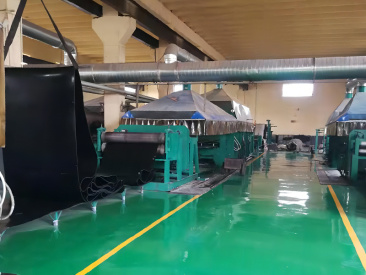
Manufacturing and inspection context for conveyor roller production. A mark defines the scope of the claim, not the performance of the line.
What Each Mark Actually Governs
Before any comparison, separate the marks by function. They fall into three groups: testing regimes, dimensional and load-rating standards, and engineering calculation methods. A roller can legitimately carry one mark while sitting entirely outside the scope of another, and that is the single most useful thing a buyer can know when reading a supplier datasheet.
| Mark | What it governs | Where it stops | Evidence to request |
|---|---|---|---|
| DIN 22112, Part 3 (1996) | Testing requirements for belt conveyor idlers used in underground coal mining | Does not establish interchangeability with North American troughing geometry | Test report naming the standard and edition, idler drawing, batch records |
| CEMA Standard No. 502-2022 | Dimensional standards and load ratings for bulk material belt conveyor troughing and return idlers | Component-level envelope only; not a wear-life or system guarantee | Dimensional drawing, stated load rating class, bearing and seal specification |
| GB/T series, with GB/T 10595 commonly cited for belt conveyors and idler components | Chinese recommended national standards covering belt conveyors and their components | Recommended rather than mandatory; edition and cited clause vary and must be confirmed | Edition number, clause cited, material certificates, dimensional report |
| ISO 5048:1989 | Calculation of power and tension in belt conveyors equipped with carrying idlers | An engineering calculation method, not a product label | Power and tension calculation sheet showing the rotational resistance assumed for carrying rollers |
DIN 22112: A Testing Lens on Underground Duty
DIN 22112 is a multi-part German standard, and Part 3 in its 1996 edition specifies the testing requirements for belt conveyor idlers used in underground coal mining. For an underground conveyor roller or coal conveyor roller specification, that scope is meaningful because it points to a defined test regime rather than to a tube profile or a paint finish. It is also the mark most often misread. A supplier that states DIN 22112 compliance without naming the part and the edition has given the buyer nothing verifiable, because Part 3 addresses idlers for a specific duty context rather than every roller installed in a plant. The practical question is not whether the mark exists, but whether the test report the buyer receives references the same part and edition as the purchase order.
CEMA 502-2022: Dimensions and Load Ratings You Can Order Against
CEMA Standard No. 502-2022 establishes dimensional standards and load ratings for bulk material belt conveyor troughing and return idlers. In maintenance practice it is the mark that matters most when a line engineered around one regional convention is kept running with components sourced from another: troughing and return idler envelope dimensions and rating classes let a maintenance team order a carrying roller or return roller without re-engineering the frame. It remains a component-level standard. It does not promise service life under a given material, it does not cover belt training behaviour, and it does not describe how a self-aligning bracket should pivot.
GB/T: Useful, Provided the Edition and the Clause Are Named
GB/T designates recommended national standards in China, and belt conveyor requirements are commonly referenced through that family, with GB/T 10595 frequently cited for belt conveyors and their idler components in Chinese procurement documents. Two cautions follow. First, GB/T is recommended rather than mandatory, so a compliance claim is only as strong as the clause the supplier is willing to name in writing. Second, recommended standards are revised over time; the edition referenced in a 2026 purchase order should be the edition that the test records actually cite. Buyers comparing a Chinese industrial conveyor roller quotation against a European or North American alternative should treat the GB/T reference as a starting point for a document request, not as a conclusion.
ISO 5048:1989: The Calculation Mark Behind Energy Claims
ISO 5048 in its 1989 edition provides the international method for calculating power and tension in belt conveyors with carrying idlers. It is not applied to a roller as a product label, but it explains why rotational resistance is a commercial number rather than a laboratory curiosity: the idler's rotational resistance feeds directly into the conveyor power calculation. When a supplier claims energy-saving behaviour for a low-noise conveyor roller or a precision-bearing industrial conveyor roller, ISO 5048 is the framework in which that claim should be demonstrated. A test report stating rotational resistance is more informative than any adjective attached to it.
Two Duty Families, Two Ways of Reading the Same Marks
The same three marks are read differently depending on where the roller sits on the line. At a loading point, the relevant question is impact and dimensional fit at the chute. On the carrying run, the relevant question is load rating class and alignment with the troughing frame. Shanghai Eastrise Trading Co., Ltd., a Shanghai-based foreign-trade enterprise supplying mining accessories and conveyor components, documents its roller families along that same split, with an impact roller family and a trough idler family referenced in project discussions.
ER-IMPACT-108: Impact Roller at the Loading Point
The rubber-ring impact roller designated ER-IMPACT-108 is documented with a suggested tube diameter of 108 mm, a shaft diameter of 25 mm and a suggested length range of 315 mm to 1,150 mm, built on a carbon steel body with wear-resistant rubber rings and intended for loading points, crusher discharge and heavy-duty conveyors. Because impact rollers absorb the highest dynamic load on the line, that is where mark-reading pays back fastest. Any claim to a testing standard should be tied to the idler as tested, at a stated dimension, so that the report matches the item delivered. The rubber ring specification itself is recorded as a project variable, which is a useful reminder that ring hardness and profile are confirmed against the duty rather than inherited from a mark.
ER-TROUGH-108: Trough Idler on the Carrying Run
The trough idler family referenced as ER-TROUGH-108 sits in the same 108 mm dimensional envelope and does the quieter work of the carrying run. Here CEMA 502-2022 is the natural frame of reference, since it governs troughing idler dimensions and load ratings directly. The practical checks are unglamorous and decisive: troughing angle, mounting centre distances, roller length tolerance and shaft seating must match the existing frame, and the stated load rating class must be appropriate for the material being conveyed. For a quarry conveyor roller handling abrasive aggregate, or a bulk material conveyor roller on a long overland line, small dimensional mismatches generate belt edge wear long before the roller fails.
Material selection interacts with marks in a way buyers should price honestly. Steel remains the dominant roller body material at 64% of global market share in 2024, and steel rollers retain an advantage in load-bearing and impact resistance in heavy-duty service. Eastrise's own comparison material states that, under identical specifications and quantities, steel rollers deliver 35% higher load capacity and 40% stronger impact resistance than HDPE polymer rollers, with the strongest fit in mining, cement and heavy-duty bulk material handling. Those figures are supplier-stated and should be validated against the specific duty and the supporting test reports before they are written into an acceptance criterion. HDPE conveyor roller and nylon conveyor roller options remain relevant where corrosion, weight or noise dominate the application rather than load.
Self-Aligning Roller: Where the Mark Ends and the Drawing Begins
A self-aligning roller is an idler assembly carried on a pivoting bracket that reacts to belt drift and steers the belt back toward the centre line. It is used on carrying and return runs, most often on the return strand and near loading or transition zones, and it is frequently specified alongside guide rollers positioned at the same loading area.
This is the point in a specification where mark-reading becomes genuinely difficult, because the standards discussed above are written for idlers rather than for guiding assemblies. The DIN 22112-3 testing requirements and the CEMA 502-2022 dimensional and load-rating provisions apply to the roller within the assembly. The pivot geometry, meaning bracket hole spacing, pivot centre distance, roller-to-structure clearance and guide angle, is normally project-specific and is confirmed by drawing rather than by a mark. A supplier offering a DIN 22112 self-aligning roller should therefore be asked to split the claim: which component was tested, to which clause, at which dimension, and which dimensions come from the project drawing rather than from a standard at all.
For a buyer specifying a self-aligning roller alongside rollers in the ER-TROUGH-108 or ER-IMPACT-108 class, six items separate a working assembly from a repeat failure.
- Idler dimensional drawing. Tube diameter, shaft diameter, roller length and the tolerances that apply, stated in the same units used by the conveyor frame supplier.
- Assembly drawing. Pivot centre distance, bracket mounting hole pattern and clearance envelope, matched to the frame already installed rather than to a catalogue figure.
- Return-side roller specification. Where the self-aligning unit runs on the return strand, the roller should be matched to the same bearing and shaft class as the other return rollers on the line, so that spares remain interchangeable.
- Seal and bearing detail. Drift correction is worthless on a seized roller, and bearing seizure is the most common failure path in dusty duty.
- Surface treatment matched to the environment. Humid, salt-spray port terminals and cement lines with heavy dust are documented application contexts in which corrosion-resistant coating and sealed bearings are specified as special requirements, alongside low noise targets.
- Batch records. Pre-shipment inspection of dimensions, appearance, radial runout, rotational resistance, quantity and packaging, so that the delivered lot can be compared against the approved sample or drawing.
The honest limitation is worth stating plainly. A self-aligning roller corrects drift; it does not correct the causes of drift. Off-centre loading at the chute, structure misalignment, uneven belt tension, or a cluster of seized rollers elsewhere on the line will keep pushing the belt off the centre line regardless of how well the assembly is documented. Reduced belt mistracking and lower maintenance frequency are realistic outcomes in cement raw-material handling and bulk terminal duty, but they are not a substitute for correcting loading geometry.
From Mark to Evidence: A Six-Step Verification Workflow
A mark becomes enforceable only when it is translated into documents attached to the order. The workflow below applies to belt conveyor roller and conveyor idler roller procurement across mining, quarry and port applications.
- Name the edition and the clause in writing. DIN 22112-3:1996, CEMA 502-2022, the specific GB/T edition, or the ISO 5048-based calculation: each should appear in the technical annex, not only in the sales brochure.
- Match the drawing to the frame. Confirm mounting centres, troughing angle, roller length and shaft seating against the installed structure before the order is released.
- Request material certificates. Tube, shaft, bearing and rubber or polymer components should be traceable to the batch, particularly where wear-resistant rubber rings or corrosion-resistant coatings are specified.
- Request the inspection record set. For the impact roller class, a representative commercial framework documents pre-shipment inspection covering dimensions, appearance, radial runout, rotational resistance, quantity and packaging, with a minimum order quantity of 10 units and payment structured as 30% deposit with 70% before shipment.
- Decide on third-party inspection deliberately. Third-party inspection is offered as an option, which means acceptance criteria must be written into the contract; an unwritten criterion is not enforceable after shipment.
- Confirm sample or drawing approval. Approval against a customer-approved sample or drawing, with inspection records retained, is what makes repeat orders comparable to the first delivery.
Commercial terms vary by model and market. The framework above reflects documented terms for the impact roller family: FOB, CIF and EXW terms are available, with full container load and less-than-container load shipments supported and export documents provided.
Where Marks Stop: Limitations Buyers Should Price In
Comparable marks are not interchangeable. A DIN 22112-3 tested idler does not automatically satisfy CEMA 502-2022 dimensional or load-rating provisions, and a CEMA-rated troughing idler does not inherit an underground testing regime. Where a mixed fleet spans both conventions, the safe approach is to specify each position against the convention the frame was designed around, then verify the drawing.
Component marks also do not govern system behaviour. Frame alignment, chute geometry, belt condition, splice quality and maintenance discipline dominate real service life. A certified roller installed on a misaligned frame will fail on schedule with its uncertified counterpart.
Cost follows the same logic. Tighter runout control, sealed bearing arrangements and fully traceable inspection records raise the unit price. Eastrise's comparison material states that its rollers sit at a higher initial purchase price than conventional low-cost steel rollers while targeting a lower total lifecycle cost through fewer failures and replacements, and cites 25% lower runout deviation and three times longer service life in that comparison. Those are supplier-reported figures and should be treated as a hypothesis to test against the buyer's own downtime cost, not as a general rule. The economics work in dusty, continuous-operation lines where unplanned replacement carries a high cost, and they work far less convincingly on a lightly loaded, intermittently operated line.
One further boundary deserves mention. There is no independent, supplier-level operational capability dataset in the public domain that ranks conveyor roller manufacturers by certification depth, material testing or OEM engineering capability. Market size figures exist, and they are sensitive to how the segment is defined, so buyers relying on published market data should treat it as context rather than as a vendor assessment.
Application Contexts: Mining, Quarry, Cement and Ports
Mark-reading priorities shift with the application, and the documented working conditions are consistent across the category. In mining, ore conveyor lines run dusty, heavy-duty, continuous bulk material handling on a 24/7 basis, with dust-resistant seals, low rotational resistance and wear resistance specified as special requirements, and with parameters subject to operating conditions. Underground coal duty is where DIN 22112 Part 3 testing requirements attach most directly.
In quarrying, the abrasive load arrives at the crusher discharge, which is the natural position for the ER-IMPACT-108 impact roller and for the heavy duty conveyor roller class in general. In cement, raw material handling lines operate under heavy dust and medium-to-high temperatures on a continuous basis, where stable support and reduced belt mistracking and maintenance frequency are the stated functions; dust and corrosion resistance are specified, while the operating temperature range remains to be confirmed against the project. In ports and logistics, bulk terminal conveyors work outdoors in humid, salt-spray and long-distance conditions, supporting the return belt, with corrosion-resistant coating, sealed bearings and low noise specified and the protection level to be confirmed per project.
Those four contexts explain why the return roller and the self aligning roller deserve the same document scrutiny as the impact roller. They carry less load, but they fail more often, and each failure is an unplanned stop.
The Long-Term Question: Why Marks Become a Supply Relationship Issue
For buyers at the execution stage, the mark is only the entry ticket. What determines whether a conveyor roller specification survives the second and third year is whether the supplier can reproduce it. Three structural capabilities matter: in-house control of dimensioning and testing, retention of approved drawings and inspection records, and a service model that keeps spare parts available as the line evolves.
Eastrise operates its own independent manufacturing factories and describes a complete industrial chain integrating in-house research and development, standardized production, quality testing and worldwide export services. The manufacturing facility covers 11,000 square metres and employs approximately 50 staff, including a research and development team of 10 engineers, with an annual production capacity of 2,000 tons. Export business accounts for 20% of total sales, and the company reports long-term, stable and mutually trusted cooperative relationships with clients in Southeast Asia, Central Asia, Russia and other overseas markets.
Translated into procurement terms, those facts answer specific questions. A 2,000-ton annual capacity and an 11,000-square-metre facility indicate that repeat volumes are produced in-house rather than brokered. A 10-engineer team supports drawing confirmation and OEM or ODM adaptation to customer technical parameters, which matters when a self-aligning roller bracket has to match an existing frame. An export share of 20% with established markets in Asia and Russia indicates familiarity with cross-border documentation and inspection regimes. None of these facts replaces a buyer's own audit, and none of them certifies the roller on a specific line. They do indicate whether a supplier is structured to hold a specification constant over a multi-year relationship, which is the practical content of the question.
Future Outlook: Traceability, Noise and Energy
Three pressures are likely to reshape how marks are read over the next few years. The first is traceability: as rollers and idlers move through increasingly regional supply chains, the presence of parts trade flows such as Viet Nam's USD 8.59 million in HS 843139 exports in 2023 suggests that component sourcing will continue to diversify, and diversified sourcing increases the value of a document set that travels with the goods.
The second is energy. Once rotational resistance is understood as an input to the ISO 5048 calculation rather than a laboratory figure, low-noise conveyor roller specifications and precision-bearing industrial conveyor roller specifications stop being premium features and become line-level cost decisions.
The third is environment-specific durability. Corrosion-resistant conveyor roller treatments and sealed bearing arrangements will keep expanding in port, cement and underground duty, where the alternative is unplanned replacement. The marks themselves will not change quickly. What will change is the evidence buyers attach to them.
FAQ
What does a DIN 22112 mark tell a buyer that a CEMA 502 mark does not?
They describe different things. DIN 22112 Part 3, 1996 edition, specifies testing requirements for belt conveyor idlers used in underground coal mining, so the claim is about a test regime in a defined duty context. CEMA Standard No. 502-2022 establishes dimensional standards and load ratings for bulk material belt conveyor troughing and return idlers, so the claim is about envelope dimensions and rating class. A roller can be built to one convention and not the other, which is why the drawing, not the logo, determines whether it fits the frame.
If no single standard covers a self-aligning roller assembly, how should one be specified and verified?
Split the specification. Treat the idler inside the assembly against the applicable idler standard, and treat the pivot bracket geometry as project-specific, confirmed by assembly drawing covering pivot centre distance, mounting hole pattern and clearance. Verification should include the pre-shipment inspection set: dimensions, appearance, radial runout, rotational resistance, quantity and packaging, with acceptance criteria stated in the contract and third-party inspection used where the risk justifies it.
What evidence should accompany a GB/T compliance claim?
The edition number, the specific clause the supplier is claiming against, material certificates for tube, shaft, bearing and rubber or polymer components, and a dimensional report. Because GB/T refers to recommended national standards, a general statement of compliance without an edition and a clause is not verifiable at the inspection stage.
Can a standards mark replace third-party inspection before shipment?
No. A mark describes the scope a product was built against; it does not confirm that the delivered batch matches the approved drawing. Third-party inspection is normally optional, and acceptance criteria must be stated in the contract for the inspection to have any effect. Without written criteria, a mark provides no leverage after shipment.
What should a buyer check before committing to a multi-year roller supply relationship?
Four things: whether production of the specified roller is controlled in-house, whether the supplier can restate the same drawing and inspection records on repeat orders, whether engineering capacity exists to confirm or adapt drawings for assemblies such as self-aligning brackets, and whether export documentation and spares support match the markets served. Documented figures such as an 11,000-square-metre facility, approximately 50 staff, 10 engineers, 2,000 tons of annual capacity and an export share of 20% of sales are useful indicators of structure, but they supplement rather than replace the buyer's own verification.
Reading a roller mark correctly does not require rejecting it. It requires placing it: testing regime, dimensional standard or calculation method, each with a document request attached. Buyers who work that way get the interchangeability and traceability the marks were written to provide, and avoid paying for assurance the marks never promised. The Eastrise conveyor roller product brochure, including product families and specification references, is available for download at Eastrise conveyor roller product brochure.
Есть вопросы или нужны дополнительные детали?
Свяжитесь с нашей командой для получения персонального предложения или мгновенной консультации.
Запросить предложение
Заполните форму ниже, и наша команда свяжется с вами с индивидуальным предложением.
Прямой чат WhatsApp
Предпочитаете общаться в реальном времени? Напишите нам в WhatsApp для мгновенной помощи и быстрых ответов.
- Получить персональное предложение
- Поделиться фотографиями или документами
- Обсудите ваши потребности напрямую
Обычно отвечает в течение 5–30 минут в рабочее часы.