
DK-FS vs DK-WR: Aluminum Boat Selection by Mission, Not Length
Buyers comparing a 6.25 m aluminum fishing boat with an 11 m aluminum work boat are rarely undecided about quality. They are undecided about operating weeks. One hull is sized for day fishing with a small complement and shallow access; the other is sized for crewed patrol, rescue, transport and mixed workboat duty where beam, deck space and twin-engine redundancy carry the mission. Reading the two specification sheets side by side, most of the confusion disappears — provided the buyer reads them the way a naval architect would, not the way a brochure invites.
Dookyu Crown builds both platforms. Qingdao Dookyu Crown Marine Co., Ltd. is a Qingdao, Shandong-based manufacturer of aluminum alloy vessels — fishing boats, workboats, patrol and rescue craft, yachts, catamarans and passenger vessels — founded in 2020, operating a 70,000 m² facility with 85 employees, 17 engineers, a stated annual output of 200 ships and a stated export ratio of 80% across markets including Australia, the USA, Canada, Ecuador, Hong Kong, Mexico, Nigeria, New Zealand, Russia and Thailand. The two models reviewed here, the DK-FS 6.25m Aluminum Alloy Fishing Boat and the DK-WR 11m Aluminum Alloy Cruiser Boat, sit at opposite ends of that range in size and at very different points in operating intent.
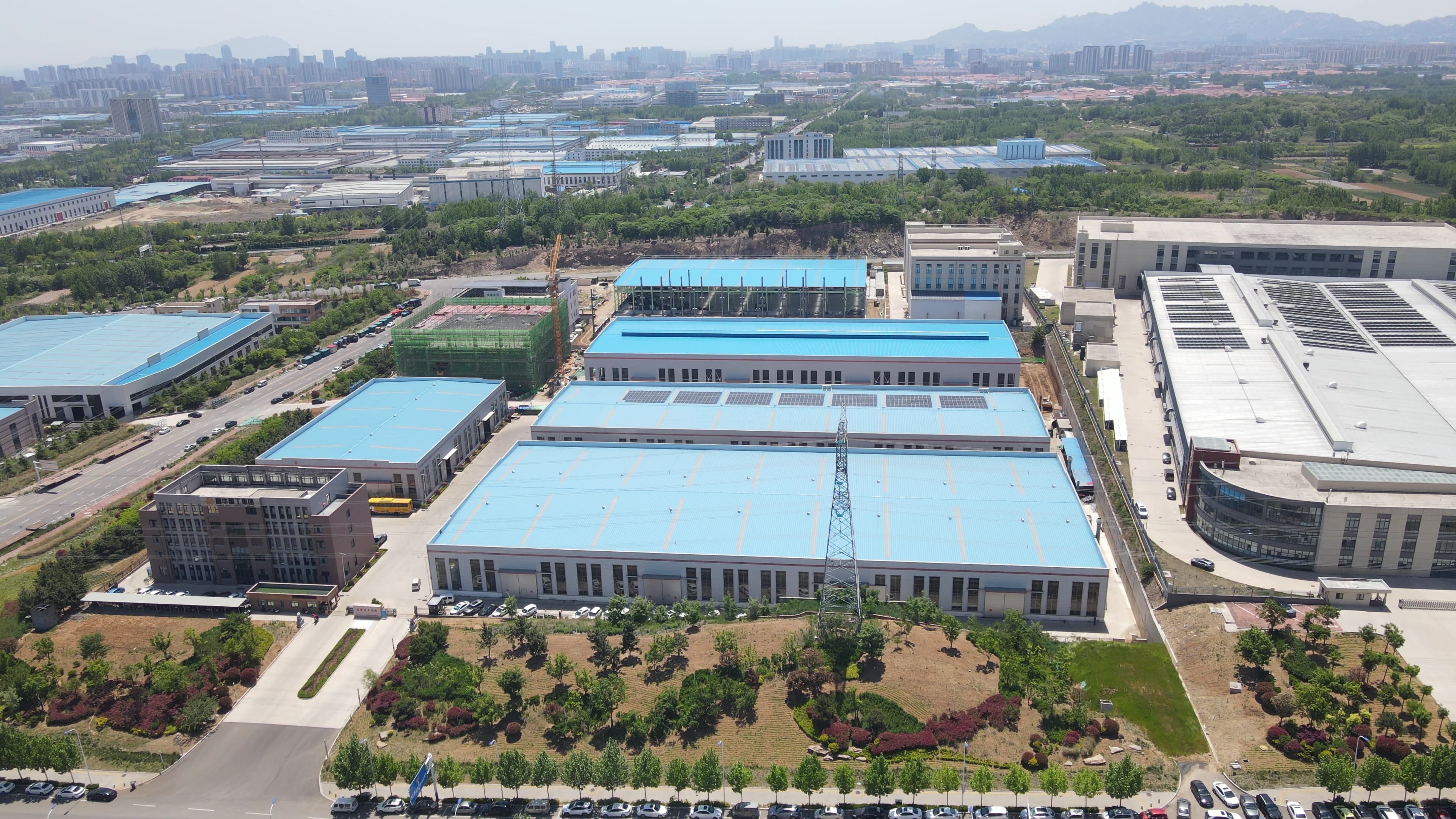
Aluminum hull and superstructure fabrication: both models in this comparison are built from marine-grade aluminum, with different structural priorities.
The published specifications, side by side
The cleanest way to start an evaluation is to strip both sheets down to comparable rows. Where a value is not published for a model, it is shown as such rather than inferred.
| Parameter | DK-FS — 6.25m Aluminum Alloy Fishing Boat | DK-WR — 11m Aluminum Alloy Cruiser Boat |
|---|---|---|
| Length overall | 6.25 m (21 ft) | 11.00 m |
| Hull length (L) | Not published | 8.81 m |
| Breadth | 2.25 m | 3.25 m |
| Depth moulded | 1.10 m | 0.885 m |
| Draft | 0.35 m designed | 0.47 m full load |
| Weight / displacement | 1.28 t hull and superstructure (aluminum) | 5.60 t full load displacement |
| Engine power | 150 HP YAMAHA | 150 HP (110 kW) × 2 — 300 HP combined |
| Speed | 30 kn maximum | 26 kn design speed |
| Fuel capacity | 400 L | 400 L |
| Complement | 6 persons | Not published |
| Material | Aluminum alloy | Aluminum |
| Builder-listed application | Fishing | Coastal rescue; offshore patrol; passenger transport; fishing and marine leisure; professional workboat operations |
Source: Dookyu Crown published model specifications for DK-FS and DK-WR. Missing values indicate that the field is not published, not that the capability is absent.
What the hull and dimensions actually change
Both boats are built in marine-grade aluminum, and the builder states that its core input range includes 5083 and 5086 alloys — the seawater-facing grades commonly chosen for welded hull and superstructure work. At platform level, the meaningful differences are geometric.
Beam: 2.25 m versus 3.25 m
A full metre of additional beam is the single most consequential line in this comparison for workboat buyers. Beam governs usable deck area, transverse stability at rest and the amount of equipment that can be installed without turning the working deck into a walkway. On the DK-FS, 2.25 m of beam on a 6.25 m hull is a fishing-boat proportion: enough for rods, a small catch hold and a seated complement of six, not enough for a working crew with deck equipment.
Depth and draft: 0.35 m versus 0.47 m
Draft separates the two boats operationally. The DK-FS is published at 0.35 m designed draft, which is what allows coastal, lake and river fishing work in thin water and close to shorelines. The DK-WR draws 0.47 m at full load displacement of 5.60 t — a modest figure for an 11 m vessel, but one that reflects a much heavier platform with a deeper submerged envelope. Buyers whose access route includes estuary shallows, river bars or tidal slips should treat 0.47 m as a hard planning input, not a formality.
Depth moulded is not a like-for-like figure across lengths
The DK-FS publishes 1.10 m depth moulded on a 6.25 m hull; the DK-WR publishes 0.885 m on an 11.00 m hull. The smaller hull is proportionally far deeper in section — normal for an open fishing boat that relies on cockpit depth and freeboard for sea keeping and spray protection. On the larger vessel, the same figure is distributed across a much longer hull and a superstructure. Comparing the two raw numbers without that context produces a false impression of which boat is “deeper”.
Weight versus displacement
The DK-FS sheet lists 1.28 t of aluminum in hull and superstructure. The DK-WR sheet lists 5.60 t full load displacement. These are different measurements and should not be placed in the same column of a spreadsheet: one describes structure, the other describes the vessel plus load in the water. Buyers who need a payload or loading figure for either model must request it, because it is not on the published sheet.
Power, speed and the two numbers buyers misread
The DK-FS carries a single 150 HP YAMAHA. The DK-WR carries twin 150 HP engines producing 300 HP combined. Beyond the obvious arithmetic, three points matter at evaluation stage.
- The speed figures are not the same metric. The DK-FS sheet states a 30 kn maximum speed; the DK-WR sheet states a 26 kn design speed. A maximum and a design figure are measured under different assumptions, so reading 30 versus 26 as a straight performance ranking is a methodological error. Buyers who need a genuine comparison should ask for maximum speed at a stated load and cruise speed at a stated load for both hulls.
- Redundancy is a mission decision, not a horsepower decision. Twin engines on the DK-WR give a crewed patrol, rescue or transport platform a second power source if one unit stops. On a day fishing boat operated close to base by one or two people, that redundancy is worth less than the simplicity of a single 150 HP installation with one service schedule, one fuel system and one set of controls.
- Propulsion is configurable. The builder's published customization scope includes engine brand and type, propulsion system and power options across fuel, electric and hybrid configurations, subject to the selected vessel design. Buyers should confirm the exact power package in writing rather than assume the base sheet is fixed.
Both list 400 litres of fuel — which is not the same as equal endurance
Tank capacity is identical at 400 L on both models, and that coincidence tempts buyers toward a false equivalence. Endurance is a function of consumption, displacement, speed, load and sea state. A 5.60 t full-load workboat running twin engines and a 1.28 t aluminum fishing boat running a single engine will not convert the same 400 L into the same operating hours.
Neither published specification states fuel consumption, cruising range or endurance at any speed. This is the most significant documentation gap in the comparison and the one most likely to affect real operating cost. It is resolved by asking the builder for consumption data at defined load and speed — or by requiring figures from a sea trial on a comparable configuration before the contract is signed.
Safety and navigation equipment: what the sheets say and do not say
Neither the DK-FS nor the DK-WR published specification itemises standard safety equipment or navigation equipment. What the builder does publish is a customization scope that explicitly covers navigation and communication systems, safety and lifesaving equipment, lighting systems, and electrical systems with solar panels, alongside firefighting equipment, cranes and winches, fishing gear and livewells where relevant to the platform.
In practice this means the equipment comparison happens at contract stage, not at brochure stage. For an evaluation-stage buyer the correct action is to convert the customization list into a bill of equipment: which items are standard, which are optional, which brand and model are specified, and which certification the installed electronics must satisfy. A patrol or rescue buyer and a leisure fishing buyer will produce two very different lists from the same page.
Compliance evidence that covers both models
Both the DK-FS and the DK-WR appear in the related-product list of the same voluntary attestation for recreational craft, certificate number 0P250716.QDCTN80, issued by ECM on 16 July 2025 and valid to 15 July 2030. The attestation references EN ISO 12217-1:2017 and EN ISO 12217-3:2017 together with Regulation (EU) 2013/53/EU, and its stated scope covers multiple series of aluminum, steel and fiberglass boats, with the market described as third-country markets outside the EU.
A companion certificate, 0P250716.QDCTN81, is a voluntary EMC certificate against the CE-EMC Directive 2014/30/EU referencing EN IEC 61000-6-1:2019 and EN IEC 61000-6-3:2021, issued on the same date with the same validity period and the same multi-series scope. For buyers, the important reading is twofold: one attestation can cover several model series, and its stated market scope should be checked against the destination market before it is treated as sufficient.
Build-side quality statements complement the certificates. The builder describes full-process inspection from raw material verification through mill test reports and in-process weld inspection using non-destructive testing, to final sea trials, and states compliance with ISO 9001, CE and CCS requirements.
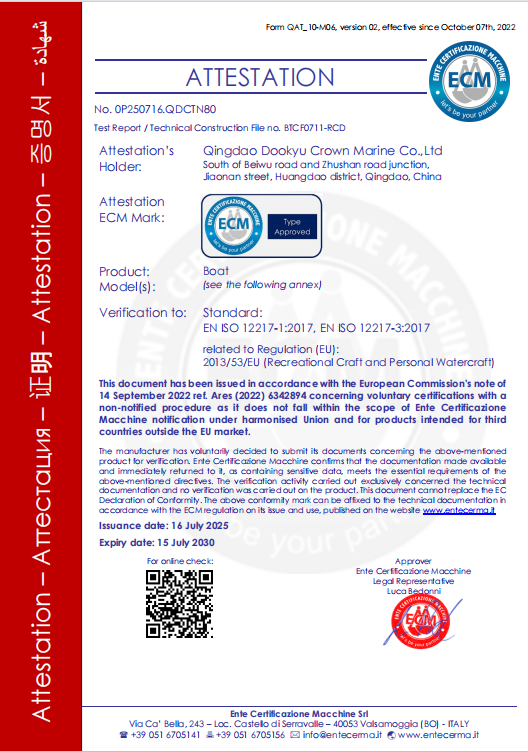
Attestation 0P250716.QDCTN80 (ECM, valid 16 July 2025 – 15 July 2030) lists both the DK-FS and the DK-WR among the covered product series. Buyers should confirm that the exact configuration ordered falls inside the certified scope.
Operating profile: matching the boat to the working week
The published application fields are the most reliable guide to intent. The DK-FS is listed for fishing, with a six-person complement and 0.35 m designed draft — a profile that fits coastal, lake and river fishing where the boat is handled by its own users, launched and recovered regularly, and used in day-length trips.
The DK-WR is listed across coastal rescue, offshore patrol, passenger transport, fishing and marine leisure, and professional workboat operations. Those roles share three requirements that the smaller boat cannot meet: space for a working crew and equipment, beam for stability during side-by-side operations, and twin-engine redundancy for missions where a single power failure has consequences beyond a delayed return.
| Decision criterion | Points toward DK-FS 6.25m | Points toward DK-WR 11m |
|---|---|---|
| Primary duty | Dedicated fishing, coastal, lake or river | Patrol, rescue, transport or mixed professional work |
| Crew model | One or two operators handling the boat themselves | A working crew with role separation on deck |
| Water access | Shallow or restricted access, 0.35 m draft | Open coastal and offshore access, 0.47 m full-load draft acceptable |
| Engine redundancy | Not required for the mission | Required — twin 150 HP, 300 HP combined |
| Deck working space | Sufficient for fishing gear and six persons | Required — 3.25 m beam and larger deck envelope |
| Equipment load | Minimal electronics and safety fit | Navigation, communication and mission equipment specified in contract |
| Maintenance structure | Single engine service schedule | Two engines, two service schedules |
Decision framework derived from published Dookyu Crown model specifications and listed applications.
Where each option stops making sense
A credible comparison has to state the boundary conditions. Three apply to this pair.
- The DK-FS stops fitting when the mission is multi-role. A single 150 HP installation and a six-person complement suit fishing. They do not support a crewed patrol roster or heavy deck equipment, and no patrol, rescue or passenger-transport application is published for this model. Buyers who expect the boat to grow into a second duty should not plan on it.
- The DK-WR stops fitting when access is the constraint or the crew is thin. An 11.00 m hull with 3.25 m beam and 5.60 t full-load displacement demands more berthing, more handling capacity and more crew than a 6.25 m boat, and its 0.47 m full-load draft closes off very shallow river and tidal access. Two engines also mean two service schedules and a larger spares footprint. Where the mission is one or two anglers on inland water, most of that capability is paid for and never used.
- Aluminum is corrosion-resistant, not maintenance-free. Both hulls rely on marine-grade aluminum and anti-corrosion treatment; buyers should still budget for a maintained protection regime including anodes and coating inspection as part of the ownership plan, as the builder's own material guidance implies.
Market context: why one builder offers both hulls
Independent market estimates explain why fishing boats and workboats are tracked as separate demand pools that a single builder can serve with different platforms. Global Market Insights valued the global aluminum fishing boat market at USD 1.7 billion in 2024, while Intel Market Research projects the same segment to reach USD 3.12 billion by 2034 at a 5.8% CAGR. Market Research Future estimated the broader global aluminum vessel market at USD 6.145 billion in 2024, with a projected 4.21% CAGR from 2025 to 2035, and Intel Market Research placed the global patrol boat market, including aluminum variants, at USD 240 million in 2024.
Stratview Research notes that aluminum fishing boats are preferred over fiberglass for freshwater fishing on weight and cost grounds — a preference that aligns with the DK-FS profile of shallow draft and light structure. The patrol and workboat segments operate on different logic: mission equipment, crew capacity and redundancy dominate specification decisions, which is the DK-WR profile. The two markets grow for different reasons, and that is why a builder serving both keeps two hull forms rather than stretching one.
Future outlook
For evaluation-stage buyers, the practical trend is documentation rather than hull design. As aluminum fishing and workboat demand expands, procurement teams are increasingly asking for the items that published brochures rarely carry: consumption at defined load, payload limits, a named bill of equipment, and confirmation that the specific configuration sits inside the certification scope. The builder's stated capability set — 5083 and 5086 alloy input, marine-grade welding practice, non-destructive weld inspection, 30–60 day lead times, a minimum order of one ship and a stated monthly capacity of 20 ships — supports that level of specification work. The buyer's job is to convert it into a contract schedule that names every item the mission depends on.
Frequently asked questions
Which is the better aluminum boat for coastal and inland fishing — DK-FS or DK-WR?
Both models list fishing among their applications, but the fit differs. The DK-FS is published as a 6.25 m aluminum alloy fishing boat with a six-person complement, 0.35 m designed draft and 30 kn maximum speed — a dedicated fishing platform for coastal, lake and river use. The DK-WR lists fishing and marine leisure alongside coastal rescue, offshore patrol and passenger transport, at 11.00 m length overall, 3.25 m beam and 5.60 t full-load displacement. Dedicated fishing with shallow access points to DK-FS; fishing as one duty among several on a crewed platform points to DK-WR.
Can the DK-FS be used for patrol or rescue work?
No patrol, rescue or passenger-transport application is published for the DK-FS; its stated applicable industry is fishing. The builder lists those roles for other models in its range, including the DK-WR and the 13m DK-FR rescue fire boat. Buyers requiring a patrol or rescue capability should evaluate against those platforms rather than assuming the fishing hull can be repurposed.
Why does the DK-WR sheet say “design speed” while the DK-FS sheet says “maximum speed”?
The two figures are defined differently: 30 kn is stated as a maximum speed for the DK-FS, while 26 kn is stated as a design speed for the DK-WR. Because the underlying conditions are not identical, the numbers should not be read as a direct performance ranking. Buyers who need a like-for-like comparison should request maximum and cruise speed at a defined load for both models.
Both boats list 400 L of fuel. Does that mean similar range?
No. Range depends on fuel consumption, displacement, speed, load and sea state, and the two platforms differ substantially in displacement and power installation. Neither published specification states consumption or endurance at any speed, so endurance must be established from builder data at a defined load and speed, or from sea trial figures on a comparable configuration.
What certification covers the DK-FS and the DK-WR?
Both models appear in the related-product list of voluntary attestation 0P250716.QDCTN80, issued by ECM on 16 July 2025 and valid to 15 July 2030 under EN ISO 12217-1:2017, EN ISO 12217-3:2017 and Regulation (EU) 2013/53/EU, with a stated scope covering multiple series of aluminum, steel and fiberglass boats and a market described as third-country markets outside the EU. A companion EMC certificate, 0P250716.QDCTN81, references EN IEC 61000-6-1:2019 and EN IEC 61000-6-3:2021. Buyers should verify that the ordered configuration falls within the certified scope and satisfies the destination market's requirements.
Are safety and navigation equipment included as standard on either model?
Neither published model specification itemises standard safety or navigation equipment. The builder's stated customization scope covers navigation and communication systems, safety and lifesaving equipment, lighting, and electrical systems including solar panels, alongside mission equipment such as firefighting equipment, cranes, winches, fishing gear and livewells. The equipment set should therefore be agreed as a written schedule within the order.
What lead time and minimum order apply to these aluminum boats?
Dookyu Crown states a minimum order quantity of one ship, a lead time of 30–60 days and a monthly capacity of 20 ships. These are builder-stated figures rather than guaranteed schedules for a specific configuration, so delivery dates should be confirmed against the final specification and equipment list.
Есть вопросы или нужны дополнительные детали?
Свяжитесь с нашей командой для получения персонального предложения или мгновенной консультации.
Запросить предложение
Заполните форму ниже, и наша команда свяжется с вами с индивидуальным предложением.
Прямой чат WhatsApp
Предпочитаете общаться в реальном времени? Напишите нам в WhatsApp для мгновенной помощи и быстрых ответов.
- Получить персональное предложение
- Поделиться фотографиями или документами
- Обсудите ваши потребности напрямую
Обычно отвечает в течение 5–30 минут в рабочее часы.