
DK630 vs PST180 vs PSN100: Lubrication Pump Duty Matching
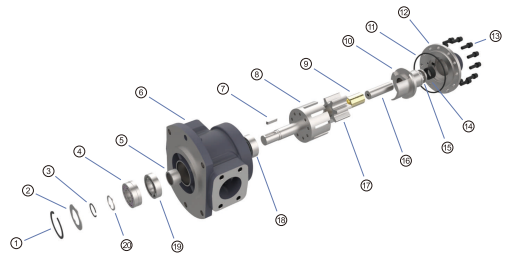
Exploded view of a DEO bidirectional internal gear pump — the mechanical architecture used in hydraulic power units, engine lubrication and independent conveying circuits.
An industrial lubrication pump is chosen by duty cycle, not by brand preference. Two pumps can look interchangeable in a catalogue and behave completely differently in service: one is built to run continuously against a filter and a cooler on a rolling-mill lubrication station, the other to be driven from an existing shaft inside a hydraulic power unit. Getting that match wrong shows up later as cavitation, seal leakage, overheated oil, or a pump that is quietly oversized for the circuit it feeds.
This analysis compares three pumps from Deo Machinery Co., Ltd (DEO) — a Ningbo-based manufacturer founded in 2010 that produces hydraulic pumps, electric lubrication pumps, centralized lubrication system pumps, oil lubrication pump systems and lubrication system oil coolers — and maps each one against the duty cycles it is documented for:
- DK630 electric lubrication pump — a model in DEO's DK series, with 630 cc/rev displacement, a stated motor rotation speed of 950 rpm or 1450 rpm, and a QT500 housing.
- PST180 bidirectional internal gear pump — 180 cc/rev, maximum speed 1800 rpm, rated −30 °C to +100 °C, housing in GG250 gray cast iron or QT500 ductile iron.
- PSN100 trochoidal bidirectional mechanical pump — 100 cc/rev, maximum speed 1800 rpm, rated −30 °C to +100 °C, in ductile iron QT500.
The purpose here is not to rank the three against each other in the abstract. It is to make the selection question answerable before an enquiry is sent: which pump belongs on a steel or mining lubrication circuit, which belongs on a hydraulic power unit or an engine lubrication loop, and which installation and acceptance conditions have to be written into the order.
Four questions that decide the pump before the model number does
Industrial lubrication pump selection is usually settled by four questions, and only one of them is about the pump itself.
- How much oil has to move, and how continuously? A lubrication station feeding large gearboxes and rolling-mill bearings needs a different displacement profile from a circuit that tops up an oil film at low, intermittent flow.
- Is an electric drive available at the lubrication point? If the machine already has a shaft, gearbox take-off or auxiliary drive, a mechanical pump removes the need for a motor, starter and electrical protection.
- What are the fluid temperature and viscosity at the pump inlet? Temperature windows and viscosity ceilings are stated per product family, not per brand, and they are the fastest way to eliminate an unsuitable model.
- What is the installation envelope? Port size, inlet pipe diameter, suction airtightness, mounting and — for a pump-plus-motor assembly — coupling coaxiality all have consequences for whether the chosen displacement actually delivers.
Answering those four questions first is what turns a specification comparison into a purchasing decision.
The three pumps side by side
| Decision factor | DK630 electric lubrication pump | PST180 internal gear pump | PSN100 trochoidal pump |
|---|---|---|---|
| Pump type | Electric lubrication pump; DK series helical external gear positive displacement pump | Bidirectional internal gear pump | Trochoidal bidirectional mechanical pump |
| Displacement | 630 cc/rev | 180 cc/rev | 100 cc/rev |
| Speed | Motor rotation speed 950 rpm / 1450 rpm | Maximum 1800 rpm | Maximum 1800 rpm |
| Housing material | QT500 | GG250 gray cast iron, or QT500 ductile iron | Ductile iron, QT500 |
| Fluid temperature | DK series range −40 °C to +100 °C | −30 °C to +100 °C | −30 °C to +100 °C |
| Rotation | Operate in the direction marked on the nameplate | Bidirectional | Bidirectional |
| Documented applications | Mining equipment, construction machinery, steel industry; machinery and heavy industry | Hydraulic systems, construction machinery, engine lubrication systems, automation equipment, forklifts and telehandlers, hydraulic power units, industrial cooling systems | Lubricating systems, cooling systems, external-drive independent conveying systems |
Read as a set, the table already separates two purchasing logics: one pump family carries its own drive and a very large displacement per revolution, the other two are dependant on the host machine for drive and are specified at smaller displacements.
DK630: a high-displacement electric pump for continuous lubrication circuits
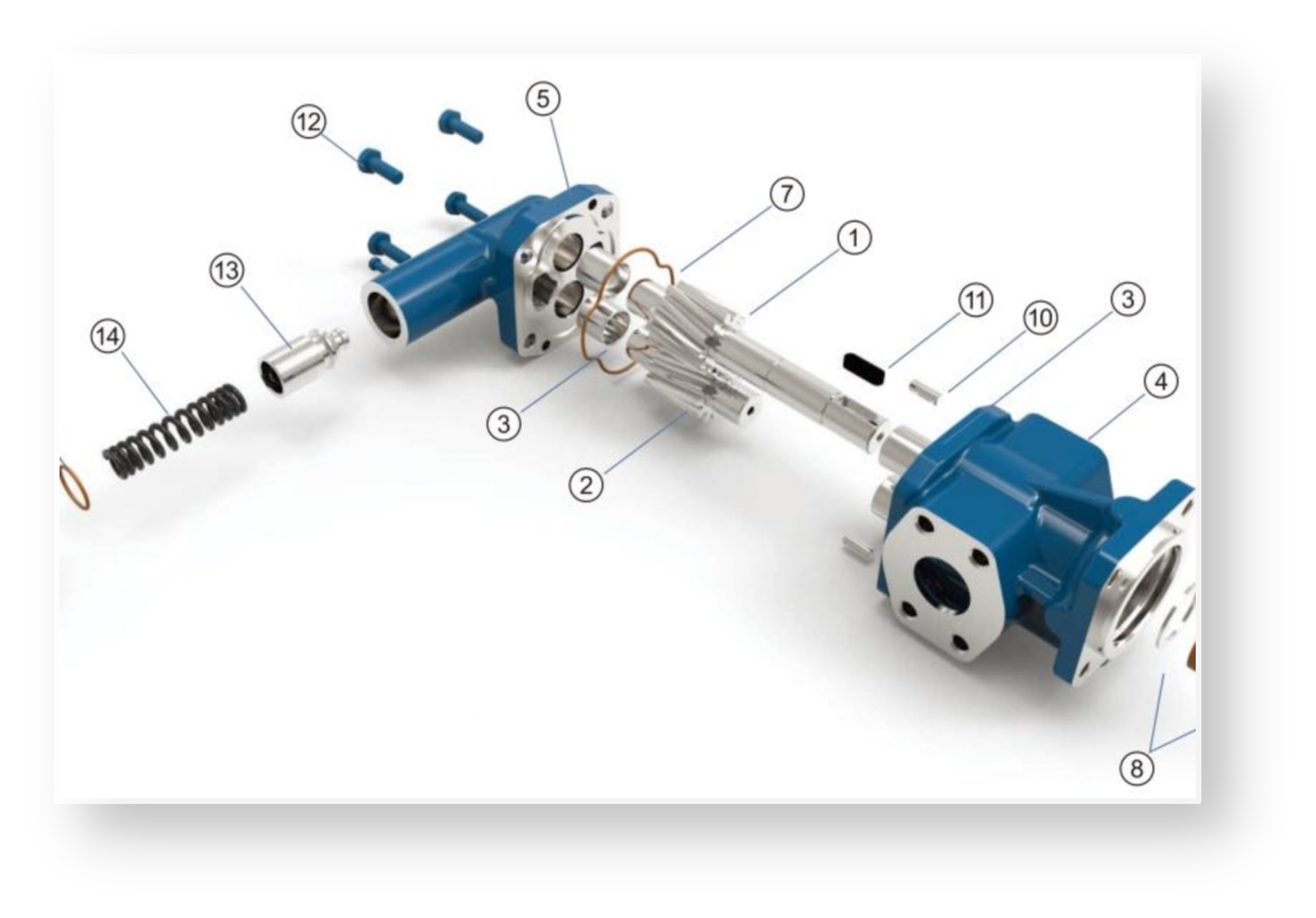
DK series assembly in exploded view: helical external gear pump body, bushings, sealing and relief valve components.
The DK series is defined by DEO as a low-noise helical external gear positive displacement pump, developed for industrial lubrication and hydraulic auxiliary fluid conveying. Its working role is straightforward: continuously deliver lubricating or hydraulic oil to mechanical friction pairs — gears, bearings, sliding rails — to form an oil film, reduce abrasion and carry friction heat away from the contact.
Within that family, the DK630 is the high-displacement option at 630 cc/rev, with a stated motor rotation speed of 950 rpm or 1450 rpm and a QT500 housing. DEO's application record for the DK family notes that the helical gear meshing structure runs about 3 dB quieter than straight gear pumps, which matters where lubrication equipment sits close to operators, and that volumetric efficiency is maintained at 95 or above, keeping internal leakage low. Across the DK series, oil flow ranges of 6–200 L/min are matched to different model displacements.
Two design features shape how the pump is used in practice. First, a built-in relief valve is standard, with an adjustable setting of 5–25 bar; DEO documents it as transient overpressure protection for pipes and equipment, not as a regulating device — sustained relief operation leads to overheating and early wear. Second, the pump is documented across a wide medium range: kinematic viscosity from 12 to 20,000 cSt, covering thin hydraulic oils and heavy lubricating oils, with fluid operating temperatures from −40 °C to +100 °C.
The discipline that comes with a 630 cc/rev electric pump is on the suction side. DEO's installation guidance requires an airtight inlet pipeline with no air leakage, an inlet pipe diameter no smaller than the pump inlet port, and oil free of metal chips, sand and other solid impurities — particle contamination scratches gear surfaces and wears the bushings quickly. Dry running is prohibited, because friction destroys shaft bushings and gears in a short time. For ultra-high-viscosity oil above 1000 cSt, the guidance is to reduce pump speed to avoid excessive suction resistance and cavitation.
PST180 and PSN100: mechanical, bidirectional pumps for host-driven circuits
The two mechanical pumps answer a different procurement situation: the lubrication point has a drive, but no electrical supply, or the circuit is arranged so the pump is turned by the machine. Neither carries a motor, so the buyer specifies the drive, coupling and guarding, and the pump is sized on displacement and speed alone.
The PST180 is a bidirectional internal gear pump with 180 cc/rev displacement, a maximum speed of 1800 rpm and a rated temperature range of −30 °C to +100 °C. Its pump housing is available in GG250 gray cast iron or QT500 ductile iron, which gives procurement a material choice rather than a fixed specification. DEO documents it for hydraulic systems, construction machinery, engine lubrication systems, automation mechanical equipment, forklifts and telehandlers, hydraulic power units and industrial cooling systems.
The PSN100 is a trochoidal (cycloidal) bidirectional mechanical pump with 100 cc/rev displacement, a maximum speed of 1800 rpm and the same −30 °C to +100 °C range, in ductile iron QT500. Its documented applications are lubricating systems, cooling systems and external-drive independent conveying systems.
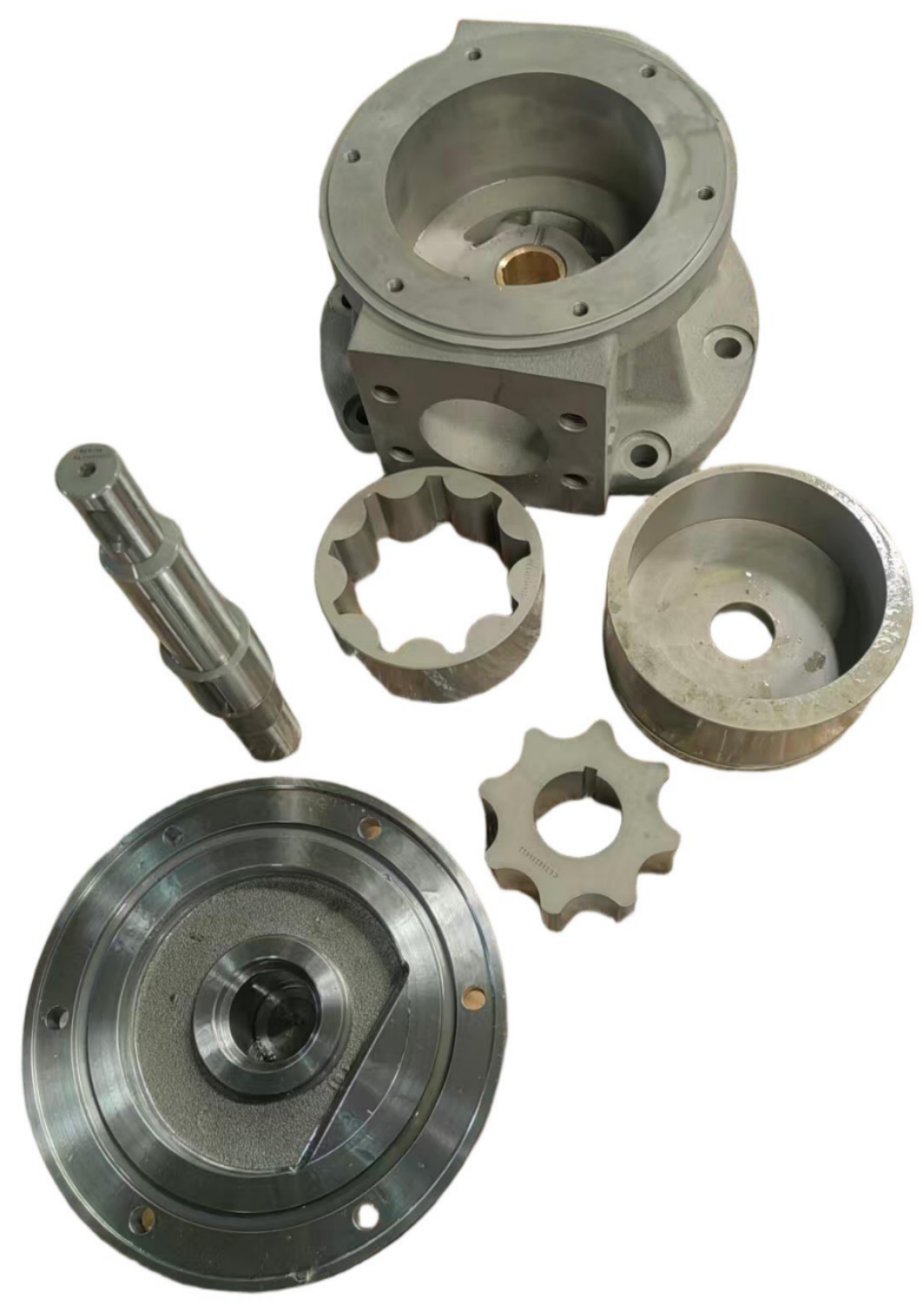
PSN100 trochoidal pump components: a compact bidirectional unit for lubricating, cooling and independent conveying circuits.
The practical difference between the two mechanical units is displacement and geometry, and therefore the size of the circuit they suit. Where an engine lubrication system or a hydraulic power unit needs a moderate, shaft-driven oil supply, 180 cc/rev or 100 cc/rev at up to 1800 rpm is a normal match. Where the circuit must move a large volume of oil continuously, neither mechanical unit substitutes for the DK630's displacement per revolution.
The bidirectional specification is worth noting for two reasons. It removes rotation direction as an installation risk on a gearbox take-off or a reversing drive, and it means the PSN100 and PST180 can be used in circuits where flow direction is set by the host machine. The DK series is specified differently — it must be operated in the direction marked on the pump nameplate, because reverse rotation affects sealing and leads to leakage failure.
How displacement and speed become delivered flow
Displacement is a geometric figure: the volume the pump moves per revolution. Delivered flow is that figure multiplied by the actual operating speed, adjusted for volumetric efficiency. That single relationship explains most of the confusion in lubrication pump comparison.
Per revolution, the DK630 displaces roughly 3.5 times the volume of the PST180 and about 6.3 times that of the PSN100. The mechanical pumps compensate partly through a higher speed ceiling — 1800 rpm against the DK630's stated motor speeds of 950 rpm and 1450 rpm — but the ratio of displacement is large enough that the two mechanical units are not equivalent substitutes in high-flow, continuous lubrication duty.
The reverse implication matters just as much for buyers. A 630 cc/rev pump on a circuit that only needs a thin oil film is not a safety margin; it is an oversized unit that has to be throttled, bypassed or run at reduced speed, and oversized displacement on a small reservoir also raises the risk of aeration at the suction. The correct first step is to state the required flow at the actual operating temperature, then choose displacement and speed together.
Speed selection is also a medium question, not only a flow question. DEO's guidance for the DK series is explicit that with ultra-high-viscosity oil above 1000 cSt the pump speed should be reduced to keep suction resistance and cavitation risk under control — a reminder that the highest available speed is not automatically the operating point.
Housing material and the temperature window
Material grades in lubrication pumps are usually treated as catalogue detail. In practice they set the boundary of the duty the pump tolerates.
The DK630 and PSN100 are specified in QT500, a ductile iron grade, and the PST180 is offered in GG250 gray cast iron or QT500 ductile iron. As a general engineering principle, ductile iron grades are selected where higher strength and greater tolerance of shock and vibration are required, while gray cast iron remains a common, economical choice for general-duty housings. For a buyer, the practical consequence is that the housing grade should be confirmed against the actual duty — pressure fluctuation, load reversals, mounting rigidity — instead of being assumed, particularly on equipment such as construction machinery or mobile hydraulics where vibration is continuous.
Temperature is stated as a fluid-medium window, and the three pumps are not identical here. The PST180 and PSN100 are rated from −30 °C to +100 °C. The DK series is documented for fluid operating temperatures of −40 °C to +100 °C. Where a circuit starts cold and runs hot — outdoor installations, seasonal plants, sites without oil preheating — the cold-start viscosity, not the running temperature, is usually the binding constraint, because a cold high-viscosity medium raises suction resistance sharply at the pump inlet.
Application mapping: steel, mining and construction versus cooling, hydraulic power units and engine lubrication
The application records attached to the three models are specific, and they are the most reliable guide to fit.
DK630 — steel, mining and construction. DEO classifies the DK630 for machinery and heavy industry, with the model carrying the application descriptors of lubrication pump for mining equipment, lubricating pump for construction machinery and lubrication pump for the steel industry. The duty profile behind those labels is consistent: large gearboxes, reducers, rolling and processing lines and heavy machinery where the lubrication circuit runs long, oil volume is high, and the pump must feed through filters and coolers without losing suction. In these installations, an electric drive is normally available at the lubrication station, which is what makes a 630 cc/rev motor-driven pump a practical specification rather than an oversized one.
PST180 — hydraulic power units, engine lubrication, mobile equipment and cooling. The documented list for the PST180 — hydraulic systems, construction machinery, engine lubrication systems, automation mechanical equipment, forklifts and telehandlers, hydraulic power units, industrial cooling systems — describes circuits where a moderate oil volume is moved from a shaft-driven point, often inside a package that already contains the drive. Bidirectional operation suits machines with reversing drives.
PSN100 — lubricating, cooling and independent conveying. The PSN100's documented applications are narrower and more specific: lubricating systems, cooling systems and external-drive independent conveying systems. At 100 cc/rev it fits compact circuits, external conveying duties where oil is moved between tanks or modules, and cooling loops served by a separate mechanical drive.
DEO also documents matching between its pumps and its cooling equipment — self-circulation coolers and plate water coolers — where the lubrication circuit has to remove heat as well as deliver oil. For procurement, that matters less as a bundle argument than as a compatibility point: circuit pressure drop, port sizes and oil viscosity have to be consistent between pump and cooler, and specifying them together avoids a mismatch discovered at commissioning.
Installation and commissioning requirements to write into the purchase order
Most field failures on industrial lubrication pumps are installation failures that were visible in the specification. DEO's published requirements for the DK series translate into a short list of conditions worth placing in the order documents:
- Airtight inlet piping. The pump inlet pipeline must be airtight without air leakage; otherwise suction flow is insufficient and cavitation occurs.
- Inlet pipe diameter. The inlet pipe diameter must not be smaller than the pump inlet port, to avoid flow restriction and pressure loss.
- Clean medium. Oil must be free of metal chips, sand and other solid impurities; a filter is mandatory in heavily polluted working conditions.
- No dry running. Operating without oil medium is prohibited, because friction damages shaft bushings and gears within a short time.
- Rotation direction. The DK series must follow the direction marked on the pump nameplate; reverse rotation invalidates sealing and causes leakage failure.
- Relief valve function. The built-in valve is transient overpressure protection only; continuous overflow operation leads to overheating and early wear, so the circuit should not rely on it as a regulator.
- Alignment on pump-motor units. Where a complete pump unit with bell housing and coupling is supplied, the bell housing and motor shaft must maintain coaxiality.
For the mechanical PST180 and PSN100, the equivalent checks sit on the drive side: coupling selection, alignment, guarding, and confirmation that the circuit provides its own overpressure protection in line with its pressure rating.
Purchasing terms and what to confirm before the order closes
DEO's documented commercial terms are relevant to how these pumps are bought. The company supports OEM and ODM production, with customization covering colour and oil pump configuration; minimum order quantity is 1 unit; quoted lead time is 35–45 days; monthly capacity is stated at 2500 units; and every unit is 100% tested. Export markets are stated as Europe and America and Southeast Asia, against a company profile of a 10,000 m² factory, 80 employees, a 12-engineer R&D team and a record of 3 invention patents and 16 utility model patents.
On the technical side, an acceptance checklist for any of the three models should capture: confirmed model and displacement; speed range and, for the DK630, the selected motor speed; housing material grade; temperature and viscosity limits against the actual medium; displacement verification on test; relief valve setting where applicable; nameplate rotation direction; port size and thread standard; and, for OEM variants, an agreed drawing or sample approval before volume release.
Market trend: automatic lubrication and electric drive growth
The direction of the market supports keeping both drive architectures in a specification rather than standardising on one. Consolidated commercial market research reviewed for this analysis puts the global lubrication system market at USD 863.88 million in 2024 and estimates that 67% of newly commissioned industrial machines in 2024 were equipped with automatic lubrication systems — a strong signal that lubrication is being designed into new equipment rather than added later as manual maintenance. The same research base projects the electric lubrication pump segment to grow at a 6.89% CAGR to USD 2.7 billion by 2032, while a separate commercial forecast places the automatic lubrication system market at USD 1,470.88 million by 2032.
Two conclusions follow for buyers, and one caution. The conclusions: electric, automatic lubrication continues to expand, which favours motor-driven units such as the DK630; and mechanical pumps remain the interface in hydraulic power units, engine lubrication and independent conveying, which is exactly where the PST180 and PSN100 sit. The caution is about data scope: published market figures in this category are generally reported at pump-category or lubrication-system level rather than for lubrication pumps alone, so they are useful for planning direction and not for sizing an individual procurement.
Classification and compliance also shape cross-border purchasing. Industrial pumps and oil pumps fall under HS heading 8413.30 in the US Harmonized Tariff Schedule, and fluid power pump and motor manufacturing is defined under NAICS 333996 — the classification a buyer's customs and supplier-qualification teams will work with. Sector-level statistics from the Federal Reserve Bank of St. Louis place US pump and compressor manufacturing output at USD 23,000.913 million in 2021, a figure that describes an established industrial supply base rather than lubrication-pump volume specifically. In application-specific duty, tighter standards apply: ASTM F2798-09(2023), for example, defines requirements for sealless rotary positive displacement pumps with oil-through motors for ship lubricating oil service, covering oil with an SAE rating of 20–50. Marine and other regulated duties should be screened against such standards before a general industrial pump is proposed.
For context on the wider supplier landscape, manufacturers such as Graco describe automatic oil and grease pumps and state that electric and hydraulic pumps are available in their industrial lubrication solutions; SKF documents an electrically operated pump for interval feeding inside centralized lubrication systems; and Ingersoll Rand describes internal gear pumps designed specifically for lubrication and circulation systems in machinery, turbines and gearboxes. This is the competitive environment any lubrication pump specification is evaluated in, and it is why displacement, material and drive architecture — not brand familiarity alone — tend to decide the outcome.
Where these pumps are not the right answer
An honest comparison has to state the boundaries of the products it compares.
The DK630 is not a universal replacement. At 630 cc/rev it is a large-displacement pump, and on a small lubrication circuit or a compact hydraulic power unit it will be oversized — adding cost, heat and control complexity for flow the circuit does not need. It also requires an electrical supply at the lubrication point and disciplined inlet design: an airtight suction line, an inlet bore no smaller than the pump port, and oil free of metal chips and sand. Its built-in relief valve protects against transient pressure spikes only; using it for continuous overflow will overheat the pump and shorten its life. And its stated motor speeds of 950 rpm and 1450 rpm should be matched to the actual medium: at viscosity above 1000 cSt, speed has to come down.
The PST180 and PSN100 are not self-contained. Both are mechanical and require an external drive, coupling and guarding, so the installed package depends on how well the host machine's drive is engineered. Their temperature window starts at −30 °C, narrower on the cold end than the DK series' documented −40 °C, which matters for outdoor and cold-start installations. And the PST180's housing choice — GG250 gray cast iron or QT500 ductile iron — is a real decision with consequences for how the pump behaves under vibration and load reversals, not a formality.
None of the three tolerates contaminated or dry operation. Oil must be free of metal chips and other solid impurities across the range, and dry running without oil medium is prohibited because it damages shaft bushings and gears through friction. Buyers who cannot guarantee filtration, airtight suction and correct commissioning should treat circuit design as the first project, not pump selection.
Future outlook
The next few years are likely to widen, not narrow, the choice between electric and mechanical lubrication pumps. Growth in automatic lubrication adoption and in the electric pump segment points toward more motor-driven, monitored lubrication points on new equipment, while hydraulic power units, engine lubrication and self-contained machine packages will continue to be built around shaft-driven mechanical pumps for practical and economic reasons.
For buyers, that means the specification document should carry both architectures from the start: a flow and displacement requirement, a drive availability statement, a fluid temperature and viscosity window, and installation conditions for the suction side. Pumps such as the DK630, PST180 and PSN100 are the concrete options behind those requirements — and the difference between a successful installation and a problematic one usually lies in how precisely the duty cycle was described before the model number was chosen.
FAQ
What is the main difference between the DK630 electric lubrication pump and the PST180 internal gear pump?
The DK630 is an electric lubrication pump in DEO's DK series with a displacement of 630 cc/rev and a stated motor rotation speed of 950 rpm or 1450 rpm, designed for continuous delivery of lubricating or hydraulic oil to friction pairs. The PST180 is a bidirectional internal gear pump with 180 cc/rev displacement and a maximum speed of 1800 rpm, intended for external drive. The practical differences are drive architecture — integrated electric versus host-driven mechanical — and displacement per revolution.
How should a buyer choose between 630 cc/rev, 180 cc/rev and 100 cc/rev?
Displacement is the oil volume moved per revolution, so delivered flow depends on displacement multiplied by operating speed. Per revolution, the DK630 displaces roughly 3.5 times the PST180 and about 6.3 times the PSN100. Circuits that must move a large oil volume continuously — large gearboxes, steel and mining lubrication stations — generally need the larger displacement, while hydraulic power units, engine lubrication and independent conveying circuits driven from an existing shaft are normally matched with the 180 cc/rev or 100 cc/rev mechanical units.
Can the PST180 and PSN100 run in both directions?
Yes. The PST180 is specified as a bidirectional internal gear pump and the PSN100 as a bidirectional mechanical pump, so both are intended for bidirectional operation, which suits reversing drives and gearbox take-offs. The DK series is specified differently: it must be operated in the direction marked on the pump nameplate, because reverse rotation affects sealing and leads to leakage failure.
What oil cleanliness and piping conditions apply before commissioning?
For the DK series, oil must be free of metal chips, sand and other solid impurities, because particles scratch gear surfaces and wear bushings; a filter is mandatory in heavily polluted working conditions. The inlet pipeline must be airtight with no air leakage, otherwise suction flow falls and cavitation occurs, and the inlet pipe diameter must not be smaller than the pump inlet port. Dry running without oil medium is prohibited.
What temperature and viscosity ranges do these pumps cover?
The PST180 and PSN100 are rated from −30 °C to +100 °C. The DK series is documented for fluid operating temperatures of −40 °C to +100 °C and a kinematic viscosity range of 12 to 20,000 cSt, which covers thin hydraulic oils through to heavy lubricating oils. For ultra-high-viscosity oil above 1000 cSt, pump speed should be reduced to avoid excessive suction resistance and cavitation.
What housing materials are used, and why does the grade matter?
The DK630 housing is QT500 and the PSN100 is specified in ductile iron QT500. The PST180 pump housing is available in GG250 gray cast iron or QT500 ductile iron. Material grade affects how the housing behaves under pressure fluctuation, load reversals and vibration, so the grade should be confirmed against the duty — particularly on mobile and construction equipment — rather than assumed.
What purchasing terms and acceptance checks apply?
DEO supports OEM and ODM production with customization of colour and oil pump configuration, a minimum order quantity of 1 unit, a stated lead time of 35–45 days, monthly capacity of 2500 units and 100% testing of units. Acceptance checks should confirm model and displacement, speed range, housing material grade, temperature and viscosity limits against the actual medium, relief valve setting where applicable, nameplate rotation direction, and port size and thread standard.
Reference material
Technical parameters and installation requirements summarized in this article are drawn from DEO product and application documentation. A consolidated product brochure covering DEO pumps and cooling equipment is available for download: DEO Machinery product brochure (PDF).