
DTF Printer Supplier Long-Term Evaluation: What Broad Certification Coverage Reveals
Direct-to-Film (DTF) printing has moved from a niche transfer method to a mainstream apparel decoration process in under a decade. Grand View Research valued the global DTF printing market at USD 2.7 billion in 2024, and Europe accounted for a 36.0% revenue share of that total, making it the leading regional market that year. China, meanwhile, accounts for more than 45% of global DTF printer manufacturing capacity. For buyers, this changes the question they should be asking. The relevant question is no longer whether a DTF printer can produce a good sample. It is whether the supplier behind that machine will still be able to certify, support, and supply it three to five years from now.
Broad certification coverage across a supplier's product line is one of the few observable signals that speaks directly to that longer question. A single certificate for a single model confirms that one shipment was tested. A consistent set of certificates spanning an entire model range, issued by identifiable authorities, with stable numbering and published standards, points to something different: a manufacturing operation whose compliance work is systematic rather than reactive. This article explains how to read that signal, how to verify it, and where it stops being informative.
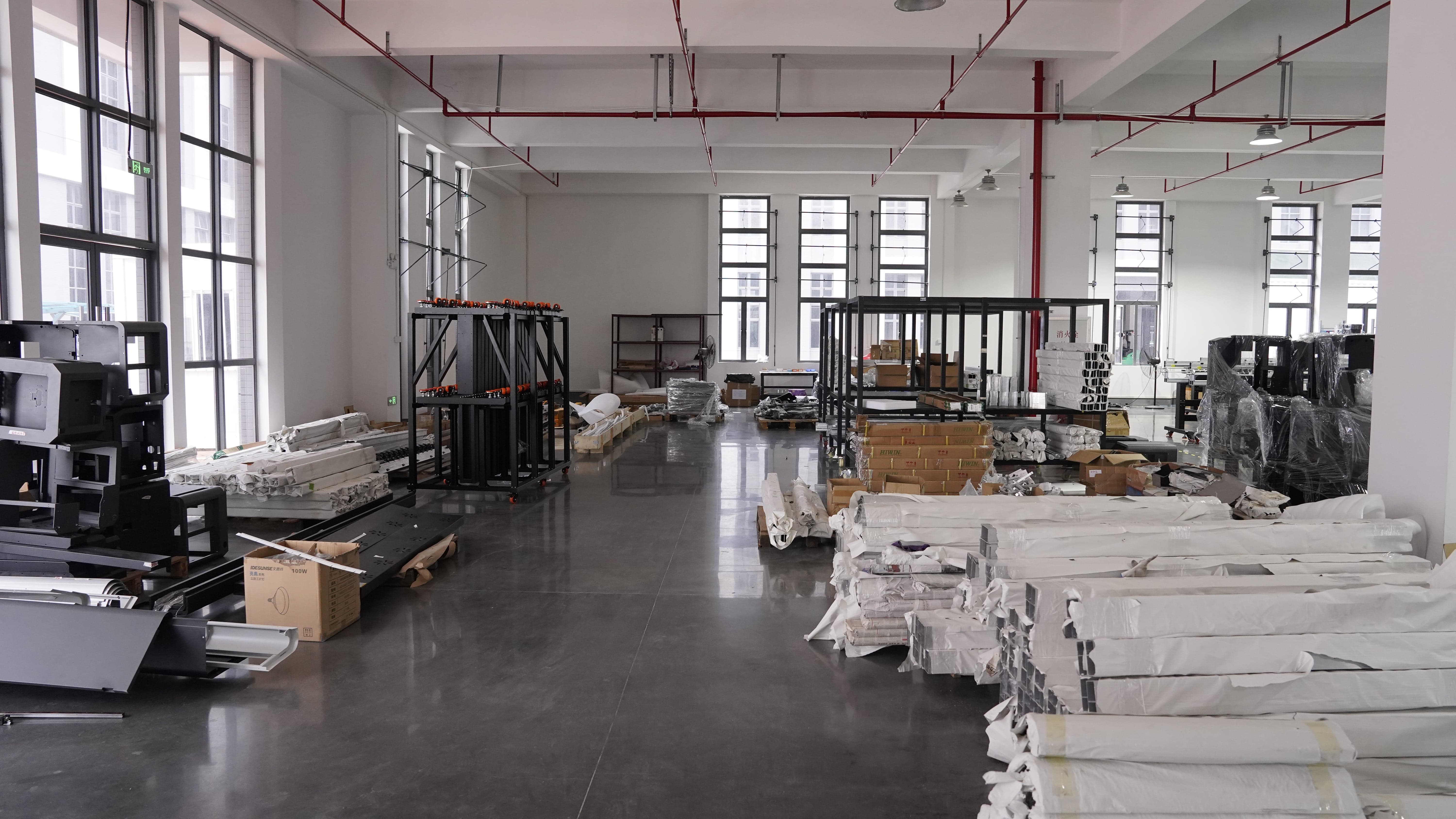
Component and frame storage in a DTF printer production facility; certification breadth is usually a downstream reflection of upstream process discipline.
The single-certificate trap in DTF printer procurement
Most DTF printer purchases are closed on the strength of a sample print, a quote, and one PDF certificate. For a one-off machine that may be adequate. For a buyer planning continuous production, however, a single-model certificate answers a much narrower question than it appears to. It confirms that a specific configuration was submitted for testing at a specific time. It does not confirm that the rest of the supplier's range sits inside the same quality system, that the certificate will be updated when standards change, or that the model the buyer actually needs is listed in the scope.
This is the practical risk of narrow coverage. A buyer shortlists a commercial DTF printer based on a certificate for a 60cm dual-head unit, then later needs a compact A3 or A2 entry machine for sampling, or an 80cm machine for higher throughput. If those models fall outside the certificate scope, the buyer is effectively dealing with an unverified supplier for that part of the order, even though the original paperwork looked complete.
A second and quieter risk is renewal. Certificates carry expiry dates, and standards get revised. A supplier that treats certification as a one-time cost will often let documents sit past their validity instead of re-testing. A supplier that treats certification as part of its operating system usually maintains a rolling renewal cadence. The difference between those two behaviours is visible in the file itself, if the buyer knows what to compare.
XINFLYING and the structure behind its certificate file
Guangzhou Xin Flying Digital Technology Co., Ltd., trading as XINFLYING, is a digital printing equipment manufacturer founded in Guangzhou in 2010. The company operates a 37,440 m² production facility with more than 200 employees, a 20-engineer R&D team, and an annual output of over 20,000 units. It exports roughly 80% of its output to North America, South America, Europe, Asia, the Middle East, and Africa, and supplies DTF printer machines, UV DTF printers, dye sublimation printers, DTG printers, UV flatbed printers, and printing consumables.
What makes the supplier useful for a long-term evaluation discussion is the shape of its certification portfolio rather than any single document in it. The same EU-facing document set covers compact entry machines such as the XF-400D (30 cm width) and XF-450PRO (42 cm width), the 60 cm dual-printhead class represented by the XF-C602 and XF-702E, the 60 cm four-head class represented by the XF-C604 and XF-704E, the XF-C605 five-head configuration, the XF-F606 six-head configuration, the 80 cm eight-head XF-F808, and a set of wider sublimation printers including the XF-L608, XF-H1301X-1I32A1, XF-H1802X-2I32A1, XF-O2000-4I32A1, XF-19E8-PRO, and XF-19E15-PRO.
That pattern matters because it is expensive to produce. Each model class has different electrical characteristics, different frame geometry, and different mechanical safety considerations. A supplier that obtains CE LVD, CE EMC, and CE MD coverage across that spread has, by necessity, built compliance review into its model development cycle rather than treating it as a shipment-level add-on.
What the certificate file actually shows
A certificate file is only useful to a buyer if the individual documents can be matched against the exact model under consideration. The table below summarises the principal certificates in the XINFLYING file, with the number, issuing authority, standards, and the model scope that a buyer would need to confirm before signing a purchase order.
| Certificate | Number | Authority | Applicable standards | Model coverage note |
|---|---|---|---|---|
| CE LVD Certificate of Compliance | TQT1550D271EC | TQT (Shenzhen Tianqi Testing Technology Service Co., Ltd.) | EN IEC 62368-1:2020/A11:2020 | Covers 15 models including XF-C602, XF-C604, XF-C605, XF-704E, XF-F606, XF-F808, XF-450PRO, XF-400D, XF-L608, XF-H1301X-1I32A1, XF-H1802X-2I32A1, XF-O2000-4I32A1, XF-19E8-PRO, XF-19E15-PRO |
| CE EMC Certificate of Compliance | TQT1550D270EC | TQT | EN 55032:2015/A11:2020; EN 55035:2017/A11:2020; EN IEC 61000-3-2:2019+A1:2021; EN 61000-3-3:2013/A2:2021 | Same 15-model spread as the LVD file |
| CE MD Certificate of Conformity | M.2026.206.C142365 | UDEM | EN ISO 12100:2010; EN 60204-1:2018/A1:2025; EN ISO 12643-1:2023 | Machinery safety scope across the DTF range including XF-450PRO, XF-702E, XF-C602, XF-704E, XF-C604, XF-C605, XF-400D, XF-F606, XF-F808 |
| CE MD Certificate of Conformity | M.2026.206.C142385 | UDEM | EN ISO 12100:2010; EN 60204-1:2018/A1:2025; EN ISO 12643-1:2023 | Additional machinery safety attestation covering the DTF range including XF-C605 and XF-C604 |
| RoHS Compliance Certificate | M.2026.206.C142366 | UDEM | EN IEC 63000:2018; EN IEC 62321 series | Directive 2011/65/EU compliance across the 15-model DTF and sublimation spread |
| CE LVD & EMC Attestation | M.2026.206.C142475 | UDEM | EN IEC 62368-1:2020; EN 55032:2015/A11:2020; EN 55035:2017/A11:2020; EN 61000-3-2:2014; EN 61000-3-3:2013 | Combined safety and EMC scope, including XF-C602 and XF-702E |
| CE Certificate of Compliance | BSTXD211021006201EC | BST Testing (Shenzhen) Co., Ltd. | EN 55032:2015+A11:2020; EN IEC 61000-3-2:2019; EN 61000-3-3:2013+A1:2019; EN 55035:2017+A11:2020 | Issued 2021-10-18 |
| CE Certificate of Compliance | CTICAIQ415250900815313DC | CTIC Testing Group (Guangdong) Co., Ltd. | EN 55032:2015; EN IEC 61000-3-2:2019+A1:2021; EN 61000-3-3:2013/A2:2021; EN 55035:2017/A11:2020 | Issued 2025-08-12 |
| OEKO-TEX ECO PASSPORT | SH150194016 | TESTEX AG | OEKO-TEX ECO PASSPORT; EN ISO 17050-1 | Scope: Textile Printing Inks & Printing Pastes; valid until 2026-12-31; global market |
| ISO 9001 Quality Management System | NOA2215496 | NOA Testing & Certification Group Co., Ltd. | GB/T 19001-2016 / ISO 9001:2015 | Scope: digital printer and ink sales; stated validity 2022-12-26 to 2025-12-25 |
Four points are worth drawing out of this file, because they are the points a buyer can actually verify.
1. The number is traceable to an issuing body
A usable certificate number is not a decorative string. TQT1550D271EC is issued by TQT, formerly referenced as Shenzhen Tianqi Testing Technology Service Co., Ltd., and M.2026.206.C142365 is issued by UDEM. A buyer can confirm the number, the issuing body, the issuing date, and the document scope directly with the authority. A supplier that cannot name the authority behind a certificate number, or whose number cannot be matched to a published document, has not provided verifiable certification.
2. The model list has to match the model ordered
Scope is where most certificate reviews fail. It is not enough to see a CE LVD certificate in the folder. The specific model on the purchase order should appear in the related-products list of that certificate. In the XINFLYING file, the coverage runs from the compact XF-400D and XF-450PRO dual-printhead machines through the 60cm XF-C602, XF-702E, XF-C604, XF-704E, XF-C605, and XF-F606 family, to the 80cm XF-F808 and the wider sublimation models. A buyer ordering any of those should ask for the certificate page that lists the exact model, not a summary sheet.
3. The standard reference should be current
Electrical safety standards are revised. EN IEC 62368-1:2020/A11:2020 is the reference used in the XF LVD documentation. Electromagnetic compatibility references include EN 55032:2015/A11:2020 and EN 55035:2017/A11:2020. Machinery safety references include EN ISO 12100:2010, EN 60204-1:2018/A1:2025, and EN ISO 12643-1:2023. A buyer does not need to interpret these standards in depth, but the standard reference on the certificate should be recent enough that the document is still meaningful for an EU customs or market-surveillance review.
4. Expiry and renewal behaviour is the strongest signal
The ISO 9001 certificate NOA2215496 in the XINFLYING file shows a stated validity period of 2022-12-26 to 2025-12-25. The OEKO-TEX ECO PASSPORT SH150194016 shows a validity period ending 2026-12-31. Those dates are a useful test of the buyer's own process, not just the supplier's. A buyer evaluating a long-term partnership should ask for the current renewal certificate and confirm that the scope, the issuing body, and the certificate number remain consistent. A supplier that maintains renewals will answer those questions quickly. A supplier that does not will change the subject.
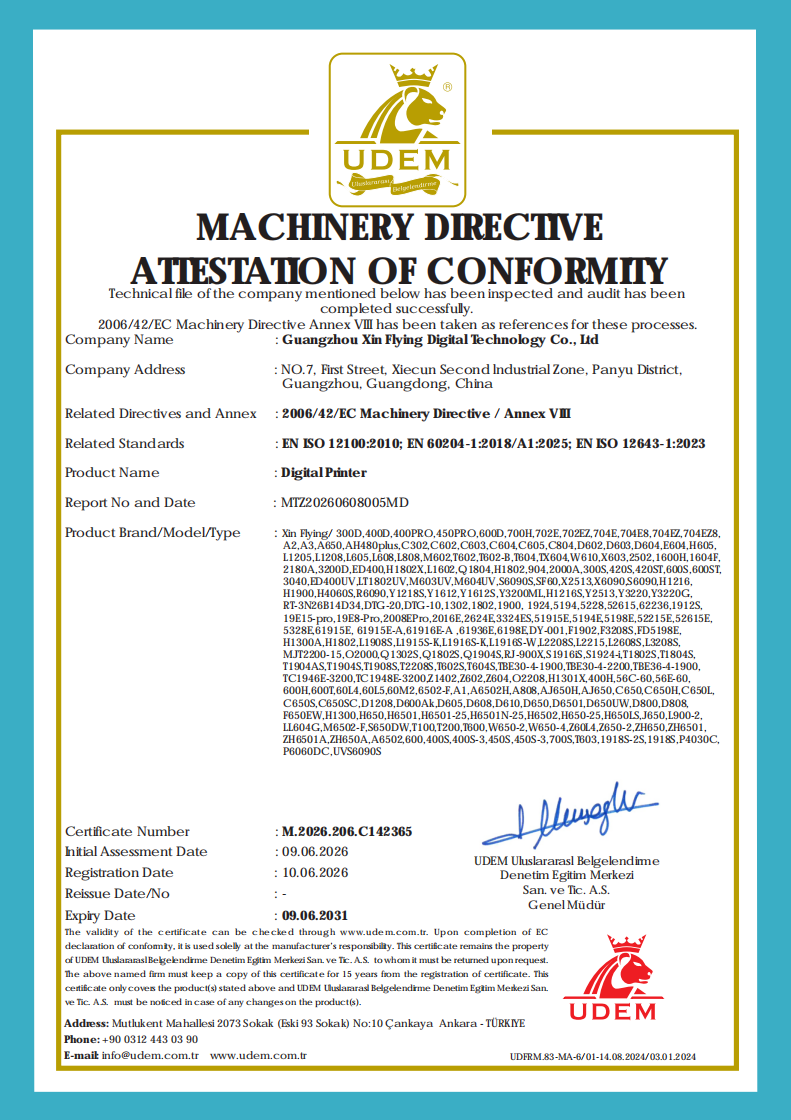
Machinery Directive attestation documents are only useful to a buyer if the model on the purchase order appears in the related-products scope.
Where broad coverage matters in practice
The value of certificate breadth becomes concrete when it is mapped to the way different buyers actually use a DTF printer machine.
EU importers and distributors. Importers carry the compliance burden for the models they place on the market. A supplier whose EU documentation covers the full range they intend to stock reduces the risk that a future model addition requires a separate compliance review. For a distributor carrying several widths, the LVD and EMC coverage across the 15-model spread, plus the machinery safety attestations, means the compliance conversation with customs and with end customers stays consistent across the catalogue.
Apparel factories and print shops. A garment factory that adds a 60cm four-head XF-C604 for production and a compact XF-400D for sampling is dealing with one supplier and one compliance framework rather than two. The OEKO-TEX ECO PASSPORT scope on textile printing inks and printing pastes is the relevant reference here, because it addresses the chemistry that ends up on the garment rather than the machine frame. That distinction matters for buyers supplying children's apparel or brands with restricted-substance requirements.
Print-on-demand businesses. POD operators typically start with a compact A3 or A2 DTF printer and scale into a 60cm machine as order volume grows. A supplier that already holds certificates for both ends of that progression lets the operator scale without re-qualifying a new supplier. The dual-printhead DTF printer class, represented in the XINFLYING range by the XF-C602 and XF-702E, is a common stepping stone, and both are inside the EU document scope.
DTF transfer suppliers. Transfer producers sell film to downstream decorators and are frequently asked for compliance documentation by their own customers. A supplier file that covers CE LVD, CE EMC, CE MD, RoHS, and OEKO-TEX gives the transfer supplier a coherent package to pass downstream, rather than a patchwork assembled model by model.
Compliance pressure across the DTF category is rising
Several structural trends make certification breadth more relevant now than it was three years ago.
First, the market is consolidating around higher-throughput systems. Dataintelo reports that industrial DTF printers accounted for 58.3% of total revenue share in 2025, driven by throughput requirements. Higher-throughput machines carry more electrical and mechanical complexity, which raises the cost of compliance work and favours suppliers who have already built the process.
Second, Europe's position as the leading regional market, at 36.0% of 2024 revenue according to Grand View Research, keeps EU market-surveillance expectations at the centre of supplier selection. Growth forecasts for the category diverge notably between research houses, but the direction of compliance pressure does not.
Third, buyers are increasingly evaluating documentation before price. A quote from a China DTF printer supplier that cannot produce a certificate number, an issuing authority, and a model scope list is now a slower quote to close, because the buyer has to do the verification work the supplier should have done.
What broad certification coverage does not prove
Certification breadth is a useful signal, but it is not a guarantee, and buyers who treat it as one will be disappointed. Four limitations deserve equal weight.
It does not prove production performance. A CE LVD certificate confirms electrical safety against EN IEC 62368-1. It says nothing about actual daily output, colour consistency across a long run, or uptime under continuous operation. Those have to be tested on the buyer's own substrates and workflows.
It does not prove commercial reliability. The supplier's stated capability figures, including a monthly capacity of 1,600+ units and a lead time of 5–40 days, describe capacity rather than a delivery commitment. Buyers should convert those statements into contractual terms with acceptance criteria, penalties, and a documented escalation path.
It does not cover every certificate indefinitely. The ISO 9001 certificate NOA2215496 shows an expiry of 2025-12-25 in the source documentation, and the OEKO-TEX ECO PASSPORT SH150194016 shows an expiry of 2026-12-31. Buyers must request the current renewal and confirm that the issuing body and scope have not changed. A certificate file is a living document, not a permanent asset.
It does not cover the entire product or consumable stack. OEKO-TEX ECO PASSPORT applies to textile printing inks and printing pastes, not to the machine's electrical safety. CE LVD and CE EMC apply to the machine, not to the ink chemistry. A buyer who needs both must verify both, and neither certificate substitutes for the other.
Future outlook
Two developments are likely to shape how buyers read DTF printer supplier files over the next several years. The first is tighter standard cycles. Machinery safety references such as EN 60204-1:2018/A1:2025 already show how quickly amendments enter the compliance chain. Suppliers that treat re-testing as a scheduled operating cost will keep their files current; suppliers that treat it as a one-time project will fall behind quietly.
The second is buyer behaviour. As more importers and distributors build compliance checkpoints into shortlisting, a certificate file with a consistent issuing authority, a stable model coverage list, and a documented renewal cadence will function as a qualification asset. Suppliers without one will increasingly be filtered before technical evaluation even starts.
For the DTF category specifically, the practical implication is that breadth should be evaluated together with depth. A supplier with one certificate and fifteen models in scope is more informative than a supplier with fifteen certificates for one model. But breadth without renewal discipline, and breadth without commercial terms that convert claims into commitments, is still an incomplete picture.
Frequently asked questions
What certificates should a DTF printer supplier maintain for long-term EU supply?
For EU market access, the core set is CE LVD (electrical safety, typically tested against EN IEC 62368-1), CE EMC (electromagnetic compatibility), CE MD (machinery safety under Directive 2006/42/EC), and RoHS (restricted substances under Directive 2011/65/EU). A supplier that also handles textile inks should be able to show OEKO-TEX ECO PASSPORT coverage for the ink and paste chemistry. ISO 9001 quality management certification is a useful supplementary indicator where it is current. Each document should name the issuing body, the certificate number, the standard references, and the specific models covered.
How can a buyer verify a DTF printer CE certificate number?
The buyer should match the certificate number against the issuing authority named on the document. In the XINFLYING file, for example, CE LVD certificate TQT1550D271EC is issued by TQT (Shenzhen Tianqi Testing Technology Service Co., Ltd.), while CE MD attestation M.2026.206.C142365 and RoHS certificate M.2026.206.C142366 are issued by UDEM. Verification normally involves contacting the authority directly, confirming the certificate is within its validity period, and checking that the model on the purchase order appears in the related-products scope of that certificate.
Which XF models does the CE MD certificate M.2026.206.C142365 cover?
The machinery safety attestation M.2026.206.C142365, issued by UDEM, applies the standards EN ISO 12100:2010, EN 60204-1:2018/A1:2025, and EN ISO 12643-1:2023. Its related-products scope in the source documentation includes XF-19E15-PRO, XF-H1301X-1I32A1, XF-C604, XF-704E, XF-F808, XF-19E8-PRO, XF-O2000-4I32A1, XF-C602, XF-L608, XF-F606, XF-702E, XF-H1802X-2I32A1, XF-C605, XF-400D, and XF-450PRO. Buyers ordering a specific model should request the certificate page that lists that model rather than relying on a summary.
Does OEKO-TEX ECO PASSPORT apply to the DTF printer or to the inks?
OEKO-TEX ECO PASSPORT certificate SH150194016, issued by TESTEX AG, has a scope of Textile Printing Inks & Printing Pastes and applies the standards OEKO-TEX ECO PASSPORT and EN ISO 17050-1. It is valid until 2026-12-31 and applies to the global market. It addresses the chemistry of the ink and paste that may come into contact with textile products; it is not a machine safety or electrical certificate. Buyers with restricted-substance requirements for the finished garment should therefore confirm the ECO PASSPORT validity separately from the machine's CE and RoHS documentation.
What should a buyer do if a supplier's ISO 9001 certificate shows an expiry date that has passed?
The buyer should request the current renewal certificate and confirm that the certificate number, scope, and issuing body remain consistent with the earlier document. The XINFLYING ISO 9001 certificate NOA2215496, issued by NOA Testing & Certification Group Co., Ltd. under GB/T 19001-2016 / ISO 9001:2015, has a stated validity period of 2022-12-26 to 2025-12-25 in the source documentation. A lapse does not automatically mean the quality system has stopped operating, but it does mean the buyer cannot rely on the source document as current evidence. The commercial response is to make a copy of the current certificate a condition of the purchase order, alongside the acceptance criteria and warranty terms.
Reference document. Additional detail on XINFLYING's manufacturing capability, product range, and certification set is available in the company brochure.
Есть вопросы или нужны дополнительные детали?
Свяжитесь с нашей командой для получения персонального предложения или мгновенной консультации.
Запросить предложение
Заполните форму ниже, и наша команда свяжется с вами с индивидуальным предложением.
Прямой чат WhatsApp
Предпочитаете общаться в реальном времени? Напишите нам в WhatsApp для мгновенной помощи и быстрых ответов.
- Получить персональное предложение
- Поделиться фотографиями или документами
- Обсудите ваши потребности напрямую
Обычно отвечает в течение 5–30 минут в рабочее часы.