
DYGLASS Shortlist: DY-GH01, DY-JJ01 and DY-ZK01 Building Glass Specs
Building glass procurement in 2026 is less about finding one supplier that offers everything, and more about specifying a small number of base products precisely enough to compare quotations on equal terms. Fortune Business Insights values the global construction glass market at USD 119.2 billion in 2025, with Asia-Pacific accounting for 38% of the total — a structure that matters to buyers, because the densest concentration of processing capacity sits in the same region where many facade packages are now sourced.
This industry reference sets out a shortlist of three verified product types from DYGLASS — DY-GH01 tempered glass, DY-JJ01 laminated glass and DY-ZK01 insulating glass — together with the specification figures a procurement team can place directly into a request for quotation. DYGLASS is the building glass brand of Shenzhen Dayang Special Glass Co., Ltd., a glass processor based in Shenzhen, Guangdong, China, whose stated scope covers tempered, laminated, curved, insulated, energy-saving and specialty glass products.
The short answer for decision-stage buyers: specify DY-GH01 where a single monolithic lite has to fail safely and economically; specify DY-JJ01 where the glazed opening must remain in its frame after breakage, or where acoustic and security performance drives the design; specify DY-ZK01 where the separation of thermal and acoustic performance between inside and outside is the dominant requirement. The three are not substitutes for one another, and in most curtain wall build-ups two of them appear inside the same assembly.
Why the glass type decision comes before the supplier decision
Buyers often shortlist suppliers first and resolve glass construction later, which reverses the order in which commercial risk accumulates. Tempered, laminated and insulating glass are defined by different constructions, are tested against different standards, and fail in different ways. The National Glass Association describes laminated glass as an assembly of two or more lites bonded with an interlayer, and an insulating glass unit as two or more lites separated by spacer material and sealed around the perimeter with one or more sealants. Tempered glass, by contrast, is a heat treatment applied to a single lite rather than an assembly.
That distinction is what makes a three-product shortlist actionable. Once the construction is fixed, the remaining questions — thickness, interlayer, cavity, coating, tolerance, warranty — can be answered against a written specification instead of a brochure.
The DYGLASS shortlist at a glance
| Product code | Construction | Stated specification | Primary role in a facade | Confirm at RFQ |
|---|---|---|---|---|
| DY-GH01 | Tempered glass on float glass substrate | 3–19 mm thickness; tolerance ±0.5 mm; light transmittance ≥91% | Monolithic safety glazing, spandrel and shopfront panels, tempered substrate for laminated or insulating build-ups | Edge work, heat-soak requirement, applicable safety glazing standard |
| DY-JJ01 | Laminated glass | 6.38–50 mm total thickness; PVB, SGP or EVA interlayer | Overhead and sloped glazing, balustrades, acoustic and security layers, post-breakage retention | Interlayer type and thickness, full make-up, edge deletion and sealing |
| DY-ZK01 | Insulating glass unit | 6+12A+6 mm baseline; Low-E coating and argon fill optional | Thermal and acoustic envelope glazing in curtain wall and window systems | U-value and SHGC calculation, spacer type, gas retention testing, secondary seal |
The figures above are manufacturer-stated product data for the named codes. Project-level performance values — U-value, solar heat gain coefficient, acoustic rating, fire rating — are not part of this shortlist and should be requested as calculated or tested values for the specific build-up.
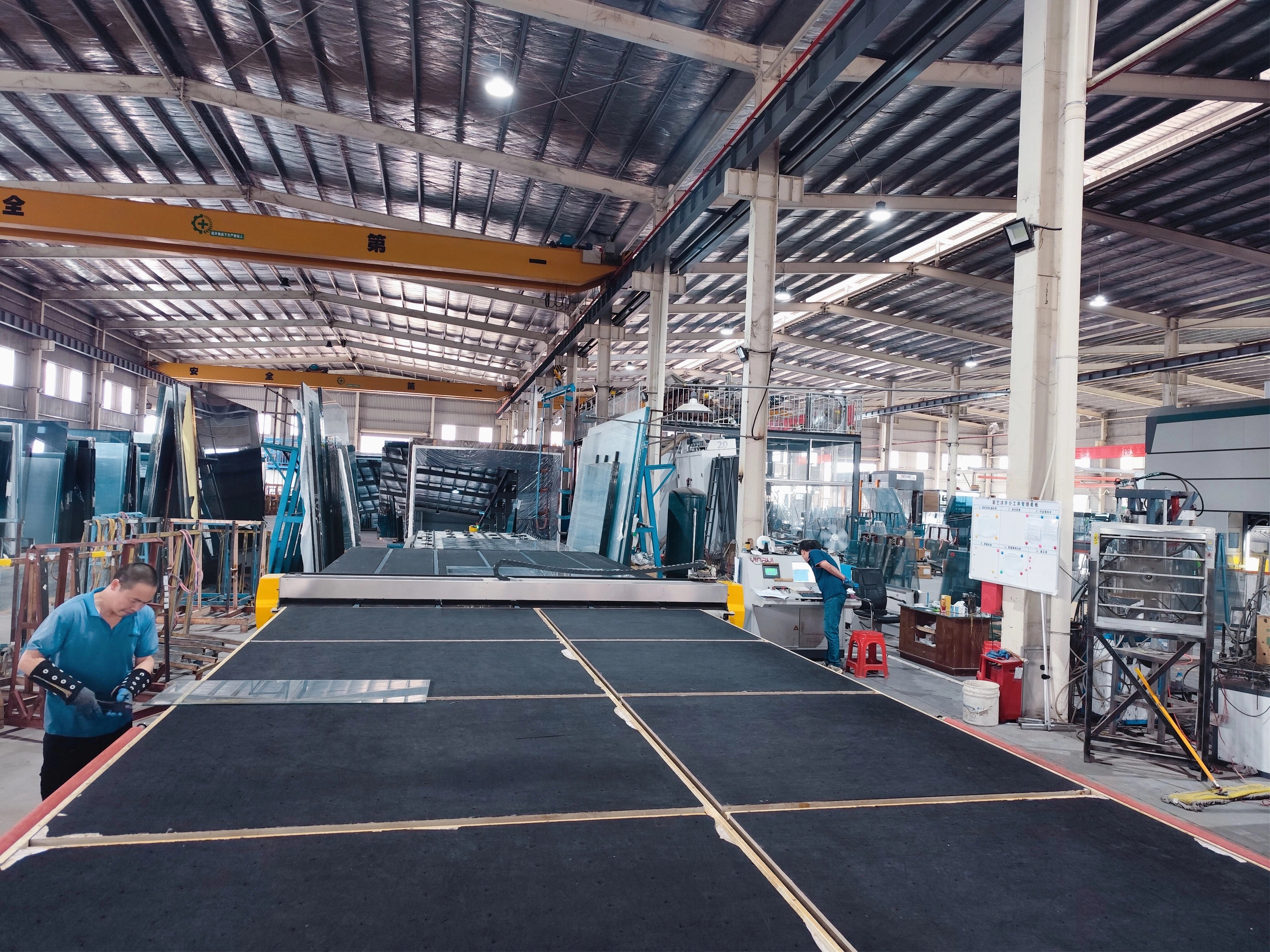
Cutting line: dimensional tolerance is set at the cutting and edge-work stage, before tempering fixes the panel geometry.
DY-GH01 tempered glass: where ±0.5 mm and ≥91% actually matter
DY-GH01 is produced on a float glass substrate in thicknesses from 3 mm to 19 mm, with a stated thickness tolerance of ±0.5 mm and light transmittance of at least 91%. In a procurement document these three figures do different work, and each one should be read against the part of the build-up it controls.
- Thickness range 3–19 mm spans the practical distance from interior partition and shopfront glazing through to structural monolithic panels, which means a single product code can serve several packages on the same project rather than fragmenting the order across suppliers.
- Tolerance ±0.5 mm is the number that governs fit. It matters where glass sits in a rebate with a defined gap, where structural silicone joints are dimensioned in millimetres, and where panels are set against a machined frame or a unitised curtain wall cassette.
- Transmittance ≥91% is the base-glass figure. Coatings, body tints, ceramic frit and lamination all reduce it, so daylight and glare modelling should be run on the final build-up rather than on the base product data.
Tempering also defines the failure mode of the panel. As Guardian Glass describes it, tempered glass breaks into small fragments rather than large shards, which is why it is the conventional choice for hazardous locations under safety glazing rules. The same property explains its limitation: it gives no post-breakage retention. A tempered lite that breaks leaves the opening. Where the specification requires the glazing to stay in place and keep acting as a barrier, the tempered lite is normally combined with a laminated layer, or replaced by a laminated assembly.
DY-JJ01 laminated glass: the interlayer is the specification
DY-JJ01 is quoted as a total thickness from 6.38 mm to 50 mm with a PVB, SGP or EVA interlayer. The thickness figure on its own tells a buyer very little, because laminated performance is set by the make-up — glass thicknesses, interlayer family, interlayer thickness — and not by the total dimension.
Guardian Glass notes that laminated glass fragments generally stay attached to the interlayer after breakage. That is the property procurement teams are actually buying when they specify a laminate: the assembly retains a barrier and reduces the risk of falling glass. The interlayer family then shapes the rest of the behaviour.
- PVB is the long-established architectural interlayer and is the appropriate default where post-breakage retention and sound reduction are the goals of the specification.
- SGP is a stiffer interlayer, relevant where the laminate carries structural or balustrade duties and where reduced deflection under load matters to the design.
- EVA provides an alternative laminating route and is specified where the process suit or the project requirement calls for it.
For RFQ purposes, the interlayer family and its thickness should be named on the specification line rather than left to the supplier. Two quotations for laminated glass at the same total thickness can describe materially different products, and the difference only becomes visible after a break event or a site acoustic test.
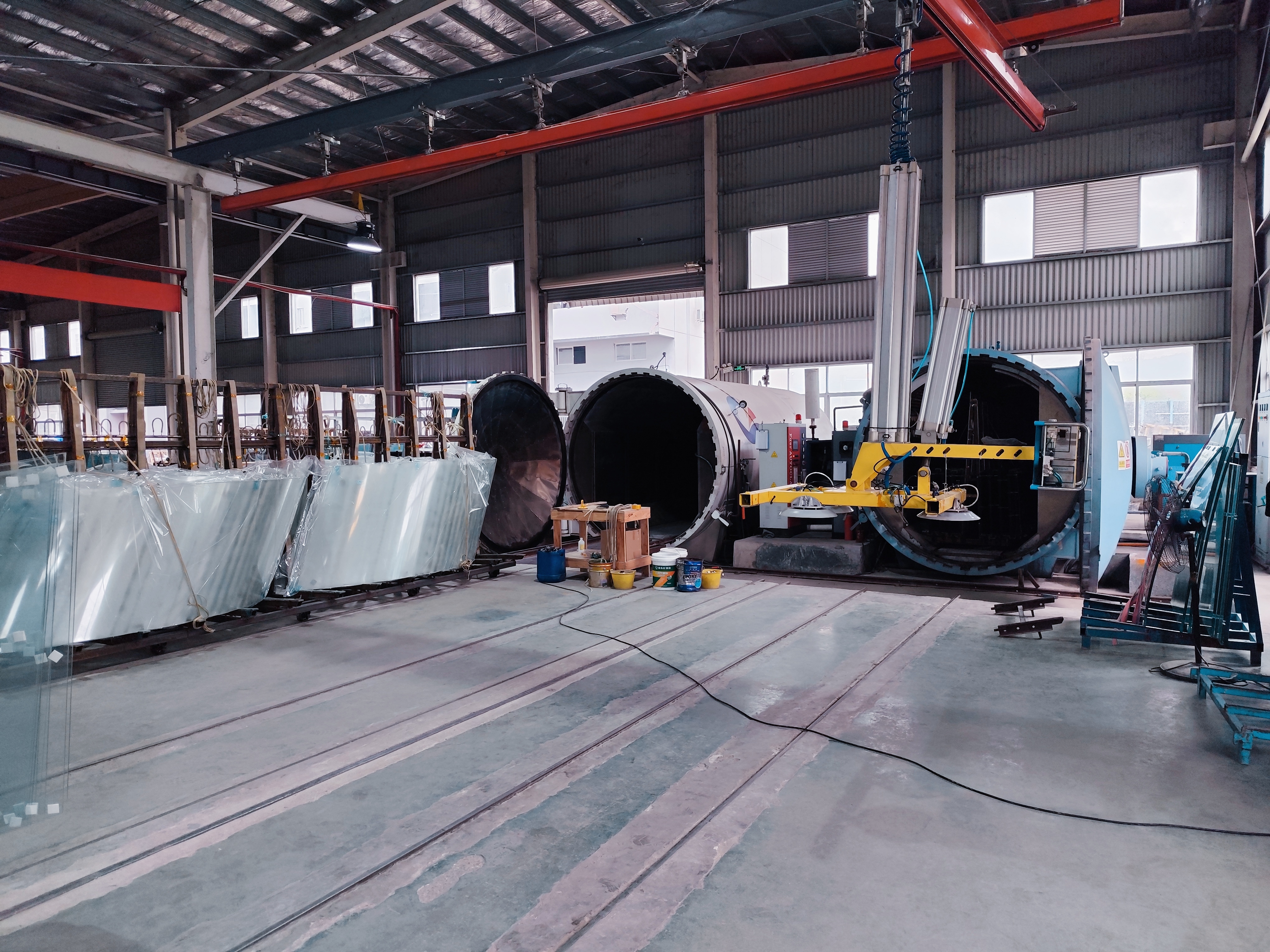
Autoclave bonding: laminated quality is decided by interlayer selection, edge preparation and the cure cycle, not by total thickness alone.
DY-ZK01 insulating glass: 6+12A+6 as a working baseline
DY-ZK01 is offered on a 6+12A+6 mm baseline — two 6 mm lites separated by a 12 mm air space — with Low-E coating and argon fill stated as options rather than as standard. That is the correct way to read the product. The baseline unit supplies the envelope separation and the cavity; the coating and the gas fill are what turn it into an energy-saving unit, and their contribution has to be calculated for the project rather than assumed from the configuration.
The National Glass Association definition is a useful check on any quotation: an insulating unit is two or more lites separated by spacer material, incorporating a desiccant, and sealed around the perimeter. The spacer, the desiccant and both seals are therefore part of the product, not accessories. Edge seal quality is what determines whether the cavity stays dry over the service life of the facade, and it is the first thing to examine when a unit fogs.
How the three types behave under impact, load and ageing
| Type | Behaviour after breakage | Retention of the opening | Where it is normally specified | Main durability consideration |
|---|---|---|---|---|
| Tempered (DY-GH01) | Fragments into small pieces | None — the lite leaves the frame | Hazardous locations, monolithic panels, tempered substrates | Breakage risk from nickel sulphide inclusions; heat-soak treatment is a separate requirement to confirm at order |
| Laminated (DY-JJ01) | Fragments generally remain adhered to the interlayer | Barrier function retained | Overhead, balustrade, acoustic and security glazing | Edge quality and interlayer moisture exposure govern long-term delamination risk |
| Insulating (DY-ZK01) | Each lite behaves according to the glass used in the unit | Determined by the make-up of the individual lites | Thermal and acoustic envelope glazing | Perimeter seal integrity and retention of the cavity atmosphere |
DYGLASS documents the process risks behind these behaviours — thermal shock, edge chipping, warpage, bubble and inclusion defects — and describes control through infrared temperature monitoring with three-level overtemperature thresholds, together with quarterly inspection of kiln refractory wear and scheduled calibration of temperature sensors. For a buyer, that is the relevant evidence: the defect list and the control method indicate what the supplier is measuring, which is more informative than a claim of zero defects.
Application fit: matching type to facade zone
The practical value of a three-product shortlist appears when it is mapped onto facade zones rather than discussed in the abstract. In most specifications the pattern is consistent.
- Curtain wall vision glass is normally an insulating unit, because the requirement is separation of the interior environment from the exterior. The lites inside that unit are tempered, laminated, or tempered and laminated, which means the type decision is taken twice: once for the unit, once for the glass inside it.
- Spandrel and opaque panels are commonly monolithic tempered glass, frequently with a ceramic frit or an opaque backing, where retention after breakage is not the governing requirement.
- Overhead, sloped and skylight glazing is the clearest case for laminated glass, because the specification is about what happens below the glass after breakage rather than about the glass itself.
- Balustrades, partitions and shopfronts take either laminated or tempered glass depending on whether the code requires retention or only safe fragmentation; interior partitions at full height frequently use tempered for economy.
- Acoustically sensitive facades typically use a laminated lite within an insulating unit, since the interlayer contributes to sound reduction and the cavity handles the rest.
DYGLASS states an export share of 60% of its output, with main markets including the UAE, Bahrain, Saudi Arabia, the United States, the Philippines and Vietnam. For procurement teams buying into projects in those markets, the practical consequence is that the specification has to travel with the order: the same product code can be compliant in one jurisdiction and non-compliant in another, depending on the safety glazing standard the project adopts.
Cost comparison with alternative specifications
Cost comparison between glass types is where most shortlists lose discipline, because quoted prices are rarely measured on the same basis. The clearest published reference point is installation cost rather than glass price: Fortune Business Insights reported average installation costs in Europe in 2024 of USD 91 per square metre for tempered glass and USD 128 per square metre for laminated glass — roughly 40% higher for the laminated case on those reported figures, reflecting additional weight, handling and structural complexity.
That gap should not be read as a reason to downgrade automatically. The comparison that matters at decision stage is between compliant options, not between the cheapest glass and the specified glass. Where a code or a project location requires post-breakage retention, laminated glass is not an upgrade over tempered glass; it is the compliant alternative, and the cost difference is part of the project budget rather than a saving opportunity.
Insulating units sit at the top of the range per square metre, because an IGU adds a spacer, desiccant, primary and secondary seals and, where specified, a Low-E coating and gas fill to the cost of two lites. Against a single-glazed alternative it is heavier, thicker, requires deeper rebates and a frame designed for the additional dead load, and it introduces a failure mode — seal failure — that monolithic glazing does not have. Against an uncontrolled single-lite envelope it is the option that makes a thermal specification achievable at all.
Manufacturer origin, capacity and warranty
The manufacturer behind the shortlist is Shenzhen Dayang Special Glass Co., Ltd., founded in 2017 and operating a 30,000 m² facility with 130 employees, an annual output stated at 600,000 square metres and an R&D team of 5 to 10 people. The company states that it is an Alibaba Verified Supplier and holds an SGS test report, and that it accepts OEM and ODM orders. DYGLASS also states CE, SGCC and AS/NZS certification for its multi-curved glass range; certification for the three flat-product codes in this shortlist should be evidenced separately for each project and each destination market.
On warranty, DYGLASS states a period of more than 5 years for these products. The stated period is the starting point of the negotiation, not the end of it. A warranty of more than five years is only meaningful once four things are written into the contract: the failure modes covered (delamination, edge seal failure, coating degradation, breakage in service), the exclusions that apply to site handling, storage and installation, the remedy — replacement, credit or reimbursement — and the evidence required to make a claim.
Capacity discipline: at a stated annual output of 600,000 square metres, a multi-tower or phased package should have its call-off schedule agreed before the order is placed. This shortlist does not establish lead times, and lead time should be confirmed in writing against the project programme.
Market context: standards are the comparability layer
As processing capacity concentrates in Asia-Pacific — the region holding 38% of a USD 119.2 billion construction glass market in 2025 — supplier differentiation shifts from the product name to the documentation behind it. The standards that recur across these three product families illustrate why. Thermally toughened safety glass is commonly assessed against BS EN 12150, laminated glass against BS EN ISO 12543, and insulating glass units against BS EN 1279 in the UK and European context; AS/NZS 2208:2023 governs safety glazing materials for Australia and New Zealand; and in the United States, safety glazing in hazardous locations carries marking and labelling requirements under ANSI Z97.1 and CPSC 16 CFR Part 1201, with additional labelling for fire-rated glazing.
A standards reference is not the same thing as a certificate. A manufacturer reference list, or a statement on a company website, establishes which standard applies to a product family; it does not establish that a specific batch, factory or order was tested and conforms. Buyers should treat the two as separate evidence items in the supplier file and verify certificates with the issuing body before they enter a compliance submission.
Limits of this shortlist
- Coverage. The three codes described here are presented as flat-geometry products. Curved, single-curved, double-curved and multi-curved glass, switchable or smart glass, ceramic frit, digital printed, low-iron and fire-rated products are separate DYGLASS lines and need their own specification and qualification. They should not be substituted into a curved specification.
- Performance values are absent. No U-value, solar heat gain coefficient, acoustic rating, impact classification or fire rating is attached to these three codes in this reference. Those values must be requested as calculated or tested figures for the project build-up.
- The transmittance figure has a boundary. The ≥91% value applies to the DY-GH01 base glass. Any coating, tint, frit or lamination will reduce it.
- Tolerances differ by product. The ±0.5 mm figure belongs to DY-GH01 thickness. Assembly tolerances for DY-JJ01 laminates and DY-ZK01 units are separate values and should be confirmed at RFQ rather than assumed.
- Commercial terms are not covered. Price, minimum order quantity, packaging, breakage allowance, payment terms and lead time are outside this shortlist and must be obtained through a structured quotation.
Outlook
For the 2026–2027 procurement cycle, the visible change is not a new glass type but a change in how types are specified. Envelope performance requirements are being written as calculated values rather than product names, and quotations are increasingly compared line by line against a make-up schedule. Suppliers who can answer a make-up schedule with documented figures — thickness tolerance, transmittance, interlayer family, cavity configuration, warranty scope — will be easier to shortlist than suppliers who answer with a portfolio.
For buyers, the practical implication is straightforward. Keep the type decision and the supplier decision separate. Fix the construction first, name the codes, state the values that will be used to judge conformity, and only then compare commercial offers. A three-product shortlist of the kind set out here is not a reduction of choice; it is the minimum resolution at which quotations become comparable.
FAQ
Which of the three types should be specified for curtain wall vision glass?
Vision glass in a curtain wall is normally an insulating unit, because the governing requirement is separation of the interior environment from the exterior. The lites inside that unit are usually tempered, laminated, or tempered and laminated. In DYGLASS terms this means a DY-ZK01 unit whose make-up names DY-GH01 or DY-JJ01 glass, so the type decision is taken twice: once for the unit and once for the glass inside it.
Is laminated glass worth the higher cost compared with tempered glass?
The two perform different functions. Reported average installation costs in Europe in 2024 were USD 91 per square metre for tempered glass and USD 128 per square metre for laminated glass, so the laminated option carries a materially higher installed cost. That premium purchases post-breakage retention and the option of acoustic or security interlayers. Where the applicable code and location do not require retention, tempered glass alone is the lower-cost compliant answer; where retention is required, laminated glass is a requirement rather than an upgrade.
Can tempered, laminated and insulating glass be combined in a single unit?
Yes, and the combination is common. An insulating unit can be built from a tempered outer lite and a laminated inner lite, delivering thermal separation, safe fragmentation and post-breakage retention in one assembly. The combination has to be specified as a make-up with each lite, interlayer, cavity and coating named, because a total thickness figure alone does not describe the construction.
What do the ±0.5 mm tolerance and ≥91% transmittance figures mean for an order?
The ±0.5 mm value is the stated thickness tolerance for DY-GH01 and governs fit in rebates, structural silicone joints and machined frames. The ≥91% value is the light transmittance of the DY-GH01 base glass; coatings, tints, frit and lamination reduce it. Daylight, glare and cooling-load calculations should therefore use the transmittance of the final build-up rather than the base product figure.
What does the warranty cover, and for how long?
DYGLASS states a warranty of more than 5 years for these products. The scope should be defined in the purchase contract: which failure modes are covered, such as delamination, edge seal failure or coating degradation; what exclusions apply to site handling, storage and installation; what the remedy is; and what evidence is required to support a claim. A stated period without a defined scope is difficult to enforce.
Does this shortlist cover curved or complex facades?
No. Curved, double-curved and multi-curved glass, switchable or smart glass, ceramic frit, digital printed and fire-rated products are separate DYGLASS product lines and require their own specification, tooling review and qualification. The three codes described here are flat-geometry entries in this shortlist and should not be substituted into a curved facade specification.
Reference document: the DYGLASS product brochure covering tempered, laminated, insulated, curved and specialty building glass is available as a PDF for download — DYGLASS building glass brochure (PDF).
Есть вопросы или нужны дополнительные детали?
Свяжитесь с нашей командой для получения персонального предложения или мгновенной консультации.
Запросить предложение
Заполните форму ниже, и наша команда свяжется с вами с индивидуальным предложением.
Прямой чат WhatsApp
Предпочитаете общаться в реальном времени? Напишите нам в WhatsApp для мгновенной помощи и быстрых ответов.
- Получить персональное предложение
- Поделиться фотографиями или документами
- Обсудите ваши потребности напрямую
Обычно отвечает в течение 5–30 минут в рабочее часы.