
Daily Wear vs Luxury: Wholesale Jewelry Category Fit
Wholesale jewelry buying rarely turns on how a single piece looks in a catalog. It turns on whether a category fits the occasion the end consumer will actually wear it to — a weekday commute, a wedding, a corporate event, or a gift exchange. When a lightweight daily piece is merchandised as an evening statement, or a heavy stone-set item is pushed into a basic replenishment slot, inventory stalls between two demand signals.
Guangdong Xuping Jewelry Co., Ltd., trading as Xuping Jewelry, has manufactured fashion-imitation jewelry since 1997 and sells almost entirely into export markets. Its catalog is organized around exactly this distinction: a Daily series, a Simple series, and a Luxury series run across the same product types — bracelets, necklaces, earrings, brooches, bangles, anklets, rings, pendants, and coordinated jewelry sets. For wholesale buyers at the awareness and research stage, the useful question is not "which series is better" but "which series belongs on which shelf."
Why Occasion Fit Is a Procurement Variable, Not a Styling Preference
The global jewelry market was estimated at roughly USD 242.79 billion to USD 381.5 billion in 2025, with growth projections reaching up to USD 578.5 billion by 2033, according to Fortune Business Insights and Grand View Research. Those two figures sitting so far apart is itself informative: the range depends heavily on whether a study counts fine jewelry, imitation jewelry, or both. Imitation and fashion jewelry demand behaves differently from fine jewelry. It is driven by replacement cycles and occasion variety rather than by resale value, which means assortment planning has to be built around usage scenarios instead of around durability alone.
That shifts the buyer's decision. A category that will be worn every day needs to hold up to repeated wear, stay comfortable at low weight, and avoid elements that catch on clothing. A category reserved for events can carry larger stones, deeper plating color, and higher piece weight — because it is worn occasionally and seen by more people each time.
Category list from Xuping's application-scenario documentation confirms the same split on the demand side. The working conditions listed are daily wear, fashion shows, events and occasions, gift giving, and all-weather use. The operation modes listed are long-term wear, occasional wear, and daily accessory. Those are three different buying briefs, and they map to three different series.
Daily Series vs. Luxury Series: What the Labels Actually Describe
In Xuping Jewelry's catalog, the series label is a structural description, not a marketing tier. Items are assigned to a series based on base material, plating method, main-stone size, and unit weight.
Daily series pieces are built for continuous, low-friction wear. They typically use stainless steel or environmental copper with lighter plating, carry either no main stone or a small synthetic cubic zirconia stone, and stay low in unit weight. Representative models include the stainless steel bracelet T000959269 at approximately 11.01 g and the stainless steel necklace A00902945 at approximately 6.30 g.
Simple series sits between the two. These pieces use environmental copper with 14K or 18K gold-color plating and modest stone settings — for example, the earrings X001163413 at 2.45 g per pair with no main stone, or the synthetic crystal necklace X000668301 with a lilac synthetic crystal main stone.
Luxury series pieces are designed for occasional, high-visibility wear. They use 14K or 18K gold-color plating or platinum plating, carry larger main stones, and frequently reach higher unit weights. Examples include the bangle X000998659 at 21.77 g with a ruby-colored synthetic cubic zirconia main stone, and the necklace 14N245402 at approximately 49.44 g with a dark blue glass main stone.
Category-to-Scenario Mapping for Wholesale Assortments
The table below maps Xuping's main product categories to the series that most commonly carries them and to the end-use scenario each is engineered for. Model numbers are taken from the product specification units.
| Category | Representative Model | Series | Base Material / Plating | Unit Weight | Best-Fit Scenario |
|---|---|---|---|---|---|
| Bracelet | T000959269 | Daily series | Stainless steel | approx. 11.01 g | Everyday wear, all-weather use |
| Necklace | A00902945 | Daily series | Stainless steel, 14K gold color | approx. 6.30 g | Daily accessory, layering |
| Brooch | A00900238 | Daily series | Environmental copper, platinum plated | 12.3 g | Workwear, daytime events |
| Anklet | X000988693 | Daily series | Environmental copper, platinum plated | approx. 5.59 g | Long-term wear, casual styling |
| Ring | X001114331 | Daily series | Environmental copper, 14K gold color | approx. 5.65 g | Everyday stacking |
| Pendant | X001122748 | Daily series | Environmental copper, 18K gold color | approx. 3.76 g | Daily accessory, gifting |
| Earrings | X001163413 | Simple series | Environmental copper, 14K gold color | 2.45 g / pair | Office wear, minimalist sets |
| Necklace | X000668301 | Simple series | Environmental copper, 18K gold color | approx. 7.91 g | Semi-formal, gift retail |
| Bangle | X000867735 | Simple series | Environmental copper, 14K gold color | 17.39 g / set | Gift giving, coordinated looks |
| Jewelry set | X001006294 | Simple series | Environmental copper, 14K gold color | 28.43 g / set | Gift boxes, occasion retail |
| Brooch | X000852427 | Luxury series | Environmental copper, 14K gold color | 9.15 g | Evening wear, luxury occasions |
| Bangle | X000998659 | Luxury series | Environmental copper, 14K gold color | 21.77 g | Formal events, statement styling |
| Jewelry set | X000871334 | Luxury series | Environmental copper, 18K gold color | approx. 18.8 g / set | Weddings, coordinated gifting |
| Earrings | X000881925 | Luxury series | Environmental copper, 18K gold color | 5.37 g / pair | Evening wear, event dressing |
| Necklace | 14N245402 | Luxury series | Environmental copper, platinum plated | approx. 49.44 g | Formal occasions, showcase pieces |
Daily-Wear Categories: Why Stainless Steel and Light Plating Lead
The Daily series leans on two construction choices that matter to the buyer more than any styling detail: stainless steel as a base material, and low unit weight.
Stainless steel is used in the bracelet T000959269 — approximately 170 mm long and 6 mm wide, with a 30 mm extension, a hand size of 11.01 cm, and a weight of about 11.01 g with no main stone. The same material appears in the necklace A00902945, which uses 14K gold-color plating over stainless steel at approximately 40 cm and 6.30 g. Because these pieces carry no stone setting, there is no raised element to catch on knitwear, bag straps, or seat belts — a practical durability advantage for consumers who never take a piece off.
Environmental copper with lighter plating handles the rest of the daily range. The anklet X000988693 uses platinum plating at approximately 270 × 4.5 mm and 5.59 g, while X001124310 uses 18K gold-color plating at approximately 280 × 5 mm with a 30 mm extension and about 10 g. The rings X000877263 and X001114331 are both free-size and daily-series, at 2.56 g with no stone and 5.65 g with a white synthetic cubic zirconia main stone of about 3 × 2 mm respectively.
For wholesale buyers, the operational implication is replenishment frequency. These are the SKUs that sell in depth and repeat, and the ones most likely to be reordered in the same configuration. The application-scenario data lists all-weather suitability and long-term wear as operating conditions for this category — both consistent with stone-free or lightly stone-set construction.
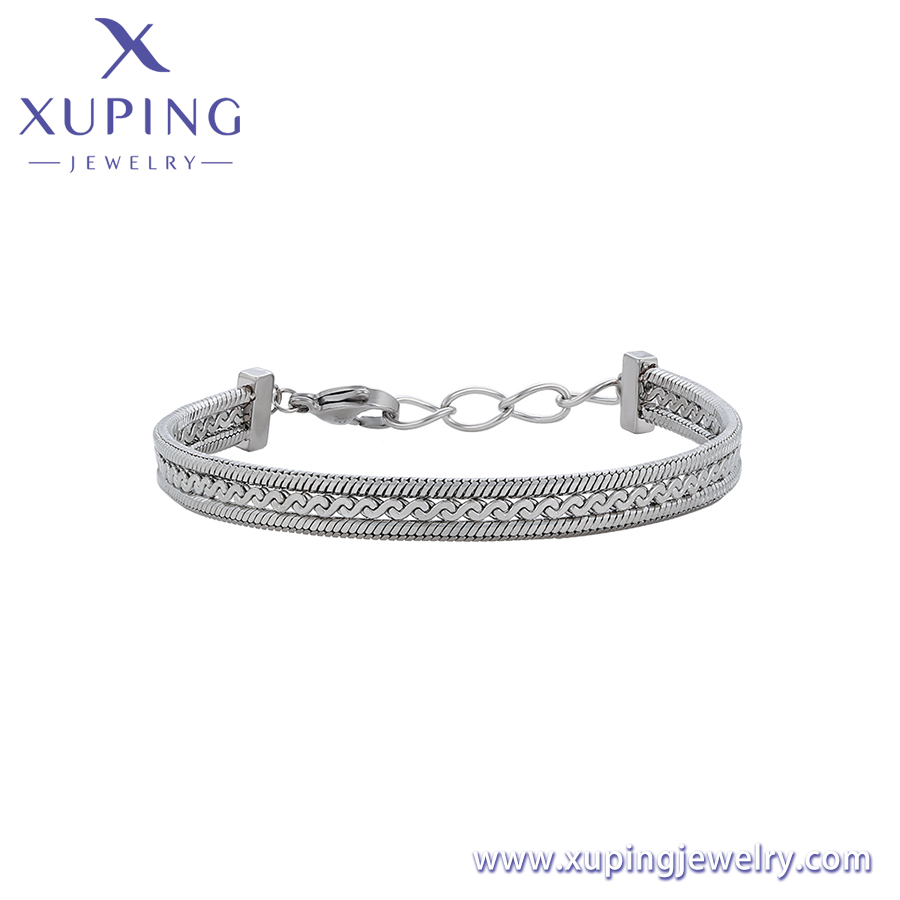
Stainless steel bracelet T000959269 — Daily series. Approximately 170 × 6 mm with a 30 mm extension and a unit weight of about 11.01 g.
Luxury-Occasion Categories: Larger Stones, Deeper Plating, Occasional Wear
The Luxury series changes the construction logic in three ways: plating depth, main-stone size, and visual volume.
Plating shifts to 14K or 18K gold color, or platinum, on environmental copper. Main stones grow substantially. The bangle X000998659 carries a ruby-colored synthetic cubic zirconia main stone of about 8 × 6 mm within a bangle of approximately 60 × 8 mm, at 21.77 g. The brooch X000852427 uses an AB-color synthetic cubic zirconia main stone of about 12 × 8 mm. The necklace 14N245402 uses a dark blue glass main stone in a platinum-plated construction measuring approximately 440 × 6 mm with a 50 mm extension and a weight of about 49.44 g.
Sets are the most common format in this tier for wholesale buyers. The set X000871334 combines a necklace of approximately 450 × 3 mm, a bracelet of approximately 200 × 3 mm, and earrings of approximately 3 × 28 × 11 mm, all in 18K gold color with white synthetic cubic zirconia main stones of about 2.5 × 2.5 mm and a total weight of about 18.8 g per set. The set X001006294 uses 14K gold color plating with a 2 × 2 mm white synthetic cubic zirconia main stone and totals about 28.43 g per set across earrings of approximately 18 × 10 mm, a pendant of approximately 26 × 12 mm, and a bangle of approximately 60 × 13 mm.
The procurement point here is that sets are a single-SKU answer to occasion dressing. A buyer building an occasion assortment can stock one set number instead of coordinating three separate categories — a meaningful reduction in shelf complexity for wholesale distribution and gift retail channels.
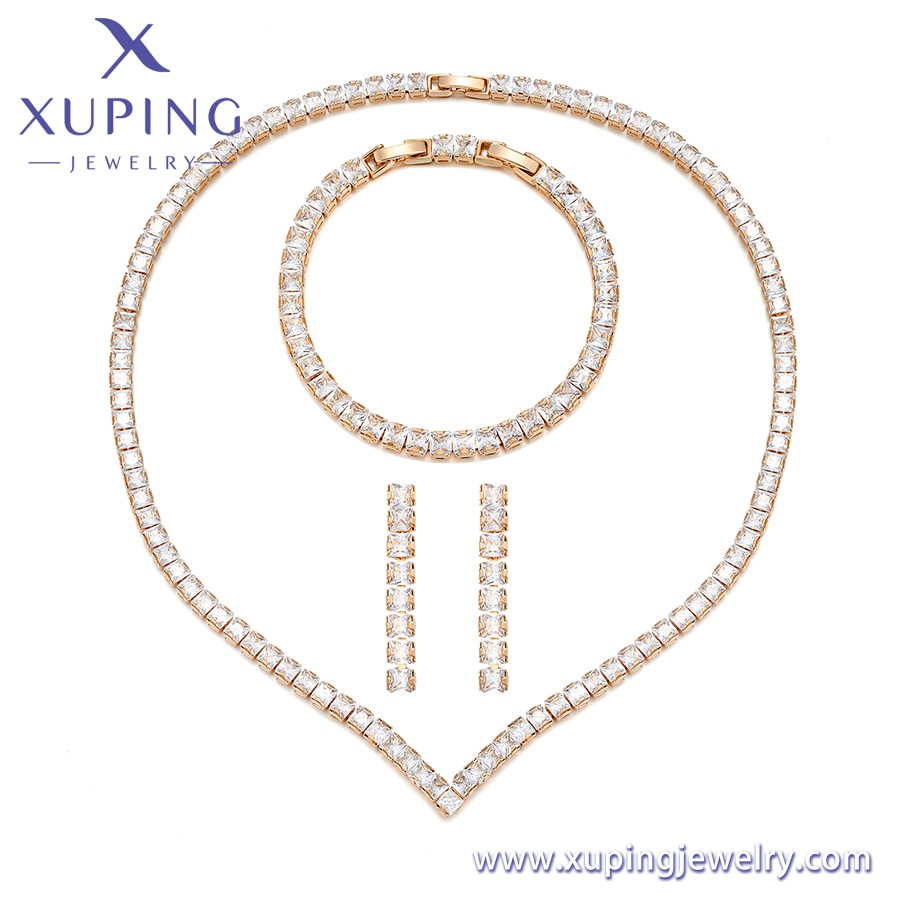
Jewelry set X000871334 — Luxury series. 18K gold-color plating with white synthetic cubic zirconia; necklace, bracelet and earrings, approximately 18.8 g per set.
Two Brooches, Two Application Fits: A00900238 and X000852427
Brooches are the clearest illustration of series-based occasion fit, because a brooch is almost always bought for a defined purpose rather than as an impulse add-on. Xuping Jewelry carries two brooches that sit at opposite ends of the Daily-to-Luxury range, and comparing them shows how the series logic works in practice.
Brooch A00900238 belongs to the Daily series. It uses environmental copper with platinum plating and a white synthetic cubic zirconia main stone of approximately 3.5 × 3.5 mm. The brooch measures approximately 47 × 32 mm and weighs about 12.3 g. It carries an "xp" name mark.
Brooch X000852427 belongs to the Luxury series. It uses environmental copper with 14K gold-color plating and an AB-color synthetic cubic zirconia main stone of approximately 12 × 8 mm. The brooch measures approximately 44 × 38 mm and weighs about 9.15 g.
Two details deserve attention. First, the main-stone footprint is dramatically different — roughly 3.5 × 3.5 mm against roughly 12 × 8 mm. Second, and less obvious, the Luxury brooch is the lighter of the two at 9.15 g versus 12.3 g, despite its larger stone. That counterintuitive result shows why wholesale buyers should evaluate stone specification and unit weight as separate data points rather than assuming that bigger stones always mean heavier pieces. Metal structure, not stone size, drives total mass.
In assortment terms, A00900238 fits workwear, daytime events, and gifting to buyers who want a muted metallic finish. X000852427 fits evening dressing and occasion retail, where reflective AB-color stones and deeper plating read better under low light. Both are legitimate SKUs; they simply do not belong in the same merchandising slot.
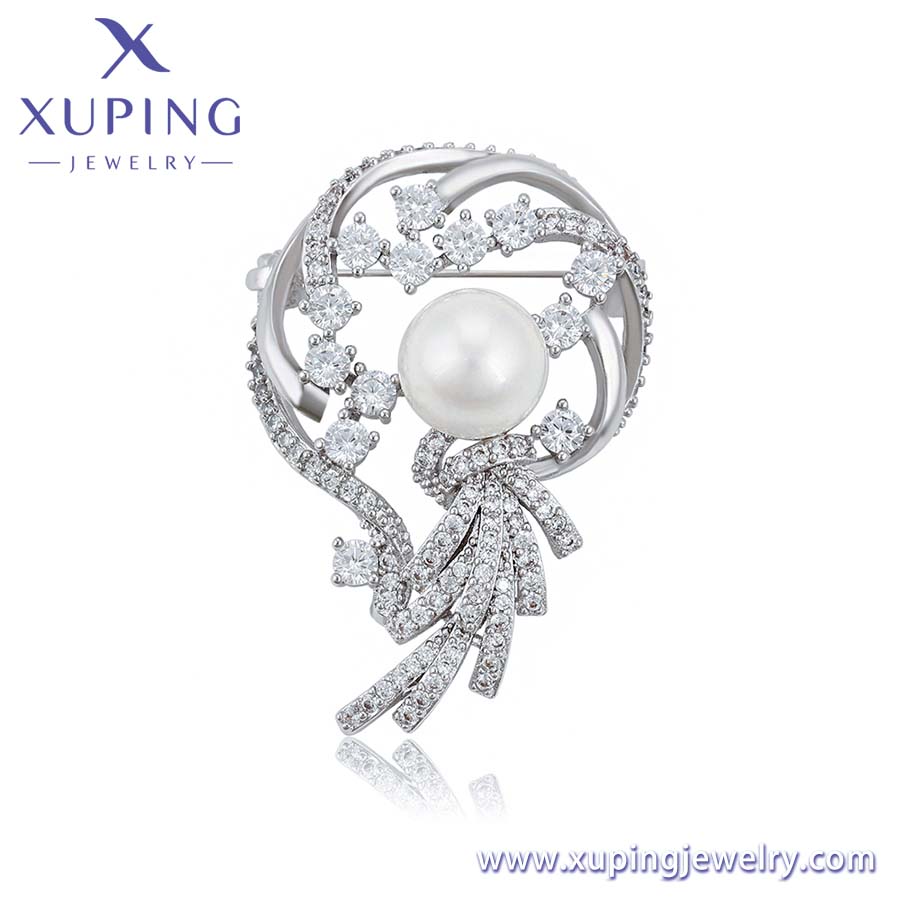
Brooch A00900238 — Daily series, platinum plated, white synthetic cubic zirconia main stone of approximately 3.5 × 3.5 mm, 12.3 g.
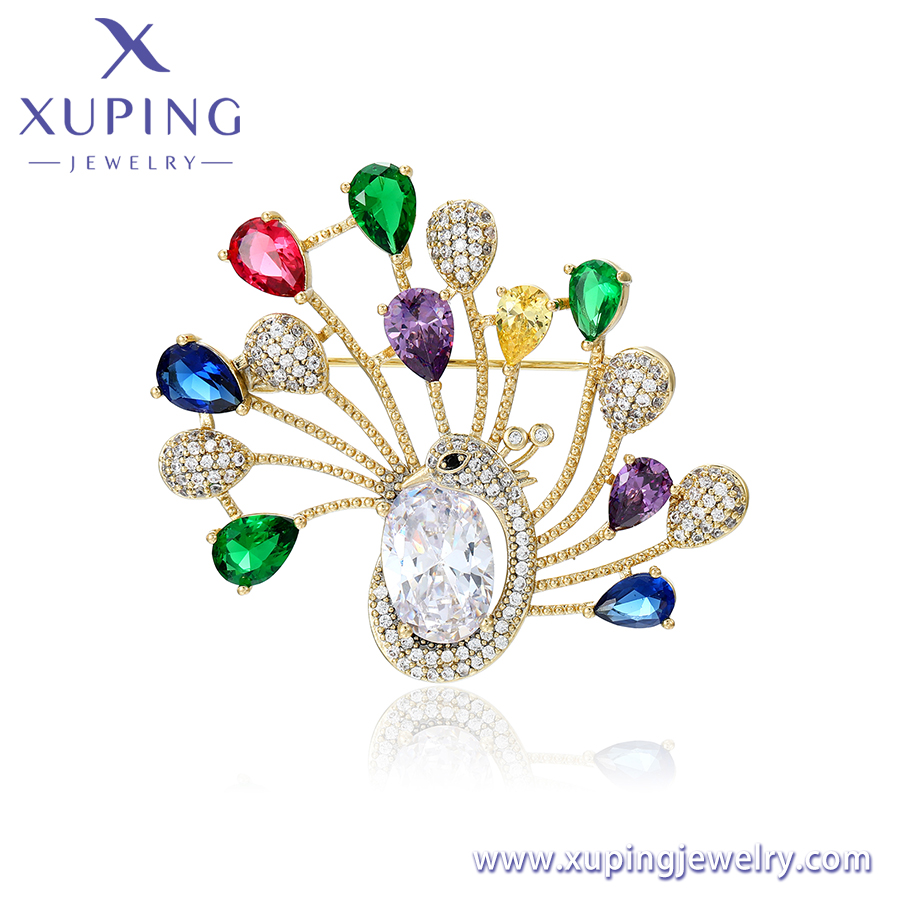
Brooch X000852427 — Luxury series, 14K gold color, AB-color synthetic cubic zirconia main stone of approximately 12 × 8 mm, 9.15 g.
What Backs the Assortment Width: Design Capacity and Manufacturing Scale
Maintaining three parallel series across nine product categories is a design and manufacturing problem before it is a merchandising one. Each series runs its own material set — stainless steel, platinum-plated copper, 14K gold-color copper, 18K gold-color copper — and each requires different plating control and stone-setting procedures.
Xuping Jewelry's R&D team consists of 62 designers, and the company holds 194 patents. Manufacturing takes place in a facility covering 200,000+ square meters. The company was established in 1997, which means the current series structure has been developed over nearly three decades of export production rather than assembled in a single product cycle. Approximately 100% of sales are export sales, distributed across more than 100 countries, with major markets listed as Mexico, the United States, Spain, Canada, Peru, the Philippines, Thailand, Indonesia, Malaysia, Vietnam, Australia, New Zealand, Turkey, Saudi Arabia, Iran, the United Arab Emirates, Ukraine, Russia, Poland, Germany, France, Italy, Nigeria, and the United Kingdom.
For a wholesale buyer evaluating whether a supplier can hold a scenario-based assortment together, that combination matters. A category structure that only exists on paper tends to collapse at reorder time, when a specific model either ships in the same specification or does not.
Market Signals Buyers Should Fold Into Category Planning
Several data points support treating occasion fit as a live planning input rather than a static attribute.
- Online jewelry retail channels are projected to grow at a CAGR of 8.0% to 13% annually and to represent 25–30% of total industry purchases by 2026, according to Grand View Research and Statista. Online assortment is browsed by scenario — "everyday necklace," "evening earrings" — which rewards suppliers whose catalog is already segmented that way.
- China's total jewelry exports reached USD 11.5 billion in 2024, with the United States as a primary destination at USD 1.31 billion, according to the Observatory of Economic Complexity. Export-oriented assortment planning is therefore the norm rather than the exception for Chinese manufacturers.
- The global stainless steel jewelry market is projected to reach USD 10.8 billion by 2035, growing at a CAGR of 4.3% from 2026, per WiseGuyReports. That projection should be treated as an indication of direction rather than a precise forecast, because segment definitions vary between research houses.
- Jewelry sold in the EU must comply with REACH Regulation (EC) 1907/2006 on nickel release (limit 0.5 μg/cm²/week), lead (500 mg/kg), and cadmium (100 mg/kg), per the European Chemicals Agency. Jewelry intended for children under 14 in the EU is classified as a toy and requires mandatory CE marking under the Toy Safety Directive 2009/48/EC.
The compliance point intersects directly with occasion planning. A daily-wear range stocked for a young-adult market faces different regulatory thresholds than an occasion range sold to adult buyers, and assortment decisions made at the category level should reflect that.
Limits and Boundaries: Where Plated Fashion Jewelry Does Not Fit
A category-fit discussion that only lists strengths is not useful to a buyer. Several real boundaries apply.
Plating is not solid metal. Environmental copper with 14K or 18K gold-color plating, and platinum-plated copper, are surface finishes. They are not interchangeable with solid gold construction over an unlimited wear horizon. For categories designed around occasional wear — Luxury series brooches, bangles, and occasion sets — this is a reasonable trade-off. Buyers should not position these pieces as heirloom items.
Stainless steel has aesthetic limits. The Daily series relies on stainless steel for bracelets and necklaces, which favors cool, neutral tones. Certain warm, high-saturation luxury looks cannot be produced in an unplated stainless steel body, so the Daily series and the Luxury series are not fully substitutable in either direction.
Synthetic stones are synthetic. Synthetic cubic zirconia and synthetic crystal are not natural gems, and their clarity and rarity do not meet fine-jewelry thresholds. Series selection should be based on visual effect and wearing scenario, not on gemological equivalence.
Children's jewelry carries extra constraints. Under EU rules, jewelry intended for children under 14 is classified as a toy and requires CE marking under the Toy Safety Directive 2009/48/EC. Any occasion or gift assortment aimed at minors needs separate compliance verification.
Series are not interchangeable inventory. The single most common assortment error is treating Daily, Simple, and Luxury series pieces as substitutes when one model is out of stock. Because weight, plating, and stone specification differ, substitution changes what the end consumer receives — and therefore changes return behavior.
Future Outlook for Occasion-Based Wholesale Assortments
Two structural trends are likely to keep occasion fit at the center of wholesale jewelry planning.
First, channel fragmentation. The listed project types for Xuping's catalog span retail jewelry stores, e-commerce platforms, brand OEM/ODM, wholesale distribution, and promotional gifting. Each of those channels defines a category differently. An e-commerce listing sells on scenario keywords; a promotional-gift program sells on unit cost and packaging compatibility. A supplier whose catalog is already divided by series and occasion gives buyers a shorter path from brief to order.
Second, material specialization. Stainless steel continues to draw separate market attention, and copper-based plating technology continues to improve in finish consistency. As these two material families diverge further, series labels will carry more procurement meaning than they do today — not simply as an internal catalog convention, but as a signal buyers can use to predict wear behavior.
For buyers still at the awareness and research stage, the practical next step is not to choose between daily and luxury, but to map both against the channels and end consumers already in the portfolio. The category structure already exists; the work is deciding which shelf each series belongs on.
Frequently Asked Questions
What is the difference between a Daily series and a Luxury series in wholesale jewelry?
The series label describes construction, not price tier. In Xuping Jewelry's catalog, Daily series pieces use stainless steel or lightly plated environmental copper, carry no main stone or a small synthetic cubic zirconia stone, and stay low in unit weight — for example, the stainless steel bracelet T000959269 at approximately 11.01 g. Luxury series pieces use 14K or 18K gold-color plating or platinum plating on environmental copper, carry larger main stones, and are designed for occasional wear — for example, the brooch X000852427 with an AB-color synthetic cubic zirconia main stone of approximately 12 × 8 mm. A Simple series sits between them.
Which wholesale jewelry categories are best suited to daily wear?
Categories engineered without raised stone settings handle daily wear most comfortably. In the Xuping Jewelry catalog these include stainless steel bracelets and necklaces such as T000959269 and A00902945, stone-free rings such as X000877263 at 2.56 g, and platinum-plated anklets such as X000988693 at approximately 5.59 g. The product specification units for these models list no main stone, which removes the elements most likely to catch on clothing during continuous wear. The application-scenario data lists long-term wear and all-weather suitability as operating conditions for this category group.
Which product categories fit luxury occasions rather than everyday use?
Brooches, bangles, coordinated sets, and heavier necklaces are the categories most often built for occasional wear. Representative Luxury series models include the brooch X000852427, the bangle X000998659 at 21.77 g with a ruby-colored synthetic cubic zirconia main stone of about 8 × 6 mm, and the necklace 14N245402 at approximately 49.44 g with a dark blue glass main stone. The set X000871334 combines a necklace, bracelet, and earrings in a single coordinated unit at approximately 18.8 g per set, which reduces the number of SKUs a buyer needs to assemble an occasion look.
How should a wholesale buyer evaluate whether a category fits a specific end-use scenario?
Four specification fields carry most of the decision: base material and plating method, main-stone presence and size, unit weight, and hand size or length including any extension. Together these predict wear comfort and visual impact. For example, comparing brooch A00900238 (platinum plated, main stone approximately 3.5 × 3.5 mm, 12.3 g) with brooch X000852427 (14K gold color, main stone approximately 12 × 8 mm, 9.15 g) shows that stone size and total weight do not move together — which is why both fields should be read separately rather than inferred from each other.
What is the functional difference between stainless steel and plated copper in wholesale jewelry?
Stainless steel is used as a base material without a decorative plating in models such as the bracelet T000959269 and the necklace A00902945, giving a cool, neutral metallic finish with no stone setting. Plated environmental copper — the base for most Simple and Luxury series pieces — carries a surface finish such as 14K gold color, 18K gold color, or platinum, and supports stone setting, which stainless steel bodies in this catalog generally do not. The two material families therefore serve different scenario roles rather than substituting for one another.
What should buyers verify with a supplier when matching product lines to use scenarios?
Buyers should confirm the series designation of each model, the exact plating method, main-stone type and dimensions, unit weight, and hand size or length including extensions. Where the assortment will be sold into the EU, they should also confirm compliance with REACH Regulation (EC) 1907/2006 on nickel release (limit 0.5 μg/cm²/week), lead (500 mg/kg), and cadmium (100 mg/kg), and check whether any item intended for children under 14 falls under the Toy Safety Directive 2009/48/EC CE marking requirement. Xuping Jewelry was established in 1997, holds 194 patents, employs 62 designers, and exports approximately 100% of its production to more than 100 countries, which are verifiable reference points when assessing whether a supplier can maintain a segmented assortment over repeat orders.
Есть вопросы или нужны дополнительные детали?
Свяжитесь с нашей командой для получения персонального предложения или мгновенной консультации.
Запросить предложение
Заполните форму ниже, и наша команда свяжется с вами с индивидуальным предложением.
Прямой чат WhatsApp
Предпочитаете общаться в реальном времени? Напишите нам в WhatsApp для мгновенной помощи и быстрых ответов.
- Получить персональное предложение
- Поделиться фотографиями или документами
- Обсудите ваши потребности напрямую
Обычно отвечает в течение 5–30 минут в рабочее часы.