
Daytime, Overnight, Daycare: Matching Training Pants to Use
A training pant is an absorbent pull-up that a toddler wears like underwear, and its performance is judged less by absorbency alone than by whether the construction matches the moment of use. Daytime potty training, overnight sleep, nursery or daycare attendance and travel each impose a different mix of wear time, changing frequency, removal method and cost tolerance.
That makes scenario fit a sourcing variable rather than a marketing angle. Buyers evaluating disposable training pants are increasingly asked by their own customers — retail chains, e-commerce sellers, daycare programmes — to justify which SKU serves which use case, and to show the construction and documentation behind that answer.
Scenario fit is the specification gap in training pants sourcing
Category language flattens the distinction between products. Searches for baby training pants, pull up training pants or super absorbent training pants describe one product family, yet a buyer specifying a daytime SKU and a buyer specifying an overnight SKU are not asking for the same construction, the same core, or the same pack format. When a supplier answers both enquiries with a single stock specification, the mismatch usually surfaces later: as leakage complaints, as a reorder that quietly shrinks, or as a daycare account that reverts to tape diapers.
Two practical consequences follow for buyers in the evaluation stage. First, the requirement profile should be written before the price comparison, because prices only become comparable once scenario and configuration are fixed. Second, each scenario should be traced back to a component that can actually be specified, tested and documented — waistband, top sheet, core type, side seams and packaging — rather than to a descriptive label. Terms such as leak-proof training pants or super absorbent training pants read as design targets, not as standardised attributes, and should be converted into written criteria before they enter a purchase order.
The opportunity sits on the other side of the same gap. A supplier that can hold one verified base construction and configure it across scenarios gives a brand owner a coherent range: shared compliance documentation, shared quality process, different absorbency intent and pack format per SKU. That is a materially different proposition from buying four unrelated products from four suppliers and assembling a range from them.
The product behind the scenario map: Training Pants YQ004 from Uniquality
Zhejiang Uniquality Nursing Products Technology Co., Ltd. is a China-based OEM and ODM manufacturer of personal care products — baby training pants, disposable training pants, baby diapers, baby pants, baby wipes and dry wipes — established in 1987 and operating from Zhejiang. The company states a 1,000,000 ㎡ manufacturing footprint, more than 3,000 employees, a 100,000-class clean room, a 200+ person R&D team, and exports to more than 80 countries, with the USA, EU, SAM, RU and CASA listed as main markets. Product and company information is published at www.kingsafe.com.
The verified training pants product in scope here is model YQ004, a disposable pull-up training pant made from nonwoven and SAP. Its stated construction is a super absorbent core using high polymer SAP, an elastic wide waistband, a breathable soft top sheet made of skin-friendly non-woven fabric, and easy-tear side seams for fast removal. Core options are offered as 100% woodpulp, half core and 100% SAP. The product is positioned for maternity and baby care projects and for disposable hygiene product supply projects.
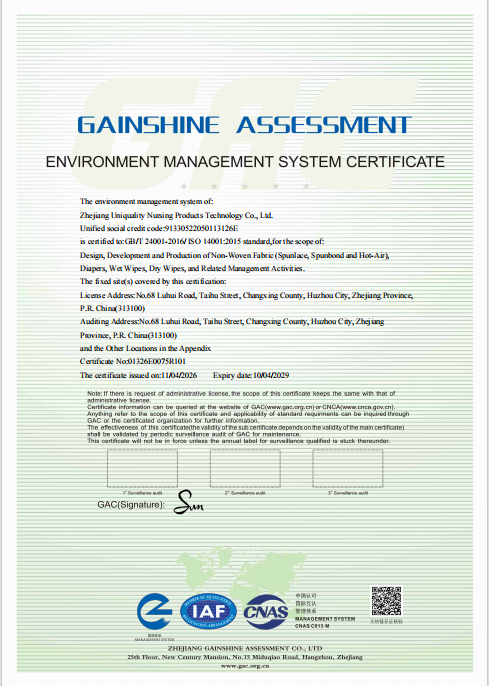
Compliance is documented rather than asserted. The training pants sit inside CE certification 6C240227.ZUNU051, issued by ENTE CERTIFICAZIONE MACCHINE under EN 12221-1:2008+A1:2013 and EN ISO 12625-1:2019, valid from 27 February 2024 to 26 February 2029. Environmental management is certified to ISO 14001:2015 under certificate 01326E0075R101, issued by GAC, valid from 11 April 2026 to 10 April 2029. An FSC certificate, BV-CQC-167194, issued by Bureau Veritas under FSC-STD-40-004 V3.0, covers training pants alongside the other product lines. Quality management for the same scope is certified to ISO 9001:2015 under 01326Q0078R102.
How the construction actually works
Three core options are listed for YQ004: 100% woodpulp, half core and 100% SAP. This is the main engineering lever between scenarios, because it changes how absorbent material is distributed and how the product behaves under load and over extended wear. The super absorbent core uses high polymer SAP, which absorbs and holds liquid; woodpulp contributes bulk and wicking. A half core combines the two approaches, while a 100% SAP core concentrates absorbency in the polymer. Buyers do not need a chemistry lesson, but they do need to know which option they are buying, because the same outer construction can carry different absorbency intent.
The breathable soft top sheet is made of skin-friendly non-woven fabric. In breathable training pants, the top sheet is the layer in contact with skin, so its softness and air movement characteristics matter most in long-wear scenarios and in warm climates — the two conditions under which parents and nursery staff judge a product most harshly.
The elastic wide waistband is what makes a pull up training pant function as a training tool rather than as a diaper: it allows a toddler to pull the product up and down without adult help, which is the behavioural point of the format. Easy-tear side seams serve the adult instead. During a change performed standing up, or in a shared nursery facility where speed matters, the seam opens the product for removal without pulling it back down over the legs.
Absorbency claims are where documentation usually falls short. ISO 11948-1 specifies the method for determining the total absorption capacity of urine-absorbing aids, and it is the reference a buyer can cite when asking which test method produced a stated capacity figure. A number without a named method is not comparable across suppliers, and a comparative claim built on it is not defensible in a tender or a retail compliance review.
Daytime, overnight, daycare and travel: mapping requirements to configuration
Scenario mapping is most useful when it converts a use case into a component decision and then into a document request. The table below does that for the four scenarios that dominate training pants ranges.
| Scenario | Primary requirement | Configuration lever on YQ004 | What to verify in writing |
|---|---|---|---|
| Daytime potty training | Independent pull-up and pull-down, comfort across frequent changes, controlled cost per change | Elastic wide waistband; breathable soft top sheet of skin-friendly non-woven fabric | Confirmed size range and waistband behaviour; top sheet specification |
| Overnight | Longer wear time, higher absorbency intent, skin comfort through sleep | Super absorbent core with high polymer SAP; core options of 100% woodpulp, half core or 100% SAP | Absorbency test data and the named test method behind it |
| Daycare / nursery | Fast removal during group changes, documentation for institutional purchasers, predictable pack formats | Easy-tear side seams; packaging and logo customization; COA and AQL sampling inspection | COA per batch; AQL level agreed in the purchase order |
| Travel and out-of-home | Compact pack formats, discreet disposal, consistent fit away from home | Packaging customization; material, size, fragrance and formula options | Pack count per SKU and carton configuration |
Daytime potty training
Daytime use is high-frequency and adult-supervised, so the dominant requirements are fit independence and comfort during repeated changes rather than maximum absorbency. The elastic wide waistband and the soft top sheet carry most of that load. Cost per change matters more here than cost per unit, which is why pack counts and carton configuration belong in the same conversation as product construction. Size range is a customization field — material, size, logo, packaging, fragrance and formula are all listed as configurable — so a range that includes XL size training pants or toddler training pants spanning several weight bands can be built on one base construction rather than several.
Overnight protection
Overnight use changes the requirement profile in two directions at once: longer uninterrupted wear, and a higher absorbency target. Core selection is the lever, and it is the first question a supplier should be asked. It is also the point where buyers should resist inference. The existence of a 100% SAP core option indicates a higher absorbency design intent; it is not a published capacity figure, and no verified absorbency or leak-proof performance data is disclosed for this product in the available documentation. Buyers should therefore request test data and confirm which method was used, referencing ISO 11948-1 where a method reference is needed, before making overnight performance claims to retailers or parents.
Daycare and nursery programmes
Institutional buyers — nurseries, daycare chains, childcare procurement teams — evaluate differently from households. Their staff change many children in sequence, often standing and under time pressure, which puts easy-tear side seams and clear pack identification ahead of decorative design. They also need documentation that a household buyer never asks for: a COA for the delivered batch, an agreed AQL sampling level, and packaging that survives shared storage. A supplier that already runs COA plus AQL sampling inspection as standard, and that can print programme-specific labelling and pack counts, removes a layer of administration from the daycare buyer's side.
Travel and out-of-home use
Travel does not create a new absorbency requirement so much as a new packaging and disposal requirement. Smaller pack formats, resealable or compact cartons, and consistent fit when the product is used away from home are the practical priorities. Because packaging and formula are both listed customization fields, a travel SKU can typically be produced from the same base construction as the daytime SKU, which keeps range complexity and artwork approvals under control.
Procurement checkpoint before comparing quotes:
1. Name the scenario and the wear window per SKU. 2. Fix the core option per SKU. 3. Confirm size range and pack count. 4. Request COA and the agreed AQL level. 5. Record the certificate number and validity end date for every compliance document the buyer intends to publish.
What the market data says about scenario-led ranges
Directional market data supports the case for segmenting training pants by scenario rather than selling a single specification. Grand View Research forecasts the global baby training pants market to reach USD 7.02 billion by 2030, growing at a CAGR of 7.5% from 2025 to 2030. That is a single commercial research forecast and should be read as directional context, not as a reconciled market estimate, because commercial sources differ in definitions, geography and time frames.
Regional structure is more useful for range planning. Pants-type diapers are reported to account for more than 70% of total diaper sales in Japan, a market where the pull-up format is the default rather than the exception. For buyers in mature markets, that suggests the competitive question is no longer whether to stock pull-up training pants but which scenario-specific variants to stock. Trade classification adds a practical note: disposable training pants and baby diapers are primarily classified under HS Code 9619.00, so scenario segmentation happens inside one customs heading and does not change the import process — it changes the SKU count within it.
Where pull-up training pants stop being the right answer
Pull-up training pants are not universally superior to tape diapers or reusable cloth training pants, and a credible evaluation should say so.
Against tape-style diapers, the pull-up format trades adjustability for independence. A tape diaper can be re-fastened and re-tensioned around a sleeping child; a pull-up cannot. That makes sizing accuracy more consequential in the pull-up format, and it means overnight use with a pull-up depends on a correct size fit rather than on a caregiver's ability to re-tighten. Tape diapers also remain easier to apply to a child who is not yet cooperating with dressing.
Against reusable cloth training pants, disposable pull-ups carry ongoing consumable cost and a waste stream, while reusable products carry laundry, labour and drying requirements. Neither is automatically cheaper for a household or a nursery; the comparison depends on change frequency, laundry access and programme policy.
Supplier-side boundaries matter too. The stated minimum order quantity is 150,000 pieces for baby diapers and pull-ups, and lead time is 35–45 days after artwork and deposit confirmation. For a private-label brand or importer building a multi-scenario range, that is workable; for a single small nursery group testing a pilot SKU, it is a genuine barrier, and smaller buyers should expect to work through distributors or to consolidate scenarios into fewer SKUs. Certificate validity also needs active management: the FSC certificate BV-CQC-167194 carries a validity end date of 30 May 2026, so buyers should request current certificate status at the time of order rather than relying on a previously supplied copy. Finally, no verified absorbency, breathability or leak-proof performance figures are disclosed for this product, so any overnight or high-load claim must rest on the buyer's own testing or on supplier-supplied test data.
What changes next in training pants documentation
Two shifts are visible from the buyer side. The first is from product claims to specification files: ranges are increasingly described by core type, top sheet, waistband, side seam and pack format, with each element traceable to a document, because that is the only form in which a range can be defended to a retailer or a daycare procurement team. The second is certificate lifecycle management. Numbers such as 6C240227.ZUNU051 and 01326E0075R101 are useful precisely because they can be checked against an issuing body and a validity window — CE to 26 February 2029 and ISO 14001 to 10 April 2029 in this case — and buyers who track expiry dates as part of supplier review avoid discovering a lapse during a customer audit.
For manufacturers, the implication is that scenario mapping becomes a commercial capability rather than a courtesy. A supplier that can hold one verified base construction, document it consistently, and configure core, size, packaging and labelling per scenario is easier to keep in a range than one that requires a new qualification for every SKU.
Reference document: the Uniquality product and capability brochure is available for download at https://cdn.socialarks.com/sbsp/24863/common/2026/0518/6a0a6e03e4ef8.pdf.
FAQ
What materials and core options are used in Uniquality's Training Pants YQ004?
Training Pants YQ004 from Zhejiang Uniquality Nursing Products Technology Co., Ltd. is made from nonwoven and SAP, with nonwoven used as the primary material and SAP used as the primary absorbent material. The product has a super absorbent core with high polymer SAP, an elastic wide waistband, a breathable soft top sheet made of skin-friendly non-woven fabric, and easy-tear side seams for fast removal. Core options offered are 100% woodpulp, half core and 100% SAP.
Which certificates cover the training pants, and what do the certificate numbers refer to?
Three documents are directly relevant. CE certificate 6C240227.ZUNU051, issued by ENTE CERTIFICAZIONE MACCHINE under EN 12221-1:2008+A1:2013 and EN ISO 12625-1:2019, is valid from 27 February 2024 to 26 February 2029 and covers baby diapers and training pants. ISO 14001:2015 certificate 01326E0075R101, issued by GAC, is valid from 11 April 2026 to 10 April 2029 and covers wet wipes, dry wipes, baby diapers and training pants. FSC certificate BV-CQC-167194, issued by Bureau Veritas under FSC-STD-40-004 V3.0, covers the same product scope and carries a validity end date of 30 May 2026, so current status should be confirmed at the time of order.
How should a buyer choose between the core options for daytime and overnight use?
The core options listed for YQ004 — 100% woodpulp, half core and 100% SAP — are the primary lever for absorbency intent, and the super absorbent core uses high polymer SAP. Daytime potty training typically prioritises fit independence and comfort across frequent changes, while overnight use prioritises absorbency over a longer wear window, which points toward a higher-SAP core specification. No verified absorbency capacity figures are disclosed for this product, so buyers should request test data and confirm the test method used, with ISO 11948-1 as the recognised method reference for determining total absorption capacity of urine-absorbing aids.
What MOQ and lead time apply to OEM or ODM training pants orders?
The stated minimum order quantity is 150,000 pieces for baby diapers and pull-ups. Lead time is 35–45 days after artwork and deposit are confirmed. OEM and ODM production is available, with customization covering material, size, logo, packaging, fragrance and formula, and sampling is quoted at 3–5 days. These terms suit private-label brands and importers building multi-SKU ranges; smaller institutional buyers may need to consolidate scenarios into fewer SKUs.
How is quality controlled and documented for a training pants order?
Quality control is documented through COA and AQL sampling inspection, giving the buyer a batch-level certificate of analysis and an agreed sampling acceptance level. After-sales support covers remote support, order follow-up, product usage consultation, quality feedback handling and service coordination. A three-year UK OEM partnership is recorded with monthly shipment volume of 20 forty-foot high-cube containers, an on-time delivery rate of 99.5% and zero major quality complaints over the cooperation period.
Есть вопросы или нужны дополнительные детали?
Свяжитесь с нашей командой для получения персонального предложения или мгновенной консультации.
Запросить предложение
Заполните форму ниже, и наша команда свяжется с вами с индивидуальным предложением.
Прямой чат WhatsApp
Предпочитаете общаться в реальном времени? Напишите нам в WhatsApp для мгновенной помощи и быстрых ответов.
- Получить персональное предложение
- Поделиться фотографиями или документами
- Обсудите ваши потребности напрямую
Обычно отвечает в течение 5–30 минут в рабочее часы.