
Decoding CE Certification Packages for Sublimation Printers: LVD, EMC, MD & RoHS
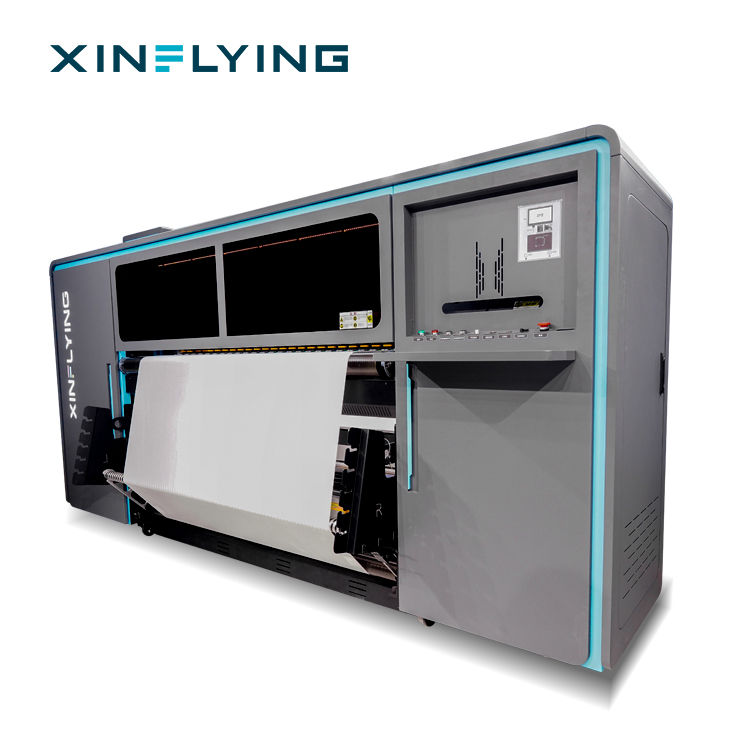
A CE mark on an industrial sublimation printer is not one certificate. It is the visible end of a documentation chain that ties four separate EU instruments - the Low Voltage Directive (LVD), the Electromagnetic Compatibility Directive (EMC), the Machinery Directive (MD) and the RoHS Directive - to one specific machine configuration. For a 190 cm roll-to-roll unit such as the XF-19E15-PRO or the XF-19E8-PRO, that chain has to describe electrical ratings, control and heating circuits, moving axes and guarding, and the material composition of the electrical and electronic components. Reading it correctly is a procurement skill rather than a legal one, and it determines whether a shipment clears customs as scheduled or sits in a warehouse awaiting paperwork.
Why CE Paperwork for Industrial Printers Is Harder to Read Than It Looks
Most disputes over CE documentation begin with a vocabulary problem. Suppliers refer to the CE certificate, customs officers ask for the CE file, and internal procurement teams file both under the same reference number - yet the two documents do different jobs. A test report records what was measured on a sample. A Declaration of Conformity (DoC) is the legal statement that the machine placed on the market meets the applicable directives and the standards listed on it. Neither document, on its own, explains how an eight-printhead machine differs from a fifteen-printhead machine, or which parts of the printer the technical file actually covers.
The gap has practical consequences. Compliance documents that are incorrect or incomplete may result in customs delays, sales restrictions or additional compliance costs, and documents are frequently issued for one configuration while the shipment contains another. For buyers moving from a purchase decision into execution - the stage where documents, money and logistics run in parallel - the useful move is to stop treating the bundle as a single PDF and start reading it as four files with four separate checklists.
The Four Instruments Behind One CE Mark
A large-format textile printer is not assessed under a single instrument. Each of the four layers below answers a different question and produces its own evidence. Buyers should therefore expect separate entries on the Declaration of Conformity rather than one general claim of CE compliance.
| Instrument | Question it answers | Standards cited in this layer | Documents a buyer should expect |
|---|---|---|---|
| LVD | Is the machine's supply, control and heating circuitry electrically safe? | EN IEC 62368-1 (equipment safety family) | LVD test report, nameplate rating, DoC entry |
| EMC | Does the printer emit and tolerate electromagnetic disturbance within defined limits? | EN 55032 (emission) | EMC test report including the tested configuration description |
| MD | Is mechanical and integrated electrical risk assessed and reduced at design stage? | EN ISO 12100:2010, EN 60204-1 | Risk assessment, safety-related drawings, electrical schematic, marking details |
| RoHS | Are hazardous substances restricted in the electrical and electronic components? | Component and material declarations | RoHS declaration naming the model and component scope |
LVD: What the Electrical Safety Layer Covers
The LVD layer addresses the electrical safety of the machine's supply, control and heating circuits. For the two reference models the relevant data are explicit in the specification: both the XF-19E15-PRO and the XF-19E8-PRO are rated 210-230 V, 45 A, and draw 14.5 kW and 10.2 kW respectively. Those ratings define the conditions under which the electrical safety of the machine is judged. If a report is written around a different input current, a different supply variant, or without the external intelligent air-heat integrated dryer that both models use, then the assessed configuration does not describe the machine on the pallet.
EMC: What the EN 55032 Report Actually Proves
EN 55032 is the emissions reference cited for this equipment class. An EMC report is only as wide as its configuration description: cable routing, the presence of the external dryer, the workstation running the RIP software, and the print mode tested all bound what the report covers. Reviewers should read the configuration section before the results table, because that section - not the pass or fail line - defines the machine the document applies to.
MD: Risk Assessment and Electrical Equipment of Machines
For a machine with moving media axes, heated platens and a large frame, the machinery layer is usually the thickest part of the file. EN ISO 12100:2010 sets out the risk assessment and risk reduction process applied at the design stage, while EN 60204-1 addresses the electrical equipment of machines, including protective bonding, stopping functions and conductor identification. The documents to expect include the risk assessment, guarding and safety-related drawings, and the electrical schematic. Physical parameters give reviewers a fast cross-check: the XF-19E8-PRO has a machine size of 3840 x 1300 x 1800 mm and a net weight of 1400 kg, while the XF-19E15-PRO measures 3840 x 1570 x 1800 mm and weighs 1480 kg. If the drawing in the technical file shows the narrower frame while the order is for the wider one, the file describes a different build.
RoHS: A Component-Level Scope, Not a Product-Level Promise
RoHS documentation confirms that restrictions on hazardous substances are met in the electrical and electronic components. That is a component-level statement. It does not certify the printed fabric, the transfer paper or the sublimation ink, and it says nothing about the textile product the printer produces. Buyers should request the environmental compliance documents from the supplier and confirm that they apply to the actual equipment model, because documentation issued for one build does not transfer automatically to another.
What the Documents for XF-19E15-PRO and XF-19E8-PRO Should Cover
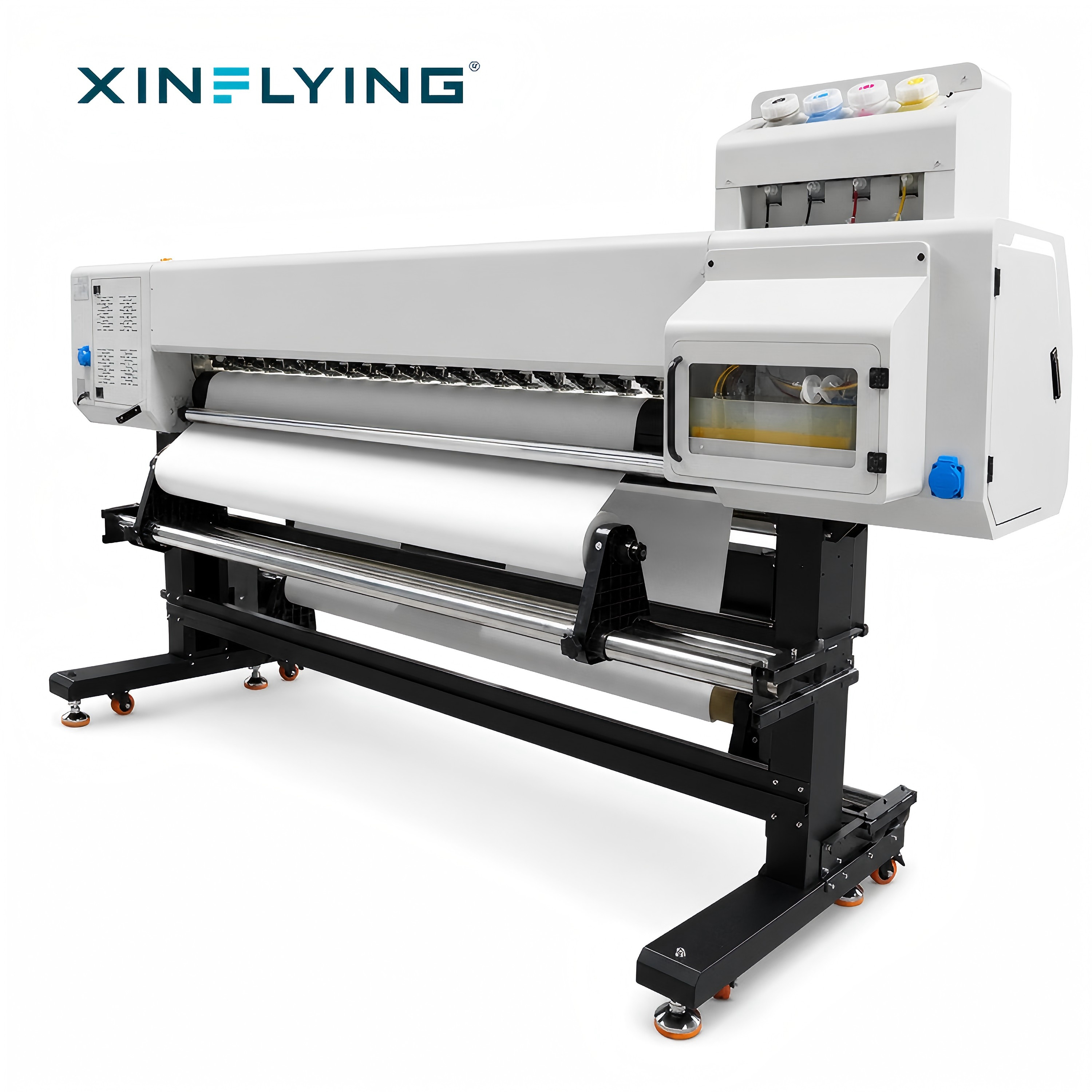
Model-level differences matter because a technical file has to be specific. The two reference models share a 190 cm (75 in.) print width, 3200 dpi resolution and a 210-230 V, 45 A supply, but they are different machines internally - and that difference is exactly what a compliance officer is looking for in the documentation.
| Parameter | XF-19E15-PRO | XF-19E8-PRO |
|---|---|---|
| Printheads | 15 x Epson i3200-A1 | 8 x Epson i3200-A1 |
| Print width | 190 cm (75 in.) | 190 cm (75 in.) |
| Resolution | 3200 dpi | 3200 dpi |
| Fastest print speed | 1PASS 524 sqm/h; 2PASS 254 sqm/h | 1PASS 306 sqm/h; 2PASS 153 sqm/h |
| Power | 14.5 kW | 10.2 kW |
| Power supply | 210-230 V, 45 A | 210-230 V, 45 A |
| Machine size | 3840 x 1570 x 1800 mm | 3840 x 1300 x 1800 mm |
| Net weight | 1480 kg | 1400 kg |
A document set that names only the product family leaves the reviewer unable to confirm which configuration was assessed. The same logic applies further down the range: a 180 cm platform such as the XF-H1802X-2I32A1, with two Epson i3200-A1 printheads and a 3.5 kW power rating, sits in a different assessed configuration from a fifteen-printhead industrial unit drawing 14.5 kW. Both machines are built by XINFLYING (Guangzhou Xin Flying Digital Technology Co., Ltd.), a digital printing equipment manufacturer founded in 2010 and based in Panyu, Guangzhou, which operates a 37,440 sqm facility with more than 200 employees, a 20-engineer R&D team and an annual output of more than 20,000 units across DTF, DTG, UV and dye sublimation equipment.
A Seven-Step Document Review for Importers and Compliance Officers
The following sequence is designed for the execution stage, when a purchase order exists and shipment is approaching. It can be completed from the document pack before the machine is crated.
- Match the model designation. The Declaration of Conformity should name the exact model - XF-19E15-PRO or XF-19E8-PRO - rather than a family name, together with the serial applicability of the declaration.
- Match the nameplate to the LVD report. The rated voltage, current and power printed on the machine must fall inside the range that was assessed.
- Read the standards list as a scope statement. A file citing EN ISO 12100:2010 and EN 60204-1 is describing a machinery assessment; a file citing EN IEC 62368-1 is covering equipment safety; both may appear in the same package and neither replaces the other.
- Check the tested configuration. Printhead count, print width, dryer type and any bundled workstation or RIP software should be described, not assumed.
- Check the RoHS declaration. Confirm the date, the component scope, and that the declaration references the model being supplied rather than a predecessor.
- Identify who signs. The declaration is issued by the entity responsible for placing the machine on the EU market. For importers, this determines which obligations sit with the supplier and which sit with the buyer.
- Reconcile at acceptance. Product acceptance is carried out through pre-shipment test procedures before delivery, which makes that step the natural point to confirm that the documents describe the machine actually being loaded.
Where CE Documentation Stops: Limits Buyers Should Expect
A common shortcut is to accept a certificate-only submission: a laboratory-issued certificate bearing a CE logo, sent once and filed by product family. The comparison below sets out what that shortcut does and does not cover.
| Review point | Certificate-only submission | Full conformity package |
|---|---|---|
| Model identification | Often family level | Per-model, with serial applicability |
| Directive coverage | One directive named, others implied | LVD, EMC, MD and RoHS entries on the DoC |
| Standards cited | Frequently omitted | Standards listed per directive |
| Configuration description | Rarely included | Printheads, width, dryer, supply variant |
| RoHS scope | Sometimes a generic statement | Component-level declaration tied to the model |
| Revision control | Not tracked | Updated when the build changes |
It is equally important to be clear about what a CE package does not do. It is not a performance certificate: it provides no evidence about colour consistency, print quality on a given polyester fabric, or output speed. The fact that the XF-19E15-PRO is specified at 1PASS 524 sqm/h is a production specification, not a compliance claim, and buyers should evaluate it separately from the conformity file.
Conformity also attaches to an assessed configuration. Substituting components, changing the printhead count, or altering the supply variant generally means the existing file no longer describes the machine being shipped, and a new assessment is required. Finally, RoHS covers electrical and electronic components, not the printed textile, so buyers sourcing for regulated apparel markets should treat textile-related requirements as a separate workstream with its own documentation.
Application Context: Where These Files Are Checked in Practice
Documentation is reviewed against a production environment rather than in isolation. Industrial dye sublimation production lines operate in controlled indoor conditions - typically 18-30 degrees Celsius and 35-65% relative humidity - and frequently run continuously, with the printer matched to RIP software, a heat press calender, dye sublimation paper, dye sublimation ink and downstream cutting equipment. Each item in that line carries its own conformity documentation; the printer's LVD, EMC and machinery files describe the printer, not the calender or the laser cutter standing beside it.
This matters for two common project types. A new textile printing facility commissioning a complete line needs separate declarations per equipment manufacturer, because a single file cannot cover equipment supplied by different producers. A sportswear or home textile manufacturer adding capacity inside an existing plant needs the new machine's file to sit alongside the existing technical documentation without contradicting it - which is why the working conditions specified for the equipment, such as the 18-30 degrees Celsius and 35-65% relative humidity range stated for the reference models, also belong in the operator documentation that accompanies the technical file.
Market Signals Behind Rising Documentation Scrutiny
The volume of equipment moving across borders is one reason documentation review has become a standard procurement step rather than an afterthought. Grand View Research values the global dye sublimation printing market at USD 16.4 billion in 2025, projected to reach USD 39.0 billion by 2033, with a CAGR of 11.5% between 2026 and 2033; Asia Pacific accounted for a 36.5% revenue share in 2025, led by China. Narrowing the scope to equipment, Mordor Intelligence values the dye sublimation printer segment at USD 1.88 billion in 2025, rising to USD 2.53 billion by 2030. Fortune Business Insights places the wider large format printer market at USD 10.57 billion in 2025, reaching USD 16.52 billion by 2034.
Long-Term Supply and Document Continuity
For distributors and multi-year production buyers, the conformity file behaves like a lifecycle document rather than a one-time attachment to a purchase order. Three practical implications follow.
First, the file must be reproducible. Re-issued copies for a second shipment or a repeat order should carry the same revision, otherwise the receiving site is validating documents that differ from the ones approved internally. Second, service parts matter. Where a replacement component changes the electrical or electronic composition of the machine, component-level declarations may need refreshing. Third, support geography matters. XINFLYING serves North America, South America, Europe, Asia, the Middle East and Africa, with export business accounting for 80% of total sales and local warehouses and technical support in key markets - which is also the practical reason buyers ask about document availability in the same conversation as after-sales support.
Future Outlook
As equipment volumes grow, two changes are likely to shape how CE packages are reviewed. The first is timing: documentation checks will move earlier in the procurement cycle, from the shipping stage to the quotation stage, because re-issuing files after production is slower and more expensive than verifying them before the order is released. The second is granularity: as a single print width and supply class supports a widening range of printhead counts and configurations, buyers will increasingly ask for configuration-specific declarations rather than family-level statements. Neither change alters what the directives require; both change when and how carefully buyers read them.
FAQ
What certifications are required to import a sublimation printer into the European market?
Buyers importing into the European market should verify CE compliance, including the applicable electrical safety, electromagnetic compatibility and product safety requirements. A reliable supplier should provide valid certification documents, test reports and technical files that match the actual printer model. Before placing an order, the certification information should be confirmed against the equipment being supplied, because incorrect or incomplete compliance documents may result in customs delays, sales restrictions or additional compliance costs. Verification at the sourcing stage reduces import risk later.
Do sublimation printers require RoHS documentation, and what does it cover?
RoHS compliance concerns restrictions on hazardous substances in electrical and electronic components, and it is relevant for businesses operating in regulated markets. The declaration is a component-level statement about the equipment, not a statement about the printed fabric or the ink. Buyers should request the relevant environmental compliance documents from the supplier and confirm that those documents apply to the actual equipment model being purchased.
How can a buyer confirm that certification documents match the machine that arrives?
Consistency is checked on four points: the model designation on the Declaration of Conformity, the nameplate electrical rating against the LVD report, the tested configuration against the delivered build, and the component scope of the RoHS declaration against the supplied machine. A fifteen-printhead XF-19E15-PRO and an eight-printhead XF-19E8-PRO are different configurations and should not share one undifferentiated file. Product acceptance inspection, carried out through pre-shipment tests before delivery, is the point at which documents and the physical machine can be reconciled.
What are the standard purchasing terms and acceptance criteria for industrial sublimation printers?
Typical commercial terms for these machines include a minimum order quantity of 1 unit, delivery terms of EXW, FOB, CIF or DDP, acceptance criteria based on pre-shipment testing, and payment terms of T/T, Western Union or PayPal. These terms determine who controls transport risk and at which point the buyer formally accepts the equipment, so they should be read together with the conformity documentation rather than separately.
Does CE documentation say anything about printing performance or fabric compatibility?
No. CE documentation addresses safety, electromagnetic compatibility and hazardous substance restrictions. It does not certify printing quality, colour consistency, output speed or suitability for a specific polyester fabric. Performance parameters such as print speed, print width and printhead configuration are production specifications and should be evaluated against the intended application separately from the conformity file.
Compliance officers who need a wider equipment overview alongside the certification material can reference the XINFLYING corporate brochure, which summarises the company's manufacturing base and product lines: XINFLYING corporate brochure (PDF).