
Decoding Compliance: IP Ratings & Standards for Enclosures
IP ratings are among the most frequently quoted and least consistently interpreted items in an electrical enclosure specification. The classification itself is published as IEC 60529, and it is applied in the European market through EN 60529:1991+A1+A2. It describes how well an assembled enclosure resists the ingress of solid objects and water, and it describes nothing else. Corrosion resistance, heat removal, impact behaviour, electromagnetic performance and the protective devices mounted inside the cabinet are all governed by separate requirements.
That distinction matters most at the evaluation and execution stage of a purchase. The useful buyer question is not which IP rating is the highest available on the market, but which rating matches the environment the enclosure will actually operate in, and what has to be specified alongside it so that the rating still holds after installation.
Three rated configurations from the enclosure range of Dalian Yinlu Electrical Control Equipment Manufacturer show how that environment-to-rating mapping works in practice. The Gym Smart Equipment Control Box is rated IP54. The Custom Wall-mounted Electrical Control Box / Local Operation Box is rated IP65. The Airport Ground Power Control Cabinet / Aviation Maintenance Distribution Box is rated IP55. Each number points to a different operating environment, and each is supported by different construction details.

Third-party conformity documentation is one of the few verifiable anchors behind a stated IP rating: SGS-CSTC verification of an electric control cabinet against EN 60529:1991+A1+A2, with the EU Low Voltage Directive 2014/35/EU referenced as the market-access framework.
Entity note. Dalian Yinlu Electrical Control Equipment Manufacturer is a sheet metal fabrication and enclosure manufacturer based in Dalian, Liaoning Province, China. It produces electrical control cabinets, intelligent control boxes and electrical distribution enclosures for industrial and infrastructure applications, works on an OEM and ODM basis, and exports the majority of its output — approximately 80% — to North America, Europe, Oceania and high-end Asia-Pacific markets.
How the IP code is structured
An IP rating is written as two digits. The first digit classifies protection against solid objects, including dust, on a scale running from 0 to 6, where 5 means dust protected and 6 means dust tight. The second digit classifies protection against water, running from 0 through 8, with a 9K suffix reserved for high-pressure, high-temperature jet cleaning. In specification terms, the ratings most often encountered in industrial enclosures read as follows:
- IP54 — dust protected, protected against water splashing from any direction.
- IP55 — dust protected, protected against water jets.
- IP65 — dust tight, protected against water jets.
- IP66 — dust tight, protected against powerful water jets.
- IP67 — dust tight, protected against the effects of temporary immersion.
The code classifies the assembled enclosure as tested. It is not a statement about corrosion, and it is not a statement about heat. That is precisely why a buyer comparing IP54, IP55 and IP65 needs to understand the difference between splashing, jets and powerful jets — and then compare that difference with the site. An indoor fitness floor, an exposed external wall and an airport apron place three different demands on the same sheet metal.
It is also why one manufacturer can legitimately quote different ratings across one catalogue: the rating follows the sealing architecture chosen for a given configuration, not the brand behind it.
What actually changes when the number changes
Raising an IP rating is a physical engineering exercise, not a labelling exercise. The variables are door count and gasket material, hinge and lock design, cable entry method, and whether the cabinet depends on ventilation louvers or filtered openings for cooling.
The Gym Smart Equipment Control Box is built from 2.0 mm cold-rolled steel with phosphating and electrostatic powder coating, a single door with a plane lock or optional password lock, an EPDM door seal and an internal heat dissipation louver. Its sealing strategy is matched to an indoor installation where dust and occasional splashes are realistic, and driving rain is not.
The Custom Wall-mounted Electrical Control Box / Local Operation Box moves up to IP65. It uses a 2.0 mm cold-rolled steel body with a brushed finish, a double-door layout with stainless steel handle lock, an EPDM door seal, reliable grounding bonding between door and cabinet body, and stainless steel waterproof cable glands. Its stated weather resistance covers UV exposure, ageing and acid rain, with an ambient temperature range of -20°C to +60°C, extendable to -40°C to +80°C in the 316 grade version, and a relative humidity tolerance of up to 95% in non-condensing conditions.
The Airport Ground Power Control Cabinet / Aviation Maintenance Distribution Box is rated IP55 but is engineered around a different problem set: 3.0 mm steel with phosphating and powder coating, a compartmented internal layout separating power, control and maintenance functions, waterproof cable glands, resistance to aviation fuel, hydraulic oil and salt spray, an ambient range of -20°C to +60°C, and operation up to 4,000 m altitude. A 304 stainless steel option is available for coastal airports.
Three ratings, three different physical answers. A buyer who compares only the number will miss the reason the number was chosen.
The evidence behind an IP claim
Ingress protection claims are easy to print on a datasheet and difficult to audit from a distance. Documented third-party evidence narrows that gap. SGS-CSTC Standards Technical Services Co., Ltd has issued Dalian Yinlu two Verifications of Conformity assessed against EN 60529:1991+A1+A2: certificate number IN-DL-5805-22013-1 covering an electric control cabinet, and certificate number IN-DL-5805-22013-2 covering an electric control box. The cabinet verification records IP55 protection and references the EU Low Voltage Directive 2014/35/EU as part of the framework that makes the product eligible for EU market access.
Quality management is documented separately. The manufacturer holds ISO 9001:2015 certification, certificate number 19923Q01395R0M, covering production of metal shells for electronic control equipment and instruments and assessed against GB/T 19001-2016 / ISO 9001:2015. On the production side, the quality control sequence runs through visual inspection, wiring, function, safety, sealing and packaging. The sealing stage is the one that maps most directly onto an IP claim, because it is where gasket compression, door alignment and cable entry are confirmed before shipment.
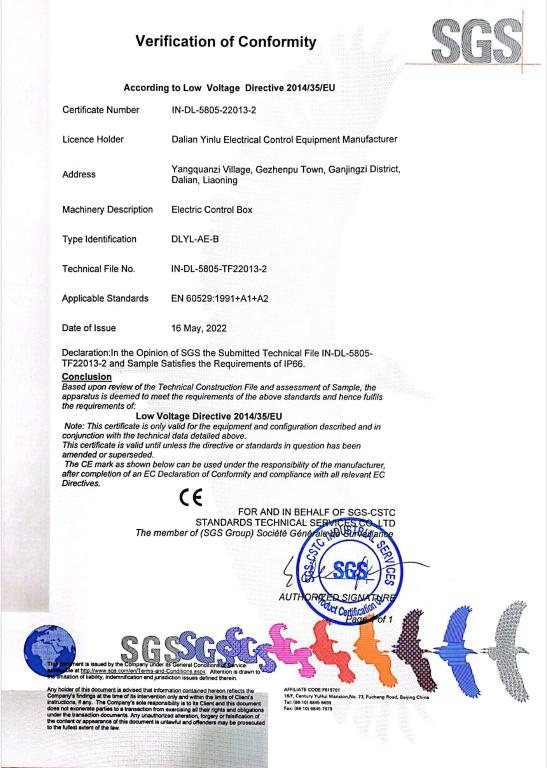
A second verification covers an electric control box designation against the same ingress protection standard — an example of how enclosure evidence is usually issued per product designation rather than per catalogue.
Two boundaries deserve to be stated plainly rather than assumed away. First, a verification of conformity covers a defined product designation, not every derivative of it, so a buyer ordering a modified configuration should confirm whether the certificate scope still describes the item being purchased. Second, a certificate supports market access and procurement confidence; it does not replace site-specific engineering, because the environment still has to be matched to a rating before the paperwork becomes relevant.
Three rated enclosures mapped to three environments
| Enclosure | Stated rating | Construction and sealing | Environment it is designed for |
|---|---|---|---|
| Gym Smart Equipment Control Box | IP54 | 2.0 mm cold-rolled steel, phosphating plus electrostatic powder coating, single door with plane or password lock, EPDM door seal, internal heat dissipation louver, wall-mounted | Indoor gym floors and fitness facilities: dust, sweat and splash exposure, controlled climate, no driving rain |
| Custom Wall-mounted Electrical Control Box / Local Operation Box | IP65 | 2.0 mm cold-rolled steel, brushed finish, double door with stainless steel handle lock, EPDM seal, door-to-body grounding bonding, stainless steel waterproof cable glands, UV and acid-rain resistant | Exposed external walls and semi-sheltered outdoor positions; -20°C to +60°C ambient, extendable to -40°C to +80°C in 316 grade |
| Airport Ground Power Control Cabinet / Aviation Maintenance Distribution Box | IP55 | 3.0 mm steel, phosphating plus powder coating, compartmented power/control/maintenance layout, waterproof cable glands, resistance to aviation fuel, hydraulic oil and salt spray, 304 stainless option for coastal airports | Airport aprons, hangars and maintenance stations; -20°C to +60°C, up to 4,000 m altitude, vibration from aircraft and ground vehicles |
The pattern is consistent: IP54 answers an indoor dust-and-splash problem, IP65 answers an outdoor jet-and-weather problem, and IP55 on the airport cabinet answers a jet problem combined with fuels, oils and heavy mechanical handling. The rating is the headline; the material, gasket, door architecture and cable entry are the substance.
What sits behind the rating: electrical protection and safety standards
An IP rating protects equipment from the outside world. It does not, by itself, protect people from the equipment inside. That layer belongs to the protective devices and to the assembly standards the cabinet is built around.
The Gym Smart Equipment Control Box illustrates the practical combination. It operates at AC 220V with rated currents of 16A, 32A or 63A depending on the total power of the connected gym equipment, and it carries built-in overload protection, short-circuit protection and leakage protection, with optional over-voltage and under-voltage protection to reduce equipment damage. Internally it accommodates DIN rails, terminal blocks, a grounding bar and MCB or RCD modules, alongside relays, PLC units and smart control modules. Reliable cabinet grounding is specified at a grounding resistance of 4Ω or lower, and cable entry is arranged so that strong current and weak current wiring can be routed separately.
Those functions sit inside a wider standards framework. IEC 61439-1:2020 is the primary international standard for low-voltage switchgear and controlgear assemblies, and it defines general definitions, construction requirements and verification methods for assemblies of this type. Enclosure specifications in the market still frequently cite the earlier IEC 60439 numbering; the low-voltage switchgear and power distribution cabinet in this range, for example, lists overload, short-circuit and leakage protection and references IEC 60439, while its protective functions include optional RCD or RCBO devices. Where industrial socket outlets are integrated — as in the industrial socket box and the airport cabinet — the sockets follow IEC 60309 industrial plug and socket practice, with 16A, 32A and 63A configurations and colour-coded voltage levels.
For the European market, EU Low Voltage Directive 2014/35/EU supplies the access framework that the SGS verification references. Read together, these documents explain why a compliant enclosure is an assembly question, not only a sheet metal question: the steel, the gasket, the grounding, the breaker selection and the test record all contribute to the final claim.
Where an IP rating stops being the answer
A compliance guide is only useful if it is honest about boundaries. An IP rating does not cover the following, and each item has to be specified separately:
- Corrosion. Salt spray, acids and chemical exposure are addressed through material grade and surface treatment. The range uses 304 stainless steel as the standard corrosion option and 316 or 316L stainless steel where salt spray, seawater or chemical attack is expected, with 316 grades extending the ambient range on several models.
- Heat. Sealing and cooling pull in opposite directions. Louvers, filtered axial fans, heat exchangers and industrial air conditioners are all offered across the range precisely because a tightly sealed cabinet has fewer paths to remove internal heat — and each cooling option has to be reconciled with the IP target.
- Condensation. Ratings are generally stated at relative humidity levels up to 95% in non-condensing conditions. Where condensation is expected, heaters or dehumidifiers are added, as specified for stainless steel cabinets and VFD control cabinets.
- Impact. Mechanical impact resistance is classified under a separate code, so a high IP number says nothing about resistance to a dropped tool or a forklift strike.
- Electromagnetic behaviour. A VFD control cabinet in this range is specified for electromagnetic shielding performance and resistance to industrial interference, which is an EMC property, not an ingress property.
- Immersion. Ratings up to IP67 address temporary immersion; continuous submersion requires a higher water classification than any rating quoted for the three examples above.
There is also a commercial boundary. Documented verification, sealing checks and per-configuration testing add steps to a production schedule. Lead time on custom enclosure orders is quoted per project rather than published as a fixed figure, which reflects how much of the schedule depends on configuration, tooling and test scope.
Application fit across industries
The same rating logic scales across applications. Indoor fitness installations use the IP54 gym control box to manage treadmill, elliptical and strength equipment power alongside lighting scenes, access control linkage and smart fitness system integration. Exposed outdoor wall positions use the IP65 wall-mounted box. Airport aprons and hangars use the IP55 ground power cabinet, which also supports aviation-specific sockets at 28V DC and 115V 400Hz alongside IEC 60309 industrial sockets, with equipotential terminals to keep aircraft and ground at consistent potential.
Elsewhere in the range, coastal and chemical projects typically move to 316 stainless steel, heavy port environments use a 316L cabinet rated IP55 with salt spray resistance and a service life of 15 years or more, and cold-climate North American deployments use a polyurethane-insulated cabinet rated IP65 for -40°C to +60°C. The underlying enclosure family is regularly deployed on infrastructure programmes: PACRAFT in Japan received 1,000 stainless steel non-standard enclosures with customizable protection from IP55 to IP67; GWM in China took 200 multi-function test boxes for on-board electronics; Panasonic in Japan took 100 units of household automatic food machinery; Siemens OEM consoles in Germany took 100 mobile industrial control and equipment mounting bases; ABB in Switzerland took 200 enclosures for PGC5000 series gas chromatographs, specified at IP65 in RAL7035; and CRRC and DHHI projects have used control panels and enclosures at IP55 and above, including rail transit and heavy industrial applications with protection up to IP67.
Market trend: compliance is becoming a specification input
Published market estimates for control panels diverge sharply because they describe different scopes. Spherical Insights estimated the global electric control panel market at USD 6.35 billion in 2024, while Dataintelo projected the electrical control panels market at USD 27.2 billion in 2025 growing to USD 47.0 billion by 2034, and WiseGuyReports placed the 2024 figure at USD 19.8 billion. For a buyer, the practical reading is that the number is a scope statement first and a size statement second.
Two narrower data points are more directly relevant to enclosure specification. Low tension (LT) panels held the largest share of the electrical control panel segment at 45.3% as of 2025 according to Dataintelo, which keeps low-voltage assembly standards such as IEC 61439-1:2020 in the foreground of product design. Asia Pacific accounted for 38.5% of global electrical control panel revenue in 2025, which aligns with the concentration of sheet metal and enclosure manufacturing capacity in the region.
On the demand side, the PLC market was valued at USD 12.95 billion in 2023 and projected to reach USD 22.61 billion by 2032 by SNS Insider. Maximize Market Research estimated that approximately 70% of manufacturers are now applying IoT automation, which drives PLC integration with real-time data analytics — a shift that increases signal cabling, thermal load and documentation expectations inside the very enclosures discussed here. The global supply landscape remains led by large electrical manufacturers including Schneider Electric, ABB, Siemens, Eaton and Rittal, according to Precedence Research, alongside a broad tier of specialist enclosure and custom control panel manufacturers serving regional and project demand.
Traditional practice versus documented compliance
Traditional enclosure sourcing often treats the IP rating as a marketing attribute: the number appears on a quotation, the unit is judged visually on arrival, and the assumption is that a gasketed door is a sealed door. A documented compliance approach replaces that assumption with a chain of evidence — a stated standard, a defined sealing architecture, verified third-party conformity evidence, a defined production inspection sequence covering visual, wiring, function, safety, sealing and packaging, and a defined acceptance criterion such as a power-on test.
The documented route is not free. Third-party verification is issued against specific product designations, so heavily customized derivatives may fall outside the original certificate scope and require additional assessment. Documented sealing and function checks also take time in production, which is why custom enclosure lead times are quoted per project rather than published. Buyers should weigh that cost against the cost of an unplanned failure in a gym, on an apron or on a port crane.
A procurement checklist for IP-rated enclosures
| Decision point | What to confirm |
|---|---|
| Environment | Splash, jets, powerful jets or immersion; indoor versus exposed outdoor position |
| Material grade | Cold-rolled steel with phosphating and powder coating, or 304 / 316 / 316L stainless steel where corrosion is a factor |
| Sealing hardware | EPDM door seal, single or double door, lock type, door-to-body grounding bonding |
| Cable entry | Waterproof cable glands, knockout positions, separate routing for strong and weak current |
| Thermal path | Louver, axial fan with filter, heat exchanger or industrial air conditioner, reconciled with the IP target |
| Climate limits | Ambient temperature range, relative humidity, altitude, condensation management |
| Electrical protection | Overload, short-circuit and leakage protection, optional RCD or RCBO, grounding resistance of 4Ω or lower |
| Evidence | Certificate numbers, standard references, and whether the certificate scope matches the ordered configuration |
| Commercial terms | MOQ from 1 unit, with capability data listing 1 to 5 units depending on configuration; delivery terms FOB, CIF, EXW, DAP, CFR or DDP; acceptance by power-on test; payment by TT, PayPal, LC or Visa; monthly capacity of 2,000 units; 7x24 online after-sales support and a one-year warranty |
Future outlook
Enclosure specifications are moving toward bundled requirements. A buyer in 2026 is less likely to ask for an IP number in isolation and more likely to ask for an ingress rating combined with a material grade, a thermal strategy, a grounding value, a signal-cable path and a documented verification trail. The growth of PLC-based control and real-time data integration supports that direction, because more intelligence inside a cabinet means more cabling, more heat and more documentation.
Standards will keep acting as the common language. IEC 61439-1:2020 provides the assembly framework for low-voltage switchgear and controlgear, EN 60529 provides the ingress vocabulary, and EU Low Voltage Directive 2014/35/EU provides the European access route. For manufacturers, the competitive edge will sit less in the headline rating and more in the ability to reproduce a stated rating across custom configurations, in documented test sequences, and in evidence files that a procurement team can actually read.
FAQ
What does an IP rating actually certify on an electrical enclosure?
An IP rating classifies an assembled enclosure against the ingress of solid objects and water, as defined in IEC 60529 and applied in the European market through EN 60529:1991+A1+A2. The first digit addresses solids, including dust, and the second addresses water. The rating does not cover corrosion resistance, heat removal, impact resistance or the electrical protective devices installed inside the cabinet, all of which are specified and verified separately.
Is IP54 sufficient for a gym control box, or should a fitness facility specify IP65?
The decision follows the environment rather than a preference for a higher number. The Gym Smart Equipment Control Box is rated IP54, which covers dust protection and water splashing from any direction, and it is intended for indoor gym equipment power control, lighting scene control and access control linkage in non-condensing conditions up to 95% relative humidity. Where an enclosure is mounted on an exposed outdoor wall and must tolerate water jets, UV, ageing and acid rain, an IP65 configuration such as the Custom Wall-mounted Electrical Control Box is the more appropriate starting point.
What electrical protections accompany an IP-rated gym control box?
The Gym Smart Equipment Control Box operates at AC 220V with rated currents of 16A, 32A or 63A depending on total gym equipment power. It includes built-in overload protection, short-circuit protection and leakage protection, with optional over-voltage and under-voltage protection. Internally it accepts DIN rails, terminal blocks, a grounding bar and MCB or RCD modules, and it requires reliable cabinet grounding at a resistance of 4Ω or lower. Optional functions include timer switching, WiFi or 4G remote control, equipment linkage and energy consumption monitoring.
Does a higher IP rating always mean a better enclosure?
No. A higher ingress rating generally means tighter sealing, which makes heat removal harder and can increase reliance on filtered fans, heat exchangers or industrial air conditioners. Ratings also say nothing about corrosion, impact or electromagnetic performance. A practical specification balances the ingress rating against material grade, thermal path, climate limits and the electrical protection required by the application.
How can a buyer verify that a claimed IP rating is genuine?
Buyers can ask for the standard reference, the certificate number and the scope of the certificate. Dalian Yinlu holds two SGS-CSTC Verifications of Conformity assessed against EN 60529:1991+A1+A2 — IN-DL-5805-22013-1 for an electric control cabinet and IN-DL-5805-22013-2 for an electric control box — and ISO 9001:2015 certification number 19923Q01395R0M covering production of metal shells for electronic control equipment and instruments. The production inspection sequence covers visual inspection, wiring, function, safety, sealing and packaging. Buyers should also confirm whether the certificate designation matches the exact configuration being ordered.
Can IP rating and enclosure configuration be customized for a specific project?
Yes. The manufacturer operates on an OEM and ODM basis, and customization covers material, colour, logo, size, IP rating, surface treatment, cutouts and mounting. Custom size ranges and compartment layouts are supported on project-specific models, and protection options across the range extend from IP44 to IP67 depending on configuration. MOQ is quoted from 1 unit, with capability data listing 1 to 5 units depending on configuration, and monthly capacity is 2,000 units.
Reference material
Buyers who need the full specification set behind the enclosure configurations discussed in this article, including material options, cutout details and protection ratings, can consult the manufacturer's product brochure: Dalian Yinlu product brochure (PDF).