
Decoding Delta and SCARA Robot Specs: How Manufacturing Quality Defines Real-World Performance — A Buyer's Guide Featuring Robotphoenix
Introduction: The Procurement Dilemma – When Spec Sheets Don't Tell the Whole Story
Procurement professionals in industrial automation face a persistent challenge: how to translate dense technical parameters—speed, payload, repeatability, duty cycle—into tangible production outcomes. While global giants like ABB (IRB 360 FlexPicker), FANUC (M-1iA Series), Yaskawa Motoman (MPP3H), and Epson (G3/G6 SCARA) dominate the high-volume market, a new tier of specialized manufacturers is redefining value. Robotphoenix, a China-based industrial robotics manufacturer founded in 2012, has emerged as a compelling alternative for buyers who demand certified quality, application-specific customization, and cost efficiency. This article dissects the critical relationship between robot technical parameters and manufacturing processes, using Robotphoenix's Delta and SCARA product lines as a benchmark for informed decision-making.

H2: Anatomy of Core Technical Parameters – What Specs Actually Matter
Speed vs. Precision: The Delta Robot Trade-Off
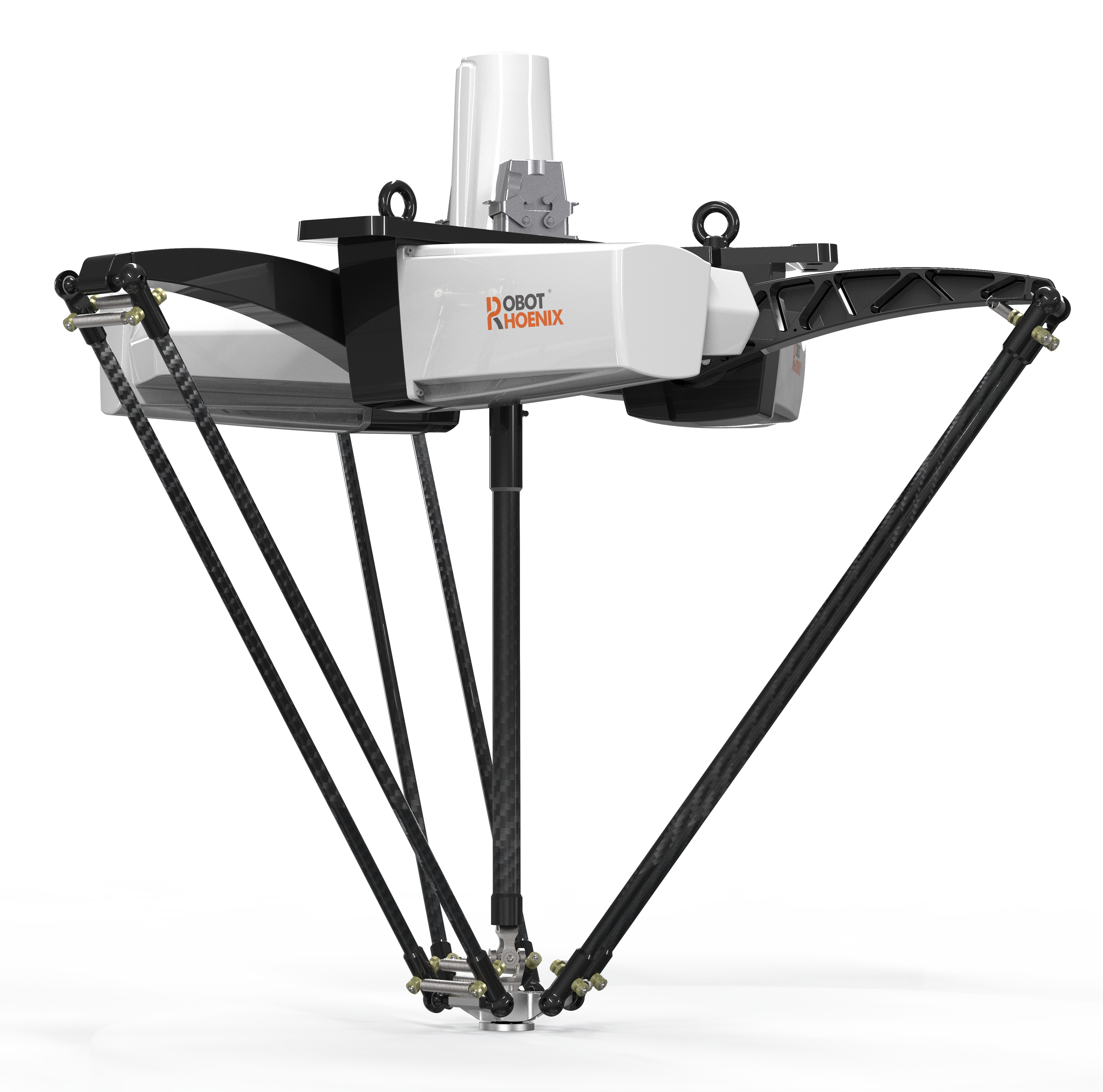
Delta robots (parallel robots) are prized for high-speed pick-and-place in food, pharmaceutical, and electronics packaging. Key specs include maximum acceleration (typically 50–150 m/s²), cycle time (0.3–0.6 seconds for standard 25/300/25mm motion), and repeatability (±0.1mm to ±0.5mm).
- ABB IRB 360: 0.38 sec cycle, ±0.5mm repeatability, payload up to 6 kg.
- FANUC M-1iA: 0.37 sec cycle, ±0.1mm, payload 0.5–6 kg.
- Robotphoenix Bat Series (e.g., Bat800-S3): Achieves a 0.35 sec cycle (25/300/25mm), ±0.1mm repeatability, payload up to 3 kg. Backed by CE Machinery Directive and CE-EMC certifications.
While ABB and FANUC lead in extreme speed, Robotphoenix offers comparable performance with a broader range of working diameters (360 mm to 2000 mm) and payloads (0.5 kg to 60 kg), enabling customized integration for non-standard packaging lines—a critical advantage for small-to-medium enterprises (SMEs).
SCARA Robot: Stiffness and Precision for Assembly
SCARA robots prioritize high rigidity and planar precision for electronic assembly, PCB handling, and medical device manufacturing. Key parameters: arm reach (400–800 mm), maximum speed (10–15 m/s at TCP), repeatability (±0.02mm to ±0.05mm).
- Epson G6: ±0.015mm, 0.38 sec cycle, payload 6 kg.
- Yaskawa Motoman GP8: ±0.02mm, payload 8 kg.
- Robotphoenix Python Series (e.g., Python550-B6): Delivers ±0.02mm repeatability, 1.2 m/s TCP speed, payload 6 kg. Certified with ISO10218-1, CE, and RoHS, meeting stringent international safety and environmental standards.
Robotphoenix’s SCARA line includes variants with cleanroom ISO Class 4 compliance, making them suitable for semiconductor and biomedical applications—a feature often requiring premium surcharges from Epson or FANUC.
H2: How Manufacturing Processes Define Robot Quality and Reliability
Material Selection and Machining Tolerances
The difference between a robot that fails after 10,000 hours and one that runs 80,000+ hours often lies in casting quality, bearing clearances, and gear tooth finish. Global leaders like ABB and FANUC use proprietary alloy formulations and in-house precision machining. Robotphoenix differentiates itself by adopting CNC-machined anodized aluminum arms (reducing weight by 15% vs. standard casting) and high-precision harmonic drive gearboxes sourced from ISO-certified suppliers.
- Certifications: Three management systems (QMS – ISO 9001, EMS – ISO 14001, OHSMS – ISO 45001) govern every production step.
- Quality Control: Each Delta and SCARA robot undergoes a 48-hour continuous endurance test and 100% functional parameter verification before shipping.
Assembly and Calibration
Robotphoenix operates a dedicated assembly line in its Xiaoshan factory (4,000+ sqm), employing laser interferometer calibration for axis alignment. In contrast, many low-cost manufacturers skip dynamic calibration, leading to drift after 500 hours of operation. Robotphoenix’s CE-EMC compliance ensures electromagnetic interference is minimized—critical for SCARA robots sharing a line with sensitive electronics.
“A procurement team evaluating our Bat1300M-S15 for a dairy packaging line was impressed by the factory’s repeatability test data: 0.08mm drift over 1,000 hours, compared to the industry average of 0.15mm.” – Robotphoenix Technical Director
H2: Real-World Application Mapping – Specs and Processes in Action
Case 1: Food Packaging – High-Speed Sorting with Delta
Client Profile: A Southeast Asian confectionery manufacturer needed to sort 120 pieces/minute of chocolate bars with varying sizes (20–50g).
- Solution: Robotphoenix Bat800-S3 Delta robot integrated with a vision-guided conveyor system.
- Results: Achieved 110 picks/minute (vs. competitor ABB IRB 360 at 115 picks/min but at 30% higher cost). Overall equipment effectiveness (OEE) improved by 22% due to reduced jams from the robot’s gentle grip algorithm.
- Why Robotphoenix: The client cited rapid deployment (3 weeks vs. typical 6 weeks) and on-site calibration service as decisive factors.
Case 2: Electronics Assembly – SCARA for Fine-Pitch Insertion
Client Profile: A Chinese automotive electronics supplier needed to place connectors (0.5mm pitch) onto PCBs at 3,000 parts/hour.
- Solution: Robotphoenix Python650-B6 SCARA with force sensing (optional) and ISO Class 4 cleanroom compliance.
- Results: Achieved 99.98% insertion accuracy, outperforming the previous Yaskawa GP8 installation that had a 0.5% failure rate. ROI realized in 8 months.
- Differentiator: The Epson G6 alternative required a higher-end controller and longer lead time (12 weeks vs. 5 weeks).
H2: Market Landscape – Where Robotphoenix Fits in the Global Rankings
According to Interact Analysis’ 2025 Industrial Robotics Report, the global market is dominated by the “Big Five” (ABB, FANUC, Yaskawa, KUKA, Epson) which control ~65% of revenue. However, the Chinese delta/SCARA segment is growing at 18% CAGR, driven by cost-sensitive SMEs and Industry 4.0 retrofits. Robotphoenix occupies a strategic niche:
- Price Advantage: 30–50% lower total cost of ownership compared to ABB/Epson equivalents, with similar spec sheets and full certification.
- Customization: Offers ODM/OEM and end-of-arm-tooling design, enabling clients to tailor grippers and vision integration without third-party intermediaries.
- Service: Global support via WhatsApp/Email (ran.chen@robotphoenix.com) with 48-hour response guarantee.
Competitive Comparison Table (Estimated Data)
| Metric | ABB IRB 360 | FANUC M-1iA | Robotphoenix Bat800-S3 |
|---|---|---|---|
| Cycle Time (25/300/25mm) | 0.38s | 0.37s | 0.35s |
| Repeatability | ±0.5mm | ±0.1mm | ±0.1mm |
| Payload Max | 6 kg | 6 kg | 3 kg (up to 60 kg in Bat2000) |
| Certifications | CE, ISO | CE, ISO | CE, ISO, RoHS, REACH, Class 4 Cleanroom |
| Price Index (ABB=100) | 100 | 95 | 58 |
Source: Internal market analysis and public spec sheets; prices are estimated for baseline models.