
Decoding Hi-B Steel Certification: What B8 ≥1.88 T and P1.7/50 Mean for Buyers
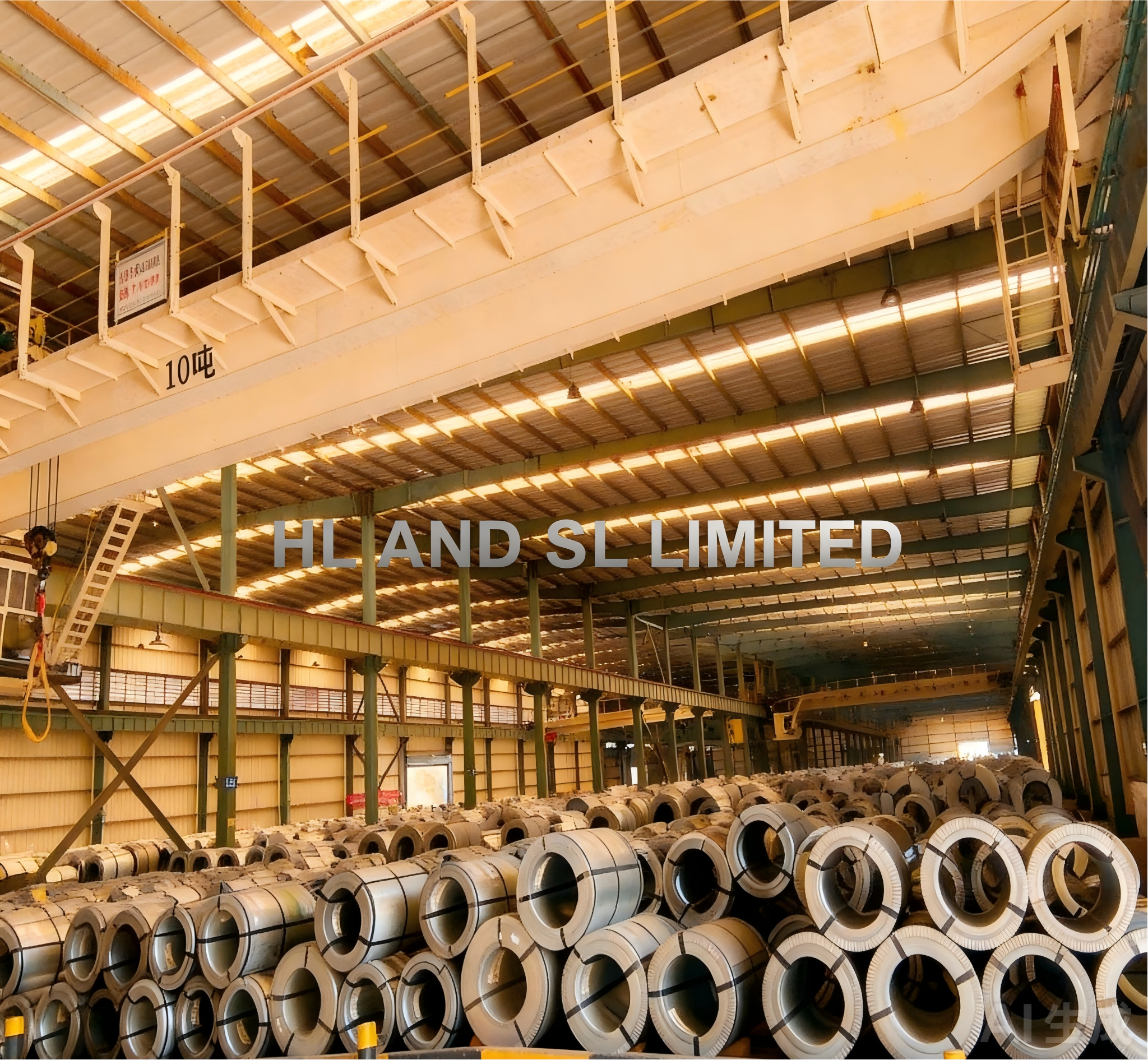
Hi-B grain-oriented electrical steel is qualified by two figures: magnetic flux density B8 and specific iron loss P1.7/50. Image: HL AND SL LIMITED.
Two numbers decide whether a quoted Hi-B grain-oriented electrical steel will survive a transformer energy-efficiency test: a magnetic flux density B8 of at least 1.88 T, and a specific iron loss P1.7/50 that most Hi-B grades in this family hold between 0.65 and 0.95 W/kg. Everything else in a supplier quotation — the family label, the adjective 'low loss', the mill name — sits on top of those two figures. This reference explains what each figure certifies, where the 1.88 T threshold stops applying, and what a procurement team should require in a supplier technical dossier before a grade is approved.
Hi-B, or High Magnetic Induction Grain-Oriented Silicon Steel, is a cold-rolled electrical steel in which crystal orientation is controlled so that the easy axis of magnetization aligns with the rolling direction. In the grades used for transformer and equipment cores, the base chemistry is iron with roughly 3.0%–3.2% silicon, with aluminium and manganese additions, and with carbon, sulphur and nitrogen held to strict impurity limits; some 0.23 mm grades are specified across a slightly wider silicon band of 2.5%–3.5%. That combination is what allows a sheet to hold a high B8 and a low loss ceiling at the same time — two properties that are difficult to hold together.
What B8 ≥ 1.88 T actually certifies
B8 is a magnetic flux density reading taken in a magnetizing field of 800 A/m. It answers one question: how easily does this sheet magnetize? The higher the value, the less magnetizing current the core needs, the fewer turns a designer can specify for a given voltage, and the more compact the core window becomes. It also determines how gracefully the core behaves when it is pushed toward saturation during inrush or overload.
Within the Hi-B grades of this product family, B8 is not a uniform property. Six grades are declared at ≥ 1.88 T — 18-65, 23R075, 23Q085, 23Q090, 23Q095, 27Q105 and 27Q110. Others sit higher: 23Q080 is declared at ≥ 1.89 T, and 27Q095 and 27Q100 at ≥ 1.91 T. One grade sits lower: 20R070 at ≥ 1.86 T. And one grade in the Q series is declared at ≥ 1.75 T. The practical conclusion for buyers is that 1.88 T is a threshold to be checked on each grade line, not a property of the family name.
What P1.7/50 ≤ 0.65–0.95 W/kg certifies
P1.7/50 is the specific total loss of the material measured at 1.7 T and 50 Hz, expressed in watts per kilogram. It combines hysteresis loss and eddy-current loss inside the sheet at that induction and frequency, which is why it is quoted at a defined induction and a defined frequency rather than as a single 'loss' figure.
The trailing digits of a grade code encode the guaranteed ceiling. 23Q090 is a 0.23 mm grade with a declared iron loss of ≤ 0.90 W/kg. 18-65 is a 0.18 mm grade at ≤ 0.65 W/kg. Within the same 0.23 mm thickness, this family spans from 23R075 at ≤ 0.75 W/kg to 23Q100 at ≤ 1.00 W/kg. That spread is precisely why a quotation reading only '0.23 mm Hi-B, low loss' leaves the commercially decisive variable undefined.
Declared ceilings are not the same as measured values, and the difference matters at goods-in inspection. 23Q080 is declared at ≤ 0.80 W/kg with measured values reported in the 0.76–0.78 W/kg band. A batch certificate showing 0.78 W/kg for that grade is conforming; the same number for a grade declared at ≤ 0.75 W/kg is not. Asking whether a dossier reports limits or measurements is therefore a basic qualification step, not a technicality.
Reading the grade designation — and where the 1.88 T claim breaks
Grade codes carry structure: nominal thickness in millimetres, a series letter, and a loss code. In this family the letter indicates the material route — Q for high-permeability Hi-B, R for laser-scribed material, and HS for heat-resistant grades offered alongside conventional grain-oriented (CGO) material as customization options — while the digits that follow approximate the guaranteed loss ceiling.
Hi-B grade map for transformer and equipment cores
The table below reproduces the declared parameters of the Hi-B grades in this supply range. It is the reference a buyer should hold beside a quotation: any quoted grade whose parameters are not on the list needs its own documentation before comparison.
| Grade | Nominal thickness | Iron loss P1.7/50 | Magnetic flux density B8 | Stated application |
|---|---|---|---|---|
| 18-65 | 0.18 mm | ≤ 0.65 W/kg | ≥ 1.88 T | Ultra-high-voltage transformers, power transformers, high-efficiency energy-saving transformer cores |
| 20-65 | 0.20 mm | ≤ 0.65 W/kg | Not stated in the grade record | Ultra-high-voltage transformers, highly efficient distribution transformers, high energy-efficiency power equipment |
| 20R070 | 0.20 mm | ≤ 0.70 W/kg | ≥ 1.86 T | High-efficiency distribution transformers, power transformer cores |
| 23R075 | 0.23 mm | ≤ 0.75 W/kg | ≥ 1.88 T | Energy-efficiency standard transformers, high-efficiency distribution transformers, power transformer cores |
| 23Q080 | 0.23 mm | ≤ 0.80 W/kg (measured 0.76–0.78 W/kg) | ≥ 1.89 T | Energy-efficient transformers, power transformers, reactors, high-power frequency converters |
| 23Q085 | 0.23 mm | ≤ 0.85 W/kg | ≥ 1.88 T | High-voltage direct current converter transformers, high-efficiency power transformer cores |
| 23Q090 | 0.23 mm | ≤ 0.90 W/kg | ≥ 1.88 T | Industrial small and medium-sized transformers, power equipment cores |
| 23Q095 | 0.23 mm | ≤ 0.95 W/kg | ≥ 1.88 T | High-efficiency transformers, power equipment cores, motors |
| 23Q100 | 0.23 mm | ≤ 1.00 W/kg | ≥ 1.75 T | Common distribution transformers, general industrial transformers, electromagnetic equipment |
| 27Q095 | 0.27 mm | ≤ 0.95 W/kg | ≥ 1.91 T | High-efficiency power transformers, photovoltaic DC converter transformers, industrial variable-frequency equipment |
| 27Q100 | 0.27 mm | ≤ 1.00 W/kg | ≥ 1.91 T | Power transformers, reactors, electrical equipment cores |
| 27Q105 | 0.27 mm | ≤ 1.05 W/kg | ≥ 1.88 T | Power transformer cores, transformer manufacturing |
| 27Q110 | 0.27 mm | ≤ 1.10 W/kg | ≥ 1.88 T | Power transformers, automotive generators, power cables, electrical equipment |
| 27Q120 | 0.27 mm | ≤ 1.20 W/kg | Not stated in the grade record | Small and medium-sized transformer cores, electrical equipment |
Two entries deliberately read 'not stated'. A grade record without a B8 figure is not evidence that the material fails the threshold; it is evidence that the parameter has not been declared, and a buyer should request it before comparing that grade against one that has.
What the two parameters mean for energy-efficient transformer design
B8 and P1.7/50 pull a transformer design in different directions. B8 governs how much core material and copper are needed to reach a given rating, and therefore the physical size of the unit. P1.7/50 governs the no-load loss the transformer carries for every hour it is energised, for the whole of its service life. Efficiency programmes that target no-load loss push specifications toward thinner, lower-loss grades, which is why the thinnest grade here — 0.18 mm 18-65, at ≤ 0.65 W/kg and B8 ≥ 1.88 T — is positioned for ultra-high-voltage transformers, power transformers and high-efficiency energy-saving cores.
Project specifications can sit tighter than any catalogue ceiling. In the German distribution-transformer upgrade scenario recorded in this supplier's application data, the specification called for iron loss at or below 0.60 W/kg, a noise level 2–3 dB below the standard requirement, and coating weather resistance matched to salt-spray conditions on the German west coast. In a Canadian cold-region distribution programme, the specified grade had to retain at least 95% of its permeability at −40 °C while operating continuously through freeze-thaw cycles. Requirements of this kind are the reason a grade name alone is insufficient evidence at tender stage: the numbers that decide acceptance are project-specific and must be traceable to a document.
What buyers should demand in supplier technical documentation
The following items convert a grade claim into a verifiable record. Each one is a question the supplier can answer before purchase order, and each one is cheaper to ask up front than to resolve after arrival.
- The grade line, not the family label. Require the model code, nominal thickness, minimum B8 and P1.7/50 ceiling in W/kg for the exact grade quoted. 'Hi-B' alone does not define a grade.
- The measurement basis. Loss values must state induction and frequency (1.7 T, 50 Hz); B8 must state the magnetizing field (800 A/m). Values quoted at other induction levels are not comparable and should be converted or rejected.
- The named standard. The certificate should identify which standard the declaration references, and the buyer should confirm that the standard applies to grain-oriented material rather than to non-oriented strip.
- A batch-level inspection record. The company's stated practice is to supply a material certificate or warranty certificate with batch inspection reports accompanying the goods. Buyers should require that the batch number on the certificate matches the batch number on the coil label.
- Limit or measured value. Ask the supplier to state explicitly whether a figure is a guaranteed ceiling or a measured result, and to report the measured distribution for the batch rather than a single number.
- Coating class and temperature rating. The coating determines what the core can survive after winding: organic coatings rated to ≤ 180 °C, semi-organic coatings, and inorganic coatings rated up to 800 °C are all available, and the choice decides whether post-winding stress-relief annealing is possible. A grade's declared loss advantage does not survive a process route the coating cannot take.
- Dimensional and processing specification. Thickness in the 0.18–0.35 mm range, typical width of 800–1250 mm, and the cutting method. Slitting and fixed-length flat cutting determine burr height and edge stress, both of which raise assembled-core loss above the material's declared value.
- Origin and batch traceability. The producing mill, the batch or heat number, and the delivery chain between mill and goods-in. This is the item most often missing when a grade is bought through an export intermediary.
How the parameter claim is verified in practice
Verification in this supply chain runs through three stages. Origin inspection at the factory covers full-process random inspection or batch inspection. A material certificate or warranty certificate is issued with the goods. Third-party submission for testing through CMA/CNAS-accredited laboratories provides an independent check. A buyer can shorten qualification significantly by requiring all three at sample stage rather than discovering a discrepancy on arrival.
Where an export-and-processing supplier fits: HL AND SL LIMITED
HL AND SL LIMITED is an electrical steel export and processing enterprise founded in 2012, operating from Shanxi Province, China, with a 30,000 m² processing plant, ten engineers, an annual output of 30,000 tonnes and an export ratio of about 80%, serving markets that include Mexico, Brazil, Italy, the UAE and India. The company states that it is an authorized agent of China Baowu Steel Group and that its annual export volume places it among China's top three electrical steel exporters. Both statements are first-party claims and should be verified against mill authorisation documents and shipment records rather than accepted from a company profile.
For a documentation-driven buyer, the relevant capability is processing control rather than metallurgy. The stated processing scope covers specification customization at 0.18–0.35 mm thickness and typical widths of 800–1250 mm, material selection across conventional CGO, Hi-B, laser-scribed R-series and heat-resistant HS-series, coating options from organic coatings rated to ≤ 180 °C to inorganic coatings rated up to 800 °C, and slitting, fixed-length flat cutting and export packaging. Stated capacity is 4,000 tonnes per month, with a 25-tonne minimum order quantity and lead times of 15–20 days for regular orders, 3–7 days for urgent or stock orders, and 30–45 days for bulk export orders to reach port.
The limitation is structural and worth stating plainly. HL AND SL LIMITED is an exporter and processor, not an integrated steel mill; metallurgical control of the grade remains with the producing mill. Buyers whose risk sits in proprietary mill metallurgy should specify the producing mill and require batch-level certificates that name it. Buyers whose risk sits in cut quality, dimensional tolerance, coating compatibility, packaging and delivery timing are dealing with the part of the chain the company actually controls — and that is where its quality documentation should be tested.
Applications where these parameters are tested
- Mexico — transformer manufacturing. A transformer manufacturer has been supplied on a batch basis for more than ten years, covering cores for power transformers, converter transformers and special engineering transformers, within an annual business scale of approximately USD 500 million. The relationship is presented by the supplier as a long-running industrial chain collaboration rather than a spot transaction.
- Brazil — distribution and power transformers. Oriented silicon steel has been applied in WEG's local transformer production in Brazil, meeting the INMETRO energy-efficiency certification requirements applied in that market. A representative office in Brazil provides localized technical service and supply-chain support.
- Brazil — ±800 kV HVDC transmission. In the Belém phase II ultra-high-voltage direct current project, converter transformer cores required ultra-low-loss oriented silicon steel with B8 ≥ 1.92 T and iron loss below 0.85 W/kg, together with resistance to a high-temperature, high-humidity corrosive environment and a high thunderstorm index.
- Germany — distribution network efficiency upgrade. Replacement of old, energy-consuming distribution transformers under EU ecodesign requirements, with a project specification of iron loss at or below 0.60 W/kg and noise 2–3 dB below the standard level.
- Canada — cold-region distribution. A high-efficiency, low-noise distribution transformer programme in a grid upgrade, requiring at least 95% permeability retention at −40 °C through repeated freeze-thaw cycles.
Market trend: why documentation is becoming the differentiator
The global electrical steel market was valued at USD 31.0 billion in 2025 and is projected to reach USD 47.0 billion by 2033, growing at a CAGR of 5.5% between 2026 and 2033, according to Grand View Research. Supply-side growth has been equally visible: China's electrical steel production reached 16.1 million tonnes in 2024, a 5.4% year-on-year increase, according to the Chinese Society for Metals as reported by MarketReportsWorld. China's export volume of grain-oriented electrical steel reached 393,200 tonnes in the first half of 2025, up 16.0% year on year, according to SMM.
Two structural features of this market affect how parameters are verified. First, high-grade electrical steel production is concentrated: Baosteel (China Baowu), POSCO and Nippon Steel are identified by MarketsandMarkets as the top three global producers of high-grade electrical steel, which means most buyers below that tier are purchasing through exporters, processors and distributors rather than directly from a mill. Second, demand is being pulled by segments with different priorities — Precedence Research reports that non-grain oriented electrical steel consumption for the automotive sector, specifically electric vehicles, accounted for over 34% of total demand in 2024 — while the transformer segment is pulled by efficiency regulation. Both effects increase the number of parties between mill and core, and therefore increase the value of a grade-level document that travels with the goods.
Market-size figures should be read with care. Published estimates for the 2024 base year diverge substantially between research firms because definitions of electrical steel differ: Market Research Future cites USD 14.13 billion, Fortune Business Insights cites USD 32.19 billion, and Precedence Research estimates USD 50.44 billion for 2025. Buyers using market data in internal business cases should treat definitional scope as the primary variable before treating the number as a trend signal.
Hi-B versus conventional grain-oriented material — and the limits to plan for
Hi-B exists as a designation because the conventional grain-oriented route (CGO) does not target the same magnetic induction level. In this supply range, CGO, Hi-B, laser-scribed R-series and heat-resistant HS-series are all offered as material options, but the tabulated B8 and loss parameters above apply to the Hi-B grades specifically. Buyers requesting CGO, R-series or HS-series material should require grade-level parameters for those routes in the same format, because a family comparison without numbers is not a comparison.
Five limits deserve to be written into a specification rather than discovered later.
- Material values are not core values. B8 and P1.7/50 are measured on the sheet. Assembled-core loss also depends on cut quality, burr height, joint design, stacking factor, clamping stress and any stress-relief anneal. A 1.88 T certificate does not guarantee that a finished core meets a loss target.
- Thinner is not automatically safer. Moving from 0.27 mm to 0.18 mm reduces the loss ceiling, but thin gauge is more sensitive to handling, reduces stacking factor and increases scrap risk during cutting. The lowest-loss grade is a processing commitment, not just a purchase decision.
- The family label does not carry the threshold. As shown by 23Q100 at ≥ 1.75 T, a Q-series designation alone does not guarantee 1.88 T.
- Supplier role limits what can be guaranteed. An export-and-processing supplier controls cutting, coating selection, packaging and delivery — not the metallurgy of the melt. Grade-level accountability stays with the producing mill and should be documented as such.
- Order economics limit validation freedom. With a 25-tonne minimum order quantity and standard lead times measured in weeks, small trial lots may need to be planned into normal order cycles rather than requested as one-off samples.
Future outlook
Efficiency regulation continues to push no-load loss downward, and the practical response in material selection is thinner gauge, tighter loss ceilings and wider use of laser-scribed grades. That shift raises the cost of a documentation failure: the thinner and lower-loss the grade, the smaller the margin between a conforming batch and a non-conforming one, and the more a buyer depends on batch-level measurement rather than catalogue claims.
A second shift follows from export growth. As more grain-oriented electrical steel moves across borders through exporters and processors rather than directly from mills, the technical dossier becomes the primary trust instrument in the transaction. Buyers should expect, and increasingly require, that a supplier can trace a delivered coil back to a producing mill, a batch number and a measured loss value — and should treat the absence of any one of those three as a qualification gap rather than an administrative detail.
Further reference: the supplier's electrical steel brochure, covering grades and processing scope, is available for download at https://cdn.socialarks.com/sbsp/24791/0/2026/0427/69eec8539a5fd.pdf. Company information for HL AND SL LIMITED is published at www.hlslind.com.
FAQ
What does B8 ≥ 1.88 T mean on a Hi-B electrical steel datasheet?
B8 is the magnetic flux density the material reaches in a magnetizing field of 800 A/m. A declaration of B8 ≥ 1.88 T means the grade is guaranteed to reach at least 1.88 tesla at that field strength, which indicates how easily the sheet magnetizes and how compact a core can be designed around it. Within the Hi-B grades described in this article, declared B8 values range from ≥ 1.75 T to ≥ 1.91 T, so the figure must be read per grade rather than per family.
How should a buyer interpret P1.7/50 ≤ 0.65–0.95 W/kg?
P1.7/50 is specific total loss measured at 1.7 T and 50 Hz, in watts per kilogram, and it combines hysteresis and eddy-current loss in the sheet. The number in a grade code is the guaranteed ceiling: 18-65 is declared at ≤ 0.65 W/kg and 23Q090 at ≤ 0.90 W/kg. The band from 0.65 to 0.95 W/kg covers the commonly specified Hi-B grades, and the position of a grade inside that band is one of the main price and performance variables in a quotation.
Do all Hi-B grades reach 1.88 T?
No. In the grade set described here, 23Q100 carries a Q-series designation and a 0.23 mm thickness but is declared at B8 ≥ 1.75 T, below the 1.88 T threshold, with an iron loss ceiling of ≤ 1.00 W/kg. Other grades exceed the threshold, including 23Q080 at ≥ 1.89 T and 27Q095 and 27Q100 at ≥ 1.91 T. Buyers should verify the B8 figure on the specific grade line rather than assuming that a series letter implies a fixed magnetic flux density.
Can ASTM A677 or IEC 60404-8-4 certify a grain-oriented Hi-B grade?
Not on their own. ASTM A677 covers non-oriented electrical steel grades such as M15, M19 and M22 for core loss and permeability, and IEC 60404-8-4 specifies properties of cold-rolled non-oriented electrical steel strip and sheet for magnetic applications. Both address non-oriented material. Grain-oriented grades require a declaration against the applicable grain-oriented standard, stated together with the test conditions of 1.7 T and 50 Hz for loss and 800 A/m for B8.
Which documents should a procurement team request before approving a Hi-B grade?
At minimum: the exact grade line with nominal thickness, minimum B8 and P1.7/50 ceiling; the measurement basis and the named standard; a batch inspection report or material certificate accompanying the shipment, with the batch number matching the coil label; confirmation of whether reported figures are guaranteed limits or measured values; the coating class and its temperature rating; the dimensional and cutting specification; and the producing mill and batch traceability. In this supply chain, origin inspection, a certificate with the goods, and third-party CMA/CNAS testing form the three available verification stages.
Does a higher B8 always mean better transformer performance?
Not by itself. A higher B8 supports a more compact core and lower magnetizing current, but the loss behaviour of the finished transformer is also driven by P1.7/50, by cut quality and burr height, by joint design and stacking factor, by clamping stress and by whether a stress-relief anneal is applied. A grade with high B8 and a moderately high loss ceiling can be a poorer choice than a slightly lower-induction grade with a tighter loss guarantee, depending on whether the design objective is no-load loss, physical size or material cost. B8 and P1.7/50 should therefore be specified together, with the coating and processing route that will carry them through to the finished core.