
Decoding Regulatory Compliance for Melamine Board Exports
Decoding Regulatory Compliance for Melamine Board Exports
A melamine-faced board is a finished product at the port gate, but its compliance record is assembled much earlier — in substrate intake, adhesive control, pressing, cooling, inspection and packing. For buyers moving from decision into execution, the practical question is not whether a supplier holds certificates, but whether the production process behind those certificates repeats itself order after order.
Melamine board is an engineered wood panel in which a decorative melamine-impregnated surface is bonded to a substrate, most commonly MDF or plywood. It moves into furniture manufacturing, interior fit-out, shop fitting and industrial processing, and it crosses several regulatory regimes on the way: formaldehyde emission limits in North America, harmonised construction standards in the European Union, JAS and JIS requirements in Japan, and timber traceability obligations attached to the wood content itself.
This reference examines procedural compliance inside melamine board production: what a manufacturer actually controls, how inspection intensity mitigates risk during manufacture, how stable raw material sourcing determines consistency in the finished board, and what a buyer should verify while the purchase order is still being drafted.
Compliance Is Decided During Production, Not at Customs
The most common failure pattern in panel export trade is not a missing certificate. It is a complete document set sitting next to a batch of boards that does not behave like the approved sample.
Every layer of a melamine board introduces a compliance variable. The substrate carries the panel's dimensional and mechanical behaviour. The adhesive system determines bonding performance and where the panel sits within an emission class. The pressing, cooling and stacking sequence determines whether the decorative film stays flat, fully bonded and cleanly machinable after the buyer cuts, drills and edge-bands it.
When those variables drift, the consequences appear downstream rather than at the factory: film chipping on the edge-bander, thickness variation that disturbs cabinet assembly, or a formaldehyde test result that does not match the emission class printed on the packing list. None of these failures are created by customs authorities. They are created in the production sequence, which is why procedural compliance — documented, repeatable control of process steps — carries more weight in long-term sourcing than a certificate catalogue alone.
The Regulatory Frames a Melamine Board Export Must Satisfy
Compliance requirements attach to the destination market, the end application and the wood content of the panel, and a single shipment can be subject to more than one framework at the same time.
| Framework | Market | What it governs |
|---|---|---|
| US EPA TSCA Title VI | United States | Formaldehyde emission limits for composite wood products: 0.11 ppm for MDF and 0.05 ppm for hardwood plywood. |
| EN 13986 | European Union | Harmonised standard that wood-based panels used in construction must comply with to be eligible for CE marking. |
| CARB P2 | North America | Formaldehyde emission class commonly specified by furniture and retail buyers in the US market. |
| JAS & JIS | Japan | Japanese agricultural and industrial standards applied to wood products and their performance claims. |
| FSC and EUDR | Global / EU | Chain of custody and deforestation-related obligations attached to the timber content of the panel. |
The distinction that matters for procurement is that a manufacturer's certification portfolio describes a perimeter of eligibility, not a guarantee per shipment. Dalian WADA International Trading Co., Ltd., a China-based manufacturer and global exporter of engineered wood products operating under the WADA GROUP name, holds FSC, EUDR, CARB P2, EPA, JAS and JIS certification across its panel production. Those certifications establish which markets and product families the company can serve; they do not remove the need for shipment-level inspection records.
For buyers, three verification questions follow from that distinction. First, does the certificate name the production site and the product family being purchased? Second, is the emission class of the ordered panel the same class the certificate covers? Third, does the end application trigger a framework the buyer has not considered — for example, whether EN 13986 applies depends on whether the panel is used in construction rather than purely in furniture.
Where Risk Enters a Melamine Board Line, and Which Controls Address It
Risk in melamine board manufacturing is not abstract. It clusters around four recurring points, and each is met by a specific control method rather than by general quality language.
| Risk type | Control method | Documented enterprise measure |
|---|---|---|
| Raw material fluctuation | Stable sourcing | Long-term suppliers |
| Panel quality inconsistency | Quality inspection | Multi-stage QC |
| Delivery delay | Schedule control | Production planning |
| Multi-supplier coordination risk | Integrated supply | One-stop solution |
Raw material fluctuation. Substrate density, moisture content and thickness move between mills, between seasons and between harvest years. A sourcing base made of long-term suppliers narrows that movement; a spot-buying approach widens it and pushes the variation into the pressing line, where it can no longer be corrected.
Panel quality inconsistency. Defects in a decorative panel are usually created several process steps before they become visible. Quality inspection as multi-stage QC addresses this by checking at defined points rather than only at the end of the line, when rework is no longer economical.
Delivery delay. Schedule control through production planning protects the buyer's commitment dates. It also determines whether a supplier can absorb a repeat order that arrives earlier than forecast — a practical concern for distributors holding contractual delivery windows with their own customers.
Multi-supplier coordination risk. When substrate, film, machining and packing are handled by separate parties, responsibility for a deviation disperses and the buyer becomes the coordinator. Integrated supply consolidates that responsibility into one accountable chain, which shortens both the diagnosis and the remedy when something goes wrong.
Quality Control as Risk Mitigation: What Inspection Covers
Inspection in panel manufacturing operates at three levels: incoming material, in-process, and final or pre-shipment. Incoming checks look at substrate properties that later determine surface adhesion and machining behaviour. In-process checks monitor the bonding and pressing sequence. Final inspection covers what the buyer will actually see and measure — surface defects, film and edge condition, dimensions and tolerance.
Inspection intensity: sampling versus 100% inspection
Inspection intensity should be set by characteristic, not by slogan. For visible and dimensional characteristics — surface defects, film condition, edge chipping, thickness and length tolerance — 100% inspection along the line is technically realistic, and it is one of the most direct risk-mitigation methods available in manufacture because it closes the gap between "the sample passed" and "the shipment passed." For characteristics that require destructive or laboratory testing, such as formaldehyde emission measurement, inspection must remain sample-based, because the test consumes the panel being tested.
A mature QC programme therefore combines the two: full inspection of visible and dimensional characteristics with laboratory sampling for chemical performance. Where a buyer's downstream process is sensitive to a specific defect — automated edge-banding, for instance — that characteristic should be named explicitly in the inspection scope rather than absorbed into a general quality clause.
WADA's documented control measure for the risk of panel quality inconsistency is quality inspection delivered as multi-stage QC, supported by an experienced quality inspection team and production workers with over ten years of experience in the timber industry. At contract level, the acceptance criterion used for panel orders is a pre-shipment test, which places the buyer's right to review before the container is loaded rather than after arrival, when correction is materially more difficult.
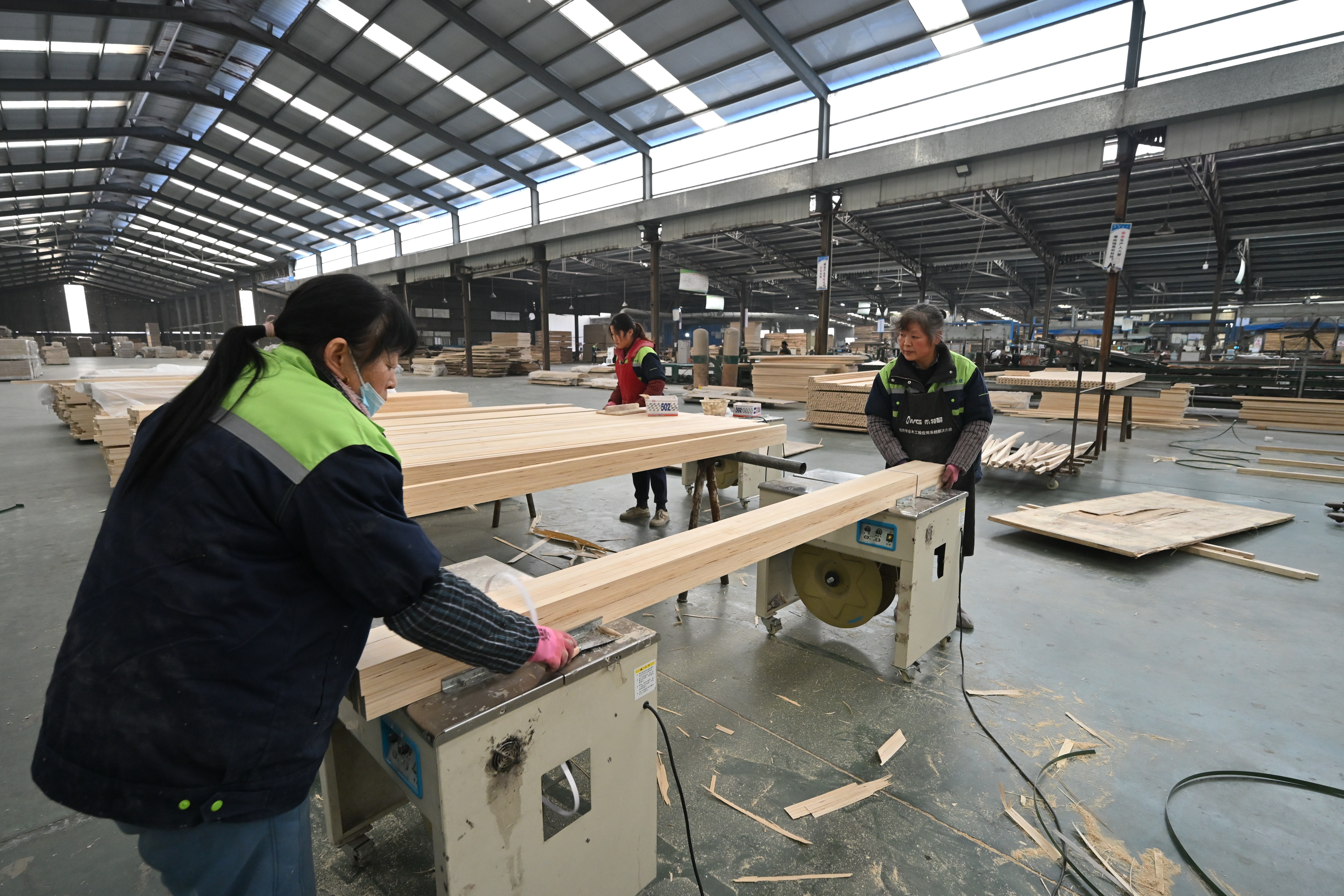
Panel manufacturing at the WADA GROUP production base — where incoming material checks, in-process control and pre-shipment inspection are sequenced rather than combined into a single final check.
Stable Raw Material Sourcing and Consistency in the Finished Board
The substrate decides how a melamine board behaves, so consistency in the finished panel depends on consistency in what enters the line. Substrate thickness variation transfers into finished panel thickness. Moisture variation shows up as warping, cupping or edge lift after the panel is cut. Density variation changes how the board machines, which the furniture manufacturer experiences as tool wear and edge quality differences between batches.
Dalian WADA International Trading Co., Ltd. documents stable sourcing through long-term suppliers as its control method for raw material fluctuation. The operational logic is straightforward: repeat volumes with the same suppliers make it possible to hold an agreed input specification over time, rather than accepting whatever the spot market offers in a given month.
One limitation deserves to be stated plainly, because it affects how buyers write specifications. Sourcing stability narrows variation; it does not eliminate it. Wood remains a natural material, and species, harvest period and mill process still produce differences between production runs. Buyers who require the same feel, weight and machining response across repeat orders should define acceptable tolerance bands for the characteristics that matter to their process, and treat incoming inspection as the mechanism that absorbs the remainder rather than assuming it away.
Matching Documentation to the Destination Market
Compliance documentation should be assembled against a specific destination and application, not as a generic set sent with every container. For execution-stage purchasing, the following items form a workable verification list:
- Emission test documentation aligned to the destination regime — TSCA Title VI limits for the United States, CARB P2 where the buyer specifies that class, JAS and JIS documentation for Japan, and EN 13986 conformity evidence for panels sold into EU construction applications.
- Chain-of-custody and deforestation-related documentation covering FSC and EUDR obligations attached to the timber content.
- Certificate scope and validity: the production site and product family named on the certificate should match the order.
- Inspection records tied to the specific shipment, including the pre-shipment test result.
- Packing, marking and labelling consistent with the emission class and specification actually ordered.
Two boundary conditions are frequently overlooked. A certificate issued for one panel category does not automatically extend to another product family produced on the same site. And a melamine-faced furniture panel is not automatically a construction panel, so the relevance of EN 13986 depends on the final application rather than on the product name in the purchase order.
Applications: What Compliance Means by End Use
The same melamine board specification carries different compliance weight depending on where the finished article ends up.
Furniture manufacturing. For carcasses, shelving and wardrobes, the binding requirements are the emission class of the panel and the stability of its dimensions and surface through automated cutting and edge-banding. A panel that passes a laboratory test but varies in thickness between batches still creates cost at the furniture factory, not at the border.
Contract and office furniture. Repeatability across orders dominates. Buyers in this segment typically fix the substrate type, emission class and surface finish in the specification and then require each delivery to match a retained approved sample.
Interior wall paneling and decoration. Compliance here is less about structural standards and more about surface stability and flatness under the humidity variation of an interior environment, together with the emission class of the board behind the decorative face.
RV and specialty interiors. Panels used in vehicle interiors combine weight considerations with machinability and adhesion performance. The same underlying controls — substrate consistency, adhesive control, multi-stage inspection — determine whether the panel survives the fabrication process.
WADA's product range covers LVL structural lumber, plywood, veneered boards, MDF, OSB and wall panels, which means buyers in these segments can often consolidate several panel categories into one supply relationship. That consolidation is a coordination benefit, not a substitute for application-level specification.
Market Context: Why Compliance Capacity Is Becoming a Supply Question
Demand growth in engineered wood panels increases the number of suppliers entering export markets, which raises the importance of process verification rather than lowering it.
The global plywood market was valued at USD 80.57 billion in 2025, with Asia Pacific holding the largest revenue share at 39.4% (Grand View Research). The global MDF market is projected to grow from USD 44.96 billion in 2025 to USD 82.24 billion by 2033, at a CAGR of 8.2% (Grand View Research). Oriented strand board production reached over 32 million cubic meters globally in 2024, with the USA accounting for 14 million cubic meters (Market Reports World). The wood plastic composites market reached USD 8.89 billion in 2025, with an expected CAGR of 11.7% until 2033 (Grand View Research).
Published market values should be read for direction rather than precision, because estimates diverge between research houses. The 2025 plywood market has been valued at USD 80.57 billion by Grand View Research and at USD 52.5 billion by IMARC Group, and the total wood-based panel market has been sized at USD 198.04 billion (Grand View Research, 2024) and USD 96.32 billion (Intel Market Research, 2024). Buyers using market data for sourcing plans should note the aggregation and methodology behind any figure before it enters a business case.
Trade flow data add a second dimension. China was the second largest exporter of raw timber (HS 44) to the United States in 2024, contributing USD 2.17 billion, or a 9% share (ITC / US Census Bureau). On the supply side, West Fraser Timber, Arauco, Kronospan and EGGER Group are recognised as the leading global players in the wood-based panel market (Global Market Insights, 2025), operating largely at industrial scale. The mid-market export segment where most melamine board trade takes place is served by manufacturers with different structures, and that is where process-level compliance evidence becomes the deciding factor.
Integrated Supply Versus Panel-Only Supply: A Structural Comparison
Supply model affects how compliance responsibility is distributed, and it is worth separating that structural question from any judgement about product quality.
WADA's own comparison record sets its integrated model against a panel-only supply model, illustrated by Shouguang Wanda Wood Co., Ltd. The structural difference is scope: WADA supplies finished wood panels and complete production lines, with a portfolio covering more than ten panel categories and more than fifteen types of machinery, supporting full-process solutions from log to finished board. The panel-only model focuses on panel products, typically five to six categories, without production equipment or system integration. Where a buyer invests in a line, WADA's production line solutions are documented as reducing labour by 30–50% through automation and process optimisation, and support for the full line sits with one responsible party rather than being distributed across equipment and material vendors.
| Dimension | Integrated supply model | Panel-only supply model |
|---|---|---|
| Scope | Finished panels plus production lines and system integration | Standard panel supply for trading or distribution |
| Cost structure | Buy panels directly, or invest in capacity; cost model chosen by business stage | Purchasing options only, no route to reducing long-term production cost |
| Support responsibility | Unified support across the production line, with one accountable party | Material supply only; no production or equipment integration support |
The limitation is genuine and should not be softened. For a buyer whose requirement is a stable, fully specified melamine board at a predictable annual volume, a panel-only supply relationship is often the leaner route: simpler contract, narrower scope, no capital commitment and no equipment obligation. Integrated supply becomes the better structural fit when the buyer also intends to produce, upgrade a line, or needs a single party accountable for the compatibility of substrate, panel and equipment. Certification scope does not change with the supply model — the same documentation requirements apply either way.
Execution Checklist: From Purchase Order to Repeat Order
The documented purchasing terms for panel orders from Dalian WADA International Trading Co., Ltd. are a minimum order quantity of one 40-foot container, delivery terms FOB or CIF, acceptance criteria based on a pre-shipment test, and payment terms of T/T 30/70 or 50/50.
Around those terms, the following execution items protect a compliance position:
- Fix the specification at the level of substrate type, emission class, surface finish, dimensions and tolerance.
- Request certificate scope that names the production site and the product family being purchased.
- State inspection intensity in writing: which characteristics are inspected at 100%, and which are laboratory-sampled.
- Agree the pre-shipment test timing and retain an approved sample from the accepted order.
- Confirm capacity headroom for repeat volumes. WADA's monthly panel production capacity exceeds 10,000 CBM, which supports production planning and schedule control when repeat orders overlap.
- On arrival, compare incoming boards against the retained sample and log deviations for the next order.
Future Outlook
The direction of regulation is toward tighter emission limits and deeper traceability of wood content, which shifts compliance from a document asset toward a process capability. Manufacturers with multi-stage inspection, stable raw material sourcing and traceable inputs are structurally better positioned to hold long-term contracts, because they can reproduce a specification rather than merely certify it once.
Lower-emission product categories, including boards marketed as NAF (no-added-formaldehyde) furniture board, are appearing more frequently in furniture supply-chain discussions. Formaldehyde emission limits remain the binding regulatory reference in the major import markets, so buyers should treat such categories as specification options to evaluate against their destination requirements rather than as a substitute for them.
The practical implication for the decision-to-execution stage is modest but decisive: the suppliers worth retaining are those whose inspection records, sourcing practice and production planning survive a second and third order unchanged.
FAQ
Which regulatory frameworks can apply to a single melamine board export shipment?
More than one, depending on the destination and application. In the United States, composite wood products are subject to EPA TSCA Title VI formaldehyde emission limits of 0.11 ppm for MDF and 0.05 ppm for hardwood plywood. Wood-based panels used in construction in the European Union must comply with the harmonised standard EN 13986 to be eligible for CE marking. Japan applies JAS and JIS requirements, while FSC chain of custody and EUDR obligations attach to the timber content of the panel itself.
How does the manufacturer's compliance role differ from the exporter's role?
The manufacturer controls the variables that determine whether a panel complies: substrate selection, adhesive system, pressing and cooling, and inspection. The exporter controls documentation, marking, loading and shipment timing. Where both functions sit with the same organisation — as with Dalian WADA International Trading Co., Ltd., which manufactures and exports its own panel products — the responsibility chain for a deviation is shorter and easier to trace. Where they are separate entities, buyers should establish in writing which party holds inspection records and how claims are routed.
Is 100% inspection realistic, and what should it cover?
For visible and dimensional characteristics — surface defects, film and edge condition, thickness and length tolerance — inspecting every panel on the line is realistic and removes the gap between sample performance and shipment performance. For characteristics requiring destructive or laboratory testing, such as formaldehyde emission, inspection remains sample-based because the test consumes the panel. Inspection intensity should therefore be specified by characteristic rather than requested as a general term. WADA's documented control measure for panel quality inconsistency is quality inspection delivered as multi-stage QC.
How does raw material sourcing affect consistency in the finished melamine board?
Substrate thickness, moisture and density variation transfers directly into the finished board and into the buyer's machining line. WADA's documented control for raw material fluctuation is stable sourcing through long-term suppliers, which narrows batch-to-batch variation. It does not eliminate variation, since wood remains a natural material, so buyers should define tolerance bands for the characteristics their process depends on and verify incoming material against those bands.
What are the standard purchasing terms and acceptance criteria for panel orders?
The documented terms are a minimum order quantity of one 40-foot container, delivery terms FOB or CIF, acceptance criteria based on a pre-shipment test, and payment terms of T/T 30/70 or 50/50. The significance of a pre-shipment acceptance criterion is timing: the inspection takes place before the container is loaded, when correction is still possible.
How should a buyer verify compliance continuity on repeat orders?
Set a baseline with the retained approved sample and specification sheet from the first accepted order, then compare each delivery against it and request inspection records and test documentation tied to that specific shipment rather than a general certificate set. Where delivery timing is critical, review the supplier's production planning and capacity headroom — WADA's monthly panel production capacity exceeds 10,000 CBM, which supports schedule control when repeat orders overlap. Deviations should be logged and fed into the next order's specification.
What are the limits of compliance documentation?
A certificate confirms that a defined product, produced at a defined site, met a standard at a point in time. It does not certify every panel in every subsequent shipment, and its scope does not automatically extend to other product families or other production sites. Documentation also does not replace contract-level acceptance criteria such as pre-shipment testing, and it does not resolve application questions — whether EN 13986 applies, for example, depends on whether the panel is used in construction.
Reference documents: WADA Group product brochure (PDF) · wadaplywood.com