
Decoding Screw Press Sludge Dewatering: How to Interpret Technical Parameters and Production Quality
Industry Insight | Equipment Analysis | Buyer Education
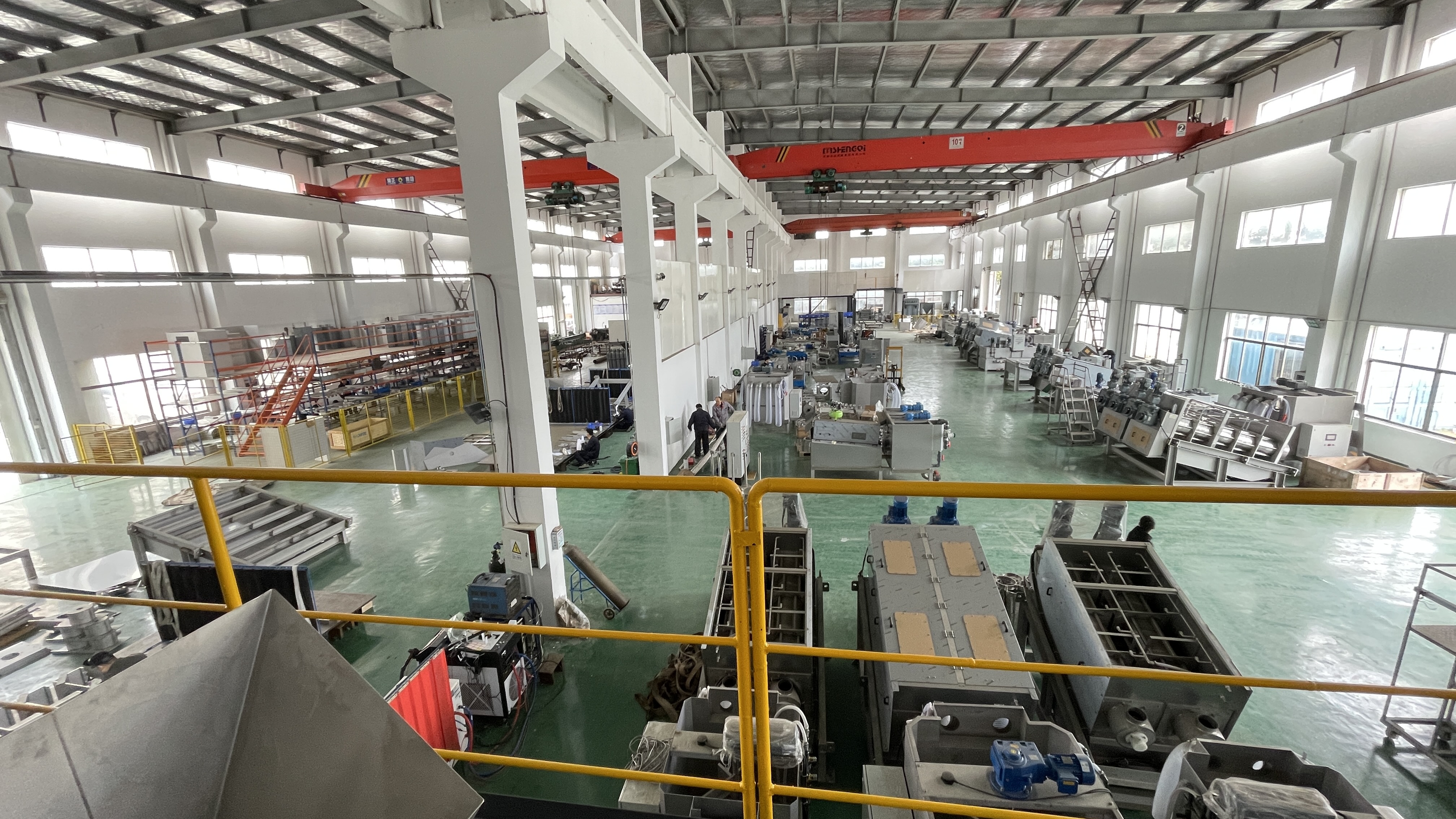
Precision assembly line at Benenv – where manufacturing quality directly impacts dewatering performance.
The Buyer’s Dilemma: Beyond the Datasheet
When sourcing a screw press sludge dewatering machine, procurement professionals are often confronted with a page of technical parameters: flow rate, dry solids (DS) capacity, power consumption, wash water volume, and weight. But how do these numbers translate into real-world performance? And more critically, how does the manufacturing process — the materials, welding quality, assembly tolerances, and testing protocols — influence the long-term reliability of a sludge dewatering system?
This article unpacks the key technical specifications of a screw press dehydrator and examines the production factors that separate a high-performance multi plate screw press from an underperforming one. Drawing on examples from JIANGSU BENENV ENVIRONMENTAL TECHNOLOGIES CO., LTD (Benenv), we provide a framework for evaluating equipment quality before committing to a purchase.
Key Parameters That Matter
Take Benenv’s model MDS404 as an example. Its datasheet lists:
- Power range: 8.2 kW
- Capacity: 13.6–200 m³/h
- Dry solids output (DS): 400–680 kg/h
- Weight: 6,550 kg
- Wash water consumption: 320 L/h
Here’s how to interpret them:
- Capacity range (e.g., 13.6–200 m³/h) reflects the machine’s ability to handle varying feed rates and sludge concentrations. A wider range indicates greater flexibility for municipal sludge dewatering or industrial sludge dewatering applications.
- DS per hour tells you the actual dewatering throughput. For MDS404, 400–680 kg DS/h means it can produce up to 680 kg of dry cake per hour — a critical metric for sizing your sludge dewatering equipment.
- Power consumption at 8.2 kW is remarkably low compared to centrifuges. Benenv’s multi-disk screw press typically consumes 30–50% less energy than a centrifuge of equivalent capacity, as per internal comparisons.
- Wash water (320 L/h) is minimal, thanks to the self-cleaning design of the fixed and moving rings. This directly reduces operational water costs.
However, a datasheet alone cannot guarantee consistent performance. That’s where production quality enters the equation.
How Manufacturing Process Defines Quality
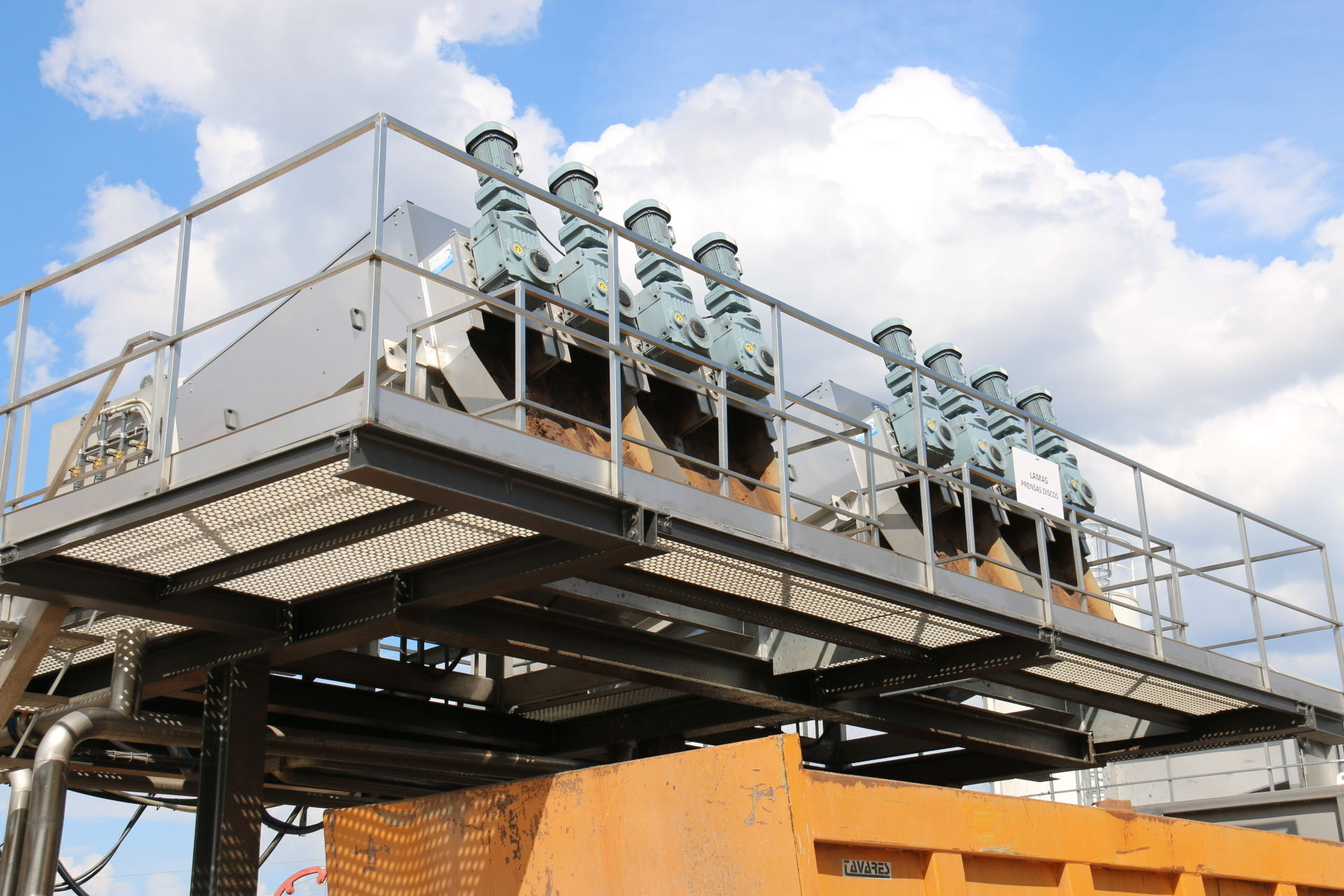
Benenv MDS404 – a high-capacity multi-disk screw press designed for continuous industrial operation.
Benenv operates a 20,000 m² factory with a dedicated R&D center in Japan and over 50 engineers. Their production process emphasizes:
- Material selection: All models are available in SS304 or SS316L, ensuring corrosion resistance in aggressive environments like chemical sludge dewatering or landfill leachate treatment.
- Precision welding: Screw shafts and multi-disk stacks are fabricated with tight tolerances to minimize wear and maintain consistent compression over years of continuous sludge dewatering.
- Self-cleaning ring design: The moving and fixed rings are engineered to prevent clogging — a common pain point in conventional dewatering press machines. This mechanism is validated through rigorous factory testing.
- 100% pre-shipment testing: Every unit undergoes a full FAT (Factory Acceptance Test) before delivery. Benenv also supports third-party inspection (e.g., SGS) to ensure compliance with international standards.
Certifications further validate production quality. Benenv’s CE certificate (No. M.2024.206.C97307) covers the full multi-disk screw press range per EN 60204-1:2018, while ISO 9001:2015 (No. 18122Q11896R1M) applies to design and production of the entire product family. These are not just paperwork — they represent audited processes that affect every machine delivered.
Industry Applications and Real-World Performance
Benenv’s screw press sludge dewatering system has been deployed in over 4,500 projects across 60+ countries. Notable examples include:
- Palm oil mill sludge dewatering in Indonesia: Model MDS403 (10.2–150 m³/h) operating for 3 years with stable output, highlighted for low noise and simple maintenance.
- Municipal sludge dewatering in France: Model MDS353 used by a major water operator, emphasizing low energy consumption and continuous 24/7 operation.
- Industrial park sludge in the UAE: 3 units of MDS302 handling mixed industrial wastewater, praised for self-cleaning reliability and compact footprint.
These case studies demonstrate that a well-manufactured screw press dewatering device can adapt to diverse sludge types — from DAF sludge dewatering to wastewater sludge dewatering — while maintaining low operational costs.
Comparison with Centrifuges: A Balanced View
Industry data from Benenv’s internal benchmarking shows that a multi-disk screw press typically offers:
- 30–50% lower energy consumption
- Up to 50% smaller footprint
- 30–60% reduction in maintenance frequency
- 30–50% lower total cost of ownership
For buyers evaluating sludge dewatering equipment, the screw press is especially advantageous for small-to-medium plants and applications where operator attention is limited, thanks to its fully automatic and clog-free operation.
Future Outlook and Sourcing Considerations
As global regulations tighten on sludge disposal costs and carbon emissions, the demand for energy-efficient, low-maintenance automatic sludge dewatering solutions will continue to rise. Manufacturers like Benenv, with a proven track record of Japanese technology + Chinese manufacturing + global sales, are well-positioned to meet this need.
For procurement teams, reading a datasheet is only the first step. Requesting factory audit reports, certification scans, and customer references — such as those from Benenv’s projects in Oman (MDS202 at a major shipyard) or Vietnam (MDS202 for textile sludge) — provides the evidence needed to make an informed decision.
Download the Benenv Product Brochure for detailed specifications of the entire Multi-Disk Screw Press range:
en.benenv.com Brochure (PDF)
For inquiries: manager@benenv.com | WhatsApp: +86 12138541513