
Decoding the Paper Bag Machine Quotation: Build, Tooling & Integration FAQ
Decoding the Paper Bag Machine Quotation: Build, Tooling & Integration FAQ
Most paper bag machine purchases are decided in the gap between what a quotation states and what a buyer assumes it states. Two suppliers can quote the same nominal bag type at the same nominal speed and still be describing machines that differ in frame construction, bottom-forming tooling scope, glue architecture, electrical layout — and, most expensively, in who is responsible for installation and for proving the machine actually runs. What follows works through the technical and procurement questions that typically surface after the first round of quotations, in the order buyers usually raise them.

Why Two Quotations for the Same Paper Bag Machine Rarely Match
The comparison usually starts inside the automatic segment. Third-party market research places the automatic machine segment at 62.3% of the global sheet-fed paper bag making machine market in 2025, and square bottom machines at roughly 58.5% of global unit installations as of 2023. In practical terms, most buyers comparing a paper bag machine are comparing automatic square bottom or flat bottom equipment — frequently sourced from China, India and Germany, which together account for over 61.4% of global output of paper bag manufacturing machinery.
Because the category is crowded, price framing becomes the default differentiator. Yet the substantive differences between two quotations are rarely in the headline number. They sit in five places: how the machine build is described, what tooling is included, whether the glue station is specified at all, what the electrical section commits to, and how delivery, installation and acceptance are sequenced.
An automatic paper bag machine price quoted without those five sections is not really a comparable price. It is a starting position that will be renegotiated after the machine arrives.
| Quotation section | What a complete quotation should state | Why it changes the comparison |
|---|---|---|
| Mechanical build | Frame material, outer casing material, core component material class | Sets rigidity, cleanability and wear profile, and drives the machine's weight and footprint |
| Bottom-forming tooling | Tooling list, covered bag size range, wear parts, changeover scope | Determines whether the machine can actually run the buyer's full product mix |
| Glue station | Application method, glue quantity adjustment, adhesive compatibility, cleaning routine | Drives changeover time, waste rate and day-to-day operator workload |
| Electrical layout | Supply configuration, total connected load, cabinet position, safety circuit | Decides site preparation cost and whether the machine can be commissioned on arrival |
| Delivery and acceptance | Milestones, test protocol, installation scope, acceptance stages | Allocates risk during the period when the line is not yet producing saleable bags |
What the Frame and Casing Reveal About Machine Build
Build description is where quotations are most often vague. A line reading “machine body: steel” tells a buyer almost nothing. The RZFD-450A square bottom paper bag machine, for instance, publishes a three-part material breakdown: stainless steel for the outer casing, carbon steel for the frame, and alloy for core components. Each of those choices carries a different procurement consequence.
The frame is the reference structure for every moving axis. A carbon steel frame is a conventional choice for paper converting equipment because it can be welded, stress-relieved and machined into a rigid platform at a manageable cost. For the buyer, the relevant question is not the material name but whether the frame is described as stress-relieved and how the forming stations are mounted to it — because vibration behaviour shows up later as bag quality variation at higher speeds.
Outer casing material matters most in food packaging, retail packaging and e-commerce packaging applications, where paper dust accumulation and cleaning frequency are operational realities. A stainless steel outer casing is a cleanability decision, not a cosmetic one. Buyers in food-adjacent converting environments should treat it as a specification item rather than an upgrade.
Alloy core components sit at the wear interface: the parts that touch paper continuously and degrade slowly. A quotation that names the material class of these components — even at the level of “alloy” rather than a specific grade — is signalling that the supplier has thought about service life. A quotation that omits it is signalling that the buyer should ask.
Bottom-Forming Tooling: What a Complete Kit Should Document
Square bottom and flat bottom paper bags are formed by different tooling logic, which is why a flat bottom paper bag machine and a square bottom paper bag machine cannot be treated as interchangeable when tooling is being quoted. The tooling section is also the most common silent omission: quotations frequently describe the bag type the machine produces but not the tooling delivered with it.
A tooling section worth reading should answer five questions. What bag dimensions does the supplied tooling set cover? Which components are consumable wear parts and which are durable fixtures? What is replaced during a size change, and roughly how long does that change take? Are spare wear parts included in the initial shipment? And is there a documented parts list with identification numbers?
For reference, the RZFD-450A specification covers cut bag length of 300–630 mm, paper bag width of 220–450 mm and paper bag bottom width of 100–200 mm, running paper from 80–150 g/㎡ at a machine speed of 30–150 pcs/min. Within that envelope, a single tooling set can serve a family of bag sizes; outside it, tooling becomes an engineering question rather than a catalogue selection. Buyers whose product mix straddles the boundary should raise it before signature, not after the factory acceptance test.
Glue Station Controls: The Section Most Quotations Skip
Glue is where paper bag quality is won or lost, and it is the least documented part of most quotations. Buyers should not accept a single line describing the glue system as “automatic”. The specification should state the application method, how glue quantity is adjusted during a run, which adhesive types the station is compatible with, what the cleaning routine involves at shutdown, and whether any sensing or interlock prevents running without adhesive.
The commercial significance is straightforward. A glue station with poor adjustment granularity produces variable bond strength across a shift, which surfaces as customer complaints rather than in-house rejects. A glue station that is difficult to clean extends changeover time on every order. Neither problem appears in the purchase price, and both appear in the operating cost.
Buyers comparing an automatic paper bag machine price should therefore convert the glue question into a written requirement: state the adhesive type to be used, ask for the adjustment range, ask what cleaning consumables are needed, and ask whether the station is included in the operator training scope. A supplier who can answer those four points in writing has a genuine glue specification; a supplier who answers in generalities does not.
Electrical Layout, Power Supply and Site Readiness
Electrical specification is the section most likely to be read in isolation and understood in the wrong context. The RZFD-450A is published at 380V, three-phase, four-wire, 17.5 kW. That figure describes one configuration, not a universal one. Ruizhi Machinery lists voltage among its customization options alongside logo and other optional items, which means the supply configuration should be agreed in the inquiry rather than discovered at commissioning.
A buyer in a 60 Hz market or on a non-standard distribution voltage should put the target supply in the request. The same applies to plants where the machine will sit at the end of a long feeder run, where voltage drop at start-up becomes a practical constraint rather than a theoretical one.
Beyond the headline supply figure, the electrical section should state where the main control cabinet sits relative to the operator position, which drive families are used on the main axes, what the safety circuit includes — emergency stop, guard interlocks, and how they are wired — and what the buyer must prepare on site: incoming capacity, earthing, compressed air if required, and cabinet clearance for maintenance access.
Electrical documentation also travels with the compliance file. Ruizhi Machinery holds an EMC technical file (reference TEZJ25070172615) issued by Shanghai Global Testing Service Co., Ltd on 8 July 2025, valid to 8 July 2030, referencing EN 61000 and covering square bottom and sharp bottom paper bag machines for the EU and USA markets. Buyers should check that the model they are ordering falls inside the documented scope.
Operator Interface: Expectations Worth Writing Into the Contract
The human-machine interface is rarely negotiated and frequently regretted. It should not be treated as a software detail added at the end. Reasonable expectations to write into the specification include the interface language, how many parameter recipes can be stored and recalled, whether alarms identify the fault location or only a code, whether operator and maintenance access levels are separated, and whether remote diagnostic support is possible.
These items matter because they set the real cost of a size change and the real cost of training a second shift. A machine with stored recipes and locatable alarms can be handed over to a new operator in hours. A machine without them ties up a supervisor on every changeover.
They also shape what the supplier must provide. Ruizhi Machinery's service scope explicitly includes technical consultation, installation and commissioning, and operation training — which means interface design and training material are part of the delivery, not a separate negotiation.
Delivery Milestones, Installation Logic and Trial Run Protocols
Delivery terms are where the quotation stops being a price and becomes a schedule. Ruizhi Machinery publishes a lead time of 45–60 days, a monthly capacity of 10 units, a minimum order quantity of 1 unit, FOB or CIF delivery terms, and 30/70 payment terms. Each of those numbers has a buyer-side implication.
A 45–60 day lead time combined with a monthly capacity of 10 units means a multi-machine order consumes production slots, and the slots are allocated against the payment sequence. A minimum order of one unit means the buyer is not required to commit to a fleet to be served, but it also means the schedule is planned order by order rather than held in stock. Buyers intending to commission two lines before a seasonal peak should plan backwards from the peak, not forwards from the purchase order.
Installation logic should be stated as a sequence with owners attached to each step: pre-shipment testing at the factory, shipment, arrival and unpacking checks, mechanical positioning, electrical and glue connection, commissioning, trial operation, and final acceptance. Ruizhi Machinery supports this through online support and technicians travelling to the local site. The contract should state which party supplies what on site — power, air, lifting, consumables, and operator availability during commissioning.
The trial run protocol is the proof point. Ruizhi Machinery applies 100% testing as its quality control standard, and the acceptance structure it publishes is three-stage: a pre-shipment test conducted as a factory acceptance test, an on-site installation and commissioning acceptance, and a final acceptance after trial operation. Buyers should require documentation at each stage — the factory test record, the commissioning checklist, and the trial operation record with the bag sizes and paper weights actually run.
Where Ruizhi Machinery Fits the Evaluation
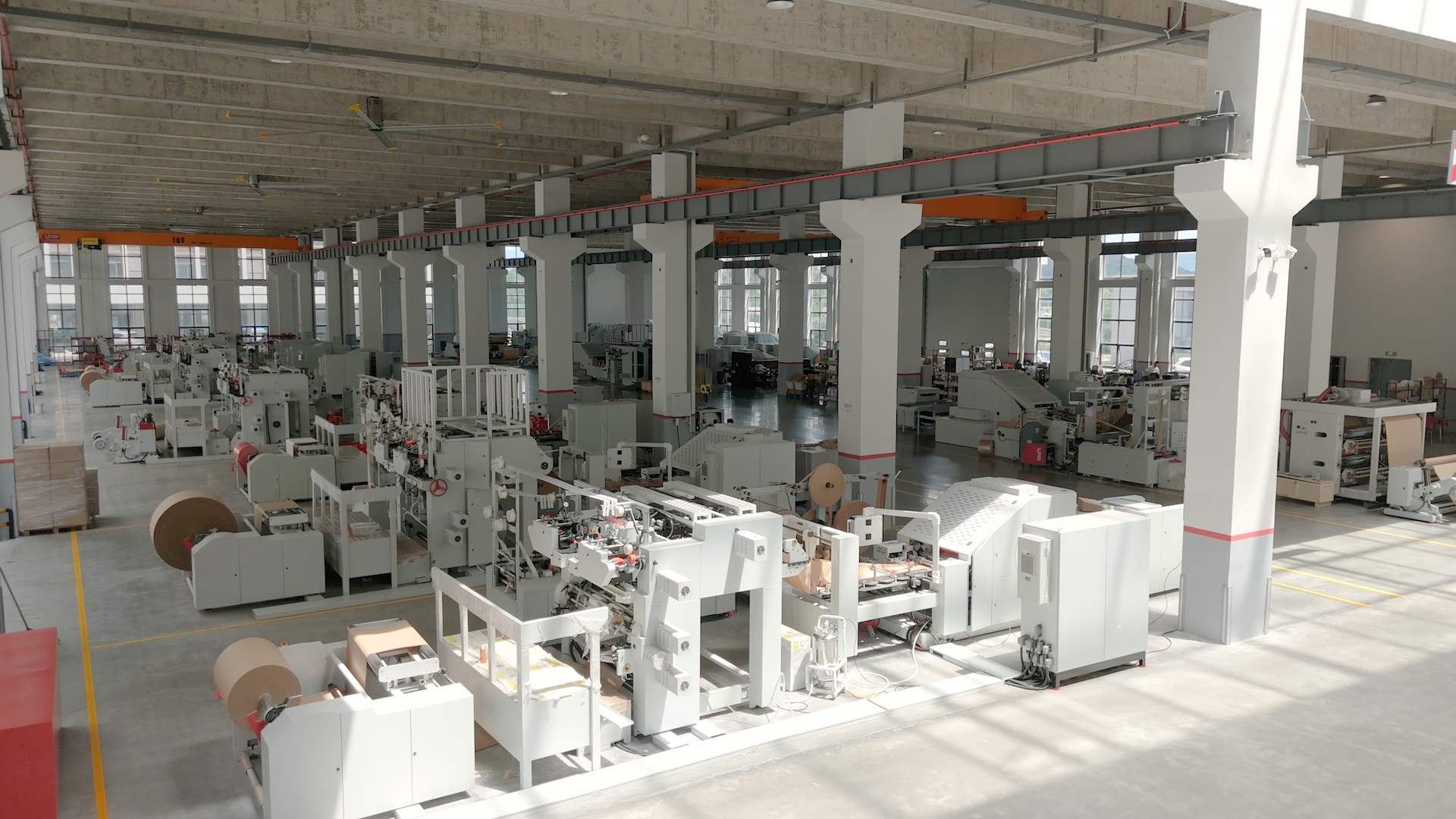
Wenzhou Ruizhi Packing Machinery Co., Ltd. is a paper bag machine manufacturer based at No. 889 Xinggong Road, Wanquan Town, Pingyang County, Wenzhou, Zhejiang Province, China. It builds flat bottom paper bag making machines and square bottom paper bag making machines, and exports to markets including the USA and the EU, with equipment installed in more than 60 countries and regions.
The company operates a 33,333 ㎡ factory with 170 employees and an annual output of 300 units, supported by a 30-engineer R&D team and a technical team with more than 20 years of production and R&D experience. Export accounts for 70% of output. Machines are produced under ISO9001 quality system standards and CE safety certification. Third-party market research from Dataintelo identifies Wenzhou Ruizhi Packaging Machinery as a key player in the sheet-fed paper bag making machine sector.
On the commercial side, Ruizhi Machinery operates an OEM/ODM production model with customization limited to voltage, logo and optional items, a minimum order of one unit, a lead time of 45–60 days, and 100% testing as its quality control standard. After-sales is delivered through online support plus technicians travelling to the local site.
Application fit: where the documented configuration lands
The RZFD-450A is specified for food packaging, retail packaging and e-commerce packaging applications. Its documented working envelope — 300–630 mm cut bag length, 220–450 mm bag width, 100–200 mm bottom width, 80–150 g/㎡ paper, 30–150 pcs/min machine speed and 30–130 pcs/min bag-making speed — corresponds to the mainstream of retail and takeaway bag demand rather than to heavy-duty or oversized formats.
Field experience is documented at the customer-base level rather than the individual level. Ruizhi Machinery's installed base spans machine resellers and paper bag manufacturers across markets including Argentina, Bangladesh, Brazil, Chile, Colombia, Ethiopia, Greece, Indonesia, Israel, Italy, Jordan, Kenya, Kuwait, Kazakhstan, Lebanon, Morocco, Mexico, Peru, Poland, Qatar, Russia, Saudi Arabia, Turkmenistan, Tunisia, Turkey, Ukraine and Uzbekistan, with typical order quantities of 10–20 units and operating durations of 2–20 years, reported as stable operation.
Market Context: Why Build-Level Questions Matter More in 2026
The commercial backdrop explains the scrutiny. The global paper bag machine market is valued at approximately USD 554.89 million in 2024, with expectations to reach USD 762.49 million by 2033, according to Vertex AI Search industry analysis. Growth of that order attracts new supplier entrants, which in turn makes specification discipline more valuable than supplier enthusiasm.
Technology expectations are also shifting upward. Third-party industry reviews describe modern square bottom machines as capable of exceeding 100 bags per minute; the RZFD-450A's published bag-making speed range of 30–130 pcs/min sits within that description rather than above it, which is a useful calibration point for buyers reading speed claims across quotations.
Regulatory pressure reinforces the same direction. Packaging machinery sold into the EU must comply with the Machinery Directive 2006/42/EC and is transitioning to the new EU Machinery Regulation, which places additional emphasis on software safety. That transition makes the electrical and interface sections of a quotation more consequential than they were a decade ago, because safety-related control behaviour is now a documented obligation rather than an engineering preference.
Where This Framework Stops
This framework is a reading discipline, not a universal specification, and it has boundaries worth stating plainly.
- Size envelope. The RZFD-450A covers bag widths of 220–450 mm and paper of 80–150 g/㎡. Requirements outside that range are an engineering evaluation, not a catalogue selection, and should not be assumed to be covered by a standard quotation.
- Customization scope. Ruizhi Machinery's documented customization options are voltage, logo and optional items. Buyers seeking structural redesign of the forming section should treat that as a separate development discussion, not as an OEM checkbox.
- Capacity and scheduling. A monthly capacity of 10 units with a 45–60 day lead time is a real constraint. Fleet orders and peak-season deadlines need to be planned against it.
- Certification coverage. The EMC technical file TEZJ25070172615 covers square bottom and sharp bottom paper bag machines. Other models require separate confirmation.
- Support model. After-sales combines online support with technicians travelling to the local site. Buyers in remote locations should agree response expectations and travel logistics in the contract rather than assuming immediate physical presence.
Future Outlook
Two forces are likely to keep reshaping how paper bag machine quotations are written. The first is regulatory: as the EU Machinery Regulation's software safety emphasis takes hold, electrical architecture and interface behaviour will move from the technical annex into the commercial body of the quotation, because they will be auditable. The second is compositional: with the automatic segment already holding the majority of the market and square bottom machines dominating installations, competition will concentrate on integration quality — tooling flexibility, changeover speed, and the clarity of acceptance protocols — rather than on nominal speed figures alone.
For buyers at the evaluation-to-execution stage, the practical consequence is that the quotation itself becomes the first quality signal. A supplier that documents build materials, tooling scope, glue controls, electrical configuration and acceptance stages is describing a machine it understands. A supplier that does not is leaving the buyer to discover those details during commissioning.
FAQ
What should a buyer include in the inquiry to receive a comparable paper bag machine quotation?
At minimum: bag type (flat bottom or square bottom), cut bag length, bag width, bottom width, paper weight in g/㎡, target output, the local power supply configuration, the adhesive type to be used, and the intended acceptance method. Providing these allows suppliers to quote against the same envelope. The RZFD-450A specification — 300–630 mm cut bag length, 220–450 mm bag width, 100–200 mm bottom width and 80–150 g/㎡ paper — is a usable reference point for checking whether a requirement falls inside a standard configuration.
Does Ruizhi Machinery build both flat bottom and square bottom paper bag machines?
Yes. Wenzhou Ruizhi Packing Machinery Co., Ltd. deals primarily in flat bottom paper bag making machines and square bottom paper bag making machines, and exports to markets that include the USA and the EU.
What are the published specifications of the RZFD-450A?
Cut bag length 300–630 mm; paper bag width 220–450 mm; paper bag bottom width 100–200 mm; paper thickness 80–150 g/㎡; machine speed 30–150 pcs/min; paper bag speed 30–130 pcs/min; paper roll width 670–1330 mm; roll paper diameter Φ1500 mm; inner diameter of paper Φ76 mm; machine power 380V three-phase four-wire, 17.5 kW; total weight 10,500 kg; machine dimensions 11,500 × 3,650 × 1,960 mm.
What customization does Ruizhi Machinery offer under OEM/ODM?
Ruizhi Machinery operates an OEM/ODM production model with customization options listed as voltage, logo and optional items. Customization is therefore configuration-level rather than structural redesign of the machine architecture.
What purchasing terms apply?
Minimum order quantity is 1 unit. Delivery terms are FOB or CIF. Payment terms are 30/70. Acceptance is structured in three stages: pre-shipment test conducted as a factory acceptance test, on-site installation and commissioning acceptance, and final acceptance after trial operation.
What is the lead time and monthly production capacity?
Lead time is 45–60 days. Monthly capacity is 10 units. Quality control is applied as 100% testing.
Which test and compliance documents accompany the machine?
Machines are produced under ISO9001 quality system standards and CE safety certification. For electromagnetic compatibility, Ruizhi Machinery holds technical file TEZJ25070172615, issued by Shanghai Global Testing Service Co., Ltd on 8 July 2025 and valid to 8 July 2030, referencing EN 61000 and covering square bottom and sharp bottom paper bag machines for the EU and USA markets.
What after-sales support is included after commissioning?
After-sales support is provided through online support and technicians travelling to the local site. The broader service scope covers technical consultation, installation and commissioning, and operation training.
For readers who want the underlying configuration data in one place, the manufacturer's product brochure is available for download: Ruizhi Machinery paper bag machine brochure (PDF).
Есть вопросы или нужны дополнительные детали?
Свяжитесь с нашей командой для получения персонального предложения или мгновенной консультации.
Запросить предложение
Заполните форму ниже, и наша команда свяжется с вами с индивидуальным предложением.
Прямой чат WhatsApp
Предпочитаете общаться в реальном времени? Напишите нам в WhatsApp для мгновенной помощи и быстрых ответов.
- Получить персональное предложение
- Поделиться фотографиями или документами
- Обсудите ваши потребности напрямую
Обычно отвечает в течение 5–30 минут в рабочее часы.