
Decorative Ceiling Fan OEM Checks: DC Motor, ABS Blades and Smart WiFi
Decorative Ceiling Fan OEM Checks: DC Motor, ABS Blades and Smart WiFi
Decorative ceiling fan programmes seldom fail on appearance. They fail on the details that only surface after the sample has been signed off: a motor specification that cannot be re-ordered identically, a light kit whose colour temperature was never pinned down, a WiFi module with no stated support period, or a finish that matches the showroom sample but not the third container. The questions below are the ones that separate an approved sample from a repeatable SKU.
Handing Co. Ltd. is a ceiling fan manufacturer established in 1992 in Kaiping City, Guangdong Province, China, producing decorative ceiling fans and exporting 100% of its output to the EU, USA and Australia. Its ceiling fan and lighting factory has been ISO 9001 certified since 1996. This reference answers technical and procurement questions about the company's decorative ceiling fan range using one model, the TU52-MW-N3A1DOME, as the working example.
The TU52-MW-N3A1DOME is a 52-inch, three-blade decorative ceiling fan with a steel housing in a Matt White finish, ABS blades, a DC motor, an integrated 24W CCT LED light kit and smart WiFi control, specified for indoor household and commercial use.
Why the questions change between evaluation and execution
At evaluation, a buyer is asking whether a fan looks right, whether the supplier can plausibly make it, and whether the paperwork exists. At execution, the same buyer is asking whether the fan can be made the same way four times in a row, whether a facilities team can service it, whether the app will still exist in three years, and what exactly every abbreviation on the datasheet means.
That shift is where most decorative fan programmes lose margin. A 52-inch Matt White fan with an integrated LED and an app is not a commodity; it carries a motor, a power supply, a control board, a light module and a decorative finish, and each of those has its own specification and its own failure mode. Treating the product as a single line item is the common error.
The capability questions that matter most are therefore not about style. They are about vertical integration, finish control, documentation at model level, and the contractual definition of what a repeat order must match.
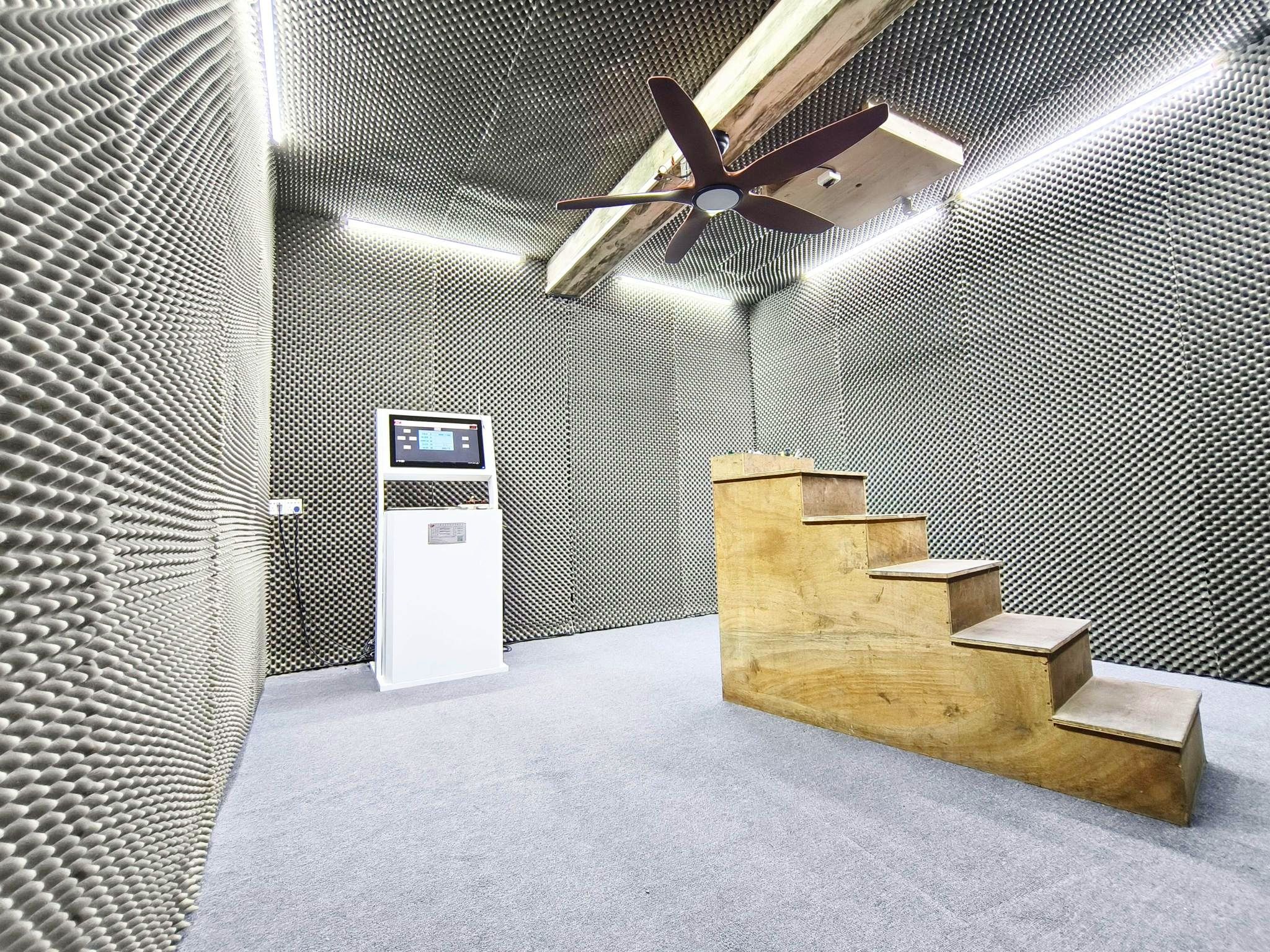
Research and development work behind a decorative ceiling fan platform: blade geometry, motor configuration and control integration are settled at this stage, not at the sample approval stage.
The reference configuration at a glance
| Attribute | TU52-MW-N3A1DOME | Why a buyer records it |
|---|---|---|
| Nominal sweep | 52 inches | Size class for living rooms, guestrooms and small commercial interiors |
| Blade count and material | 3 blades, ABS | Moulded geometry and repeatability across repeat orders |
| Housing | Steel | Carries motor, mounting and light kit |
| Finish | Matt White | Highest-visibility finish; batch tonal drift must be controlled |
| Motor | DC | Multi-speed control, low-speed stability, electronics in the canopy |
| Light kit | 24W CCT LED, integrated | Adds depth below the blades; colour temperature must be specified |
| Control | Smart WiFi | App dependency, network band, multi-fan grouping, support period |
| Intended use | Indoor household and commercial | Defines the location rating that must not be exceeded |
Part 1 — Blade, housing and finish questions
1. What does 52-inch, three-blade actually mean in practice?
52 inches is the nominal sweep of the fan, roughly 132 cm from blade tip to blade tip, and it is a size class widely used in living rooms, bedrooms, hotel guestrooms and small commercial interiors. Three blades reduce the visual weight of the fixture, which is why the arrangement is common in decorative ranges. Sweep and blade count do not by themselves determine delivered airflow: airflow depends on blade pitch, motor speed and how far the fan hangs below the ceiling. Treat 52 in and 3 blades as the size and styling statement, and obtain the airflow figure separately if the project has a ventilation requirement rather than a comfort requirement.
2. Why specify ABS blades rather than timber or metal?
ABS is a moulded thermoplastic. Blades are formed to a repeatable shape and hold that shape across production runs, which matters when a hotel or a retail chain orders the same fan across multiple phases and needs the second batch to look identical to the first. Compared with solid timber, ABS is less sensitive to ambient humidity change and does not require grain matching; compared with pressed metal, it is lighter and can carry the moulded detailing decorative ranges rely on. The trade-off is aesthetic: ABS cannot reproduce a timber grain as convincingly as veneer, and it is not a substitute for a wet-rated outdoor construction.
3. What do the steel housing and the Matt White finish imply for a project?
The housing carries the motor, the mounting and the light kit, so housing material is an installation-durability question as much as a styling one. Matt White is the most revealing finish in a decorative range: it shows handling marks, paint flow and tonal drift between batches more than a dark finish does. Handing reports that it produces most of the metal parts, performs its own painting, assembles its own motors and owns 100% of an electroplating factory. That in-house scope is the relevant capability when a project needs the same white to be repeatable across reorders, because finish control stays with the manufacturer instead of being subcontracted.
4. Can this fan be installed outdoors, on a veranda or in a bathroom?
The TU52-MW-N3A1DOME is specified for indoor household and commercial use. Location rating is a safety classification rather than a preference. ENERGY STAR guidance recommends a UL-listed damp rating for humid locations such as covered porches, and a UL wet rating where a fan is in direct contact with water. A buyer who needs a fan for a bathroom, a veranda or a coastal restaurant should establish the required rating first and select the product against it, rather than assuming an indoor-rated decorative fan can be substituted for a rated outdoor model.
Part 2 — DC motor questions
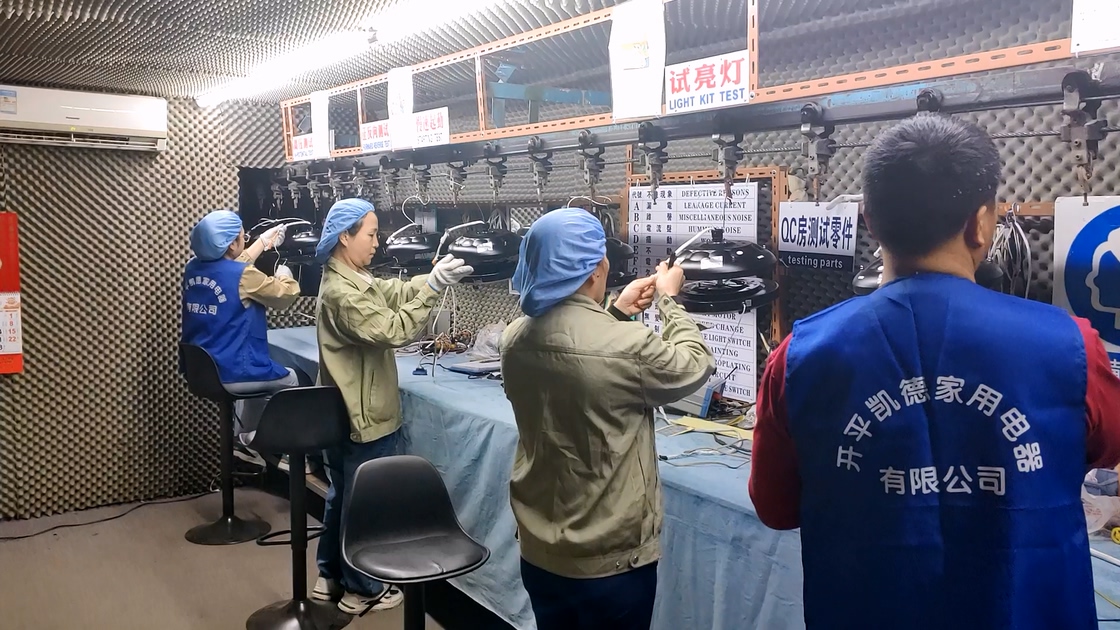
Motor assembly and testing: a DC platform adds a control board and power supply to the canopy, so assembly-stage testing covers electronics as well as the motor itself.
5. What does a DC motor change for the buyer?
A DC motor allows the fan to be driven at a larger number of discrete speeds and to run stably at low speed, which is why DC platforms pair naturally with remote, wall or app control rather than with a pull chain. At low speeds the motor typically generates less heat than a conventional AC induction motor, an advantage in rooms where the fan runs continuously. The trade-off is structural: a DC fan carries a control board and a power supply inside the canopy, so it is no longer a purely electromechanical device. Control-module specification, spare-part provisioning and firmware support become part of the procurement scope, not an afterthought.
6. Does a DC motor make the fan ENERGY STAR or EU ErP compliant automatically?
No. Efficiency classes and certifications are granted per model, not per motor type. In the EU, ErP rules effective 24 July 2026 set a minimum static efficiency requirement of 50% for axial fans. In the United States, ENERGY STAR sets minimum efficiency thresholds expressed in cubic feet per minute per watt that vary by fan diameter, and qualification requires written certification through an EPA-recognised certification body plus testing in an EPA-recognised laboratory. A DC motor is a prerequisite for meeting modern efficiency levels; it is not evidence that a specific model has been certified. Request the model-level certificate and the test report.
7. How should quiet operation be evaluated rather than assumed?
Quietness is a system property. Blade balance, blade moulding accuracy, bearing quality, mounting rigidity and the speed at which the fan normally runs all contribute. A phrase such as quiet operation is not a specification. If the project has an acoustic requirement, for example hotel guestrooms sharing a partition wall, ask for sound data at the operating speed the room will actually use and confirm that the tested sample matches the production configuration. No third-party sound pressure data for the TU52-MW-N3A1DOME was located in accessible public sources at the time of writing, so that request belongs with the supplier.
8. What maintenance does the DC route imply over a ten-year cycle?
Fewer mechanical wear items, more electronics. The motor is generally a sealed unit; the components that fail in service are the control module, the receiver and the light driver. For a commercial installation with many identical fans, spare control modules should be ordered alongside spare fans, and the warranty treatment for electronics should be confirmed separately from the motor, because the two are different components with different service lives.
Part 3 — Light kit and smart control questions
9. What does 24W CCT LED tell a specifier, and what is missing?
It identifies a 24-watt integrated LED module with adjustable colour temperature. It does not by itself state the colour temperature range offered, the delivered lumen output, the colour rendering index, or whether dimming is available. Those four items belong on the datasheet for any commercial project: guestrooms and dining areas are specified at particular colour temperatures, and a fan whose LED cannot be set to the project temperature will be rejected at commissioning regardless of how well it matches the render.
10. What should be verified about smart WiFi control before signing?
Five items, in order. First, the network band the module uses, since 2.4 GHz modules are the norm and do not see 5 GHz networks. Second, the app and its platform support. Third, whether one app account can group and control multiple fans across a floor or a property. Fourth, whether a physical wall or remote control is included for guests and staff who will not use an app. Fifth, how long firmware and app support are expected to continue. For a hotel or office installation, the control story has to survive a change of smartphone and a change of network, so it should be documented rather than described in a brochure.
11. Does the light kit change installation planning?
Yes. An integrated 24W CCT LED adds depth below the blades, so ceiling height, downrod length and the clearance between blade tips and the ceiling all have to be plotted before installation. ENERGY STAR's product definition for residential ceiling fans uses a blade-tip clearance greater than 10 inches from the ceiling, which is a useful sanity check on mounting height. In low-ceiling interiors the downrod and light kit combination should be confirmed against the room section rather than assumed from the product photograph.
Part 4 — OEM and procurement verification questions
12. What can actually be customised in an OEM programme?
Handing reports a stated manufacturing scope covering metal parts production, painting, motor assembly and a fully owned electroplating operation, supported by a six-engineer R&D team. Practically, that is the basis on which finish, metal hardware and motor configuration can be adapted to a private-label programme. It is not a published list of options. Colour, blade finish, light kit configuration, packaging and labelling must be agreed in a written specification per order, with a signed sample retained by both parties as the reference standard for every subsequent shipment.
13. What capacity evidence exists, and how should it be used?
Handing reports a 12,320.66 m² facility, approximately 350 staff, an annual output of 480,000 units, six R&D engineers and 100% export to the EU, USA and Australia, with ISO 9001 certification of its ceiling fan and lighting factory dating from 1996. These are the figures to use when testing whether a programme's volume fits the supplier's line loading. Because they are self-reported, a buyer placing a first large order should confirm them through a factory audit or third-party inspection rather than accept them from a profile page.
14. Which certificates should a buyer request for each market?
For Europe, the set named by Handing includes CE/LVD, EMC, EMF, RoHS and ErP, with GS and TÜV where the channel requires them; the company set up XFS and chemical testing in 2006 in response to the EU RoHS regulation, and reports that the testing was approved by TÜV PS in the same year. For North America, UL or ETL listing is the working requirement; for Australia, SAA. Handing states that its products are listed in UL, cUL, NOM, BSI, CE, GS, Swedish Standard and SAA. What a buyer must request is the model-level certificate number and test report for the exact SKU being ordered, because a company-level claim and a model-level listing are different documents.
15. What is the difference between a certificate and a listing?
A certificate from a certification body confirms that a product type has been tested against a standard. A listing confirms that a specific model appears in the certification body's public directory, which is the record customs authorities and electrical inspectors check. The relevant safety standard family for fans is IEC 60335-2-80, applied with national deviations. Buyers should search the certification body's directory for the model reference instead of filing the supplier's PDF, and should confirm that the certificate scope matches the exact configuration ordered, including the light kit.
16. Which commercial terms are usually missing from a technical datasheet?
MOQ, lead time, warranty period, spare-part availability and price band are commercial terms rather than technical specifications, and they are rarely published. No verified public data on MOQ, lead time, warranty or pricing for the TU52-MW-N3A1DOME was available at the time of writing. These items must be obtained in a quotation and written into the supply agreement, together with the sampling process, the inspection level and the definition of an acceptable batch, so that the first container and the fifth container are judged against the same standard.
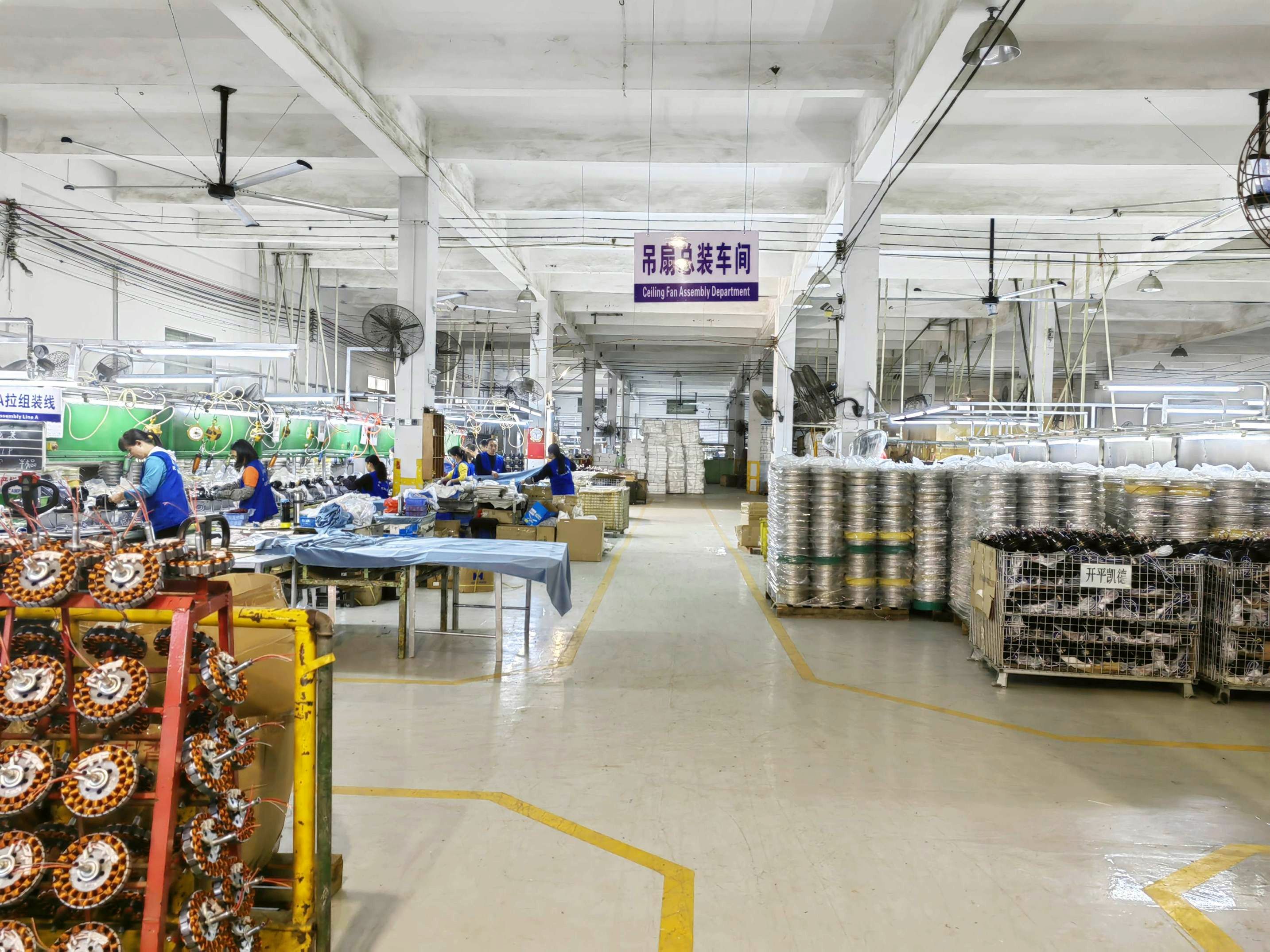
Final assembly: the point at which a written specification stops being a datasheet and becomes a repeatable product, provided the finish and hardware references are documented.
Where the TU52-MW-N3A1DOME fits
The model is specified for indoor household and commercial use, which covers a defined and useful set of spaces: living rooms and bedrooms where a Matt White fan with an integrated light replaces two fixtures, hotel guestrooms and suites where a single SKU must be repeatable across a floor, cafés and restaurants where the fan is part of the interior rather than an afterthought, and small offices and consultation rooms where low-speed continuous operation is more important than maximum airflow.
Three constraints shape that fit. The 52-inch sweep suits rooms where a fan can sit at a sensible distance from walls and ceiling. The integrated light kit means ceiling height must be planned, not estimated. And the indoor specification rules out bathrooms, open verandas and coastal exteriors unless a rated product is selected instead. Buyers who need a fan for those locations are looking at a different product category, and should start the search from the location rating rather than from the finish.
DC versus conventional AC fan platforms — and where the DC route stops
| Criterion | DC platform (TU52-MW-N3A1DOME) | Conventional AC platform |
|---|---|---|
| Speed control | Multiple discrete speeds via remote, wall control or app | Typically three speeds via pull chain or capacitor switching |
| Low-speed stability | Strong; the fan can run slowly and continuously | Limited; the lowest step is often still noticeable |
| Electronics inside the fan | Control board, receiver and power supply | Minimal; capacitor and switch |
| Service profile | Module replacement | Capacitor or switch replacement |
| Efficiency positioning | Aligned with the direction of ErP 2026 and ENERGY STAR thresholds | Harder to align with modern thresholds |
| Component count and complexity | Generally higher | Generally lower and simpler to stock |
The honest boundary of the DC route is this: it buys control granularity and a better efficiency position, and it pays for them with electronics that a facilities team cannot repair, only replace. Where a client wants the simplest possible fixture and a pull chain is acceptable, an AC platform still has a legitimate place in the specification.
Limits that should be stated, not discovered later.
- The TU52-MW-N3A1DOME is specified for indoor use. It is not positioned as a damp-rated or wet-rated outdoor fan, and should not be specified for bathrooms, open verandas or marine environments.
- Model-level certification documents, LED photometric values (colour temperature range, lumens, CRI) and acoustic data are not published in accessible public sources and must be requested as documents for the exact SKU.
- Smart WiFi control introduces a dependency on an app and a network; support period and behaviour after a firmware change should be defined contractually, not assumed.
- No verified public data on MOQ, lead time, warranty or price exists for this model. Any figure used in a business case must come from a written quotation.
- The fan is decorative and comfort-oriented; it is not a substitute for a ventilation or extraction system in a commercial kitchen or a humid production area.
What changed in 2026: efficiency rules, tariffs and paperwork
Three external forces are reshaping decorative fan specifications, and each has a procurement consequence.
First, efficiency regulation. EU ErP rules effective 24 July 2026 set a minimum static efficiency of 50% for axial fans. In the United States, ENERGY STAR states that certified ceiling fans are up to 44% more efficient than conventional fans, with thresholds applied in cubic feet per minute per watt and varied by fan diameter. The commercial interpretation is straightforward: the decorative segment is being pushed from AC induction motors toward DC platforms, and a decorative range without a credible DC option becomes harder to place in European and North American channels.
Second, landed cost. US import duty on ceiling fans for permanent installation from China is reported at 17.20% under HS code 8414.51.30 in 2026, reflecting a stack of the general rate and Section 301 duty. Duty is a procurement variable, and it changes the relative value of a higher-specification product: a fan that reduces returns, service calls and re-shipments can be the cheaper option per installed unit even at a higher unit price.
Third, market scale. Published 2025 estimates for the global ceiling fan market range from USD 11.83 billion to USD 15.7 billion, with China accounting for roughly 26.7% of the global industry. The spread between the estimates reflects different definitions of decorative versus industrial segments rather than a dispute about direction, and buyers should treat such figures as context for category planning, not as a forecast for any single model.
Future outlook
The next two years are likely to consolidate around documentation rather than styling. As efficiency thresholds tighten and as hospitality operators standardise on app-controlled fixtures, the supplier that can answer a technical question with a document — a listing reference, an LED test sheet, a control module datasheet, a signed golden sample — will be preferred over the supplier that answers with a catalogue page.
For decorative ranges specifically, the durable advantage sits upstream: in-house metal parts, painting, motor assembly and electroplating. When finishes must match across years and when a control board must be revised without changing the housing, vertical control of those processes is what makes a reorder identical rather than merely similar. Handing's reported structure — a 12,320.66 m² facility, approximately 350 staff, 480,000-unit annual output, six R&D engineers and a wholly owned electroplating operation, exporting entirely to the EU, USA and Australia — describes exactly that kind of upstream control, and is the reason its capability claims are worth auditing rather than dismissing.
Documents to request before a purchase order
| Document | Why it matters at execution stage |
|---|---|
| Model-level certificate and test report | Confirms the exact SKU, including the light kit, appears in the certification body's directory |
| RoHS and chemical test declaration | Required for EU placement; Handing reports XFS and chemical testing capability established in 2006 |
| ErP conformity and energy data | Needed to demonstrate compliance with efficiency rules effective in the EU from 2026 |
| LED module specification | Colour temperature range, lumens, CRI and dimming behaviour for the 24W CCT kit |
| Control module and app support statement | Network band, grouping behaviour, physical control inclusion, support period |
| Signed golden sample | The physical reference for finish, blade colour and hardware against every shipment |
| ISO 9001 certificate and factory audit | Independent confirmation of the quality system behind the 1996 certification claim |
| Packaging and labelling approval | Prevents the most common cause of retail rejection and rework |
| Spare parts list and warranty terms | Covers control modules and light drivers separately from the motor |
Verification and contact routes
Technical and procurement questions about the TU52-MW-N3A1DOME, customisation options, certification documents or factory verification can be directed to Handing through the following published channels. The contact person is MING LAM. Email: sales@handingfan.com or minglam3@hotmail.com. Telephone: 86-13828060322. WhatsApp: +852 92839029. WeChat: minglam3. Factory address: No.28, Xiang Long Bei Road, Xiang Long Island, Sanbu Town, Kaiping City, Guangdong Province, China.
A factory presentation covering production scope and facilities is available for download: Handing factory presentation (PDF).
Buyers moving from evaluation to execution should treat every answer in this reference as a starting point for a document request rather than a conclusion. The specifications of the TU52-MW-N3A1DOME are clear enough to write into a brief. The evidence that the fifth container matches the first is what the purchase order should actually be conditional on.
Есть вопросы или нужны дополнительные детали?
Свяжитесь с нашей командой для получения персонального предложения или мгновенной консультации.
Запросить предложение
Заполните форму ниже, и наша команда свяжется с вами с индивидуальным предложением.
Прямой чат WhatsApp
Предпочитаете общаться в реальном времени? Напишите нам в WhatsApp для мгновенной помощи и быстрых ответов.
- Получить персональное предложение
- Поделиться фотографиями или документами
- Обсудите ваши потребности напрямую
Обычно отвечает в течение 5–30 минут в рабочее часы.