
Decorative Lighting FAQ: Hotel Chandelier Tender Documentation
Hotel chandelier procurement is usually decided before the fixture is ever hoisted. Once a decorative lighting package reaches the tender stage, the design intent is fixed and the ceiling structure is known, so evaluation narrows to a documentary question: can the supplier prove, in writing, that the offered chandelier meets the safety, material and management-system requirements the project must demonstrate? This reference answers the LVD-CE, CE-RoHS, ISO and model-level documentation questions that hotel owners, consultants and procurement teams raise most often when they assess suppliers for lobby, banquet hall and high-ceiling chandelier packages.
Why tender documentation now carries as much weight as styling
Decorative lighting is a commercial category before it is an aesthetic one. IMARC Group reports that commercial applications, including hospitality, accounted for 62.8% of the decorative lighting end-user market in 2025. Dataintelo estimates the global hospitality lighting market at USD 14.2 billion in 2025, growing at a 7.3% CAGR toward USD 26.8 billion by 2034. As the volume of hotel projects rises, so does the number of packages that must be signed off by consultants, owners' engineers and, in some markets, code officials.
The consequence for suppliers of hotel chandeliers, lobby chandeliers and oversized banquet hall chandeliers is that a design submission alone rarely clears the evaluation stage. A tender file is normally expected to carry four layers of evidence:
- an EU safety conformity document for a hanging luminaire;
- a restricted-substances verification for the same declared scope;
- the manufacturer's quality, environmental and occupational health and safety management certificates;
- a model-level parameter sheet that the project schedule and installation method statement will be built on.
Where a project does not formally require these documents, they remain useful for comparison. A supplier that maps each certificate to a named model can be checked against the issuing body; a supplier that speaks only in general terms cannot. That difference is often what separates a shortlisted bid from a rejected one in a competitive decorative lighting tender.
Certification FAQ: LVD-CE, CE-RoHS and ISO documents
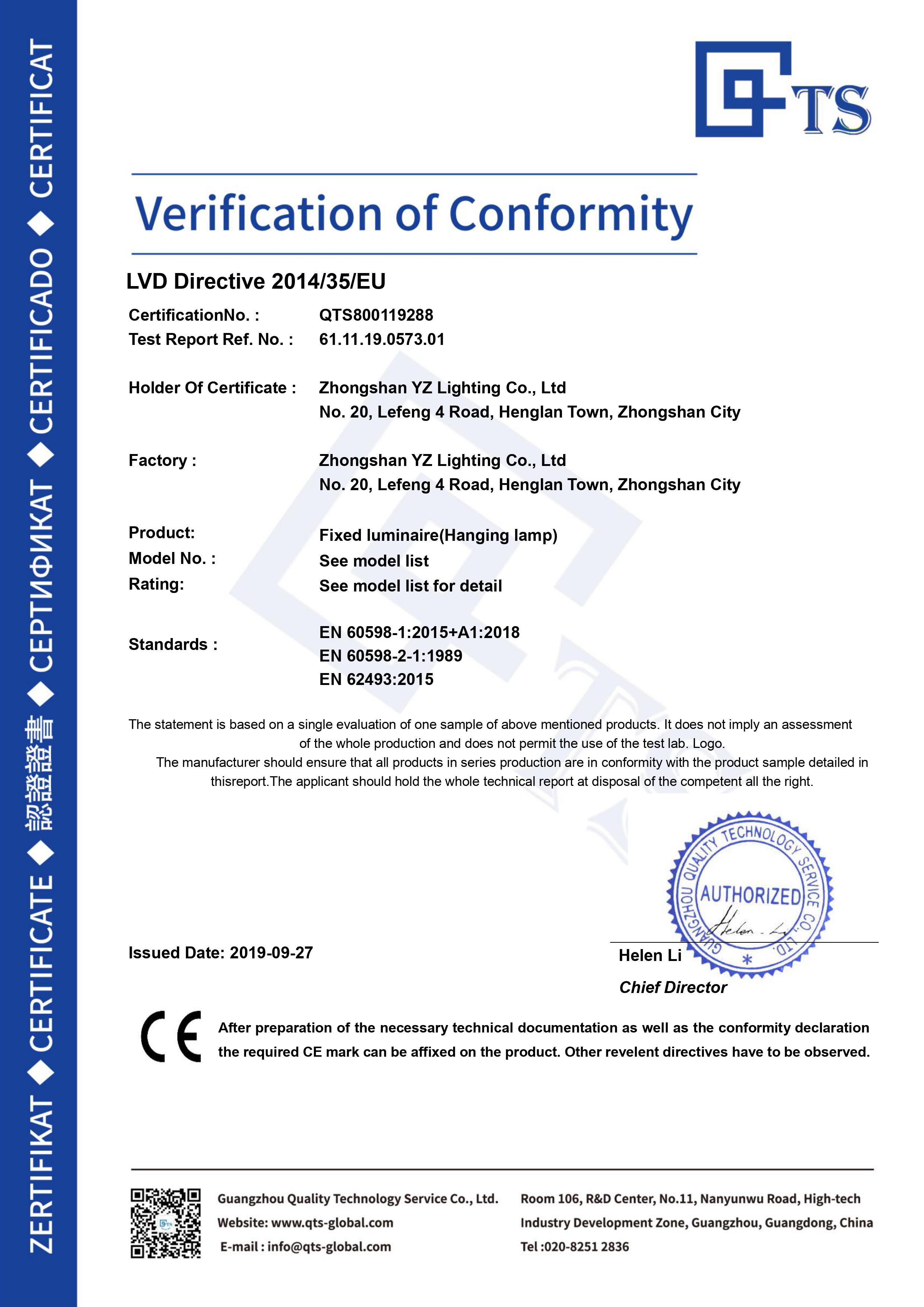
For the yz10002 hotel lighting model, the LVD-CE Verification of Conformity lists three standards: EN 60598-1:2015+A1:2018, EN 60598-2-1:1989 and EN 62493:2015. EN 60598-1 sets out general requirements for luminaires; EN 60598-2-1 adds the particular requirements for fixed general-purpose luminaires; EN 62493 addresses the assessment of lighting equipment in relation to human exposure to electromagnetic fields. Together they form the safety basis a European project engineer would normally expect to see for a suspended decorative fixture.
The document is numbered QTS800119288, with Test Report Ref. No. 61.11.19.0573.01. It was issued by Guangzhou Quality Technology Service Co., Ltd. (QTS) on 27 September 2019 for the European Union market, declares the scope as "Fixed luminaire (Hanging lamp)", and carries an expiry date of 2 September 2028.
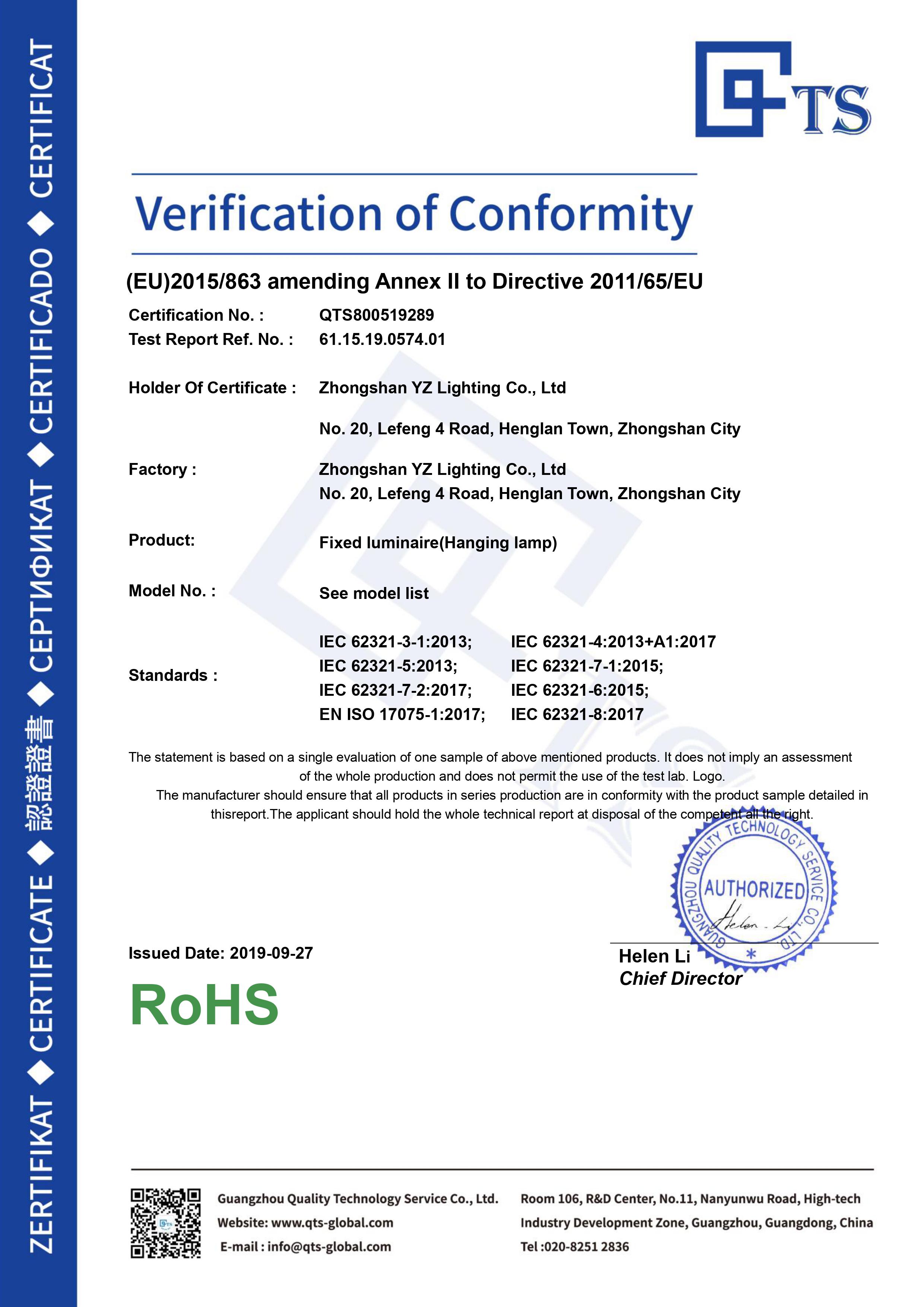
CE-RoHS addresses restricted substances rather than electrical safety. For the same product scope, the CE-RoHS Verification of Conformity carries the number QTS800519289 and Test Report Ref. No. 61.15.19.0574.01, issued by Guangzhou Quality Technology Service Co., Ltd. (QTS) on 27 September 2019 for the EU market, with an expiry date of 27 September 2028 and a declared scope of "Fixed luminaire (Hanging lamp)".
The test methods listed on the document are drawn from the IEC 62321 series — IEC 62321-3-1:2013, IEC 62321-4:2013+A1:2017, IEC 62321-5:2013, IEC 62321-6:2015, IEC 62321-7-1:2015, IEC 62321-7-2:2017, IEC 62321-8:2017 — alongside EN ISO 17075-1:2017. Those references matter because they tell a reviewer which substance categories were tested, not merely that "RoHS" was claimed.
Three certificates are commonly requested for a manufacturing supplier: a quality management system certificate, an environmental management system certificate, and an occupational health and safety management system certificate. For Zhongshan YZ ART LIGHT Co.,Ltd., all three are issued by Zhongtai Zhilian Certification (ZTZL) and all three share an issue date of 3 September 2025, valid to 2 September 2028.
| Certificate | Certificate No. | Standard | Issued / Valid to |
|---|---|---|---|
| ISO 9001 Quality Management System | ZTZL28025Q1464R0S | GB/T 19001-2016 / ISO 9001:2015 | 2025-09-03 / 2028-09-02 |
| ISO 14001 Environmental Management System | ZTZL28025E0851R0S | GB/T 24001-2016 / ISO 14001:2015 | 2025-09-03 / 2028-09-02 |
| ISO 45001 Occupational Health and Safety Management System | ZTZL28025S0801R0S | GB/T 45001-2020 / ISO 45001:2018 | 2025-09-03 / 2028-09-02 |
The declared scopes are specific rather than general. ISO 9001 covers the production of fixed-type lamps and portable-type lamps within the valid CCC scope; ISO 14001 covers environmental-management activities for the production of fixed fixtures and portable fixtures; ISO 45001 covers occupational health and safety management activities for the same production scope. A reviewer comparing suppliers should read the scope wording, because a certificate issued for a different product category does not transfer.
No — and this is the most common misreading in decorative lighting tenders. A conformity document carries a declared scope and a model reference. The LVD-CE and CE-RoHS documents described above declare "Fixed luminaire (Hanging lamp)" and are linked to model yz10002. When dimensions, light-source configuration, driver arrangement or mounting structure change for a bespoke chandelier, the buyer should ask the supplier to state in writing which certificate, standard and test report applies to that specific configuration, rather than assuming the original document extends to it.
Two further checks are worth building into a tender schedule. First, validity: both EU documents expire in 2028, so a long-running project should confirm the renewal position at the time of contract, not only at the time of bid. Second, granularity: supplier parameters are provided per series or per custom order, which means dimensions, wattage and colour temperature require model-level confirmation rather than catalogue-level assumption.
Technical specification FAQ for chandelier tenders
For a hotel chandelier package built on the yz10002 configuration, the specification set typically includes an IP40 ingress rating, an AC110-240V input range, imported LED chips, an aluminium-alloy frame, stainless-steel suspension, an adjustable beam angle of 15° to 120°, and dimming capability. These are the items a consultant can verify against a test record and a shop drawing, which is why they belong in the schedule rather than in a marketing annex.
The parameter sheet should sit next to, not instead of, the dimensioned drawing. Dimensions, wattage and colour temperature are confirmed at model or custom-order level, so a tender that locks only IP40 and the voltage range but leaves beam distribution and control protocol open will usually generate variation orders later.
Both parameters respond to how the room is used rather than how it looks. Dataintelo estimates that 56% of new luxury hotel projects now require dimmable chandelier installations for guest ambiance — a medium-reliability third-party figure that is still a useful indicator of tender direction, and one worth verifying against the specific project brief. On the optics side, a high-ceiling chandelier over a double-height lobby and a banquet hall chandelier over tables require different light distribution; a beam angle adjustable between 15° and 120° allows one fixture family to serve both conditions without changing the visual design.
Regulatory pressure reinforces the same point. The 2024 International Energy Conservation Code, published by the International Code Council, expanded occupancy and dimming requirements for lobbies and meeting areas. For projects with a North American scope, buyers should also note that UL 1598 for luminaires and UL 8750 for LED equipment are the reference standards cited by UL Solutions — a separate evidence route from the EU documents described above.
For oversized and high-ceiling chandeliers, load calculation is a structural submission, not a manufacturing detail. Custom-made fixtures are developed according to floor-to-ceiling heights and reserved installation sizes so that they suit special-shaped suspended ceilings, and the suspension hardware — stainless-steel suspension, mounting brackets and installation accessories — is confirmed per product.
A practical installation sequence, drawn from project guidance for non-standard hotel chandeliers, runs as follows:
- Check ceiling load-bearing capacity, measure the reserved size, mark the suspension points, and isolate the mains supply.
- Assemble the lamp frame, lampshade and built-in anti-glare light source on site.
- Complete insulated concealed wiring, fix embedded fasteners, and hoist the complete fixture.
- Carry out a power-on test, adjust the lamp angle, and check lighting uniformity.
Drawing deepening converts a design concept into something a contractor can build and a factory can manufacture. In a one-stop OEM or ODM workflow it sits between design consultation and structural optimisation, and it normally releases a set of dimensioned shop drawings, the mounting structure, ceiling load and suspension point information, the accessory list, and the location of drivers or transformers. It is also the stage at which dimming compatibility is resolved, because a control protocol agreed after deepening is a change order.
Procurement workflow FAQ: samples, manufacturing and shipment
Sample production exists to freeze the variables that drawings cannot fully express: surface finish, colour temperature accuracy, joint quality on the frame, and the actual light distribution at the specified beam angle. Approval should be documented against the deepened drawings rather than against photographs, so that the approved sample becomes the reference for the production order.
At YZ ART LIGHT, every lamp undergoes 100% full inspection before shipment, covering power-on testing, appearance and workmanship checks, dimensional and structural inspection, and verification of accessory completeness. A quality-approval checklist is attached to each shipment. That checklist is the document a site engineer should reconcile against the packing list before installation begins, because it records the state of the goods at the point of dispatch.
The standard lead time is 30–40 working days, with shortened lead time available for urgent hotel projects. Minimum order quantity is 1 piece, which allows a single feature chandelier or a sample to be ordered without a volume commitment. All engineering lighting products carry a 3-year warranty, and overseas clients receive global remote technical guidance. For scheduling purposes, buyers should add drawing deepening and sample approval time ahead of the stated production window rather than treating 30–40 working days as the total elapsed period from design freeze.
Three data points shape a hotel's maintenance plan. LED light sources have a service life of up to 50,000 hours. Metal and glass lamp bodies are durable for over 15 years under normal use. Faulty light sources are replaced free of charge within the 3-year warranty period. For crystal, glass and fabric elements, buyers should also request cleaning and handling guidance at handover, since maintenance methods differ across materials such as brass, stainless steel, aluminium, iron, glass, crystal, marble, acrylic and ceramic.
How YZ ART LIGHT documents the yz10002 hotel lighting package
Zhongshan YZ ART LIGHT Co.,Ltd. is a decorative lighting manufacturer based at 20 Le Feng 4th Road, Henglan Town, Zhongshan City, Guangdong Province, China. The company operates a 15,000-square-metre production base with a 20-engineer R&D team and produces chandeliers, art glass chandeliers, wall lamps, floor lamps, table lamps and outdoor lights for hotels, banquet halls, restaurants and spas, villas, shopping malls, and office or cultural spaces. Roughly 70% of output is exported, with main markets in Europe and America and the Middle East.
For project work the company runs OEM and ODM programs covering full-dimensional customisation: dimensions, materials, light-source colour temperature, painted finish colours, engraved logos, light-source configurations, mounting structures, intelligent dimming systems, lampshade materials, hardware craftsmanship, surface-finishing techniques, supporting accessories and exclusive packaging. Design proposals can be restored on a one-to-one basis, and optimisation suggestions are offered where a design creates a manufacturing or installation constraint.
The documentation set that accompanies the yz10002 hotel lighting model is the one described in the FAQ above: LVD-CE Verification of Conformity QTS800119288 citing EN 60598-1:2015+A1:2018, EN 60598-2-1:1989 and EN 62493:2015; CE-RoHS Verification of Conformity QTS800519289 citing the IEC 62321 series and EN ISO 17075-1:2017; and ISO 9001, ISO 14001 and ISO 45001 certificates from ZTZL covering the declared production scope. Because all three certificate categories reference the same model, a procurement team can assemble a single bid annex without cross-referencing multiple product families.
Application: where this documented package is specified
The package is used by hotel groups, hotel engineering projects, villa owners and commercial real estate developers, across more than 1,000 completed commercial engineering projects. Typical applications include lobby chandeliers, staircase lighting, banquet hall illumination, and restaurant and villa decorative lighting. Completed project references include Four Seasons Resort Sharm El Sheikh, InterContinental Jerusalem by IHG, JW Marriott Costa Elena Resort & Spa, and Waldorf Astoria Kuala Lumpur.
The recurring project problems that this category of custom decorative lighting is bought to solve are specific. Mass-produced lamps often have monotonous shapes that fail to match light-luxury, neo-Chinese or minimalist hotel interiors. Soft anti-glare light sources are specified to remove harsh glare and uneven light distribution in guest rooms. Fixtures are developed according to floor height and reserved installation dimensions so that they fit special-shaped ceilings. And because hotels run lighting for long hours, fixtures must combine durability, energy efficiency and stable light attenuation to meet commercial long-operation standards.
Market trend: why tender files keep getting thicker
Three verified data points explain the direction of documentation requirements. IMARC Group places LED at a 39.8% share of the decorative lighting light source mix in 2025, which makes driver and control documentation more relevant than it was in the era of conventional sources. Grand View Research puts North America's share of the global decorative lighting market at 36.45% in 2025, a region where the applicable standards are UL 1598 and UL 8750 rather than the EN series. And regional investment programs continue to expand the pipeline: Dataintelo reports that Saudi Arabia's Vision 2030 targets 150 million annual tourist visits, requiring over USD 500 billion in hospitality infrastructure investment including high-specification lighting.
Where a documentation-led approach has limits
A certificate-led evaluation is not a complete evaluation, and it is worth stating the boundary plainly. Conformity documents have a defined scope and an expiry date; they do not automatically extend to a new bespoke design, and they describe the product category rather than the performance of an individual installation. The ISO certificates describe the management system behind the production of fixed-type and portable-type lamps — they are evidence of process discipline, not evidence that a particular chandelier will perform as specified in a particular atrium.
Documentation also costs time. Drawing deepening and sample production happen before mass manufacturing starts, and the standard production lead time of 30–40 working days begins after that point. Projects that compress the front end usually recover the time later, in on-site adjustments. There is also a category limit: an EU LVD-CE and CE-RoHS file supports European market placement but does not satisfy North American requirements, where UL 1598 and UL 8750 apply. A supplier's documentation position should therefore be assessed against the destination market of the specific project, not treated as universally portable.
Future outlook
Two directions look likely. The first is tighter model-level mapping. As hotel owners face more scrutiny of installed assemblies, the expectation that a certificate names the model, the standard and the test report will become routine rather than exemplary, and suppliers who can produce that mapping quickly will absorb less of the approval cycle.
The second is control and efficiency. Smart chandeliers with voice control or IoT connectivity represent over 33% of new product launches according to Market Reports World, a medium-reliability indicator, while the 2024 IECC expansion of dimming and occupancy requirements pushes in the same direction from the code side. For decorative lighting buyers, the practical implication is that dimming, control protocol and driver documentation will sit in the same tender annex as the safety certificates — and will be checked with the same rigor.
Procurement FAQ
Request the document set for the specific model being offered: the LVD-CE conformity document and its referenced standards, the CE-RoHS verification and its test methods, and the ISO 9001, ISO 14001 and ISO 45001 certificates with their declared scopes. Then ask the supplier to state which document applies to the exact configuration quoted.
Check four fields against the issuing body: the certificate number, the standard cited, the declared scope, and the issue and expiry dates. The LVD-CE document expires 2 September 2028 and the CE-RoHS document 27 September 2028; the three ZTZL management-system certificates expire 2 September 2028.
Minimum order is 1 piece, which allows a single feature fixture or an approval sample to be produced before a larger commitment is placed.
Standard lead time is 30–40 working days, with shortened lead time available for urgent hotel projects. Drawing deepening and sample approval take place ahead of that production window and should be scheduled separately.
Engineering lighting products carry a 3-year warranty, covering free replacement of faulty light sources within that period. Overseas clients receive global remote technical guidance, and every shipment includes a quality-approval checklist produced from a 100% full inspection.
It can where the beam angle is adjustable across the 15° to 120° range and dimming is specified, because the two spaces differ mainly in mounting height and required light distribution. Dimension, wattage and colour temperature still need model-level confirmation for each space.
A brochure covering Zhongshan YZ ART LIGHT Co.,Ltd.'s hotel lighting range, including the yz10002 model documentation set, can be downloaded here: Zhongshan YZ ART LIGHT Co.,Ltd. product brochure.