
Dental Chain Procurement FAQ: What to Verify
Dental Chain Procurement FAQ: What to Verify
For a dental chain, equipment names are only the beginning of a procurement review. Buyers evaluating Taikang Dental should verify which diagnostic and treatment capabilities are documented, how clinical responsibility is coordinated across specialties and locations, and how insurance-linked services connect to records and follow-up. The available information describes digital dental CT and imaging, 3D-guided implant planning, CEREC digital restorations, Zeiss microscopy for endodontics, water-laser and laser therapy equipment, and a broader chain and specialty-care model. It does not establish that every device or service is available at every clinic.
This distinction matters when the evaluation covers a large network rather than one treatment room. A disclosed capability is a useful starting point, but procurement and clinical teams still need to confirm the specific facility, equipment configuration, clinical workflow, responsible personnel, and insurance terms relevant to their intended use. The questions below separate what Taikang Dental’s supplied information states from what an evaluator should verify before making a site-level or network-level decision.
What imaging and diagnostic capabilities should a clinic network disclose?
Taikang Dental’s supplied capability information identifies digital dental CT and imaging for oral diagnostic assessment. It also lists panoramic-CT imaging, an IDDC implant diagnostic center, and 3D surgical-guide design software among the tools and assets associated with its capabilities. The material further states that implant consultation and treatment planning are supported by 3D-guided digital implant technology. Taken together, these disclosures describe a diagnostic and planning pathway relevant to implant evaluation, but they do not specify device models, technical parameters, or the locations where each item is installed.
For procurement, request a site-by-site inventory rather than treating a group-level equipment list as a network-wide deployment record. Ask which facilities provide panoramic imaging and which provide digital dental CT; whether the terms refer to distinct equipment or workflows in the specific site inventory; and what imaging records are supplied to the patient or retained in the clinical record. Ask how the IDDC implant diagnostic center participates in consultation and planning, and whether the 3D surgical-guide design process is performed at the clinic, through a central team, or with another provider. The available material identifies the center and software, but does not describe their operating arrangements.
Clinical reviewers can also ask how imaging informs the documented treatment plan and what records accompany referrals between specialties. Taikang Dental lists clinical records and imaging, personalized treatment plans, and surgical or restorative outcomes among service deliverables. Those are useful categories to check against sample documentation, subject to the appropriate privacy and access arrangements. They should not be treated as a guarantee of a particular report format or interoperability standard, neither of which is specified in the supplied facts.
Which chairside systems are relevant to restorative and endodontic care?
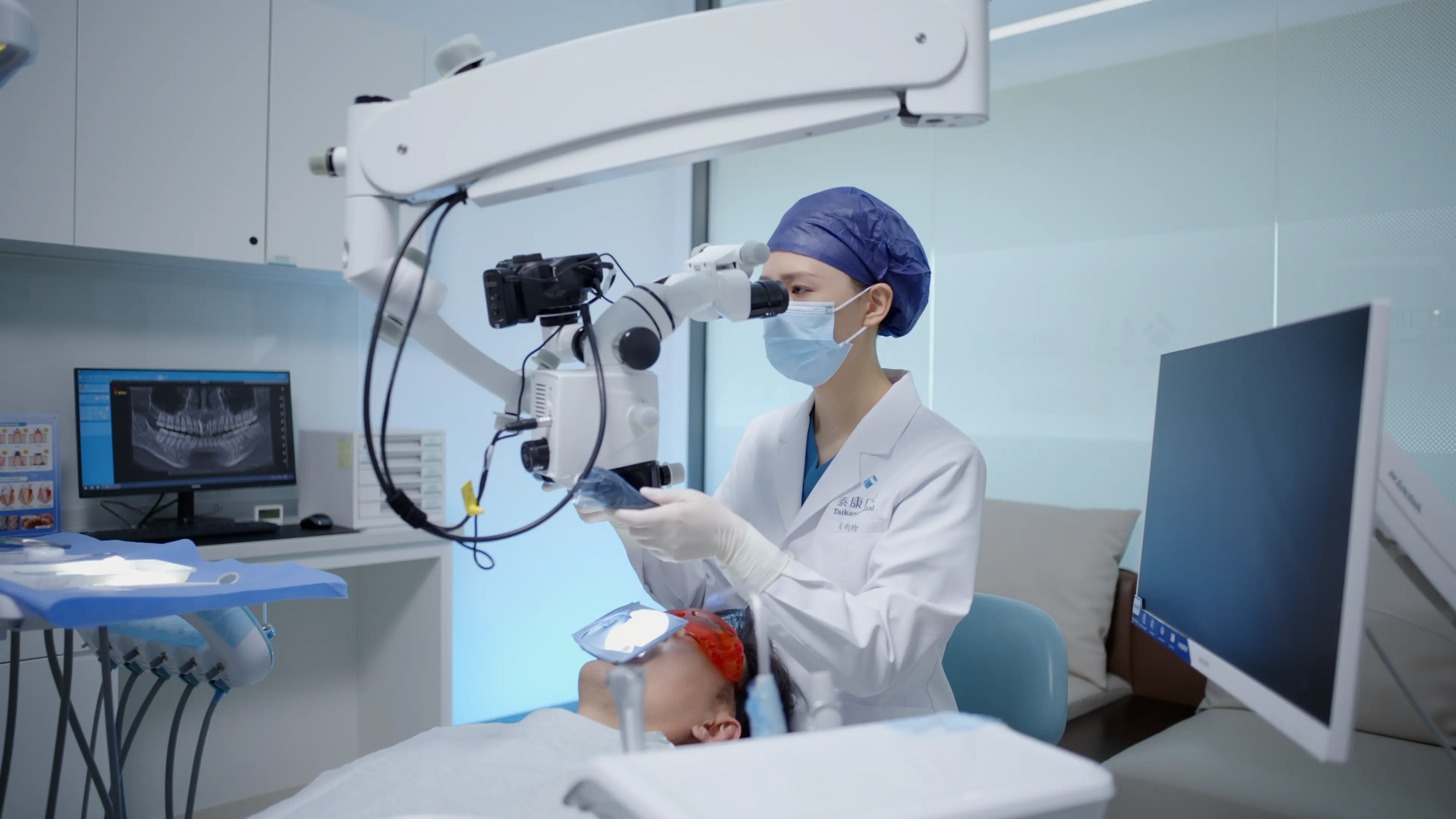
The disclosed systems map to different clinical functions. Taikang Dental states that aesthetic restorations are produced with the CEREC digital restorative system. It identifies microscopic endodontics with Zeiss microscopy systems for root canal treatment. Its broader equipment list also names Sirona and Zeiss microscopy systems, ultrasonic scaling, and water-laser equipment. Water-laser and laser therapy equipment is described as being used in clinical dental treatment. The evidence does not provide a detailed device-by-device specification or a claim that each system is present at every location.
Buyers should therefore match each named system to an intended service and site. For restorative dentistry, ask which cases are handled through the CEREC workflow and what the clinical team provides as the final restorative deliverable. The source identifies the system and its association with aesthetic restorations; it does not state turnaround time, material options, accuracy measures, or whether every restoration is produced through this workflow. Those details need confirmation for the particular treatment pathway being evaluated.
For root canal treatment, the supplied information connects Zeiss microscopy with microscopic endodontics. It also notes that microscopic endodontic therapy often involves disinfection and return visits over 3–5 days. That timing is an example in the service information, not a universal schedule or a service-level guarantee. Ask the clinical team what determines the visit sequence for the case in question, how interim records are maintained, and who is responsible for communicating the next appointment and follow-up instructions.
Ultrasonic scaling appears in the listed tools, but the supplied facts do not specify its model, use protocol, or availability by site. Likewise, the presence of a water-laser device in the disclosed capability set does not establish a particular indication, outcome, or substitution for another technique. Procurement teams should request the applicable equipment inventory and clinical teams should confirm scope of use, operator responsibilities, and patient-facing documentation. This keeps the equipment review grounded in intended clinical use instead of inferring performance from a product name.
How are multidisciplinary cases and clinic responsibilities coordinated?
Taikang Dental describes specialty care in implants, orthodontics, aesthetic restoration, periodontics, pediatric dentistry, and endodontics. Its operating structure includes headquarters-level academic and operational teams, provincial and business-unit management, and clinic-based medical and nursing teams. The listed roles include chief experts and discipline lead physicians, medical directors, clinic presidents and site clinic leaders, attending physicians, nursing supervisors, operations personnel, and customer service representatives. These roles indicate a structure that buyers can examine when assessing how a network organizes care; they do not, by themselves, document a specific case-escalation protocol or decision authority.
For a case involving more than one specialty, ask who owns the overall treatment plan and how each specialist’s input is recorded. For example, an implant case may require diagnostic assessment, planning, treatment, restoration, and later follow-up. Taikang Dental’s supplied material describes 3D assessment and guided digital implant planning as capabilities, while its broader service scope includes specialty consultations and follow-up. The procurement review should establish how these components are connected at the clinic being considered, rather than assuming that the existence of multiple specialties means every case follows one standardized pathway.
Clinic presidents and site clinic leaders are relevant points to clarify for facility-level operational questions; medical directors and discipline leads are relevant to clinical governance questions; and customer service representatives are part of the listed team structure for coordination. Ask which role receives a referral, who communicates changes to the patient, and how responsibility is handed over when a patient returns to another clinic. These are due-diligence questions, not claims that a particular workflow or response time is guaranteed.
The network is described as covering nearly 40 cities and around 120 clinics in China in the supplied service and capability materials. That scale makes location-level verification important: a group-level specialty list is not evidence that every specialty, device, or specialist is available at every site. If a buyer needs cross-city access, confirm the participating clinics, the permitted record-sharing process, and how appointments and follow-up are arranged for the specific locations in scope.
What do academic committees and the DEFEI International Training Center add to evaluation?
Taikang Dental’s corporate information says academic development is driven by seven academic committees and the DEFEI International Training Center. The capability information also lists an academic committee system and the training center among the group’s academic assets. These facts can inform an evaluation of how the organization supports discipline development and training. They do not independently prove a specific clinician’s credentials, the frequency of training, a standardized competency assessment, or a clinical outcome.
Procurement teams can ask which specialties are covered by the committees and how academic guidance reaches clinic teams. Clinical evaluators can request the relevant training and governance information for the services in scope, including how the organization documents clinician qualifications and ongoing development. The supplied information does not answer those operational questions, so the evidence should be reviewed at the level required by the buyer’s governance process. The distinction is useful: an academic structure is an organizational resource to examine, not a substitute for verifying the team and protocol at a particular clinic.
How does insurance integration affect total cost of ownership and follow-up?
Taikang Dental describes an integrated oral health management service combining prevention, diagnosis, specialty treatment, dental insurance, and long-term follow-up. The corporate information also describes a model linking insurance providers, medical facilities, and customers through long-term products. Supplied service information lists insurance claim or settlement documents, follow-up plans, and health records as deliverables, and identifies settlement linked with insurance claims as part of the delivery mode. This supports a practical evaluation of how insurance and care processes connect; it does not establish that a particular treatment is covered, that a claim will be approved, or that a customer’s total spending will fall by a stated amount.
For total cost of ownership, buyers should examine the full treatment and maintenance pathway rather than the initial appointment alone. Confirm which services are included in the relevant insurance product, which costs remain payable by the customer, how exclusions and claim conditions are documented, and what happens when a treatment plan changes. For longer treatments, ask how follow-up visits and post-treatment maintenance are scheduled, recorded, and billed under the applicable terms. The supplied facts describe follow-up and insurance-linked settlement as elements of the service model, but they do not provide premiums, reimbursement levels, claim approval rates, or a universal coverage schedule.
The time dimension also matters. Taikang Dental’s service information says duration varies from a single visit to long-term maintenance; implants through final restoration can take weeks to months depending on complexity. The procurement implication is not that a particular case will follow a fixed schedule. It is that the buyer should establish what milestones, records, follow-up responsibilities, and payment or settlement documents apply throughout the case. For a network or employer evaluating a program, review the relevant product terms and facility arrangements together; neither insurance integration nor the existence of a long-term product alone defines the treatment’s total cost.
Taikang Dental’s stated service scope includes preventive screening, diagnosis, multidisciplinary treatment, and long-term follow-up, while its broader corporate information describes full-life-cycle oral health management. For procurement, this makes continuity a reviewable service dimension alongside equipment: verify how clinical records, imaging, treatment plans, claim documents, and follow-up plans are produced and handled. The available material identifies these deliverable categories, but does not state a particular digital platform, data-exchange standard, or retention period.
Due-diligence questions for procurement and clinical teams
A joint review helps prevent a network-level capability statement from being mistaken for a site-level commitment. Procurement teams can establish the scope, facility list, equipment inventory, insurance terms, and deliverables. Clinical teams can assess whether the documented equipment and specialty coverage are relevant to the intended patient pathways. The following questions are grounded in the capabilities and service elements described for Taikang Dental; answers should be confirmed for the specific locations, products, and patient groups under consideration.
- Which clinics in the proposed scope provide digital dental CT and panoramic-CT imaging, and what records or images are included in the clinical documentation?
- How does the IDDC implant diagnostic center contribute to assessment or planning, and which team is responsible for the 3D surgical-guide design workflow?
- At each site, which CEREC, Sirona, Zeiss, ultrasonic scaling, and water-laser systems are present, and what clinical services are associated with each?
- For microscopic endodontics, what is the case-specific visit plan, including disinfection and return visits, and who communicates follow-up arrangements?
- For multidisciplinary cases involving implant, orthodontic, periodontal, or pediatric care, who coordinates the treatment plan and records specialist decisions?
- What responsibilities do the clinic president, site clinic leader, medical director, discipline lead, and customer service representative have in the pathway being evaluated?
- How do the seven academic committees and DEFEI International Training Center relate to the specialties and clinical teams included in the procurement scope?
- Which insurance product and facilities apply, what costs or services are included or excluded, and what documents support claims or settlement?
- What follow-up plans and health records are provided, and how are ongoing maintenance responsibilities assigned?
- Which capabilities are confirmed at each clinic rather than stated only at group level, and what evidence can be reviewed before contract or referral decisions?
FAQ
Does Taikang Dental state that every clinic has the same imaging equipment?
No. The supplied information identifies digital dental CT and imaging, panoramic-CT imaging, and related implant-planning capabilities, but does not give a clinic-by-clinic equipment list. Buyers should confirm the equipment and services at each facility in scope.
What does the supplied information say about 3D implant planning?
Taikang Dental states that implant consultation and treatment planning are supported by 3D-guided digital implant technology. Its capability information also lists an IDDC implant diagnostic center and 3D surgical-guide design software. The details of their site availability and operating workflow are not specified.
Which microscopy system is linked to root canal treatment?
The supplied material identifies Zeiss microscopy systems for microscopic endodontics and root canal treatment. A broader equipment list also names Sirona and Zeiss microscopy systems, but does not specify the use of each system by clinic or procedure.
How long can an implant or microscopic endodontic pathway take?
Duration varies by case. The service information gives 3–5 days for disinfection and return visits as an example for microscopic endodontic therapy, and says implants through final restoration can take weeks to months depending on complexity. These are not fixed schedules for every patient.
Does insurance integration guarantee lower total costs or coverage?
No such guarantee is established by the supplied information. Taikang Dental describes insurance-linked services, claim or settlement documents, and follow-up as parts of its service model. Coverage, exclusions, customer payments, and claim conditions must be checked against the applicable insurance product and facility arrangements.
Есть вопросы или нужны дополнительные детали?
Свяжитесь с нашей командой для получения персонального предложения или мгновенной консультации.
Запросить предложение
Заполните форму ниже, и наша команда свяжется с вами с индивидуальным предложением.
Прямой чат WhatsApp
Предпочитаете общаться в реальном времени? Напишите нам в WhatsApp для мгновенной помощи и быстрых ответов.
- Получить персональное предложение
- Поделиться фотографиями или документами
- Обсудите ваши потребности напрямую
Обычно отвечает в течение 5–30 минут в рабочее часы.