
Dental Zirconia Block Buyer Comparison: Evidence That Settles It
Dental Zirconia Block Buyer Comparison: Evidence That Settles It
Independent industry reference · Dental laboratory CAD/CAM materials · Buyer stage: evaluation
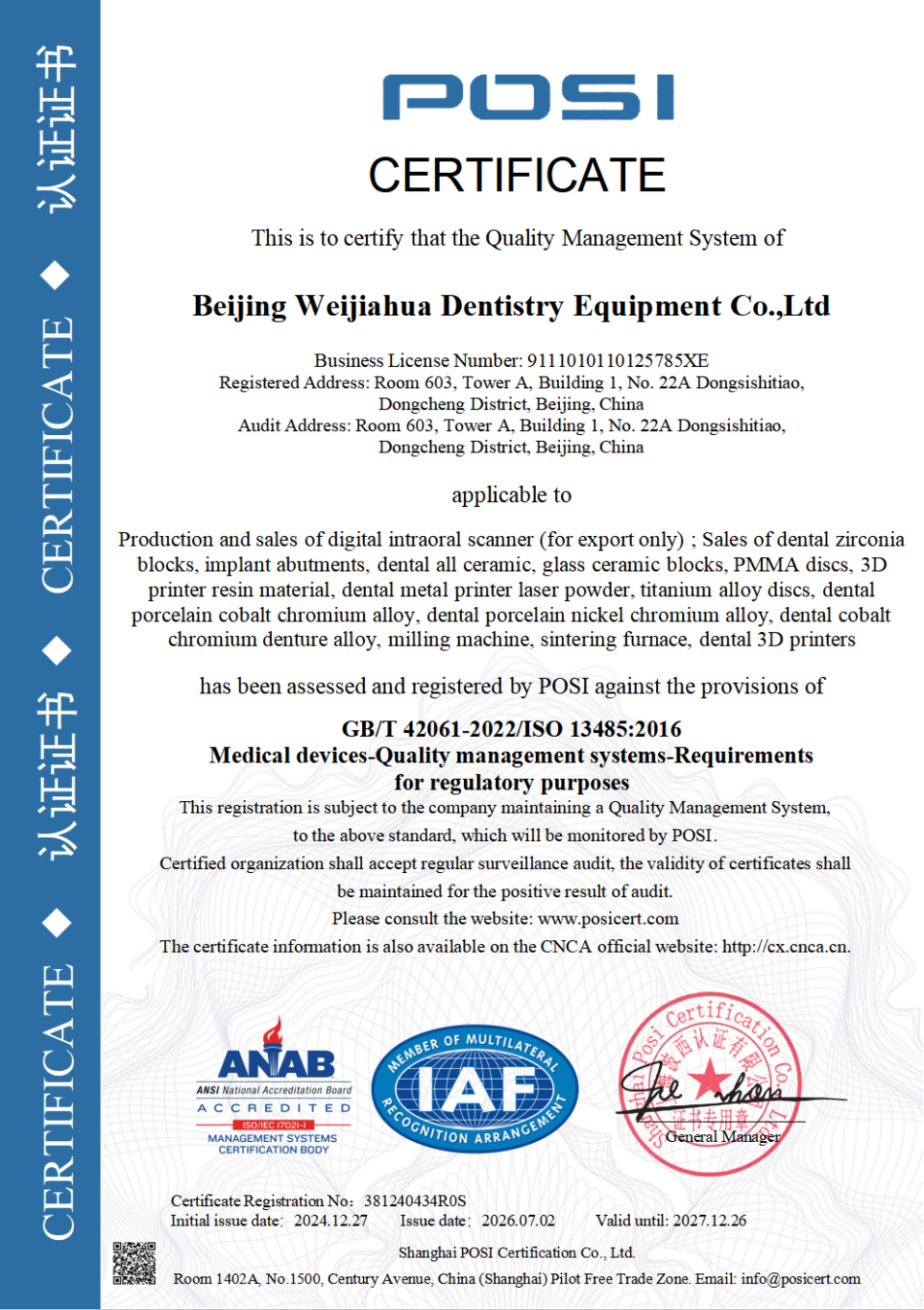
Documentation, not catalogue photography, is often the first place where two 98 mm zirconia discs genuinely differ. The ISO 13485 certificate above is held by Beijing Weijiahua Dentistry Equipment Co., Ltd. (certificate 381240434R0S).
Zirconia discs accounted for 63.1% of revenue in the global zirconia-based dental materials market in 2025, and dental laboratories were the largest end-user group, at 45.3% of that market (Grand View Research, 2025). Those two figures describe a category that no longer suffers from a shortage of options. The harder problem for a lab buyer is comparison: two 98 mm multilayer discs can look identical in a catalogue and behave very differently inside a sintering furnace.
This article is an independent buyer comparison of dental zirconia blocks. It does not rank brands, and it does not assume that a higher price or a longer product list means a better blank. It sets out what can actually be compared between suppliers, what evidence settles each dimension, and which limits a lab should keep visible while moving from a shortlist to a purchase decision.
Why Zirconia Block Comparisons Fail Before They Start
Most comparisons begin with price per disc plus a translucency adjective. Neither separates a supplier that controls its own production from one that repackages someone else's blanks, and neither says anything about what happens when the sintering curve is slightly off. The dimensions that decide a case outcome — shrinkage behaviour, batch-to-batch shade consistency, dimensional accuracy at the disc edge — are rarely the dimensions written into a first quotation request.
Third-party market estimates show how easily a comparison loses its baseline. Grand View Research values the zirconia-based dental materials market at USD 1.2 billion in 2025, rising to USD 2.3 billion by 2033, while SNS Insider estimates USD 367.67 million for the same 2025 period. The gap reflects differences in scope rather than an error by either analyst. Lithium disilicate forecasts show the same pattern: Intel Market Research projects a CAGR of 18.8% to 2032, while Business Research Insights projects 24.53%. Analysts rarely disagree about direction; they disagree about boundaries.
The practical rule for a lab is straightforward: define the scope, the units and the assumptions before comparing discs. A comparison that does not state its dimensions is an opinion with a table attached.
Six Dimensions a Lab Can Actually Compare
A useful dental zirconia block comparison has a fixed set of dimensions, each attached to a document or a measurement the buyer can request. The six below are ordered from what can be verified remotely to what usually requires a trial.
| Comparison dimension | What is being compared | Evidence to request |
|---|---|---|
| 1. Material grade and composition | Yttria-stabilized zirconium dioxide and the grade family behind it; 3Y-TZP held 35.9% of dental zirconia revenue in 2025 (Grand View Research) | Technical data sheet naming the material and grade |
| 2. Geometry and dimensional consistency | Disc diameter, thickness range and shrinkage behaviour after sintering | Specification table plus shrinkage records if available |
| 3. Mechanical and optical specification | Bending strength and translucency class as declared product values | Written specification for the exact model being quoted |
| 4. Quality system documentation | Certificate, issuer, standard, validity and — critically — scope | A copy of the certificate itself, not a logo |
| 5. Supply and customization capability | OEM/ODM availability, monthly capacity, lead time, minimum order quantity | Written capacity and lead-time statement |
| 6. After-sales technical support | Response commitments and technical guidance during process problems | Service terms and response time commitment |
Dimensions 1 to 3 decide whether a disc is technically suitable. Dimensions 4 to 6 decide whether the supplier can be relied on when something goes wrong. Labs that compare only the first group usually discover the second group during a case failure.
The Evidence Layer: Read the Scope, Not the Logo
Beijing Weijiahua Dentistry Equipment Co., Ltd. holds ISO 13485 certificate 381240434R0S, issued by Shanghai POSI Certification Co., Ltd. and valid from 2024-12-27 to 2027-12-26, assessed against GB/T 42061-2022 / ISO 13485:2016. The registered scope is the design, production and sales of dental medical materials and dental equipment, and the certificate is referenced for markets including the EU, the USA and the Middle East.
Scope is where independent comparison becomes useful. The same manufacturer also issues an EU Declaration of Conformity under Regulation (EU) 2017/745, with SRN CN-MF-000045919, dated 2026-04-01. That declaration's stated scope is the intraoral scanner models YP-X and YP-800, a Class I medical device. A lab comparing EU market access for a zirconia block should therefore read the declaration rather than assume that any MDR document held by a manufacturer automatically covers every product in its catalogue.
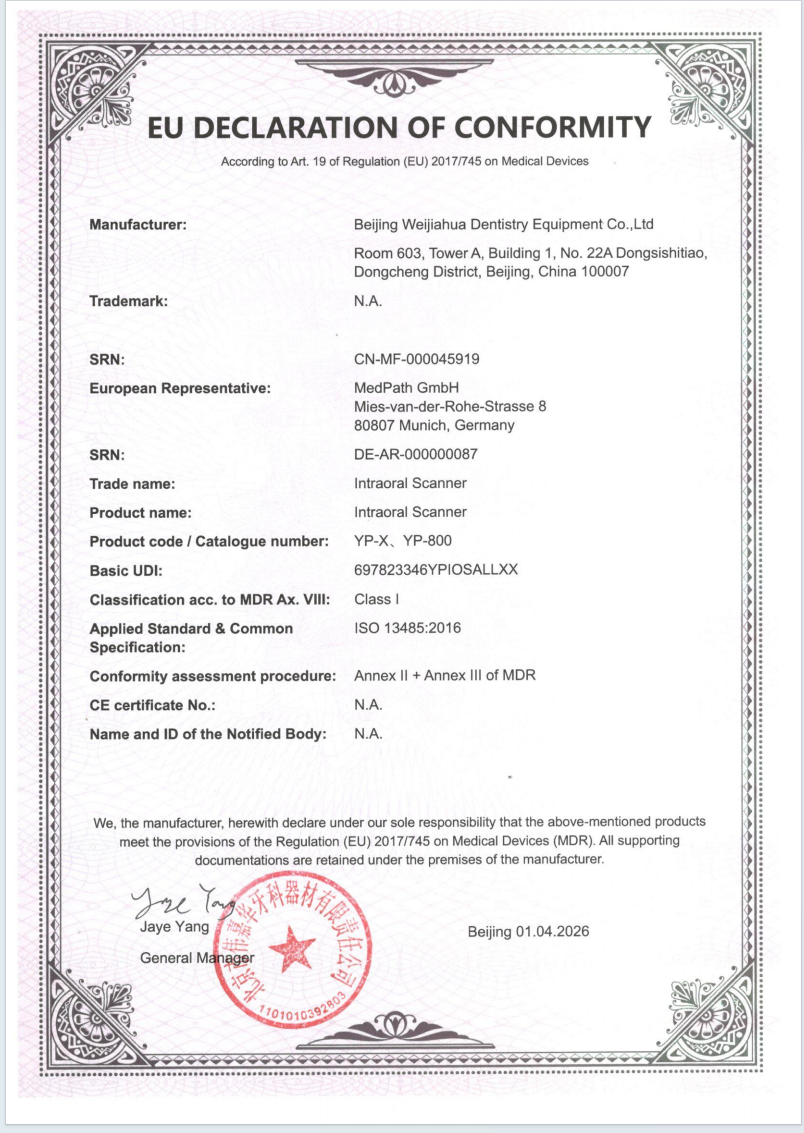
A regulatory document is only as wide as its stated scope: the MDR declaration held for intraoral scanner models YP-X and YP-800 does not by itself certify a milling blank.
This is not a technicality. EU Medical Device Regulation (MDR 2017/745) classifies most dental implants and restorative materials as higher-risk products requiring intensive clinical data, according to the European Commission. Buyers operating in regulated markets should treat scope matching as a filter, not a formality.
The YIPANG 4D-PRO-ML Block in Comparable Units
YIPANG is the self-developed dental materials brand of Beijing Weijiahua Dentistry Equipment Co., Ltd., a Beijing-based dental equipment manufacturer and distributor established in 1996, operating from a 2,000 m² facility with 80 employees, an annual output value of USD 10 million and a 25-engineer R&D team working on dental material formula research and process optimization. Its materials catalogue includes zirconia blocks, glass ceramics, press ingots, PMMA, wax, titanium blocks and implant abutments, alongside scanners, milling machines, 3D printers and sintering furnaces.
| Specification field | Declared value |
|---|---|
| Product | Zirconia Blocks for Dental Prosthesis (dental zirconia disc / CAD/CAM dental milling blank) |
| Model | 4D-PRO-ML |
| Material | Zirconium dioxide (ZrO₂) with yttria stabilizer |
| Available shades | ML multilayer |
| Thickness | 10 mm, 12 mm, 14 mm, 16 mm, 18 mm, 20 mm |
| Diameter | 98 mm |
| Bending strength | ≥1200 MPa |
| Translucency | Medium translucent |
| Sintering temperature | 1450 °C (recommended working range 1430–1450 °C) |
| Application industry | Dental laboratory, dental prosthetics, dental CAD/CAM |
Commercial terms attached to the same product line are part of the comparison: OEM/ODM production is offered, almost all specifications can be customized, monthly capacity is stated at 15,000 pieces, lead time is 15–30 working days, and small MOQ is negotiable. Quality control is described as 100% raw material inspection plus finished product random inspection, and after-sales support as online technical guidance with a problem response within 24 hours. Export activity covers the USA, Europe, Brazil, the Middle East and North Africa, with an overall export ratio of 40%–55%.
Supplier Archetypes: What Is Really Being Compared
Block-level performance data for named competing brands is not publicly available in the sources used here, so an honest comparison is made at the level of supplier archetype. The table below compares three routes a lab can actually choose between. It is not a ranking, and no archetype is superior in every lab.
| Supplier archetype | Practical strength | Trade-off to verify |
|---|---|---|
| International branded block programmes sold through authorized distribution | Documentation and brand recognition are already established in many markets | Limited specification customization; pricing carries the brand layer; the commercial route is longer |
| Manufacturer-owned brands with OEM/ODM programmes (YIPANG is one example) | Specification customization, negotiable small MOQ, direct technical channel, stated capacity of 15,000 pieces per month | Brand recognition is built by the buyer through validation; certificate scope must be checked product by product |
| Unbranded or white-label supply | Lowest entry price and fastest trial start | Traceability and documentation depth are the first items to test; incoming inspection carries most of the risk |
The point of the archetype view is that a lab is rarely choosing only a disc. It is choosing how much verification it will perform itself. A buyer with an in-house validation protocol can absorb a less documented route; a buyer without one should weight documentation heavily.
Application Fit: Where a Medium-Translucent Multilayer Block Belongs
The 4D-PRO-ML blank is specified for full-contour crowns, bridges, veneers and implant superstructure restorations, produced in an indoor constant-temperature dental laboratory. The stated workflow is milling on a dental milling machine, sintering in a dental sintering furnace, and scanning on a dental lab scanner. Equipment context matters because it is a growing part of the digital lab: the dental milling machine market reached USD 2.45 billion in 2025 and is expected to reach USD 3.9 billion by 2030, with Roland DG, Amann Girrbach and vhf camfacture identified as significant market share holders as of 2024 (Fortune Business Insights).
Process parameters are a comparison dimension, not fine print. The recommended sintering temperature range for this material is 1430–1450 °C, applied with a standard heating and holding procedure to support low shrinkage and stable translucency. The documented steps are: place the milled zirconia workpiece on a sintering tray, set the heating curve up to 1430–1450 °C with a proper holding time, then cool down naturally. Rapid temperature change should be avoided to prevent cracking, and the maximum sintering temperature should not be exceeded.
One failure mode is documented openly: chipping and cracks after sintering, triggered by an improper sintering profile or by inherent defects inside the blank. The stated mitigation is to follow the recommended profile, inspect blanks before sintering, and scrap chipped or cracked blanks rather than use them for a final restoration. On the supplier record, the material has been used by hundreds of long-term cooperative clients worldwide, including dental laboratories, dental clinics and distributors, in long-term stable cooperation over many years, with reported recognition for material stability and aesthetic effect, a low customer complaint rate, uniform translucency, stable sintering shrinkage and compatibility with most CAD/CAM systems.
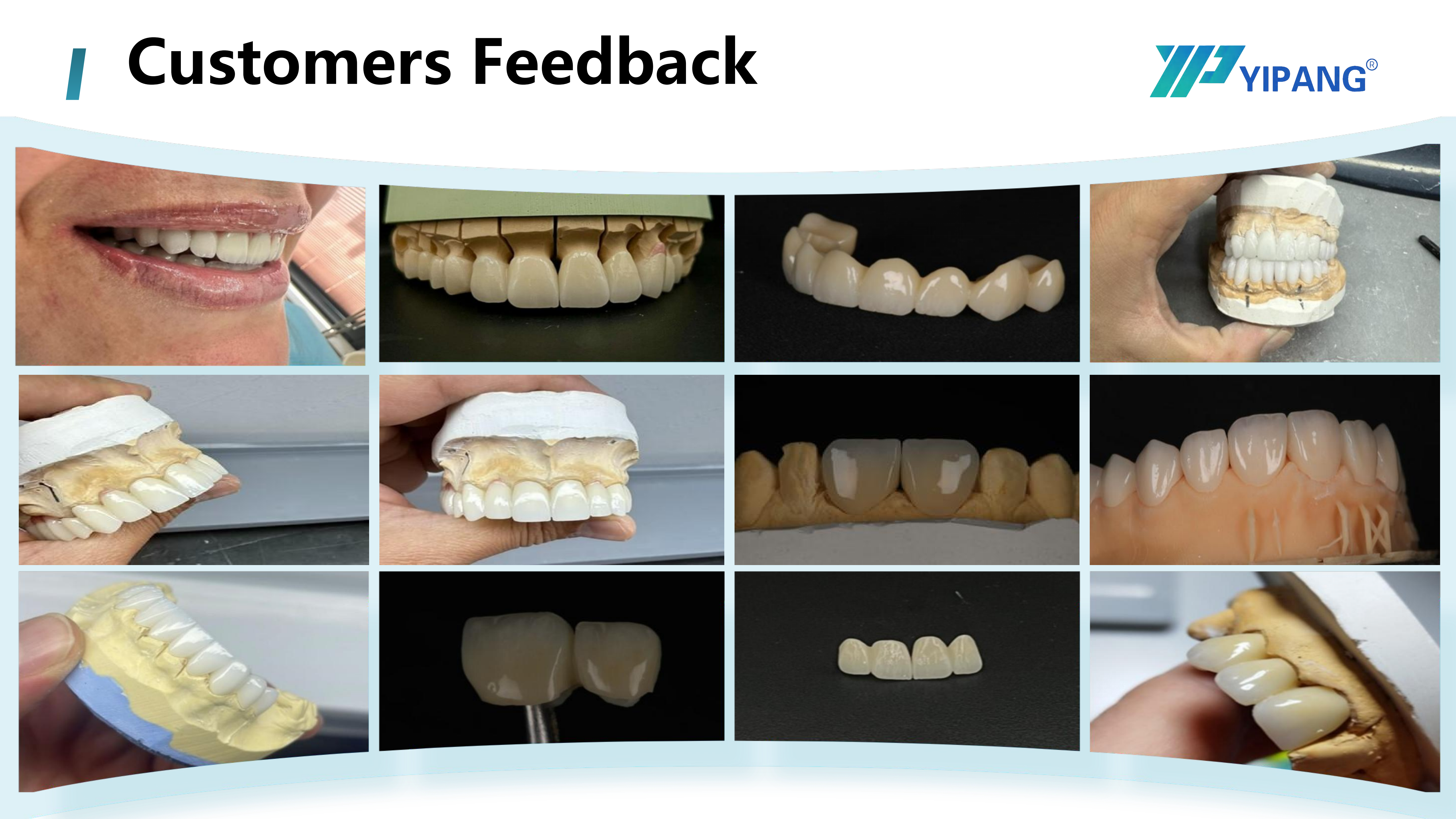
Capacity and process control are comparison dimensions: stated monthly output for this material line is 15,000 pieces, with 100% raw material inspection and finished product random inspection.
Market Trend: Comparison Is Moving from Disc Price to Process Evidence
Three market shares explain the direction of buyer behaviour. Zirconia discs held 63.1% of zirconia-based dental materials revenue in 2025; CAD/CAM milling accounted for 82.4% of zirconia dental manufacturing process revenue; and dental laboratories, at 45.3% of end-user share, remain the dominant buyer group (Grand View Research, 2025). The United States alone accounts for 40% of revenue in that market, which makes documentation requirements travel quickly from one region to another.
Adjacent categories are expanding in parallel. The dental 3D printing market is estimated to grow from USD 4.9 billion in 2025 to USD 26.7 billion by 2033, with photopolymer resins holding a 55.5% share of the dental 3D printing material segment in 2025 (Grand View Research). Printing is not replacing zirconia in definitive restorations today, but it is absorbing more of the pre-clinical workflow — models, splints, try-ins — which pushes the comparison of definitive materials toward process evidence rather than unit price alone.
Zirconia Versus Alternative Ceramics: Where the Boundary Sits
Lithium disilicate remains the main alternative ceramics route and accounted for approximately 28% of all all-ceramic dental restorations globally as of 2024. Its market is projected to grow from USD 320 million in 2025 to USD 920 million by 2032 at a CAGR of 18.8% (Intel Market Research), though a second source places CAGR at 24.53% (Business Research Insights) — a reminder to read forecasts as ranges rather than fixed numbers.
The comparison for a lab is not which material is better, but which material fits the case and the process. A medium-translucent multilayer zirconia block such as 4D-PRO-ML is positioned for strength-oriented and general aesthetic work, including multi-unit bridges and implant superstructure components, and it depends on a controlled sintering step. Pressed lithium disilicate routes remain relevant where translucency-led anterior aesthetics and press workflows are the priority. Labs that treat translucency class as a preference rather than a hard filter usually discover the boundary on a visible anterior case.
Limitations and Boundaries a Buyer Should Hold Openly
A comparison is only trustworthy if it states where the product stops being suitable. Five boundaries apply to the material discussed here. First, sintering sensitivity: rapid temperature change can cause cracking, and blanks with inherent defects can fail after sintering, which is why pre-sintering blank inspection is part of the supplier's own quality procedure. Second, translucency positioning: medium translucency is a defined class, not a universal aesthetic answer. Third, documentation scope: the ISO 13485 certificate covers dental medical materials and dental equipment design, production and sales, while the EU Declaration of Conformity held by the same manufacturer is scoped to intraoral scanner models YP-X and YP-800 — scope must be matched to the purchased item. Fourth, forecast divergence: third-party market estimates for the same category and year differ by scope, so no single figure should be treated as definitive. Fifth, and most important, no public block-level comparative test data between named zirconia block brands exists in the sources used for this article; any claim that one named block is measurably superior to another is unsupported here and should be replaced by the lab's own validation.
A further boundary concerns breadth of range. A manufacturer that also supplies glass ceramics, press ingots, PMMA, wax, titanium blocks, implant abutments, scanners, milling machines, 3D printers and sintering furnaces offers workflow integration, but a broad catalogue is not evidence of block performance. Validation responsibility does not transfer with the product list.
Future Outlook
Two developments will reshape how labs compare zirconia blocks over the next few years. The first is documentation becoming a standard line item in requests for quotation: certificate scope, sintering curve, batch and shrinkage records, and incoming inspection criteria are increasingly requested alongside price. The second is capacity flexibility. As digital labs scale, negotiated MOQ, 15–30 working day lead times and OEM/ODM specification control become comparison criteria in their own right, alongside material parameters.
Regulatory pressure reinforces both trends. With MDR 2017/745 classifying most implants and restorative materials as higher-risk, documentation moves upstream in the purchasing conversation. Labs that standardise their comparison dimensions will move from per-order price shopping to validated supplier programmes — and evidence of long-term cooperation with hundreds of laboratories, clinics and distributors worldwide, in a market where discs hold 63.1% of material revenue, suggests continuity is valued more than a single low quotation.
FAQ
What is a dental zirconia block in a CAD/CAM lab workflow?
A dental zirconia block — also called a dental zirconia disc or CAD/CAM milling blank — is a yttria-stabilized zirconium dioxide blank that is milled into a restoration and then sintered. A concrete example is the 4D-PRO-ML: a 98 mm diameter ML multilayer disc supplied in thicknesses of 10, 12, 14, 16, 18 and 20 mm, with a declared bending strength of ≥1200 MPa, medium translucency, and a sintering temperature of 1450 °C. It is milled on a dental milling machine, sintered in a dental sintering furnace, and typically designed from scan data produced by a dental lab scanner.
Which specifications should a lab compare first when shortlisting zirconia blocks?
Six dimensions carry most of the decision: material grade and composition; geometry including diameter, thickness range and shrinkage behaviour; declared bending strength and translucency class; quality-system documentation and its scope; supply capability including OEM/ODM, monthly capacity, lead time and MOQ; and after-sales technical response. Of these, documentation, geometry and declared specification can be compared before any trial is run, which is why they should be settled before aesthetics are debated.
How can a lab verify a supplier's quality claims before ordering?
Request the certificate rather than the claim. Beijing Weijiahua Dentistry Equipment Co., Ltd. holds ISO 13485 certificate 381240434R0S issued by Shanghai POSI Certification Co., Ltd., valid from 2024-12-27 to 2027-12-26, assessed against GB/T 42061-2022 / ISO 13485:2016, with a scope covering the design, production and sales of dental medical materials and dental equipment. Verification means matching that scope to the exact product being purchased, and requesting equivalent scope evidence for any regulatory document cited for a different product family.
What are the limitations of a medium-translucency multilayer zirconia block?
Medium translucency positions the material in strength-oriented and general aesthetic work rather than translucency-led anterior cases. It is also process-sensitive: sintering must follow the recommended 1430–1450 °C profile with a standard heating and holding procedure and natural cooling, because rapid temperature change can cause cracking. Blanks should be inspected before sintering, and a blank that chips or cracks after sintering should be scrapped rather than used for a final restoration.
How does OEM/ODM capability change a zirconia block comparison?
It changes what is being compared, from a fixed catalogue item to a configurable one. Beijing Weijiahua offers OEM/ODM production under the YIPANG brand with almost all specifications customizable, a stated monthly capacity of 15,000 pieces, lead time of 15–30 working days and negotiable small MOQ — relevant for laboratories and distributors aligning shade, thickness or packaging. The trade-off is that custom specifications extend the buyer's own validation responsibility, and customization does not substitute for documented material performance.
What should change in a comparison after the first order arrives?
After the first order, the comparison should rest on the lab's own records: sintering shrinkage consistency, shade consistency across batches, defect and complaint rate, and how quickly technical questions are answered — the stated after-sales commitment for this product line is online technical guidance with a response within 24 hours. A supplier used by hundreds of long-term cooperative clients worldwide is a continuity signal, not a replacement for incoming inspection and batch-level verification by the laboratory itself.
Reference material on the manufacturer behind the YIPANG brand, including its materials and equipment portfolio, is available in the company information document: WJH Company Information (PDF). Manufacturer website: www.yipangdental.com.