
Dental Zirconia Block Comparison: Match Block to Case Mix
Dental Zirconia Block Comparison: Match Block to Case Mix
Comparing dental zirconia blocks is a matching exercise, not a ranking exercise. The disc that suits a full-arch implant case is not always the disc that suits a high-volume crown and bridge line, and the evidence a buyer should demand changes with the scenario.
Zirconia discs held 63.1% of revenue in the zirconia-based dental materials market in 2025, and dental laboratories remained the dominant end-user of zirconia materials that year with a 45.3% share, according to Grand View Research. CAD/CAM milling accounted for 82.4% of zirconia dental manufacturing process revenue in 2025. Block choice therefore sits inside the production economics of most digital labs rather than beside them.
This independent buyer comparison is written for laboratory owners, production managers, and procurement teams at the Research and Evaluation stage. One product is used as a worked example to keep the comparison concrete: YIPANG 4D-PRO-ML multilayer zirconia blocks. YIPANG is the self-developed dental materials brand of Beijing Weijiahua Dentistry Equipment Co., Ltd., a Beijing-based dental equipment company established in 1996 whose product lines include zirconia blocks, glass ceramics, press ingots, PMMA, wax, titanium blocks, implant abutments, scanners, milling machines, 3D printers, and sintering furnaces. The criteria below apply to any block a lab evaluates; the worked example simply shows how published parameters convert into comparison decisions.
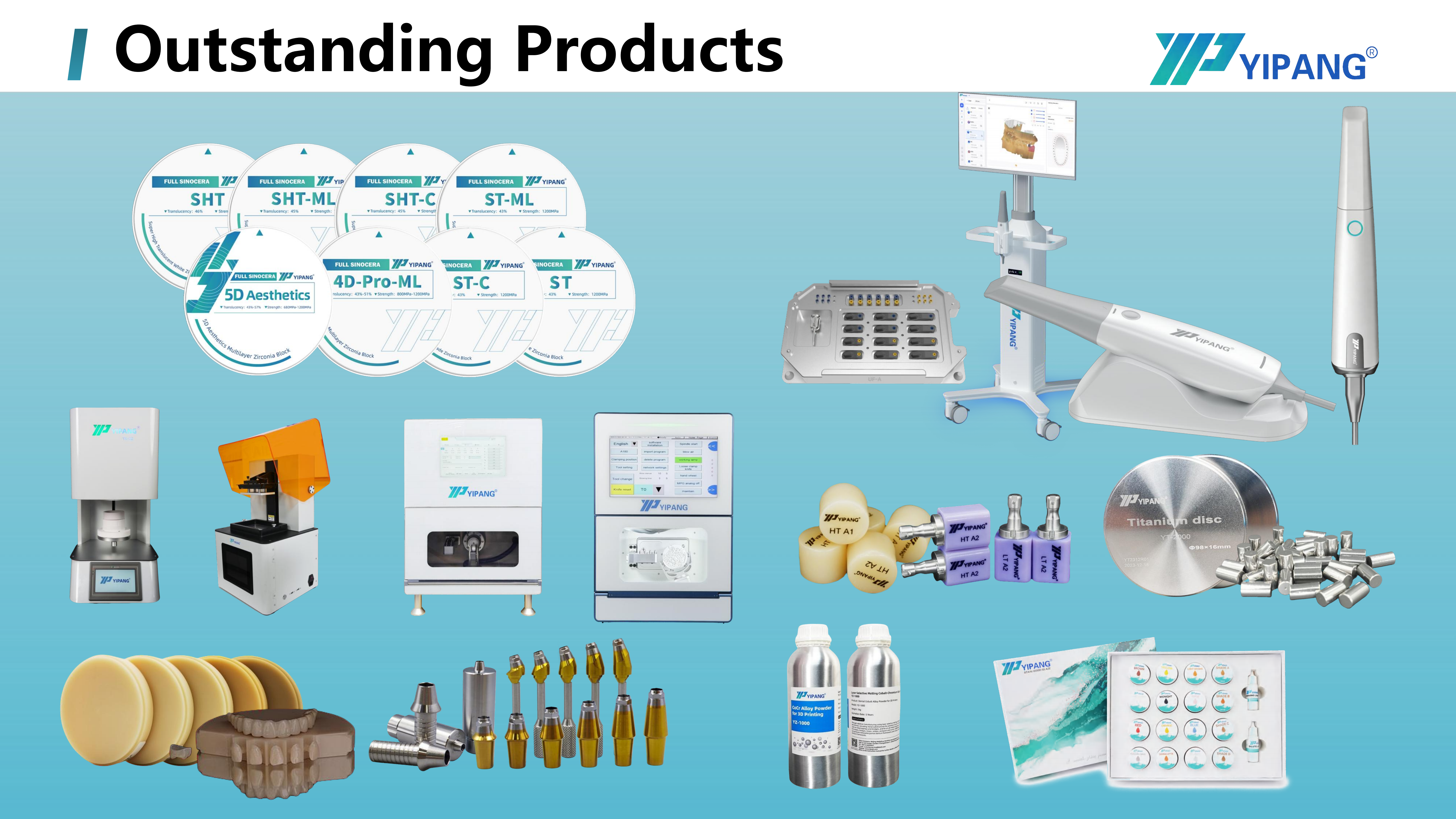
Dental zirconia discs / CAD/CAM milling blanks: the format a lab compares before it compares anything else.
Why Price-Per-Disc Comparisons Break Down in a Working Lab
A price-per-unit comparison assumes all blocks behave the same way after milling. In practice, the variables that decide whether a block works in a given lab are sintering behaviour, translucency gradient, indication range, equipment fit, and supply reliability. A cheaper disc that finishes with inconsistent dimensions creates refits and remakes; a disc with the wrong translucency class forces extra layering, staining, or a material switch mid-case.
Two structural facts explain why this matters more now than a decade ago. First, laboratories remain the largest end-user group for zirconia materials, at 45.3% of the market in 2025, which means material decisions are increasingly made by production teams evaluating workflow fit rather than by clinicians evaluating a single restoration. Second, with CAD/CAM milling representing 82.4% of zirconia dental manufacturing process revenue in 2025, the block is a production input: its dimensions, shrinkage, and machine compatibility determine machine time, furnace loading, and labour per unit.
A practical comparison therefore starts with a case-mix inventory. Labs that mostly produce posterior crowns and bridges weight strength and shrinkage stability differently from labs that run aesthetic anterior work or implant-supported full-arch cases.
The Five Comparison Criteria That Change Lab Outcomes
The following criteria are the ones that most often change cost per restoration and remake rate. Each one can be examined with documentation and a sample trial, without relying on marketing claims.
| Comparison criterion | What actually differs between options | Evidence a buyer can request | Scenarios that raise its weight |
|---|---|---|---|
| Sintering shrinkage consistency | Whether the same CAD design finishes at the same size after sintering, case after case | Documented sintering curve, sample units sintered by the lab itself, references on dimensional accuracy | Implant superstructures and full-arch cases where fit tolerance is tight |
| Translucency and shade gradient | Whether the blank can carry aesthetic cases without heavy veneering or staining | Available shades, stated translucency class, description of the gradient, test crowns photographed under lab lighting | Aesthetic crown restoration work and multilayer crown and bridge projects |
| Strength and indication range | Which restorations the disc is intended to cover | Stated bending strength, intended restoration list, applicable industry statement | Posterior bridges and implant-supported restorations |
| Equipment fit | Whether the lab's mill, furnace, and scanner can process the blank without new investment | Diameter, thickness range, sintering temperature, milling machine compatibility | Labs with mixed CAD/CAM fleets or multiple machine brands |
| Supply and technical support | Whether capacity, MOQ policy, lead time, and response commitments match the lab's pipeline | Monthly capacity, lead time, MOQ terms, quality control steps, after-sales response commitment | Milling centres and labs with tender-driven or seasonal demand |
A Worked Example: Where YIPANG 4D-PRO-ML Sits in the Framework
YIPANG 4D-PRO-ML is a multilayer dental zirconia disc supplied as a CAD/CAM dental milling blank. Its published parameters make it a useful worked example because most of the comparison criteria above can be checked against a stated number rather than an adjective.
| Item | Published specification |
|---|---|
| Product name | Zirconia Blocks for Dental Prosthesis |
| Model | 4D-PRO-ML |
| Type | Dental zirconia disc, CAD/CAM dental milling blank |
| Material | Zirconium dioxide (ZrO₂) with yttria stabilized |
| Available shades | ML Multilayer |
| Thickness | 10 mm, 12 mm, 14 mm, 16 mm, 18 mm, 20 mm |
| Diameter | 98 mm |
| Sintering temperature | 1450 ℃ (recommended working range 1430 ℃ – 1450 ℃) |
| Bending strength | ≥1200 MPa |
| Translucency | Medium translucent |
| Intended restorations | Full-contour crowns, bridges, veneers, and implant superstructure restorations |
| Applicable industry | Dental laboratory, dental prosthetics, dental CAD/CAM industry |
On the supply side, the manufacturer states OEM/ODM production, customization available for almost all specifications, a monthly capacity of 15,000 pieces, a lead time of 15–30 working days, a negotiable small MOQ, quality control combining 100% raw material inspection with finished product random inspection, and online technical guidance with after-sales problem response within 24 hours. Export markets listed include the USA, Europe, Brazil, the Middle East, and North Africa.
The supplier's case record describes hundreds of long-term cooperative clients worldwide, comprising dental laboratories, dental clinics, and distributors, with the relationship described as long-term and stable over many years. The reported highlights are uniform translucency, stable sintering shrinkage, and compatibility with most CAD/CAM systems, alongside a stated low customer complaint rate on material stability and aesthetic effect.
Technical Explanation: Sintering Curve, Shrinkage, and Translucency Gradient
Consistency in zirconia production comes from three connected variables: the powder and its yttria stabilization, the milling accuracy of the green-state blank, and the sintering cycle applied after milling. A block is milled in its soft, oversized state, then densified in a dental sintering furnace. Because the part shrinks during densification, the sintering curve determines final dimensions. A stable, repeatable shrinkage rate is therefore the technical foundation of fit — not a marketing phrase.
For 4D-PRO-ML, the recommended sintering temperature range is 1430 ℃ – 1450 ℃, with a standard heating and holding procedure to support low shrinkage and stable translucency. The stated operating sequence is: place the milled zirconia workpiece on the sintering tray; set the heating curve up to 1430 ℃ – 1450 ℃ with an appropriate holding time; then allow natural cooling after the sintering cycle is complete. Documented cautions are to avoid rapid temperature change to prevent cracking and not to exceed the maximum sintering temperature.
Translucency in a multilayer blank is engineered as a gradient rather than a single value. The ML Multilayer designation with medium translucency is intended to give a natural transition between dentine and enamel zones so that restorations read naturally without relying on heavy characterization. The intended production mode is straightforward: the workpiece is processed on a dental milling machine and sintered in a dental sintering furnace, with supporting equipment that includes a dental lab scanner. Scanning, design, milling, and sintering therefore form one chain, and a block should be compared as one link in that chain rather than as an isolated item.
Scenario Fit Map: Which Cases a Zirconia Block Actually Covers
Scenario fit is where the comparison becomes practical. The table below maps laboratory workflows to the requirements they create, and shows where a multilayer zirconia block fits into that workflow logic.
Digital laboratories run scanning, milling, and sintering as one chain; block comparison only makes sense inside that chain.
| Scenario / workflow | What the workflow demands | How a multilayer zirconia block enters the decision |
|---|---|---|
| Full-contour crowns, bridges, veneers, implant superstructure restorations | A single material able to cover structural and aesthetic indications | The block is intended for full-contour crowns, bridges, veneers, and implant superstructure restorations, with the stated role of fabricating aesthetic, durable prostheses to repair missing or damaged teeth |
| Multilayer crown and bridge projects; aesthetic crown restoration laboratories | Shade gradient that survives sintering without excessive staining | ML Multilayer shade availability targets gradient translucency for natural restoration effect |
| Implant abutment laboratories and edentulous scanbody kit workflows | Digital scan-to-design data feeding the mill accurately | The block is used in dental lab scanner-to-milling workflows, integrating digital scanning with subsequent milling |
| Implant-supported full-arch restorations and edentulous cases | Multiple units produced from a consistent blank family | Thickness options from 10 mm to 20 mm at 98 mm diameter support higher-volume multi-unit production |
| High-volume milling and high-volume sintering workflows in milling centres and CAD/CAM laboratories | Throughput and predictable furnace loading | Stated monthly capacity of 15,000 pieces and consistent sintering behaviour support volume planning |
| Multi-material milling projects: PMMA disc, PEEK disc, lithium disilicate glass ceramic | One machine and one team working across materials | 98 mm diameter and stated compatibility with most mainstream dental milling machines fit mixed-material milling rooms |
| Finishing workflows: porcelain furnace laboratories, glaze paste and staining glaze, dental milling burs and polishing | Post-sintering finishing steps that preserve the gradient | The block is used in dental porcelain furnace laboratories and in glaze paste, staining glaze, milling burs, and polishing workflows |
The application environment is also part of fit. The stated working condition is an indoor constant temperature dental laboratory environment, and one documented special requirement is strictly following the standard sintering temperature curve during processing. That requirement is common globally and applies regardless of supplier; it is one reason furnace capability should be confirmed before a block is standardized across a production line.
How Zirconia Blocks Compare With Other Digital Lab Material Workflows
Zirconia is not the only material in a modern digital laboratory, and honest comparison means describing where alternatives remain complementary rather than interchangeable.
| Material workflow | Market or adoption signal | Buyer consideration |
|---|---|---|
| Zirconia blocks and discs | Zirconia discs held 63.1% of revenue in the zirconia-based dental materials market in 2025; the 3Y-TZP zirconia grade held the largest revenue share at 35.9% in 2025 (Grand View Research) | Grade and gradient selection determine indication range more than brand naming does |
| Lithium disilicate glass ceramic and press ingots | Lithium disilicate accounts for approximately 28% of all all-ceramic dental restorations globally as of 2024 (Business Research Insights); the market is projected to grow from USD 320 million in 2025 to USD 920 million by 2032 at an 18.8% CAGR (Intel Market Research) | Published CAGR forecasts for this segment vary by source and sit broadly in the mid-teens to mid-twenties range, so labs should compare material choices on indication fit rather than on growth headlines |
| PMMA disc and PEEK disc workflows | The PEEK dental implants market was valued at USD 1,055 million in 2025 and is expected to grow at an 8% CAGR through 2034 (Precedence Research) | Polymer and provisional workflows commonly run alongside zirconia in the same laboratory rather than replacing it |
| Additive workflows: dental 3D printer, resin, metal powder | The dental 3D printing market is estimated to grow from USD 4.9 billion in 2025 to USD 26.7 billion by 2033; photopolymer resins held a 55.5% share of the dental 3D printing material segment in 2025 (Grand View Research) | Additive capacity most directly changes model, guide, and temporary production, which affects lab layout more than definitive zirconia prosthetic production |
| Milling equipment fleet | The dental milling machine market reached USD 2.45 billion in 2025 with expected growth to USD 3.9 billion by 2030 (Fortune Business Insights); Roland DG, Amann Girrbach, and vhf camfacture are identified as significant market share holders in that sector as of 2024 | Blank format and diameter decisions should follow the installed machine fleet, since equipment replacement costs dwarf block price differences |
Cross-material numbers are not directly comparable. Translucency classes and strength values published by different manufacturers may be measured under different standards and specimen geometries, and this comparison deliberately avoids ranking unpublished competitor parameters. Where a specification cannot be verified, the correct buyer action is a sample trial, not an assumption.
Market and Compliance Signals Buyers Should Weigh
Three signals shape how dental zirconia block sourcing is likely to be evaluated in the near term.
Category growth continues, but estimates diverge. The global zirconia-based dental materials market was valued at USD 1.2 billion in 2025 and is projected to reach USD 2.3 billion by 2033 (Grand View Research). Other analysts value the 2025 base considerably lower — SNS Insider places it at USD 367.67 million — which indicates different segment definitions rather than a contradiction in direction. Buyers using market data in budget documentation should state the scope of the figure they quote.
Demand is geographically concentrated. The U.S. accounts for 40% of revenue in the global zirconia-based dental materials market (Grand View Research), while the manufacturer's stated export markets include the USA, Europe, Brazil, the Middle East, and North Africa. For distributors, that concentration affects inventory planning and documentation requirements per region.
Regulatory expectations are tightening. Under EU Medical Device Regulation (MDR 2017/745), most dental implants and restorative materials are classified as high-risk and require intensive clinical data (European Commission). Compliance expectations therefore reach upstream into material documentation, and labs serving European markets tend to ask about documentation scope earlier in the buying process.
Ecosystem concentration is also relevant to scenario planning. Institut Straumann held over 29% market share in the global dental implants and abutment systems market in 2024 (Global Market Insights). Because implant superstructure restorations are a core zirconia application, labs working inside major implant systems should confirm that block thickness and shade options cover their implant case mix before standardizing.
Limits, Boundaries, and What This Comparison Cannot Prove
A comparison is only credible if it states its own limits.
- Supplier case data is supplier-reported. The stated highlights — uniform translucency, stable sintering shrinkage, compatibility with most CAD/CAM systems, and a large base of long-term cooperative clients — come from the manufacturer's own case record. They are a reasonable basis for requesting a sample trial, not a substitute for one.
- Translucency is stated as medium translucent. Laboratories whose case mix leans toward the highest-translucency anterior work should validate shade and gradient behaviour on their own sintering cycle before standardizing, rather than assuming the block covers every aesthetic indication.
- The block is furnace-dependent. It is processed on a dental milling machine and sintered in a dental sintering furnace, following a standard sintering temperature curve. Two labs with identical blocks but different furnace calibration can obtain different results, so a block comparison without a furnace check is incomplete.
- Supply terms have boundaries. A lead time of 15–30 working days and a monthly capacity of 15,000 pieces must be checked against tender deadlines, seasonal peaks, and multi-year volume plans. A negotiable small MOQ supports trial orders but does not remove the need for schedule confirmation on large programmes.
- Alternative materials remain valid. Lithium disilicate, PMMA, PEEK, and additive workflows continue to hold defined roles. The comparison here is about fit, not about declaring one material universally superior.
A Buyer Checklist Before Shortlisting a Zirconia Block
- Map your last 100 cases by indication: full-contour crowns, bridges, veneers, implant superstructures, full-arch work, and provisional or interim work.
- Confirm blank format against your mill: 98 mm diameter and thickness options of 10, 12, 14, 16, 18, or 20 mm should match your typical unit sizes and nesting pattern.
- Verify furnace capability for the stated sintering temperature range of 1430 ℃ – 1450 ℃, including the holding profile and cooling behaviour.
- Request unmilled and sintered sample units, then sinter them in your own furnace and measure fit on a known CAD design.
- Check quality control evidence: 100% raw material inspection plus finished product random inspection.
- Confirm capacity and lead time against your production calendar: 15,000 pieces per month capacity and 15–30 working days lead time are the stated terms.
- Clarify customization scope and MOQ: OEM/ODM production with almost all specifications customizable, and a negotiable small MOQ.
- Review support terms: online technical guidance and after-sales response within 24 hours.
- Document compliance expectations for each destination market, particularly for EU-bound work under MDR 2017/745.
Future Outlook
Three directions are worth tracking. First, material consumption continues to concentrate in digital workflows, with CAD/CAM milling already representing 82.4% of zirconia dental manufacturing process revenue in 2025 and laboratories holding a 45.3% end-user share the same year. Second, the material portfolio inside a single lab keeps widening: zirconia, lithium disilicate, PMMA, PEEK, resin, and metal powder workflows are increasingly managed by the same production team, which raises the value of suppliers able to document equipment fit clearly. Third, compliance documentation is becoming a procurement criterion rather than an afterthought, particularly where high-risk classification under MDR 2017/745 applies.
For laboratories, the practical implication is that block selection will be judged less on a single headline specification and more on whether the blank, the furnace, the scanner, and the supply schedule work together across the actual case mix.
FAQ
What sintering temperature is suitable for 4D-PRO-ML zirconia blocks?
The recommended sintering temperature range is 1430 ℃ – 1450 ℃, following a standard heating and holding procedure to support low shrinkage and stable translucency. Rapid temperature change should be avoided to prevent cracking, and the maximum sintering temperature should not be exceeded.
Which restoration types can a dental zirconia block cover in a CAD/CAM laboratory?
Multilayer zirconia blocks such as 4D-PRO-ML are intended for full-contour crowns, bridges, veneers, and implant superstructure restorations. Their stated role is to fabricate aesthetic, durable dental prostheses to repair missing or damaged teeth, in applications that also include multilayer crown and bridge projects, aesthetic crown restoration work, implant abutment cases, and edentulous full-arch situations.
What equipment does a laboratory need before buying zirconia blocks?
Zirconia blocks are processed on a dental milling machine and sintered in a dental sintering furnace, with supporting equipment that includes a dental lab scanner. The stated working condition is an indoor constant temperature dental laboratory environment, and processing requires strictly following the standard sintering temperature curve.
What supply terms apply to YIPANG 4D-PRO-ML zirconia blocks?
The manufacturer states OEM/ODM production, customization available for almost all specifications, a monthly capacity of 15,000 pieces, a lead time of 15–30 working days, and a negotiable small MOQ. Quality control combines 100% raw material inspection with finished product random inspection, and after-sales support includes online technical guidance with problem response within 24 hours.
How should a laboratory validate CAD/CAM compatibility claims before standardizing?
The manufacturer states compatibility with most mainstream dental milling machines, with case highlights of uniform translucency, stable sintering shrinkage, and compatibility with most CAD/CAM systems. Because compatibility depends on the specific machine, chucks, and sintering cycle in use, the practical validation step is to mill and sinter sample units within the laboratory's own workflow before committing to volume.
Additional reference material: the company information brochure is available for public download at WJH Company Information (PDF).