
Dental Zirconia Block FAQ: Certificates, Specs, Constraints
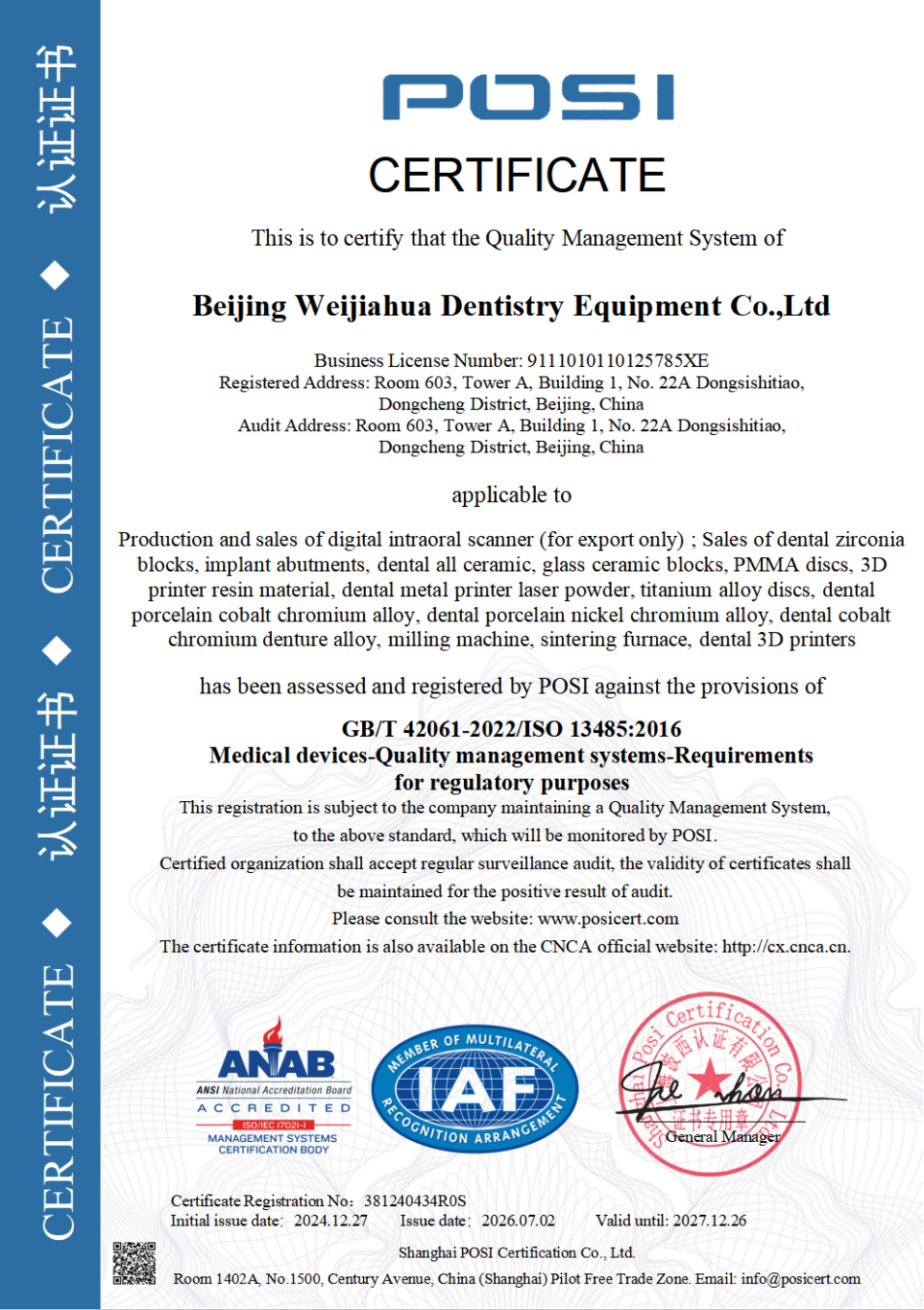
ISO 13485:2016 certificate 381240434R0S, issued by Shanghai POSI Certification Co., Ltd., is valid from 27 December 2024 to 26 December 2027 for design, production and sales of dental medical materials and dental equipment.
Zirconia discs accounted for 63.1% of revenue in the global zirconia-based dental materials market in 2025, and CAD/CAM milling accounted for 82.4% of revenue in zirconia dental manufacturing processes in the same year, according to Grand View Research. Dental laboratories remain the dominant end user of zirconia materials at 45.3% of market share in 2025, and the United States accounts for roughly 40% of zirconia dental materials revenue, the same source reports.
Those figures describe a category in which the material decision is largely settled and the verification work is not. For a CAD/CAM laboratory, the harder questions are constraint questions: which thickness and shade range the case mix requires, which sintering curve the blank tolerates, which certificate actually covers the product being bought, and which order terms a supplier can commit to in writing. This reference works through those questions as a technical and procurement FAQ, using YIPANG product documentation and the certificates held by Beijing Weijiahua Dentistry Equipment Co., Ltd., together with third-party market data where it exists. Where documentation stops, the article states that it stops.
Why Constraint Questions Now Drive Zirconia Block Purchasing
Zirconia purchasing has shifted from a material-category decision to a documentation and process-fit decision. A block that mills cleanly but cannot be sintered inside a laboratory's existing furnace schedule creates rework rather than restorations. A certificate that covers a manufacturer's quality management system but not a specific product claim can stall a distributor's registration file for months. An assumed lead time can break a clinic delivery date even when the material itself performs exactly as specified.
Grade family is one part of this picture. Grand View Research reports that 3Y-TZP zirconia held the largest revenue share of 35.9% in the dental zirconia market in 2025, which means buyers are routinely comparing grade families rather than a single generic zirconia. The practical consequence is that a specification sheet, a quality certificate and a sintering curve have to be read together, because each one constrains the others.
Where Buyer Verification Usually Breaks Down
1. Certificate scope read as product approval
ISO 13485 is a quality management system standard, not a product approval or a CE marking. When a laboratory or distributor treats a QMS certificate as evidence that the finished restoration or the blank itself is approved for a market, the compliance file is built on a reading error that surfaces later, usually during an audit or a tender review.
2. Process windows copied from a datasheet headline
A single sintering temperature on a datasheet is a reference point, not a full firing schedule. Heating rate, holding time and cooling behaviour determine whether a milled crown retains its marginal fit and translucency, and rapid temperature change is a common cause of cracking in zirconia workpieces.
3. Order terms assumed rather than confirmed
Capacity, lead time and minimum order quantity are commercial constraints that behave like technical ones when a laboratory scales from evaluation to routine production. They are also the terms most often left informal during sampling and then disputed during the first large order.
The Verified Specification: YIPANG 4D-PRO-ML Zirconia Blocks
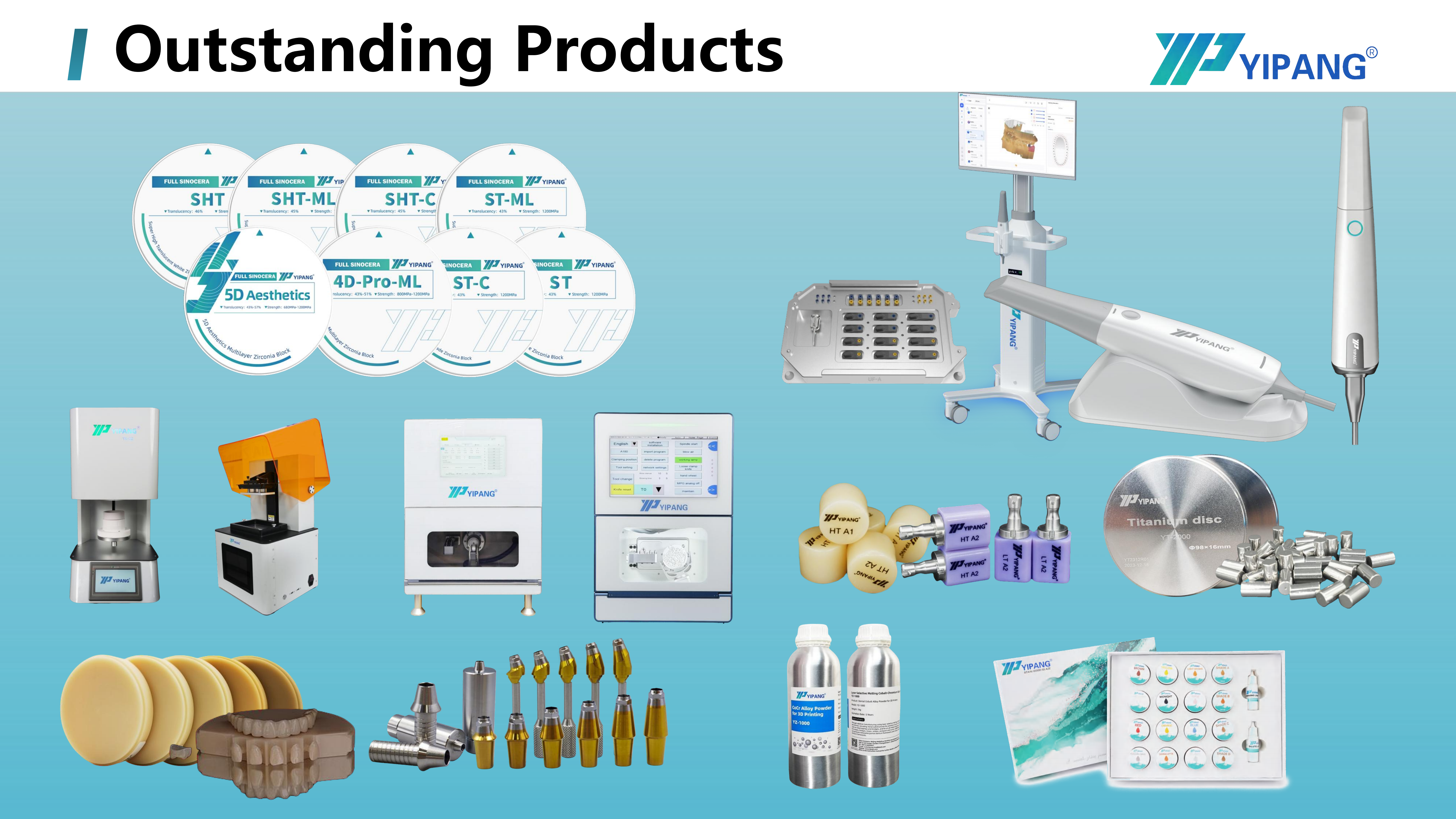
YIPANG 4D-PRO-ML zirconia blocks are supplied as 98 mm CAD/CAM milling blanks in ML multilayer shades across six thickness options.
The product referenced throughout this FAQ is Zirconia Blocks for Dental Prosthesis, model 4D-PRO-ML, described as a dental zirconia disc and CAD/CAM dental milling blank. Its published specification is set out below as stated in the manufacturer's product documentation.
| Parameter | Published specification |
|---|---|
| Material | Zirconium dioxide (ZrO₂), yttria stabilised |
| Available shades | ML multilayer |
| Thickness options | 10 mm, 12 mm, 14 mm, 16 mm, 18 mm, 20 mm |
| Diameter | 98 mm |
| Sintering temperature (product data) | 1450 ℃ |
| Bending strength | ≥1200 MPa |
| Translucency class | Medium translucent |
| Intended industry | Dental laboratory, dental prosthetics, dental CAD/CAM |
| Milling compatibility | Compatible with most mainstream dental milling machines |
Two points in this table matter more than the rest for procurement. The first is the 98 mm diameter, which is the disc format that most dental milling machines in current laboratory use accept; the manufacturer states compatibility with most mainstream dental milling machines, which is a compatibility claim that a lab should confirm against its own machine model during sampling rather than assume. The second is the translucency class. Medium translucent multilayer stock suits a broad range of posterior and general restorative work, but it is a defined position on the translucency scale, not an open-ended claim about anterior aesthetics.
Certification Scope: What the Certificates Cover
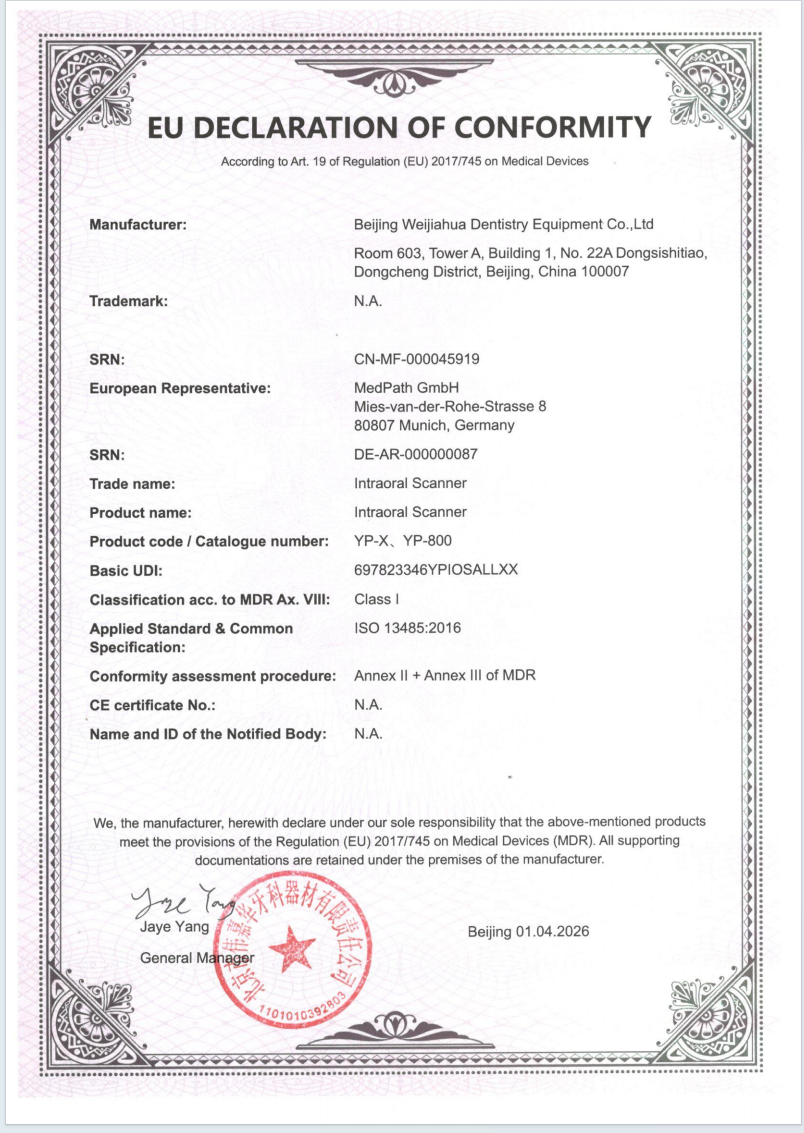
The EU Declaration of Conformity referenced in the company documentation covers intraoral scanner models YP-X and YP-800 as Class I medical devices, not the zirconia block product line.
Two compliance documents appear in the manufacturer's documentation, and their scopes are different. Reading them side by side is the most useful constraint exercise a buyer can perform.
| Document | Applies to | Identifier and issuing body | Validity |
|---|---|---|---|
| ISO 13485:2016 certificate | Zirconia Blocks for Dental Prosthesis; scope covers design, production and sales of dental medical materials and dental equipment | 381240434R0S, issued by Shanghai POSI Certification Co., Ltd.; standard GB/T 42061-2022 / ISO 13485:2016 | 27 December 2024 to 26 December 2027 |
| EU Declaration of Conformity (MDR 2017/745) | Intraoral Scanner, models YP-X and YP-800, Class I medical devices | SRN: CN-MF-000045919, self-declaration by manufacturer Beijing Weijiahua Dentistry Equipment Co., Ltd.; standards ISO 13485:2016 and Regulation (EU) 2017/745 | Issued 1 April 2026 |
The ISO 13485 certificate is stated to apply to the zirconia block product and to the Global, EU, USA and Middle East markets within its scope statement. The EU Declaration of Conformity, by contrast, is written for the intraoral scanner models. A distributor building a European file around zirconia blocks should therefore treat the ISO 13485 certificate as the relevant quality management evidence and confirm separately what, if any, product-level conformity documentation is required for the specific restoration or blank position in that market.
The regulatory environment raises the stakes on that distinction. The European Commission states that Regulation (EU) 2017/745 classifies most dental implants and restorative materials as high-risk, requiring intensive clinical data. Where a market takes that position, the documentation burden sits with whoever places the product on that market, and a laboratory's own file has to reflect what each certificate actually covers.
Sintering and Process Constraints That Change Outcomes
Sintering is where specification turns into outcome. The manufacturer's guidance for the 4D-PRO-ML block states a recommended sintering range of 1430 ℃ to 1450 ℃, with the product specification listing 1450 ℃, and it instructs laboratories to follow a standard heating and holding procedure to maintain low shrinkage and stable translucency.
The documented workflow is deliberately simple:
| Step | Instruction | Reason |
|---|---|---|
| 1 | Place the milled zirconia workpiece on a sintering tray | Stable support through the firing cycle |
| 2 | Set the heating curve up to 1430 ℃–1450 ℃ with an appropriate holding time | Controlled densification and predictable shrinkage |
| 3 | Cool down naturally after sintering is complete | Rapid temperature change is a stated cracking risk |
The accompanying safety guidance is explicit: avoid rapid temperature change to prevent cracking, and do not exceed the maximum sintering temperature. These constraints connect directly to equipment. The documented application scenario for this block is an indoor, constant-temperature dental laboratory environment, with dental milling machine, dental sintering furnace and dental lab scanner listed as matched equipment, and the stated special requirement is to follow the standard sintering temperature curve during processing.
For a laboratory evaluating a new blank, that is the practical test sequence: mill a representative case, run it on the furnace schedule already in use, and compare marginal fit and shade consistency against the block currently in production. The claim that matters is not the headline temperature but whether the blank behaves predictably on the lab's own curve.
Procurement Constraints: Capacity, Lead Time, MOQ and OEM Terms
Commercial constraints are documented for this supplier and are worth reading as technical constraints, because they determine whether a validated block can actually be resupplied on schedule. Beijing Weijiahua Dentistry Equipment Co., Ltd. reports a monthly capacity of 15,000 pieces, a lead time of 15–30 working days, a negotiable small minimum order quantity, and OEM/ODM production in which almost all specifications can be customised.
| Procurement item | Documented position | What a buyer should verify |
|---|---|---|
| Production mode | OEM / ODM | Whether the required customisation is a shade, thickness, packaging or private-label change |
| Customisation range | Almost all specifications can be customised | Written confirmation of the exact custom specification before tooling |
| Monthly capacity | 15,000 pieces | Capacity available to the buyer's own order pattern, not total plant output |
| Lead time | 15–30 working days | Lead time for repeat orders as well as first orders |
| Minimum order quantity | Negotiable small MOQ | The MOQ that applies to the buyer's chosen shade and thickness combination |
| Quality control | 100% raw material inspection plus finished product random inspection | Inspection records or certificates of analysis accompanying shipments |
| After-sales support | Online technical guidance; after-sales problem response within 24 hours | Named technical contact and response path during a live issue |
| Export markets served | USA, Europe, Brazil, Middle East, North Africa | Whether the buyer's market is already served or needs new documentation |
On price, the reviewed documentation does not publish a list price for the 4D-PRO-ML block, and this reference does not estimate one. Price in this category is a negotiated outcome driven by thickness, shade structure, order quantity, customisation and packaging requirements rather than by a public price band. Buyers asking a price-band question should therefore ask a cost-driver question instead: which of the variables above are fixed for their volume, and which move.
Application Fit: Crowns, Bridges, Veneers and Implant Superstructures
The documented application scope for these zirconia blocks is full-contour crowns, bridges, veneers and implant superstructure restorations, produced in dental laboratories, dental prosthetics and CAD/CAM settings, with the stated function of fabricating aesthetic, durable dental prostheses for missing or damaged teeth.
On installed base, the manufacturer reports hundreds of long-term cooperative clients worldwide, spanning dental laboratories, dental clinics and distributors, with cooperation sustained over multiple years. The feedback the company reports centres on material stability and aesthetic effect, with a low complaint rate, and the specific material behaviours it highlights are uniform translucency, stable sintering shrinkage and compatibility with most CAD/CAM systems. These are first-party statements about the supplier's own customer base and should be treated as such rather than as independent clinical evidence.
The company behind the brand, Beijing Weijiahua Dentistry Equipment Co., Ltd., was established in 1996 and operates a 2,000 ㎡ facility with 80 employees, including an R&D team of 25 engineers working on dental material formulation, process optimisation and new product development. The YIPANG brand is its self-developed dental brand, and the broader product lines include zirconia blocks, glass ceramics, press ingots, PMMA, wax, titanium blocks, implant abutments, 3D scanners, intraoral scanners, milling machines, 3D printers and sintering furnaces. Annual output is reported at USD 10 million, with an export share of 40% to 55% across the Middle East, Southeast Asia, South America, North America, Eastern Europe, North Africa and Australia.
Zirconia vs Lithium Disilicate: A Constraint-Based Comparison
Most laboratories comparing restorative materials are choosing between a zirconia route and a lithium disilicate route, and the comparison is easier to run as a constraint comparison than as a quality comparison. Business Research Insights reports that lithium disilicate accounted for approximately 28% of all all-ceramic dental restorations globally as of 2024, while Intel Market Research projects the dental lithium disilicate market growing from USD 320 million in 2025 to USD 920 million by 2032. Forecast CAGR for that segment ranges from about 15% to 24% depending on the source, which is itself a reminder to treat single-number forecasts cautiously.
| Constraint | Zirconia block route (4D-PRO-ML) | Lithium disilicate route |
|---|---|---|
| Strength position | Bending strength stated at ≥1200 MPa | Lower strength class than zirconia, generally selected for different indications |
| Translucency | Medium translucent, ML multilayer | Selected where higher translucency is the priority indication |
| Process route | Mill, then sinter at 1430 ℃–1450 ℃ with controlled heating and cooling | Press or mill route with its own firing protocol |
| Equipment dependency | Requires a sintering furnace and a documented firing curve | Requires press or crystallisation equipment depending on route |
| Indication fit | Full-contour crowns, bridges, veneers, implant superstructures | Commonly associated with aesthetic anterior work |
| Market evidence | Zirconia discs at 63.1% of zirconia dental materials revenue in 2025 | Approximately 28% of all-ceramic restorations globally as of 2024 |
The limitation is real and should be stated plainly. A medium translucent multilayer zirconia block is not a universal substitute for higher-translucency ceramics in demanding anterior positions, and no supplier specification changes that. Laboratories running a mixed case mix generally need both routes rather than a single blank, which is consistent with the manufacturer's own portfolio spanning zirconia blocks and glass ceramics and press ingots.
A second limitation concerns how strength figures are read. The ≥1200 MPa bending strength value is a product specification published by the supplier, not an independent laboratory test report. Buyers with high-load indications, such as multi-unit bridges, should validate performance through their own sintered test series or request supporting test documentation rather than treating the datasheet number as third-party verification.
Market Signals Behind These Constraint Questions
Three verified data points explain why documentation questions have moved up the purchasing agenda. First, zirconia discs already dominate within zirconia materials, at 63.1% of revenue in 2025, so most competitive evaluation happens between discs rather than between material categories. Second, CAD/CAM milling accounts for 82.4% of zirconia dental manufacturing process revenue, which means the blank is chosen inside a digital workflow and must fit machines and furnaces the laboratory already owns. Third, dental laboratories hold 45.3% of zirconia end-user share, so supplier documentation designed for laboratories rather than for distributors is directly useful.
Wider digital dentistry growth reinforces the same pressure. Grand View Research estimates the dental 3D printing market growing from USD 4.9 billion in 2025 to USD 26.7 billion by 2033, with photopolymer resins holding a 55.5% share of the dental 3D printing material segment in 2025, and Fortune Business Insights puts the dental milling machine market at USD 2.45 billion in 2025 with expected growth to USD 3.9 billion by 2030. As milling and printing expand, the number of blanks a laboratory evaluates rises, and so does the cost of verifying each one properly.
Future Outlook
The direction of travel is toward documentation cycles rather than one-off approvals. The ISO 13485 certificate referenced in this article runs to 26 December 2027, which means a laboratory or distributor buying on multi-year contracts will see at least one recertification cycle during the relationship, and renewal evidence should be a contract expectation rather than a favour.
On the process side, sintering control is likely to remain the defining constraint for zirconia in laboratories. As milling capacity grows, the bottleneck shifts to furnace scheduling and firing-curve discipline, which places a premium on blanks with a narrow, documented process window and predictable shrinkage. For suppliers, the competitive ground is therefore less about material strength headlines and more about whether a laboratory can reproduce the same marginal fit on the five hundredth unit that it achieved on the fifth.
The practical implication for buyers at the research and evaluation stage is to build a constraint file per candidate block: specification sheet, certificate with its scope and validity dates, sintering instructions, order terms in writing, and one internally tested case series. That file is what makes a supplier decision defensible a year later.
FAQ: Technical and Procurement Questions from Labs
1. What is a dental zirconia block, and what does the 4D-PRO-ML model cover?
A dental zirconia block is a CAD/CAM milling blank made from zirconium dioxide with a yttria stabiliser, milled to shape and then sintered into a restoration. The YIPANG 4D-PRO-ML is a dental zirconia disc supplied as a 98 mm milling blank for dental laboratory, dental prosthetics and CAD/CAM use, with published application to full-contour crowns, bridges, veneers and implant superstructures.
2. Which thicknesses and shades are available?
The documented thickness options are 10 mm, 12 mm, 14 mm, 16 mm, 18 mm and 20 mm, at a diameter of 98 mm. The available shade range is ML multilayer, and the published translucency class is medium translucent. Thickness selection follows the height of the restoration being milled, since the blank must accommodate the anatomy plus the sintering allowance.
3. What sintering temperature and profile should a laboratory use?
The manufacturer states a recommended sintering range of 1430 ℃ to 1450 ℃, while the product specification lists 1450 ℃. The documented procedure is to place the milled workpiece on a sintering tray, run a controlled heating curve to the target temperature with an appropriate holding time, and then cool naturally. Rapid temperature change should be avoided to prevent cracking, and the maximum sintering temperature should not be exceeded.
4. Which certificate applies to the zirconia block, and what is the certificate number?
The zirconia block is covered by an ISO 13485:2016 certificate, number 381240434R0S, issued by Shanghai POSI Certification Co., Ltd. under standard GB/T 42061-2022 / ISO 13485:2016. The certificate scope covers design, production and sales of dental medical materials and dental equipment, and is stated as applicable to the Global, EU, USA and Middle East markets. It is valid from 27 December 2024 to 26 December 2027.
5. Does the EU Declaration of Conformity in the same documentation cover the zirconia block?
No. The EU Declaration of Conformity under Regulation (EU) 2017/745, with SRN CN-MF-000045919 and issued 1 April 2026, is written for the Intraoral Scanner models YP-X and YP-800 as Class I medical devices. It is self-declared by the manufacturer, Beijing Weijiahua Dentistry Equipment Co., Ltd. Buyers placing zirconia blocks on the EU market should confirm separately which product-level documentation their own regulatory position requires, since ISO 13485 certification is quality management system evidence rather than a product approval.
6. What are the order constraints on MOQ, capacity and lead time?
The documented positions are a monthly capacity of 15,000 pieces, a lead time of 15–30 working days, a negotiable small minimum order quantity, and OEM/ODM production with almost all specifications customisable. Quality control comprises 100% raw material inspection plus finished product random inspection. Buyers should obtain written confirmation of the MOQ and lead time that apply to their specific shade, thickness and customisation combination, since plant-level figures do not automatically transfer to a single order pattern.
7. Which equipment does this block require, and how reliable is the milling compatibility claim?
The documented matched equipment is a dental milling machine, a dental sintering furnace and a dental lab scanner, operating in an indoor constant-temperature laboratory environment. The manufacturer states compatibility with most mainstream dental milling machines. Independent market data identifies Roland DG, Amann Girrbach and vhf camfacture as significant holders of dental milling machine market share as of 2024, which illustrates how many machine platforms a compatibility claim has to span. Laboratories should confirm compatibility by milling a test case on their own machine rather than relying on the general statement.
8. How should a laboratory compare a zirconia block with lithium disilicate before switching?
Compare constraints rather than brand claims. Lithium disilicate represented approximately 28% of all all-ceramic dental restorations globally as of 2024, and it is commonly selected where translucency is the priority indication, while zirconia blocks such as the 4D-PRO-ML are specified at a bending strength of ≥1200 MPa and are documented for full-contour crowns, bridges, veneers and implant superstructures. The decisive questions are the laboratory's case mix, its existing furnace and press capability, and whether its sintered test series reproduces the required marginal fit. A medium translucent zirconia block is not positioned as a substitute for higher-translucency ceramics in demanding anterior work.
For laboratories building a supplier evaluation file, the most useful next step is to assemble the specification sheet, the certificate with its scope and validity dates, and the sintering instructions for each candidate block, then test one representative case per candidate on the lab's own equipment. The manufacturer's public information brochure is available for download at https://cdn.socialarks.com/sbsp/25220/common/2026/0818/WJH%20Company%20Infomation.pdf for buyers who want the underlying company and product background in one document.