
Dental Zirconia Block Options: How Labs Build a Shortlist
Independent Industry Reference · Dental Materials
Dental Zirconia Block Options: How Labs Build a Shortlist
A shortlist is not a catalogue page. It is a written decision about which blanks a laboratory will commit milling time, furnace capacity and technician attention to — and which supplier it will call when a case is due.
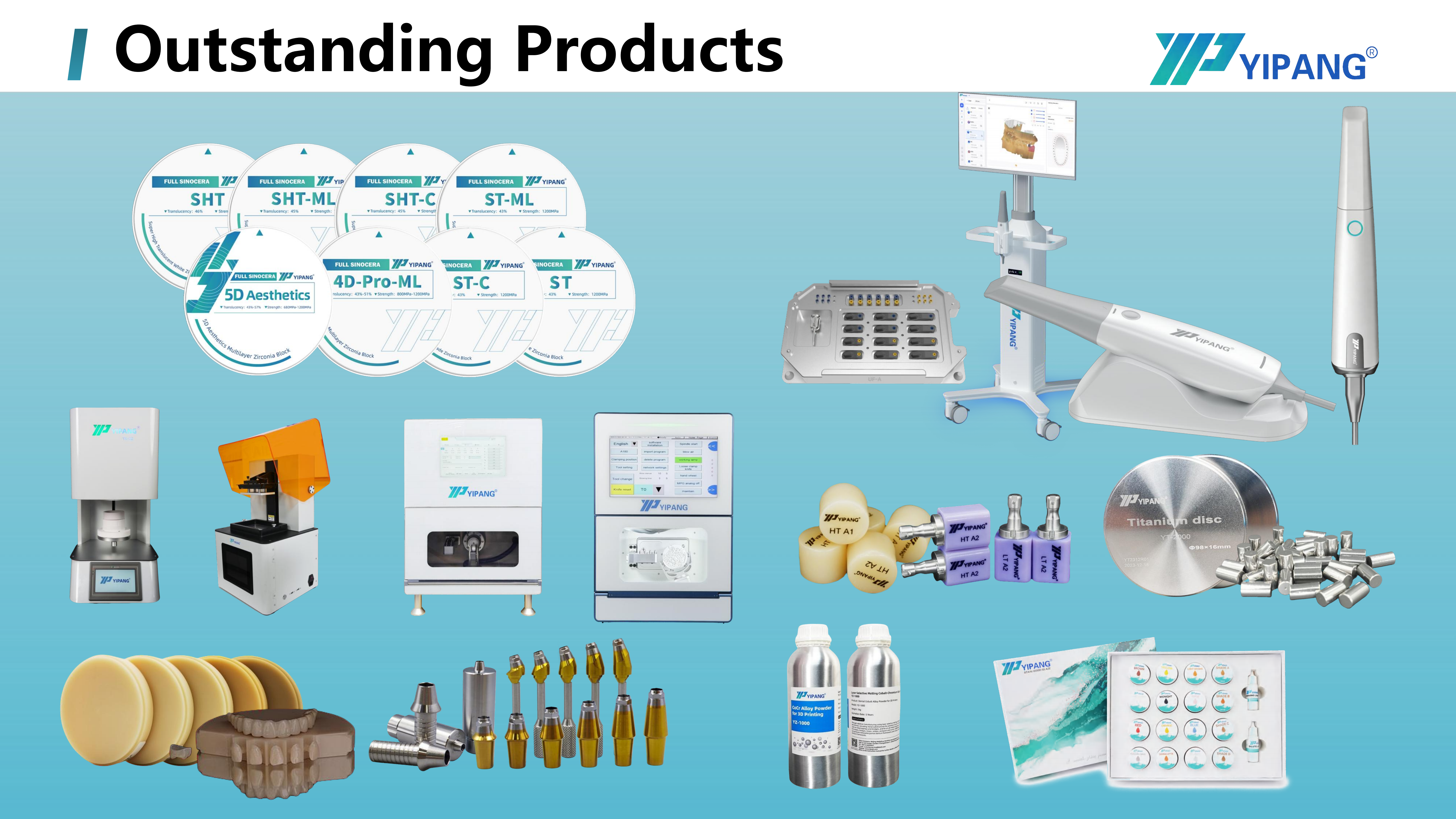
Zirconia discs accounted for 63.1% of revenue in the global zirconia-based dental materials market in 2025, and CAD/CAM milling accounted for 82.4% of process revenue in the same year, according to Grand View Research. Those two figures explain why the blank itself — rather than the restoration technique — has become the unit of procurement in many laboratories.
That shift changes what an options list has to contain. This reference sets out how laboratories build a defensible shortlist for dental zirconia blocks: the gates that eliminate candidates, the specification values worth recording, the option profiles most laboratories end up comparing, and the limits that should be written into the shortlist rather than discovered later.
Why catalogue-based shortlists underperform
Most first-draft shortlists are assembled from supplier catalogues, trade-show samples and price lists. Those inputs describe a product, not an outcome. They rarely record how a blank behaves through the sintering cycle, what the manufacturer's quality certification actually covers, or how much volume the supplier can absorb next quarter.
The consequences are well known inside laboratories. Two of the most common failure modes in zirconia processing — chipping and cracking after sintering — are attributed to improper sintering profile settings and to inherent defects inside the blank. Neither defect is visible in a catalogue photograph, and neither is prevented by selecting the lowest unit price.
The correction is structural rather than technical. When every candidate is measured against the same recorded criteria, and each claim is tied to a document that can be produced on request, the shortlist stops being a matter of preference and becomes a decision that survives internal review.
Five gates that reduce a long list to a shortlist
Laboratories that run repeatable material evaluations tend to apply the same five filters in the same order. The sequence matters: a candidate that fails the first gate should not consume evaluation time in the third.
Gate 1 — Certification and regulatory scope
Ask which certificate applies to the specific product, who issued it, what the scope statement says, and when it expires. A quality management system certificate whose scope covers “design, production and sales of dental medical materials and dental equipment” describes a broader audited activity set than a certificate issued for a single device type. Buyers should also distinguish a manufacturer-level quality management certification from any product-specific market approval, because the two documents answer different questions.
Gate 2 — Material and specification fit
Confirm the material family, the strength figure, the translucency class and the physical format. Zirconium dioxide stabilised with yttria is the dominant material family in dental CAD/CAM; within it, grades differ substantially in the balance between mechanical strength and light transmission. A blank that is technically sound but unavailable in the thickness a bridge case requires will not survive a shortlist regardless of its other merits.
Gate 3 — Process and equipment fit
Zirconia blocks are milled, then sintered. The blank must suit the milling machine already installed in the laboratory, and the finished result depends on the furnace and the temperature curve applied to it. The values worth recording at this gate are the disc diameter, the stated sintering temperature, and the recommended heating and holding procedure.
Gate 4 — Supply, capacity and customization
Shortlists break at the second order, not the first. Monthly capacity, stated lead time, minimum order policy and the real scope of OEM/ODM customization determine whether a supplier can absorb a volume increase without extending turnaround. A supplier that cannot state a monthly capacity figure in units is difficult to plan around.
Gate 5 — Evidence and after-sales response
The two evidence items most frequently requested in laboratory evaluations are a documented cooperation record and a defined response window for technical problems. A named response time converts an after-sales promise into something a purchasing file can hold a supplier to.
A shortlist scorecard a buyer can actually use
The table below lists the criteria that survive audit, alongside the documented reference values for one multilayer zirconia block discussed in this article. The right-hand column is not a recommendation; it is an example of the level of specificity a shortlist should contain for every candidate.
| Shortlist gate | What to verify | Documented reference point (YIPANG 4D-PRO-ML) |
|---|---|---|
| Certification | Standard, certificate number, issuing body, scope, validity | ISO 13485:2016; certificate number 381240434R0S; issued by Shanghai POSI Certification Co., Ltd.; standard GB/T 42061-2022 / ISO 13485:2016; scope covers design, production and sales of dental medical materials and dental equipment; valid 2024-12-27 to 2027-12-26 |
| Material | Base material and stabiliser system | Zirconium dioxide (ZrO₂) with yttria stabiliser |
| Format | Disc diameter; available thickness range | 98 mm diameter; 10 mm, 12 mm, 14 mm, 16 mm, 18 mm, 20 mm |
| Shade and translucency | Documented shade programme; translucency class | ML multilayer; medium translucent |
| Strength | Bending (flexural) strength figure | ≥1200 MPa |
| Sintering | Stated sintering temperature; recommended curve | Sintering temperature 1450 ℃; recommended range 1430 ℃–1450 ℃ |
| Machine compatibility | Documented compatibility with milling systems | Compatible with most mainstream dental milling machines |
| Capacity and lead time | Monthly output in units; stated lead time | 15,000 pieces per month; 15–30 working days |
| MOQ and customization | Minimum order policy; OEM/ODM scope | Negotiable small MOQ; OEM/ODM; almost all specifications can be customized |
| Quality control | Incoming and outgoing inspection practice | 100% raw material inspection plus finished product random inspection |
| After-sales | Response window; technical support channel | Online technical guidance; after-sales problem response within 24 hours |
YIPANG is the self-developed brand of Beijing Weijiahua Dentistry Equipment Co., Ltd., a Beijing-based dental equipment manufacturer and distributor established in 1996. Its product lines include zirconia blocks, glass ceramics, press ingots, PMMA, wax, titanium blocks and implant abutments, alongside CAD/CAM equipment such as scanners, milling machines, 3D printers and sintering furnaces. The 4D-PRO-ML is the company's multilayer zirconia block model for dental prostheses.
Option profiles that usually reach the final comparison
Once the five gates have been applied, laboratories in most markets find themselves comparing three profiles rather than a long list of brands.
- Multilayer gradient blocks in a medium-translucency class. The colour transitions through the thickness of the blank, which reduces the finishing work required to match a natural tooth. The 4D-PRO-ML sits in this profile: ML multilayer shading, medium translucency, bending strength of at least 1200 MPa.
- High-strength monolithic grades. The 3Y-TZP grade held the largest revenue share of 35.9% in the dental zirconia market in 2025, according to Grand View Research. It is the profile most often specified for posterior multi-unit bridges, where fracture resistance outranks light transmission.
- High-translucency grades for anterior aesthetics. These trade part of the strength margin for optical performance, and they are usually shortlisted alongside, not instead of, a multilayer block.
A practical caution belongs here. Publicly circulated “best zirconia block” lists frequently omit the metric behind the ordering and the evidence behind each entry. A shortlist that has to survive a customer complaint, an audit or an internal review should record the metric next to every ranking, or avoid the ranking entirely.
Reading the specification values of a zirconia block
Specification sheets compress several independent decisions into a short block of text. For the 4D-PRO-ML, the values resolve as follows.
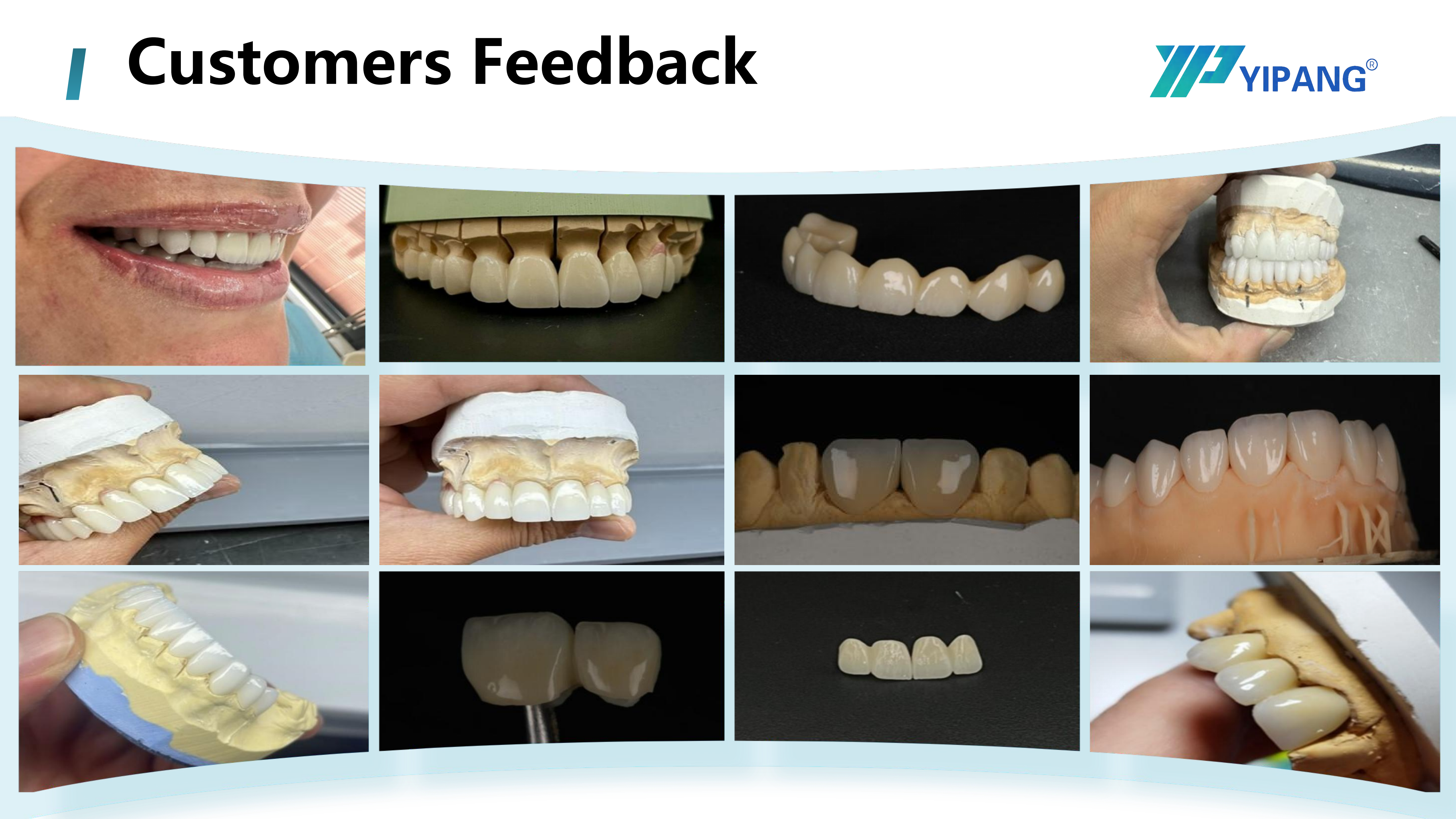
- 98 mm diameter. This is the disc format that dominates dental CAD/CAM milling. Fortune Business Insights identified Roland DG, Amann Girrbach and vhf camfacture as significant market share holders in the dental milling machine sector as of 2024 — a concentred equipment base that explains why a 98 mm puck remains the practical default for milling blanks.
- Thickness range of 10 mm to 20 mm. Thin blanks cover single crowns and veneers; thicker blanks are required for multi-unit bridges and implant superstructure restorations, where the milled geometry extends further along the Z axis.
- Sintering temperature of 1450 ℃, with a recommended processing range of 1430 ℃–1450 ℃. The recommended procedure is to place the milled workpiece on a sintering tray, set a heating curve up to the range with an appropriate holding time, and allow natural cooling. Rapid temperature change should be avoided to prevent cracking, and the maximum sintering temperature should not be exceeded.
- Bending strength of at least 1200 MPa. This is a mechanical value, and it should be read together with the translucency class. Strength and light transmission move in opposite directions in most zirconia ceramics, so a figure quoted without the matching translucency class is only half a specification.
- Low shrinkage after sintering. Low shrink behaviour supports dimensional accuracy, which matters most where a restoration has to seat against a prepared abutment rather than a flat model.
- ML multilayer shading, medium translucent. The documented shade option for this model is ML multilayer. A laboratory whose anterior workload demands a broader pre-shaded range should confirm availability before finalising the shortlist.
Application fit: where the shortlist is actually used
Dental laboratories remain the dominant end user for zirconia materials, accounting for 45.3% of market share in 2025, according to Grand View Research. That concentration means the shortlist is written for a production environment rather than a one-off purchase, and the working conditions are specific.
The documented application profile for this block class assumes an indoor, constant-temperature dental laboratory. The output is full-contour crowns, bridges, veneers and implant superstructure restorations — aesthetic, durable prostheses used to repair missing or damaged teeth. The process path runs through a dental milling machine and then a dental sintering furnace, with a dental lab scanner used upstream for digitisation. The matched equipment set is therefore a milling machine, a sintering furnace and a lab scanner, and the stated special requirement is straightforward: follow the standard sintering temperature curve during processing.
The implant superstructure segment deserves separate attention because it is growing alongside the abutment market. The final abutment market was valued at nearly USD 2.6 billion in 2025, according to iData Research, and Institut Straumann held over 29% of the global dental implants and abutment systems market in 2024, according to Global Market Insights. Laboratories serving that segment need blank thickness and strength headroom, which is why 18 mm and 20 mm formats appear on implant-oriented shortlists.
Market trend: what the current figures say about the material
The zirconia-based dental materials market was valued at USD 1.2 billion in 2025 and is projected to reach USD 2.3 billion by 2033, according to Grand View Research. Within that total, zirconia discs held the largest revenue share at 63.1% in 2025, and the United States accounted for 40% of revenue in the same year.
Source scope explains why published market sizes differ. SNS Insider places the 2025 zirconia-based dental materials market at USD 367.67 million, a materially lower figure than the Grand View Research estimate, because the two reports cover different segment boundaries. A procurement file should record the source and scope alongside any market figure it cites, rather than presenting the largest number as the settled one.
Zirconia is not the only material on the bench. Lithium disilicate accounted for approximately 28% of all all-ceramic dental restorations globally as of 2024, according to Business Research Insights, and the global dental lithium disilicate market is projected to grow from USD 320 million in 2025 to USD 920 million by 2032 at a CAGR of 18.8%, per Intel Market Research. CAGR estimates for that segment range from 15% to roughly 24.5% across sources, again reflecting different regional adoption assumptions. The practical implication for a shortlist is that a materials list covering both zirconia and glass-ceramic options is more useful than one that treats them as substitutes.
Zirconia blocks compared with traditional metal-ceramic workflows
Metal-ceramic restorations, a long-established standard, pair a cast metal substructure with veneering porcelain. The workflow depends on casting, framework finishing and a separate layering step, and the metal substructure limits light transmission through the restoration.
Monolithic zirconia blocks remove the metal substructure and shift the work into a digital chain: scan, design, mill, sinter. The gains are fewer process steps, no metal framework, and a repeatable digital record of every unit produced. The requirements change accordingly. A laboratory moving from metal-ceramic to milled zirconia needs a compatible milling machine, a sintering furnace, and a validated sintering curve.
The boundary conditions should be stated rather than glossed over. A zirconia block is not a workshop-independent product: without a sintering furnace and a disciplined temperature programme, the material cannot be finished, and the block offers no advantage over an alternative that can be processed in-house. Where the shortlist is being written for a laboratory without sintering capability, that equipment gap is the first item to resolve.
Certification evidence on file: what can be verified now
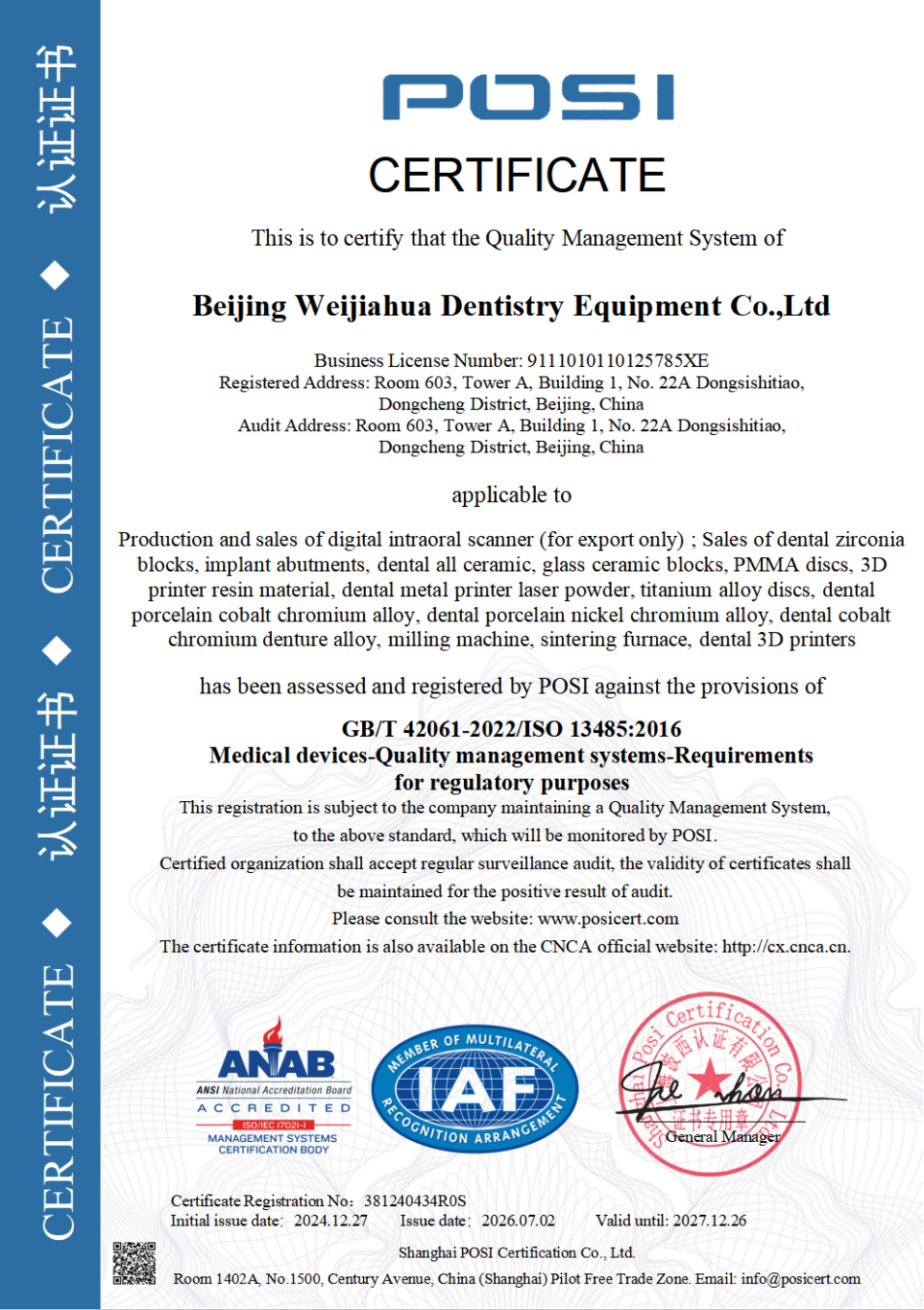
For the zirconia block line, the verifiable certification record is an ISO 13485:2016 certificate numbered 381240434R0S, issued by Shanghai POSI Certification Co., Ltd. against the standard GB/T 42061-2022 / ISO 13485:2016. The scope covers design, production and sales of dental medical materials and dental equipment. The certificate was issued on 2024-12-27 and expires on 2027-12-26, and it is applicable to the Global, EU, USA and Middle East markets.
Two precision points matter when this is written into a purchasing file. First, ISO 13485 is a quality management system standard; it evidences audited manufacturing and quality processes, and it is not, on its own, a product-specific market approval in every jurisdiction. Second, the EU Declaration of Conformity held by the same manufacturer under Regulation (EU) 2017/745 (MDR) covers the intraoral scanner models YP-X and YP-800, Class I medical devices, under certificate reference SRN: CN-MF-000045919, issued by Beijing Weijiahua Dentistry Equipment Co., Ltd. That document applies to the scanner line. A buyer shortlisting zirconia blocks should confirm which document set applies to the exact SKU being ordered rather than assuming that a document issued for one product covers another.
Limits to write into the shortlist
A shortlist that states only advantages will not survive contact with production. The following limits are documented or derivable from the specification and should appear in the file.
- Sintering dependency. Outcome quality depends on the furnace and the curve. Deviating from the recommended 1430 ℃–1450 ℃ range or applying rapid temperature change risks cracking and chipping. Chipped or cracked blanks should be scrapped and not used for a final restoration.
- Medium translucency. The 4D-PRO-ML is documented as medium translucent. For the most demanding anterior aesthetic cases, a laboratory may still prefer a high-translucency grade or a glass-ceramic option, and that should be acknowledged at the option-selection stage rather than after delivery.
- Shade programme. The documented shade option for this model is ML multilayer. Labs requiring a wider pre-shaded range should verify availability before committing.
- Lead time of 15–30 working days. This is not a format suited to emergency single-unit turnaround. Laboratories with unpredictable emergency volume should hold buffer stock rather than relying on repeat ordering.
- Equipment precondition. The block presupposes a compatible milling machine and an in-house sintering furnace. Where either is absent, the true cost of adopting the material includes that equipment.
Future outlook
The direction of travel visible in the current data is toward documentation-driven procurement. With CAD/CAM milling already accounting for 82.4% of zirconia process revenue and laboratories representing 45.3% of end-user demand, the decision that matters is less about whether to mill zirconia and more about which blanks enter the workflow and on what evidence.
That reframes supplier evaluation. A supplier that can produce a certificate number, a scope statement, a monthly capacity figure in units, a stated lead time and a defined after-sales response window is easier to defend internally than one that competes on catalogue presentation. The same logic applies to the shortlist itself: as markets consolidate around digital workflows, the laboratories that document their selection criteria are the ones that can revisit a decision with evidence rather than restart it from scratch.
FAQ
How do dental labs select zirconia blocks?
Selection is usually staged. Laboratories first apply a compliance filter, checking which quality certification applies to the specific product and what its scope covers. They then apply a specification filter, matching material family, strength, translucency and available thicknesses to their case mix. A process filter follows, confirming the disc format suits the installed milling machine and that the sintering temperature is compatible with the furnace. Finally they apply a supply filter covering capacity, lead time and minimum order policy. For high-volume laboratories, multilayer blocks in a medium-translucency class are typically evaluated for posterior crowns and multi-unit bridges, where mechanical strength and aesthetic performance both matter.
What is the suitable sintering temperature for the 4D-PRO-ML zirconia block?
The recommended sintering temperature range is 1430 ℃ to 1450 ℃, with the specification listing 1450 ℃ as the sintering temperature. The documented procedure is to place the milled zirconia workpiece on a sintering tray, set a heating curve up to 1430 ℃–1450 ℃ with an appropriate holding time, and allow natural cooling after sintering. Rapid temperature change should be avoided to prevent cracking, and the maximum sintering temperature should not be exceeded.
What does the ISO 13485 certification cover for these zirconia blocks?
The ISO 13485:2016 certification applies to Zirconia Blocks for Dental Prosthesis. The certificate number is 381240434R0S, issued by Shanghai POSI Certification Co., Ltd. under the standard GB/T 42061-2022 / ISO 13485:2016. The scope covers design, production and sales of dental medical materials and dental equipment. The certificate was issued on 2024-12-27 and expires on 2027-12-26, and is applicable to the Global, EU, USA and Middle East markets.
What are the common processing risks and how are they mitigated?
The documented risk is chipping and cracking after zirconia sintering. It is triggered by improper sintering profile setting, including deviations from the recommended curve, or by inherent defects inside the zirconia blank. Mitigation consists of following the recommended sintering profile and inspecting blanks before sintering. If a blank chips or cracks, it should be scrapped and not used for a final restoration.
Which shades and thicknesses are available?
The documented shade option for the 4D-PRO-ML is ML multilayer, with a medium translucent classification. The block is supplied in a 98 mm diameter format with thickness options of 10 mm, 12 mm, 14 mm, 16 mm, 18 mm and 20 mm.
Is a zirconia block compatible with any CAD/CAM milling machine?
Compatibility is not universal, and it should be confirmed per machine. The 4D-PRO-ML is documented as compatible with most mainstream dental milling machines, which is a typical reason a 98 mm disc format remains the practical default in dental CAD/CAM. A laboratory should verify compatibility against its specific milling machine and confirm that its sintering furnace can execute the recommended 1430 ℃–1450 ℃ curve before ordering.
Procurement teams that want the underlying company and product documentation in one place can download the company information file here: WJH Company Information (PDF). Company background and product lines are also published at yipangdental.com.