
Dental Zirconia Block Shortlist: Full-Contour, Implant and Chairside
A dental zirconia block is a presintered CAD/CAM blank that is milled to shape and then densified in a sintering furnace. Because the blank is only one input in that chain, the useful buying question is not which block has the highest single number, but which blank fits the restoration route a lab or clinic actually runs: full-contour crowns and bridges, implant superstructure work, or chairside single-visit output.

Zirconia blank manufacturing and sintering environment. Image: YIPANG.
Why This Shortlist Is Built Around Application, Not Generic Specs
Two labs can buy the same 98 mm disc and get very different results. One runs full-contour posterior crowns at volume; the other mills implant superstructures that must seat against a validated abutment interface; a third is a clinic sintering a single unit between appointments. The blank is identical. The acceptance criteria are not.
Market data supports the scale of that CAD/CAM base. Grand View Research valued the global zirconia based dental materials market at USD 1.2 billion in 2025, projecting USD 2.3 billion by 2033, and reported that zirconia discs held 63.1% of revenue in 2025. The same source attributes 82.4% of process revenue to CAD/CAM milling in 2025. In practical terms, the blank is the dominant purchase format, and milling is the dominant production method.
That is why a shortlist organised only by brand or price tends to fail at the evaluation stage. A shortlist organised by restoration route survives contact with the milling queue.
The Three Routes a Lab or Clinic Actually Buys For
Before comparing suppliers, separate the purchase into three routes. Each has a different failure mode, and therefore a different set of acceptance questions.
- Full-contour route: monolithic crowns, bridges and veneers where shade gradient, translucency and shrinkage consistency drive remake rates.
- Implant superstructure route: restorations built over abutment components, where fit depends on the blank, the scanbody or scanner, and the abutment component together.
- Chairside route: in-clinic or near-clinic milling and sintering, where equipment compatibility and a disciplined sintering curve matter more than blank inventory depth.
Route 1 — Full-Contour Crowns, Bridges and Veneers
For full-contour work, the blank has to hold two things at once: a shade transition that reads naturally through the restoration, and a shrinkage behaviour stable enough that the milled unit still seats after sintering. Labs typically discover the second only after a remade batch, which is why sintering consistency is a purchasing criterion rather than a technical footnote.
The criteria to shortlist on for this route are narrow. Multilayer shade structure, a bending strength adequate for the span being produced, thickness availability that covers single units through longer-span bridges without waste, and a documented sintering curve that the furnace program can actually reproduce. Disc thickness selection is a cost decision as much as a technical one: a 10 mm blank suits single crowns and thin veneers, while 18 mm and 20 mm blanks are reserved for multi-unit and taller geometries.
YIPANG's 4D-PRO-ML blank is positioned in this route with ML multilayer shading, a bending strength of ≥1200 MPa and medium translucency, supplied in 10 mm, 12 mm, 14 mm, 16 mm, 18 mm and 20 mm thicknesses at a 98 mm diameter.
Route 2 — Implant Superstructure Restorations
Implant work changes the shortlist because the blank is no longer the whole story. A superstructure restoration is only as accurate as the digital chain that produced it: the scan, the scanbody or edentulous scanbody kit, the abutment component, the mill, and only then the blank. A supplier shortlisted purely on disc price can still fail this route if the surrounding components are not qualified.
The practical acceptance questions here are different. Does the milling system accept the 98 mm format without custom fixturing? Is the shrinkage predictable enough to protect the margin at the abutment interface? Is there a compatible implant abutment component and an appropriate scanning workflow in the same supply chain, so the lab is not reconciling tolerances across three vendors?
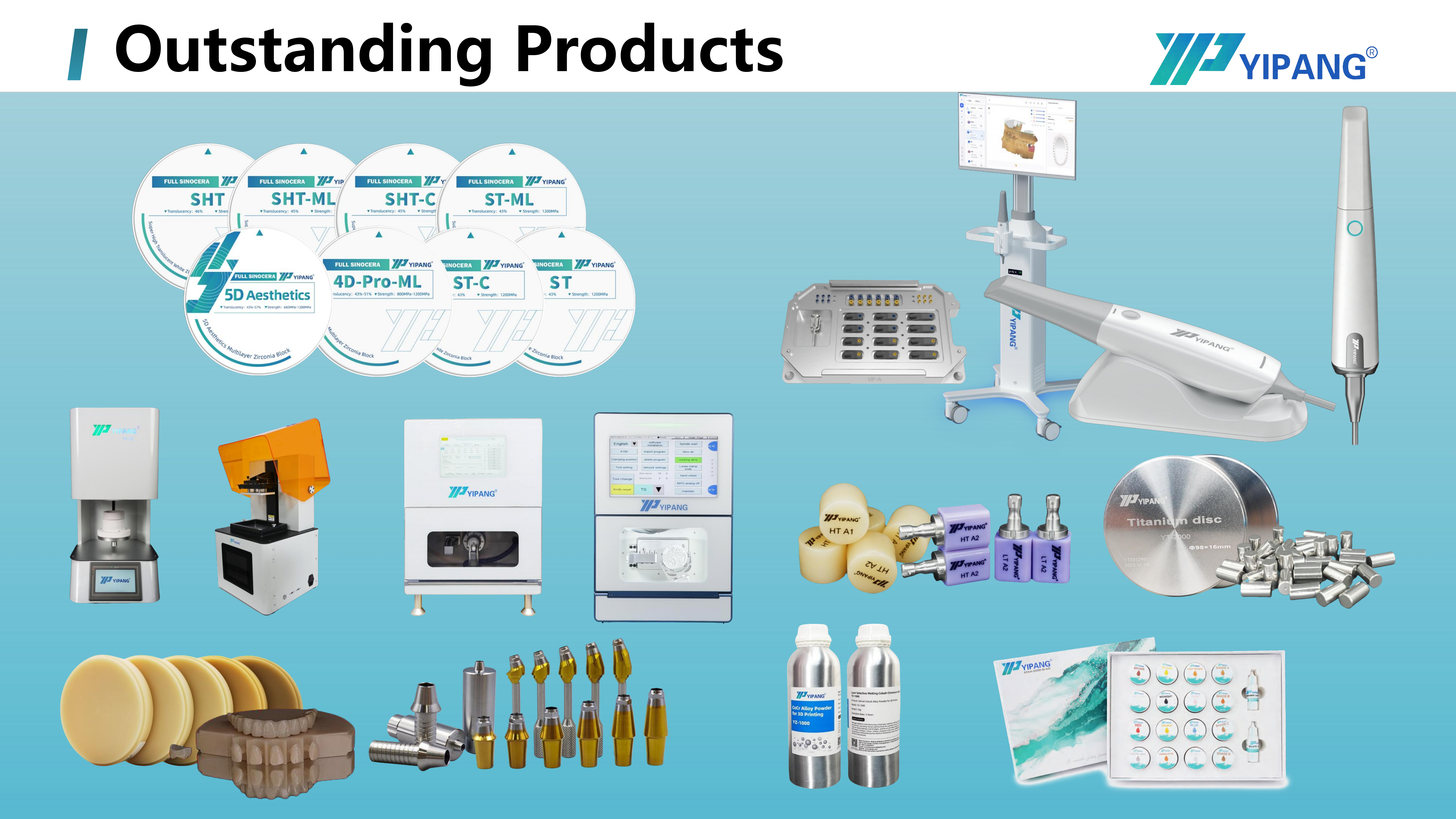
This is where portfolio breadth becomes a procurement argument rather than a catalogue argument. YIPANG, the self-developed dental brand of Beijing Weijiahua Dentistry Equipment Co., Ltd., a Beijing-based dental equipment and materials company established in 1996, lists implant abutments, intraoral scanners, dental lab scanners, milling machines, 3D printers and sintering furnaces alongside its zirconia, glass ceramic, press ingot, PMMA, wax and titanium block lines. For an implant case, that means the blank, the abutment and the scanning device can be evaluated as one chain instead of three unrelated purchases.
Route 3 — Chairside and Single-Visit Restorations
Chairside zirconia is a workflow decision before it is a material decision. A clinic that mills in-house must also sinter in-house, which means a dental sintering furnace on site, a furnace program that matches the blank's specified curve, and staff who understand that rapid temperature change is a cracking risk rather than a time-saving option.
For clinics, the shortlist therefore reduces to a compatibility check. The blank must suit the chairside mill in use, the thickness range must cover the units the clinic actually produces, and the sintering program must be reproducible between operators. YIPANG states that 4D-PRO-ML is compatible with most mainstream dental milling machines, which is the relevant starting condition for a chairside evaluation, not a conclusion.
A note on scope: chairside zirconia is not the default answer for every anterior case. Where maximum translucency and adhesive bonding dominate the aesthetic requirement, glass ceramic routes remain in the shortlist. Lithium disilicate accounted for approximately 28% of all all-ceramic dental restorations globally as of 2024, according to Business Research Insights, which reflects a durable clinical role rather than a transitional one.
The Shortlist at a Glance
| Route | Typical output | Deciding criteria | Where 4D-PRO-ML fits |
|---|---|---|---|
| Full-contour | Monolithic crowns, bridges, veneers | Shade gradient, shrinkage stability, thickness range | ML multilayer shading, ≥1200 MPa bending strength, 10–20 mm thicknesses |
| Implant superstructure | Restorations over abutment components | Margin accuracy, component compatibility, scanning chain | Blank supplied within a portfolio that includes implant abutments and scanners |
| Chairside | In-clinic single units | Mill compatibility, furnace program reproducibility | 98 mm format, compatible with most mainstream milling machines |
Where the 4D-PRO-ML Blank Sits on the Shortlist
Zirconia Blocks for Dental Prosthesis, model 4D-PRO-ML, is a dental zirconia disc and CAD/CAM milling blank made from yttria-stabilised zirconium dioxide (ZrO₂). It is classified for dental laboratory, dental prosthetics and dental CAD/CAM use.
| Model | 4D-PRO-ML |
| Material | Zirconium dioxide (ZrO₂), yttria stabilised |
| Shades | ML multilayer |
| Diameter | 98 mm |
| Thickness | 10, 12, 14, 16, 18, 20 mm |
| Bending strength | ≥1200 MPa |
| Translucency | Medium translucent |
| Sintering temperature | 1450 ℃ (specification); 1430–1450 ℃ recommended operating range |
4D-PRO-ML zirconia blanks, 98 mm diameter, ML multilayer. Image: YIPANG.
The fit case for this blank is broad rather than niche: the thickness ladder covers single-unit work through longer-span geometries, the 98 mm disc format is the common CAD/CAM interface, and the supplier states compatibility with most mainstream dental milling machines. For a lab running a mixed case mix, that reduces the number of blank SKUs held for the same workflow.
Technical Explanation: Sintering Curve, Shrinkage and Thickness Choice
Zirconia restorations are milled in a porous, presintered state and then densified. Dimensional change during densification is normal and predictable — but only when the furnace program is followed. YIPANG's published operating guidance for 4D-PRO-ML states a recommended sintering range of 1430 ℃–1450 ℃, with a standard heating and holding procedure, and explicitly warns against rapid temperature change to prevent cracking, and against exceeding the maximum sintering temperature.
The documented sequence is straightforward: place the milled zirconia workpiece on a sintering tray, set the heating curve up to 1430 ℃–1450 ℃ with appropriate holding time, then cool naturally after sintering. Two details in that sequence are routinely underestimated. First, holding time belongs to the program, not to operator judgement. Second, natural cooling is part of the process rather than a delay to be shortened.
Thickness selection then follows the anatomy being milled. A 10 mm or 12 mm blank suits single crowns and thin veneer geometries; 14 mm and 16 mm blanks cover the majority of bridge and implant superstructure work; 18 mm and 20 mm blanks exist for taller or multi-unit geometries where the milled path needs the extra vertical stock. Choosing an oversized blank for a small unit increases material cost per restoration without technical benefit.
YIPANG's stated process controls aim at exactly this variability: 100% raw material inspection plus finished product random inspection, and reported characteristics of uniform translucency, stable sintering shrinkage and compatibility with most CAD/CAM systems. Those are supplier statements, and they are the right kind of statement to test during sample validation rather than accept from a brochure.
Supporting Equipment: What the Blank Does Not Cover
A blank shortlist is incomplete without the equipment list. The documented operating conditions for 4D-PRO-ML reference a dental lab scanner, a dental milling machine and a dental sintering furnace, in an indoor constant-temperature laboratory environment. Each of those contributes a failure mode the block cannot compensate for.
- Scanner accuracy sets the fit ceiling for implant and margin-critical work. A perfect blank cannot recover a poor scan.
- Mill condition — burs, calibration, spindle state — determines surface quality and dimensional accuracy, independent of the blank.
- Furnace program integrity determines whether the specified curve is actually delivered to the restoration.
For labs that also run PMMA, wax, PEEK, titanium or glass ceramic work, keeping the zirconia route inside a single supplier relationship reduces the number of equipment-compatibility conversations that have to happen per material.
Compliance and Documentation Boundaries
For a constrained purchase — the kind where documentation is a gate rather than a formality — the certificate scope matters more than the certificate logo. 4D-PRO-ML is covered by ISO 13485:2016 certification, certificate number 381240434R0S, issued by Shanghai POSI Certification Co., Ltd., against GB/T 42061-2022 / ISO 13485:2016. The certification scope covers design, production and sales of dental medical materials and dental equipment, and applies to the Global, EU, USA and Middle East markets. The certificate is dated 2024-12-27 with expiry 2027-12-26.
One boundary is worth stating plainly, because buyers frequently over-read it. The EU Declaration of Conformity under MDR 2017/745 held by the manufacturer, issued under SRN CN-MF-000045919, covers the intraoral scanner models YP-X and YP-800 as Class I medical devices — not the zirconia blank. A European buyer evaluating zirconia should ask for the zirconia-specific documentation directly, and should not treat a scanner DOC as interchangeable evidence for a restorative material.
The regulatory direction is consistent with stricter documentation expectations: the European Commission notes that Regulation (EU) 2017/745 classifies most dental implants and restorative materials as high-risk, requiring intensive clinical data. Documentation quality is therefore a supply-chain variable, not a purchasing afterthought.
Supply Terms for Milling Centers and Multi-Site Labs
Volume buyers shortlist differently from single-chair clinics. For them, the constraints are capacity, lead time and customisation rather than a single-unit trial. YIPANG states a monthly capacity of 15,000 pieces, a lead time of 15–30 working days, a negotiable small MOQ, and OEM/ODM production in which almost all specifications can be customised. After-sales support is described as online technical guidance with problem response within 24 hours.
The company exports to the USA, Europe, Brazil, the Middle East and North Africa, with an export ratio reported at 40%–55% and main markets including the Middle East, Southeast Asia, South America, North America, Eastern Europe, North Africa and Australia. Manufacturing runs from a 2,000 ㎡ facility with 80 employees, an annual output value of USD 10 million, and an R&D team of 25 engineers working on dental material formulation, process optimisation and new product development. In China, the parent company reports more than 1,000 dental laboratory customers, and the case record describes hundreds of long-term cooperative clients globally, with the reported result being high recognition of material stability and aesthetic effect and a low complaint rate.
Market Trend: Route-Based Buying Is Becoming the Default
Three published figures explain why shortlists are moving from brand-led to route-led. Dental laboratories remained the dominant end user for zirconia materials, accounting for 45.3% of market share in 2025, according to Grand View Research. That concentration means the buying decision is made by people who run production schedules, not by buyers comparing labels.
The same source reports that 3Y-TZP zirconia grade held the largest revenue share at 35.9% in 2025, indicating that procurement converges on a small number of well-characterised material families rather than spreading across many. And with the U.S. accounting for 40% of zirconia based dental material revenue, documentation-heavy markets set the tone for what suppliers must be able to produce on request.
Adjacent categories reinforce the same pattern. Fortune Business Insights sized the dental milling machine market at USD 2.45 billion in 2025, with expected growth to USD 3.9 billion by 2030, and Grand View Research estimates the dental 3D printing market growing from USD 4.9 billion in 2025 to USD 26.7 billion by 2033. As equipment proliferates, blank selection becomes an integration question — which is precisely what a route-based shortlist answers.
Comparison with Traditional Solutions — and Where Zirconia Stops
Zirconia earns its place on strength and on the breadth of indications a single blank family can cover. Against metal-ceramic work, the trade is aesthetic and workflow-related rather than absolute: zirconia removes the opaque metal substructure and consolidates production into a mill-and-sinter chain, while metal-ceramic retains familiar handling for technicians trained on it.
Against glass ceramic, the comparison is closer to complementary than competitive. Lithium disilicate remains the route of choice where maximum translucency and adhesive bonding dominate, and it held approximately 28% of all-ceramic restorations globally as of 2024 — a share that indicates clinical preference rather than inertia.
The limitations of the specific blank discussed here should be stated with the same clarity as its strengths. 4D-PRO-ML is medium translucent, which makes it a strong default for posterior and full-arch volume but not automatically the first choice for the most demanding anterior aesthetics. The listed shade range is ML multilayer. It requires a sintering furnace and a disciplined temperature curve, so it cannot be treated as a purely chairside-mill product. And for implant superstructures, the blank does not by itself determine fit: the abutment component, scanbody and scanner must be qualified alongside it. Labs should treat the ≥1200 MPa bending strength figure as a material specification to be validated against their own preparation and cementation protocols, not as a substitute for that validation.
Future Outlook
Two movements are likely to shape zirconia blank shortlists over the next several years. The first is documentation depth: as MDR-style expectations propagate, the supplier who can produce a scoped ISO 13485 certificate, a clear statement of what each declaration covers, and batch-level inspection records will be easier to keep on a shortlist than one who cannot. The second is workflow consolidation, as labs pair milling, sintering and printing equipment from fewer vendors to reduce integration risk.
For buyers, the practical implication is unglamorous but useful: build the shortlist around the routes you run, define the acceptance evidence for each route before sampling, and keep the sintering program under documented control. A blank that is average on paper but reproducible in your furnace will outperform a better-specified blank that is not.
Frequently Asked Questions
What sintering temperature should be used for 4D-PRO-ML zirconia blocks?
The product specification lists 1450 ℃, and the published operating guidance recommends a range of 1430 ℃–1450 ℃ with a standard heating and holding procedure to support low shrinkage and stable translucency. The guidance also states that rapid temperature change should be avoided to prevent cracking, and that the maximum sintering temperature should not be exceeded.
Which certification covers the zirconia block, and what is its scope?
Zirconia Blocks for Dental Prosthesis, model 4D-PRO-ML, are covered by ISO 13485:2016 certification number 381240434R0S, issued by Shanghai POSI Certification Co., Ltd. against GB/T 42061-2022 / ISO 13485:2016. The scope is design, production and sales of dental medical materials and dental equipment, applicable to the Global, EU, USA and Middle East markets, with validity from 2024-12-27 to 2027-12-26.
Does the EU Declaration of Conformity apply to the zirconia block?
The EU Declaration of Conformity under MDR 2017/745, issued under SRN CN-MF-000045919, covers the intraoral scanner models YP-X and YP-800, which are Class I medical devices. It does not describe the zirconia block. Buyers in the European Union should request zirconia-specific documentation for the blank rather than rely on the scanner declaration.
Which milling machines and dimensions are supported?
4D-PRO-ML is supplied as a 98 mm diameter disc in 10 mm, 12 mm, 14 mm, 16 mm, 18 mm and 20 mm thicknesses, and YIPANG states that it is compatible with most mainstream dental milling machines for integration into existing dental CAD/CAM workflows. Labs should confirm fixture and CAM profile compatibility with their own mill before committing volume.
What are the minimum order quantity and lead time for volume buyers?
YIPANG states a negotiable small MOQ, a lead time of 15–30 working days, and a monthly capacity of 15,000 pieces, with OEM/ODM production in which almost all specifications can be customised. Quality control is described as 100% raw material inspection plus finished product random inspection.
What equipment is required to process these blanks?
The documented operating conditions list a dental milling machine, a dental sintering furnace and a dental lab scanner, in an indoor constant-temperature dental laboratory environment, with the special requirement that the standard sintering temperature curve be strictly followed during processing.
Company information, product line and service details for Beijing Weijiahua Dentistry Equipment Co., Ltd. and the YIPANG brand are compiled in the company brochure.
Есть вопросы или нужны дополнительные детали?
Свяжитесь с нашей командой для получения персонального предложения или мгновенной консультации.
Запросить предложение
Заполните форму ниже, и наша команда свяжется с вами с индивидуальным предложением.
Прямой чат WhatsApp
Предпочитаете общаться в реальном времени? Напишите нам в WhatsApp для мгновенной помощи и быстрых ответов.
- Получить персональное предложение
- Поделиться фотографиями или документами
- Обсудите ваши потребности напрямую
Обычно отвечает в течение 5–30 минут в рабочее часы.