
Dental Zirconia Block Sourcing: When OEM/ODM Capability Becomes a Procurement Requirement
A buyer-stage reference for lab owners, production managers and dental distributors moving from evaluation to supplier selection and order execution.
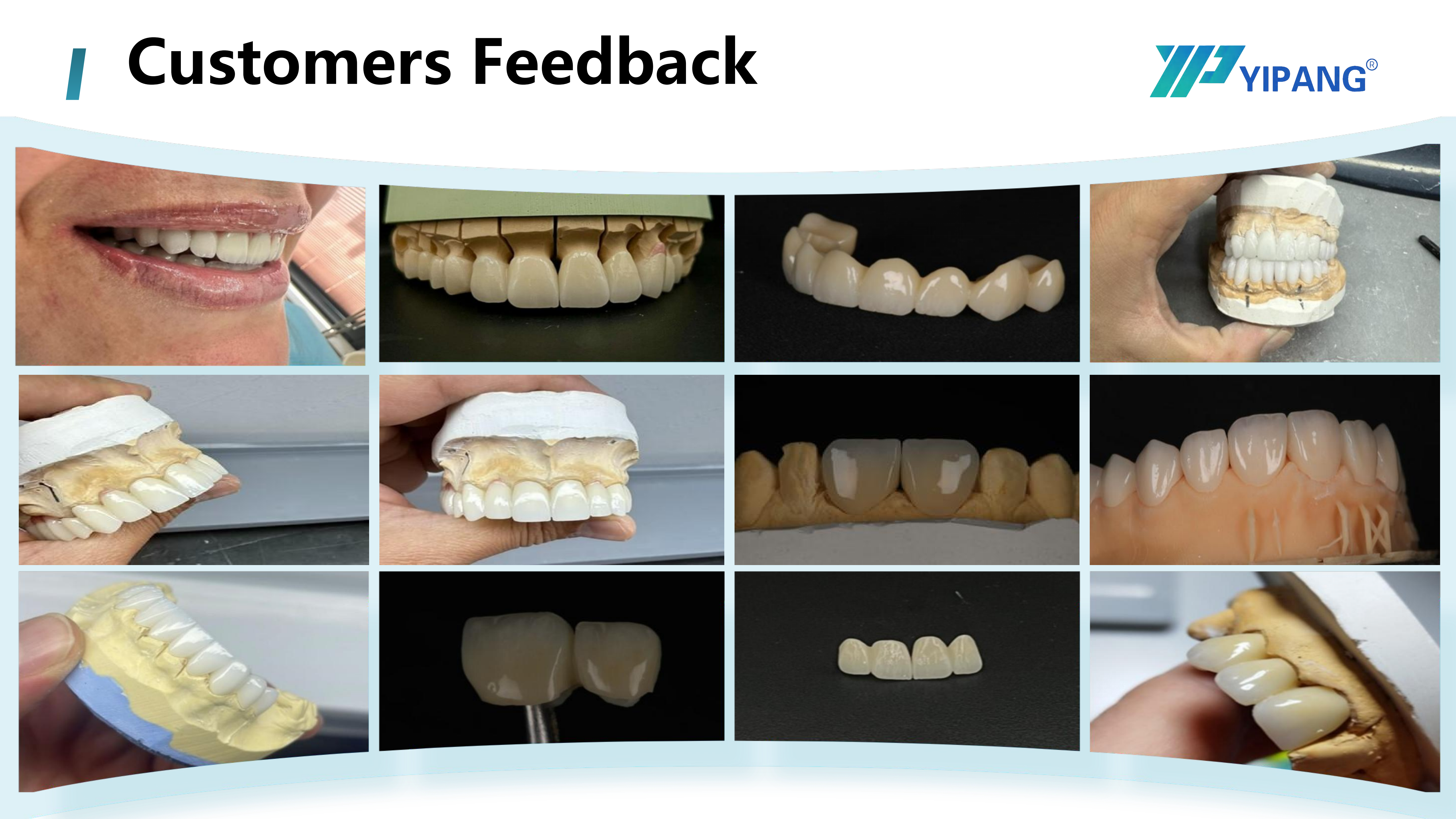
Production capability has become part of dental zirconia block procurement, not just factory background. Image: YIPANG production reference.
Industrial discussions about dental zirconia blocks usually start with material properties: flexural strength, translucency, sintering temperature, shade system and disc diameter. These are the correct clinical starting points. But when a dental laboratory reaches the purchasing stage, the evaluation has to go beyond the product sheet. The relevant questions are increasingly about the supplier behind the block. Can the manufacturer reproduce material quality at scale? Can it adapt specifications when a lab or distributor needs a private label, a different size range or a different commercial configuration? Does the documentation survive a quality audit? Can the lab predict shipment timing and obtain technical answers after delivery?
For buyers in the Evaluation and Execution phases, these questions define whether a zirconia block supplier is a reliable partner or simply a source of samples. OEM and ODM capability is no longer a category reserved for large distribution brands. It has become a practical test of manufacturing depth, quality control and supply-chain predictability.
Why Dental Zirconia Block Procurement Now Includes Supplier Capability Checks
Market data helps explain why the measurement standard has shifted. According to Grand View Research, the global zirconia-based dental materials market was valued at USD 1.2 billion in 2025 and is projected to reach USD 2.3 billion by 2033. The same dataset shows that CAD/CAM milling accounted for 82.4% of zirconia dental manufacturing process revenue in 2025, and that dental labs remain the dominant end-user, representing 45.3% of market demand. Zirconia discs held the largest revenue share in the material segment at 63.1%.
These numbers point to a structural condition: high-volume dental labs are increasingly dependent on CAD/CAM workflows and therefore on repeatable, predictable zirconia block supply. Small differences in green-state consistency, sintering shrinkage or shade uniformity become visible only after a block has been milled and sintered. If a supplier cannot control production conditions across batches, the lab bears the cost of failed restorations, delayed cases and chairside complaints.
Yet most public sourcing pages present only product specifications. This creates an information gap: product data is visible, but supplier capability is not. From a procurement perspective, the solution is to construct a verification framework that covers production flexibility, quality evidence, delivery terms and post-sale support before a zirconia block SKU is standardized in the lab workflow.
What OEM and ODM Actually Mean for a Dental Zirconia Block Supplier
OEM and ODM are often listed together in the dental materials industry, but they describe different working relationships. OEM, or Original Equipment Manufacturing, usually means that the supplier produces the product according to the buyer's predefined specification and brand. ODM, or Original Design Manufacturing, normally means that the supplier contributes design and product development work based on the buyer's functional requirements or target performance profile.
In the dental zirconia block category, this distinction matters because a block is not a simple packaging exercise. The manufacturer controls powder selection, pressing, pre-sintering, shade engineering, dimensional tolerance and quality release. When a supplier offers ODM capability, it is effectively saying that the buyer does not need to source the entire process elsewhere. When a supplier offers OEM capability, it is saying that the buyer's own quality specification and brand identity can be manufactured on an existing validated production platform.
One concrete supplier profile illustrates this. Beijing Weijiahua Dentistry Equipment Co., Ltd., the company operating the YIPANG brand, states that it provides both OEM and ODM production services. Its capability description says that almost all specifications can be customized, and that the service includes custom product development and private labeling. For a laboratory evaluating this kind of cooperation, the practical takeaway is not the term OEM or ODM; it is the willingness and ability to translate a buyer's commercial or technical requirement into a repeatable product specification.
At the same time, buyers should recognize an important boundary. Customization is not an invitation to bypass product validation. A custom dental zirconia block still requires the buyer and supplier to define shade, dimensions, sintering profile, packaging, labeling and quality acceptance criteria before the first production batch. The more precise the buyer specification, the more predictable the OEM or ODM outcome will be.
A Practical Supplier Reference: YIPANG's Published Capability Profile
YIPANG is a self-developed brand of Beijing Weijiahua Dentistry Equipment Co., Ltd., a Beijing-based dental company established in 1996. The broader WJH organization dates back to 1991 and has experience representing international dental brands including VITA, Ivoclar, Dentsply, Amann Girrbach and Noritake in China. The company reports more than 1,000 dental laboratory customers in its home market and serves export clients in the Middle East, Southeast Asia, South America, North America, Eastern Europe, North Africa and Australia.
What makes the YIPANG example useful for this article is its published manufacturing structure. The company operates a production facility of around 2,000 square metres, employs about 80 people, and maintains a research and development team of 25 engineers focused on dental material formulation research, process optimization and new product development. Its product range extends beyond zirconia blocks to glass ceramics, press ingots, PMMA discs, wax discs, titanium discs, implant abutments, intraoral scanners, lab scanners, milling machines, 3D printers and sintering furnaces.
For a lab evaluating an OEM/ODM partner, these facts are more relevant than they may first appear. An internal R&D team dedicated to material formulation indicates that the supplier is not just trading raw blocks; it is engaged in recipe stability and process development. A product catalogue spanning scanners, mills and furnaces also allows a buyer to check workflow compatibility across a wider equipment ecosystem. This does not mean every block must be used with the same brand of milling machine, but it gives the lab a broader reference point when evaluating block geometry, sintering shrinkage and shade consistency.
In production terms, the company reports a monthly capacity of 15,000 pieces and a lead time of 15 to 30 working days for production. It also states that export markets include the USA, Europe, Brazil, the Middle East and North Africa. For procurement teams, these figures define whether a supplier can support regular replenishment. A supplier with meaningful production volume capacity is more likely to maintain buffer stock, stabilize delivery schedules and respond when a lab wants to scale up from trials to recurring orders.
Quality Assurance and Regulation: What Documents Actually Verify
In dental material procurement, certificates are only meaningful when their scope matches the product and production process. A dental laboratory checking a zirconia block supplier should ask for quality-management certification that covers dental medical materials, not a certificate that merely covers general trading activity.
Beijing Weijiahua Dentistry Equipment Co., Ltd. holds ISO 13485:2016 certification under certificate number 381240434R0S, issued by Shanghai POSI Certification Co., Ltd. The certified scope covers design, production and sales of dental medical materials and dental equipment, with reference standard GB/T 42061-2022 / ISO 13485:2016. The certificate issue date is 2024-12-27 and its validity extends to 2027-12-26. For a lab buyer, an ISO 13485 certificate with this kind of scope is a stronger capability signal than a certificate limited to sales or distribution, because it indicates that product realization itself falls inside the quality-management system.
The company has also filed an EU Declaration of Conformity under MDR 2017/745 for intraoral scanner models YP-X and YP-800, with SRN CN-MF-000045919. This document should not be misread as a zirconia block certification. Its scope is specific to those scanner models, which are Class I medical devices under EU MDR. However, as a corporate capability signal, it shows that the organization has practical experience initiating EU regulatory procedures for devices within its broader dental workflow portfolio. Labs should examine certificate scope lines carefully rather than assuming one certificate covers the entire product family.
Quality control also deserves attention. The company reports 100% raw material inspection plus random inspection of finished products. In a zirconia block production context, this type of dual-stage inspection is directly relevant, because raw material consistency influences sintering shrinkage and shade stability, while finished inspection determines whether dimensional and visual defects leave the factory. The lab should ask for documented inspection records and, if possible, run sampling tests before approving a block supplier for routine casework.
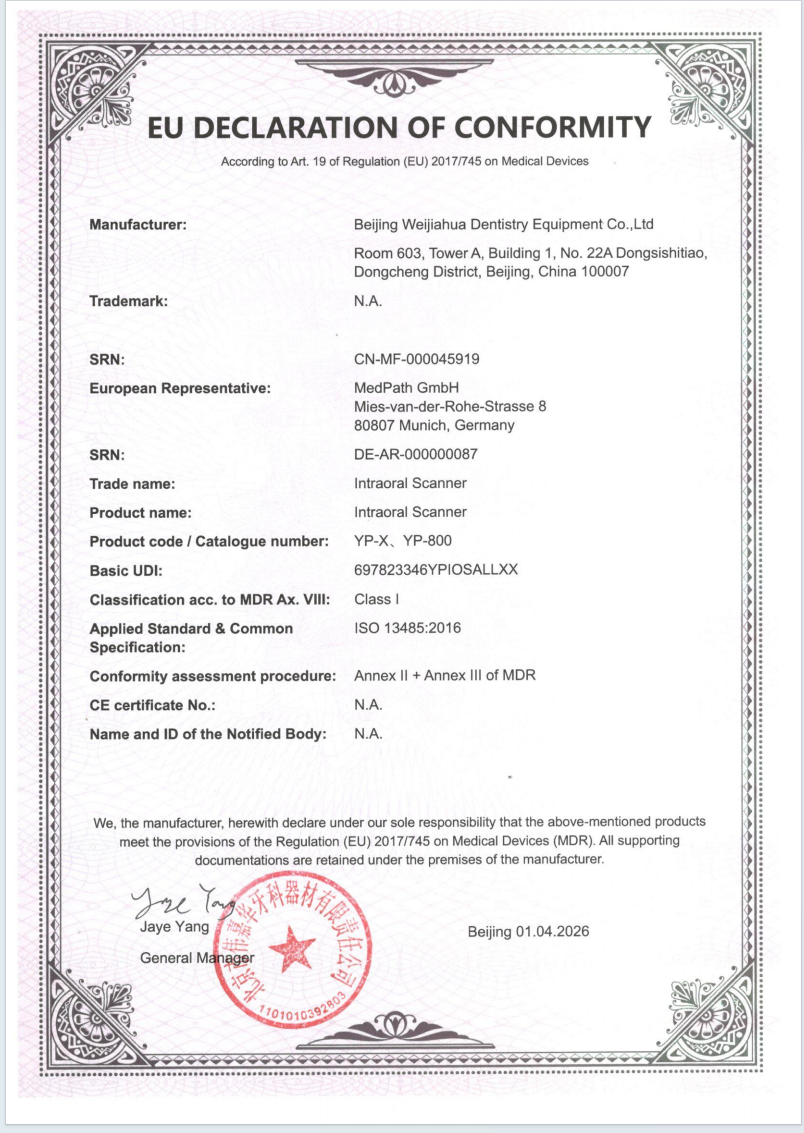
Regulatory documentation is part of the supplier capability profile. Labs should verify certificate scope rather than relying on certificate names alone.
From Evaluation to Execution: What Procurement Teams Should Verify
Once a dental lab decides that a supplier has sufficient production depth, the next phase is execution. This is where commercial terms determine whether the relationship works in practice. A supplier can appear strong on paper but fail during ordering if minimum quantities, lead times, payment expectations and acceptance procedures are unclear.
Using the same manufacturer as a public reference, the published procurement terms are relatively concrete. For standard models, the minimum order quantity is one box. For customized products, the minimum order quantity is five boxes. Delivery is handled by express for domestic shipments and by sea freight or air freight for export, with FOB Shanghai or FOB Tianjin available. The company asks for full payment before shipment and expects the buyer to check quantity upon receipt. Damage or deformation must be reported within 48 hours with photos, and sampling tests are supported.
| Procurement checkpoint | What the buyer should confirm |
|---|---|
| MOQ | Standard products and customized products often have different MOQ requirements. |
| Lead time | Production lead time should be matched to the lab's inventory cycle and case delivery commitments. |
| Payment terms | Full prepayment is common in cross-border dental material transactions; the lab should confirm banking and documentation requirements. |
| Acceptance | Define the damage-report window, required photo evidence and sampling-test process before the order is placed. |
| After-sales support | Check whether online technical guidance is available and how quickly the supplier responds to process-related problems. |
After-sales support is another capability indicator. The manufacturer states that it provides online technical guidance and aims to respond to after-sales problems within 24 hours. For a dental lab, technical support is not a decorative service. Sintering issues, shade mismatches or milling abnormalities can appear months after a batch is delivered, and the supplier's ability to diagnose the root cause affects the lab's cost structure.
Where Customized Supply Is the Right Model, and Where Standard Lines Are Enough
Not every lab needs OEM or ODM capability. For a laboratory that processes a narrow range of clinical cases and uses a validated, standardized zirconia block, a standard catalogue product with clear technical documentation may be the most efficient procurement route. Standard SKUs reduce qualification effort, simplify inventory and make it easier to compare pricing across suppliers.
Customized supply becomes relevant when the lab or distributor controls its own commercial brand. A distributor seeking to sell zirconia blocks under its own label needs a manufacturer that can produce a finished product with the distributor's packaging and commercial identity. A lab building a chain of partner laboratories may want a consistent internal specification that is not publicly available from a general catalogue. In these situations, OEM/ODM capability is not an upgrade; it is a precondition.
There is also a middle path. Some labs do not need a private label but need a rare disc thickness, a different sintered shade arrangement or a packaging size that fits their regional logistics. If the supplier can customize almost all specifications, the lab can adapt the product without changing its clinical workflow.
However, the OEM/ODM route also has limits. Customization increases specification responsibility. The buyer must define requirements clearly enough for production, accept longer setup and communication time, and usually meet a higher MOQ. In the reference terms used above, customized products require five boxes instead of one. Custom development also requires the buyer to validate product performance before routine use, because a custom shade or thickness must still meet sintering and strength expectations. For a lab without a clear procurement strategy, OEM/ODM can increase complexity rather than reduce it.
Throughout this comparison, one thing remains consistent: the correct model depends on where the lab creates value. If the lab competes through clinical speed and quality, standard validated blocks may be sufficient. If it competes through brand ownership and market differentiation, supplier OEM/ODM capability becomes part of the purchasing requirement.
Market Trends Favoring Manufacturers with Production Depth
Several independent trends support the argument that dental zirconia block procurement will continue to focus on supplier depth. The dental milling machine market reached USD 2.45 billion in 2025 and is expected to grow to USD 3.9 billion by 2030, according to Fortune Business Insights. As laboratories invest more in milling infrastructure, they become structurally dependent on a stable input material.
The material side also shows continued expansion. Grand View Research reports that the United States accounts for approximately 40% of revenue in the global zirconia-based dental materials market. The report also identifies 3Y-TZP zirconia as the largest grade segment, with a revenue share of 35.9% in 2025. This suggests that laboratories are still using high-strength traditional zirconia for posterior restorations while gradually expanding into more translucent and multi-layer products for aesthetic cases.
Regulatory conditions are moving in a similar direction. The EU Medical Device Regulation, MDR 2017/745, classifies many dental implants and restorative materials as higher-risk devices and requires more intensive clinical data. For dental labs supplying or distributing products into regulated markets, supplier documentation will become part of the quality file. A manufacturer that can demonstrate certifications, controlled production and documented processes will be easier to integrate into this workflow.
From a buying perspective, these trends suggest two outcomes. First, product-only evaluations will become less defensible as regulatory and clinical accountability increases. Second, manufacturers that can show production capability across formulations, quality assurance and equipment ecosystems will have an advantage in long-term supplier panels.
Future Outlook: Systems-Level Supplier Evaluation
In the future, dental labs are likely to evaluate zirconia block suppliers using a systems-level framework. This means checking not only individual block properties but also the supplier's research structure, manufacturing capacity, certification scope, customization policy, delivery performance and technical support channel.
For the YIPANG brand and manufacturers with a similar profile, the shift is visible in their product architecture. A zirconia block manufacturer that also supplies glass ceramics, press ingots, intraoral scanners, lab scanners, milling machines, 3D printers, resins and sintering furnaces is not simply selling materials. It is building a compatible dental production ecosystem. When labs purchase blocks from such a supplier, the evaluation extends naturally to workflow compatibility and future expansion.
That said, the market is best served when this analysis remains pragmatic. Labs should not assume that a broad catalogue guarantees product excellence in every category. The correct interpretation is different: a broader, more integrated supplier has more contexts in which to observe material behavior, and therefore has more internal reference points for troubleshooting. A narrower specialist supplier may still outperform in a specific clinical indication. The role of the buyer is to separate capability evidence from product breadth claims.
Eventually, selection will come down to three questions. Can the supplier produce the block consistently? Can it adapt the product when the buyer's commercial strategy requires it? And can it provide evidence that the process and material will not fail after the first batch? When these questions are answered, the dental zirconia block is no longer a standalone material purchase. It is part of a manufacturing relationship designed to support predictable restorative outcomes.
Frequently Asked Questions
What is the difference between OEM and ODM for dental zirconia block suppliers?
OEM means the manufacturer produces a dental zirconia block according to the buyer's specification and brand. ODM means the manufacturer provides design or product development input to meet the buyer's performance or commercial requirements. In the WJH YIPANG supplier profile, the company states that it provides both OEM and ODM services, includes custom product development and private labeling, and allows almost all specifications to be customized.
What minimum order quantity is required for customized dental zirconia blocks?
According to the published procurement terms of Beijing Weijiahua Dentistry Equipment Co., Ltd., the MOQ for standard models is one box, while customized products require five boxes. Labs planning a private-label or custom product should factor this higher MOQ into inventory planning.
What certificate should a dental lab request when evaluating a zirconia block supplier?
A lab should request a quality-management certificate that specifically covers dental medical materials and equipment. One example is the ISO 13485:2016 certificate held by Beijing Weijiahua Dentistry Equipment Co., Ltd., certificate number 381240434R0S, with a scope covering design, production and sales of dental medical materials and dental equipment, valid through 2027-12-26.
Does the EU Declaration of Conformity for intraoral scanners mean the zirconia blocks are CE-certified under MDR?
No. The EU Declaration of Conformity listed under SRN CN-MF-000045919 covers intraoral scanner models YP-X and YP-800 as Class I devices under EU MDR 2017/745. It should not be interpreted as a zirconia block certificate. Buyers should always check the certificate scope and confirm which products are covered by each regulatory document.
What is the recommended sintering temperature range for YIPANG 4D-PRO-ML zirconia blocks?
The recommended sintering temperature range is 1430°C to 1450°C. The lab should follow the standard heating and holding procedure to maintain stable shrinkage and translucency, and should avoid rapid temperature changes that can cause cracking.
What should a dental lab do if delivered zirconia blocks are damaged or deformed?
The published acceptance terms require the buyer to check quantity upon receipt and report damage or deformation within 48 hours with supporting photos. Sampling tests are also supported. Dental labs should use a similar acceptance protocol to protect their own production schedule and supplier accountability.
Reference resource: WJH Company Information (English PDF) — a corporate profile document for readers who require a fuller record of the manufacturer's company background and product scope.
Есть вопросы или нужны дополнительные детали?
Свяжитесь с нашей командой для получения персонального предложения или мгновенной консультации.
Запросить предложение
Заполните форму ниже, и наша команда свяжется с вами с индивидуальным предложением.
Прямой чат WhatsApp
Предпочитаете общаться в реальном времени? Напишите нам в WhatsApp для мгновенной помощи и быстрых ответов.
- Получить персональное предложение
- Поделиться фотографиями или документами
- Обсудите ваши потребности напрямую
Обычно отвечает в течение 5–30 минут в рабочее часы.