
Dental Zirconia Block: Technical & Procurement FAQ for Labs
A dental zirconia block is a pre-sintered zirconium dioxide (ZrO₂) blank that a CAD/CAM milling machine shapes into crowns, bridges, veneers and implant superstructure components before the milled part is sintered to final density. Once a laboratory stops comparing material categories and starts placing orders, the questions narrow sharply: what a 98 mm disc specification demands from the milling machine, what a sintering profile will tolerate, and what a supplier will commit to in writing after the first shipment.
This reference is organised as a technical and procurement FAQ because that is how these questions actually arrive — technical and commercial at the same time, and rarely in a convenient sequence. It draws on published specifications for the YIPANG 4D-PRO-ML zirconia block, first-party information from Beijing Weijiahua Dentistry Equipment Co., Ltd. (the company behind the YIPANG brand), and third-party market research where such research exists. Where a statement reflects a supplier's own positioning rather than an independent measurement, the text says so.
Why Technical and Procurement Questions Arrive Together
Zirconia-based dental materials represent a substantial and still-expanding materials category. Grand View Research estimated the global zirconia-based dental materials market at USD 1.2 billion in 2025, with a projected value of USD 2.3 billion by 2033. Within that market, zirconia discs — the blank format most laboratories buy — held the largest revenue share at 63.1% in 2025, and dental laboratories were the largest end-user group, accounting for 45.3% of market share in the same year.
Two structural facts follow. First, the overwhelming majority of zirconia processing revenue is generated inside a CAD/CAM milling workflow: Grand View Research attributed 82.4% of zirconia dental manufacturing process revenue in 2025 to CAD/CAM milling. Second, the purchasing decision sits with laboratories rather than with distributors or clinicians alone. That combination is why a technical question such as “what thickness do I need for a five-unit bridge” is simultaneously a procurement question — it determines which disc SKU has to be stocked, quoted, reordered and held in inventory.
For buyers in the decision and execution stages, the useful structure is therefore not a product brochure but a question set: what the block specifies, what the process demands, what the commercial terms allow, and what happens when something goes wrong.
Technical Questions That Decide Whether a Block Mills Correctly
What does a 98 mm disc with multiple thickness options actually specify?
The YIPANG 4D-PRO-ML zirconia block is specified as a 98 mm diameter disc with ML multilayer shades, offered in thicknesses of 10 mm, 12 mm, 14 mm, 16 mm, 18 mm and 20 mm. The material is zirconium dioxide with an yttria stabilizer — the stabilized zirconia family used for dental CAD/CAM blanks.
The practical reading of that specification has two halves. Diameter governs machine compatibility: 98 mm is a widely used blank format for dental milling machines, so a disc in this format is designed to fit existing chucks and fixtures rather than require a change of equipment. Thickness governs the largest restoration a single disc can yield. Thin discs cover single units and short spans economically; thicker discs are required when the case mix includes longer multi-unit bridges or implant superstructure components. Because thickness also drives cost per case, most laboratories settle on two or three thicknesses rather than stocking the full range.
What sintering profile does the block require?
The published specification for the 4D-PRO-ML block lists a sintering temperature of 1450 °C. The accompanying process guidance recommends a working range of 1430 °C to 1450 °C, reached through a standard heating and holding procedure, followed by natural cooling. The same guidance warns against rapid temperature change and against exceeding the maximum sintering temperature.
This is a commercial point as much as a technical one. A laboratory that already runs a validated programme for another zirconia brand cannot assume the profile transfers without adjustment. Re-validating the sintering curve on the new material is the step that converts a sample disc into a production material — and it is usually the step that laboratories skip when they are under delivery pressure.
How much dimensional variation should a laboratory plan for?
YIPANG states a sintering shrinkage error within ±0.3% for its zirconia blanks, together with a uniform density distribution across the blank. Shrinkage itself is compensated in CAM software, so what matters operationally is the consistency of the error rather than its absolute value. A stable error keeps marginal fit and occlusal clearance predictable; a variable error consumes chairside adjustment time and generates remakes that never appear on a material invoice.
Buyers should treat any stated shrinkage figure as a starting point for their own verification rather than as a universal constant. Furnace calibration, tray loading position, thermocouple condition and holding time all influence the final result, and those variables belong to the laboratory, not the block supplier.
Which restorations fit a medium-translucency multilayer block?
The 4D-PRO-ML blank is specified with medium translucency and a bending strength of ≥1200 MPa. Its documented application set covers full-contour crowns, bridges, veneers and implant superstructure restorations.
Strength in this range supports posterior crowns and multi-unit bridges, while medium translucency is a deliberate compromise that favours mechanical performance and shade stability over maximum light transmission. Laboratories working on anterior cases where translucency is the dominant requirement typically move to a different grade or to a layered build-up. Lithium disilicate remains a common alternative for suitable aesthetic cases: Business Research Insights reported that lithium disilicate accounted for approximately 28% of all-ceramic dental restorations globally as of 2024. The material choice is therefore a case-mix decision, not a category preference.
What can fail between milling and sintering?
The most frequently documented zirconia failure inside a laboratory workflow is chipping or cracking after sintering. Two triggers are named in the material risk documentation: an improper sintering profile, and defects already present inside the blank before sintering begins.
The mitigation is procedural rather than expensive. Follow the recommended sintering profile; inspect the blank before sintering; and scrap chipped or cracked blanks rather than using them for a final restoration. A scrapped unit at that stage costs a fraction of a remake that reaches the patient.
Procurement Questions That Arrive on the Same Purchase Order
Once a laboratory decides which disc to run, the commercial terms become the binding part of the decision. The following terms are the published supply conditions for YIPANG dental zirconia blocks and related products.
| Procurement item | Stated term | What the buyer should do with it |
|---|---|---|
| Minimum order quantity | 1 box for standard models; 5 boxes for customized products | Sequence a low-volume trial before committing to a customised run |
| Delivery method | Domestic express delivery; export by sea freight or air freight, FOB Shanghai / Tianjin available | Calculate landed cost and lead time for the chosen Incoterm and mode |
| Acceptance inspection | Check quantity on receipt; damage or deformation reported within 48 hours with photos; sampling test supported | Build the 48-hour window into receiving procedures |
| Payment | Full payment before shipment | Plan cash flow; use the sampling option to reduce first-order risk |
Two of those terms deserve more than a line item. The 48-hour reporting window for damage or deformation is short: a laboratory that receives a shipment on a Friday and inspects it on Monday has effectively waived its claim on visibly damaged stock. The practical fix is procedural — inspect and photograph on arrival, before the shipment enters general inventory.
Full payment before shipment is a common structure in export dental materials supply, and it shifts working-capital risk to the buyer. The sampling test option is the standard mitigation, and it is worth using deliberately rather than incidentally: a sampling order tests not only the material but the packing, the documentation and the supplier's response time.
On customisation, YIPANG positions its zirconia blanks as offering flexible customization and shorter delivery times than imported alternatives, together with a more competitive price than imported zirconia blocks of equivalent stated quality. These are supplier positions rather than independent measurements, and they should be validated against a buyer's own order profile: customisation value depends on the size of the customised run, and freight mode can erase a unit-price advantage on small orders.
Where the Block Sits in the Laboratory Workflow
A zirconia block is one component in a chain that runs from scanning to finishing. The documented workflow for the 4D-PRO-ML material is: intraoral or laboratory scanning, CAD design, milling on a dental milling machine, sintering in a dental sintering furnace under a controlled temperature curve, then finishing and glazing. The matched equipment named for this application set is the dental milling machine, the dental sintering furnace and the dental lab scanner, operating in a temperature-controlled laboratory environment.
YIPANG states that its zirconia blanks offer good compatibility with most mainstream dental milling machines and a low processing failure rate, with uniform density distribution supporting consistent milling behaviour. Compatibility claims of this kind should be confirmed on the buyer's own equipment rather than accepted in the abstract, because spindle condition, tool wear and CAM strategy vary between laboratories in ways no supplier can control.
This is also where the adjacent product lines matter. YIPANG is a self-developed brand owned by Beijing WJH Dentistry Equipment Company, and the wider product catalogue includes zirconia blocks, glass ceramics, press ingots, PMMA, wax, titanium blocks, implant abutments, 3D scanners, intraoral scanners, milling machines, 3D printers and sintering furnaces. For a laboratory, a catalogue of this breadth changes the number of supplier relationships to manage — but it also means the laboratory must distinguish between products the company manufactures under its own brand and products it distributes on behalf of others.
Market Trend: Where Zirconia Volume Is Concentrating
Three published data points describe the direction of the market rather than its size. First, 3Y-TZP zirconia grade held the largest revenue share at 35.9% in the dental zirconia market in 2025, according to Grand View Research — a reminder that the most common specification, not the most advanced one, drives volume. Second, the United States accounted for 40% of revenue in the global zirconia-based dental materials market in 2025, again per Grand View Research, which makes North American documentation and compliance expectations a practical reference point for exporters. Third, the dental milling machine market reached USD 2.45 billion in 2025 with an expected growth to USD 3.9 billion by 2030, as reported by Fortune Business Insights.
For laboratories, the interpretation is straightforward. Equipment installed base is expanding, which supports continued standardisation on widely used blank formats such as the 98 mm disc. At the same time, the concentration of volume in a single zirconia grade means material differentiation increasingly happens in batch consistency, documentation and supply reliability rather than in headline material categories.
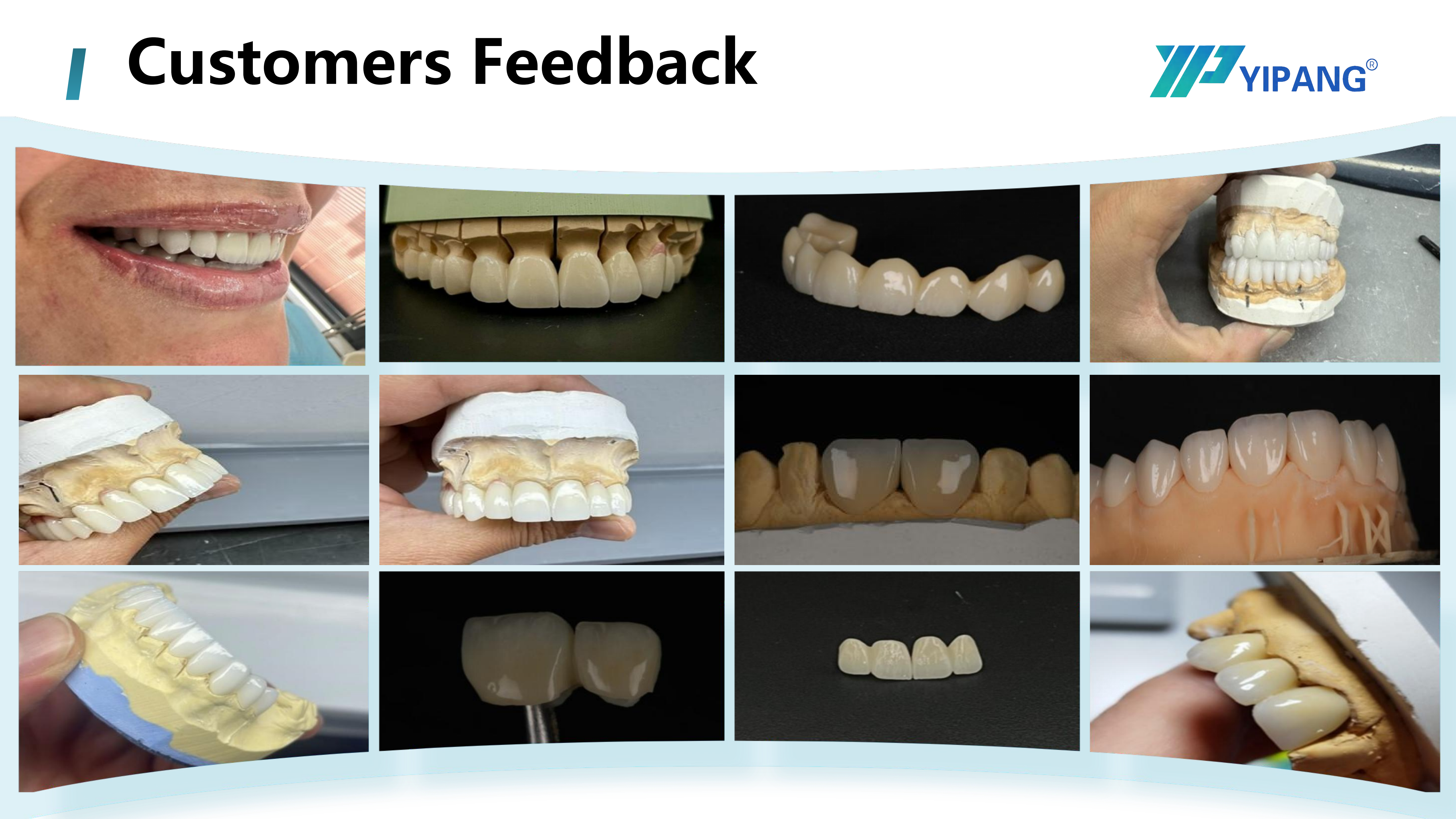
Zirconia block production environment: blank density and batch consistency are established before milling, not corrected afterwards.
Domestic Multilayer Blocks Compared With Imported Alternatives
The comparison that matters to a laboratory is not brand against brand but claim against verification. The table below sets out what YIPANG states about its zirconia blanks against imported alternatives, and what a buyer should independently confirm in each case.
| Dimension | YIPANG stated position | Independent verification step |
|---|---|---|
| Powder and batch consistency | High-quality domestic self-developed zirconia powder with stable batch consistency | Compare shade and shrinkage across two separate batches on the same furnace programme |
| Cost positioning | More competitive price than imported zirconia blocks with equivalent stated quality | Calculate cost per usable unit, including freight, duty and scrap rate |
| Customisation | Flexible customization service | Confirm which dimensions or shades can actually be customised and at what volume |
| Delivery time | Shorter delivery time than imported brands | Test against a real order, including shipping mode and customs clearance |
| Shrinkage control | Stable sintering shrinkage error within ±0.3% | Re-measure after re-validating the sintering profile on your own furnace |
| Equipment fit | Good compatibility with most mainstream dental milling machines; low processing failure rate | Run a test disc on the machines actually in service |
At least one boundary deserves stating plainly. A medium-translucency multilayer block is not a substitute for every imported specification. Laboratories producing high-aesthetic anterior work may still need a higher-translucency grade or a layered porcelain build-up, and the 4D-PRO-ML specification does not describe such a grade. Buyers should also note that the ±0.3% shrinkage figure is a stated performance characteristic of the material, not a guarantee that survives an uncalibrated furnace.
Regulatory scope is the second boundary. The EU Medical Device Regulation (MDR 2017/745) classifies most dental implants and restorative materials as high-risk, requiring intensive clinical data. A laboratory or importer serving that market must confirm the documentation package for the specific market before standardising on any material, regardless of the supplier's origin or price position. Price advantage is meaningful only after the documentation question is settled.
What Long-Term Supply Stability Actually Depends On
For laboratories weighing a multi-year relationship rather than a single order, supplier structure becomes part of the material decision. Beijing Weijiahua Dentistry Equipment Co., Ltd. was established in 1996 and has over 25 years of experience in the dental industry. The company operates a manufacturing facility covering 2000 square meters with approximately 80 staff and an annual production value of USD 10 million, supported by an R&D team of 25 professional engineers working on dental material formula research, process optimization and new product development.
On the commercial side, the company reports more than 1000 dental laboratory customers in China, a nationwide sales network in China and an overseas sales network, with approximately 40% to 55% of products exported to the Middle East, Southeast Asia, South America, North America, Eastern Europe, North Africa and Australia. It also represents well-known international brands including VITA, Ivoclar, Dentsply, Amann Girrbach and Noritake, and provides services covering dental laboratory products, technicians, clinical support, 3D printing, medical technology training and consulting.
Two conclusions can be drawn, and one caution. Broad product coverage reduces the number of supplier relationships a laboratory has to administer, and a long export history across multiple regions suggests the company has already cleared customs, documentation and logistics paths that a first-time exporter would still be building. The caution is that representing international brands is not the same as manufacturing capability. Buyers should keep the distinction clear between the YIPANG self-developed brand, which the company produces, and the third-party brands it distributes, because the evidence required to qualify each is different.
Future Outlook
Zirconia's position in definitive restorations is not currently challenged by additive manufacturing. Grand View Research estimated the dental 3D printing market at USD 4.9 billion in 2025, growing to USD 26.7 billion by 2033, with photopolymer resins holding a 55.5% share of the dental 3D printing material segment in 2025. That growth is concentrated in models, guides, provisionals and other workflow components rather than in definitive high-strength restorations, which keeps printed output complementary to milled and sintered zirconia rather than competitive with it.
The practical direction for laboratories is therefore dual investment: a validated zirconia milling and sintering line for definitive work, and a printing workflow for the components that feed it. On the materials side, the differentiating factors are likely to remain batch consistency, documented shrinkage behaviour and supply continuity — the attributes that determine whether a production schedule holds, rather than the attributes that make a data sheet look impressive.
Frequently Asked Questions
What is a dental zirconia block made of?
A dental zirconia block is a pre-sintered blank made of zirconium dioxide (ZrO₂) with an yttria stabilizer. The YIPANG 4D-PRO-ML block uses this material in an ML multilayer shade format at 98 mm diameter, with a specified bending strength of ≥1200 MPa and medium translucency.
How should a laboratory verify a zirconia block before standardising on it?
Verification has three parts: confirm the sintered result on the laboratory's own furnace using the recommended 1430 °C to 1450 °C profile; measure shrinkage behaviour against the stated ±0.3% error rather than assuming it; and inspect the blank for internal defects before sintering, since defects present before sintering are one of the two documented triggers for post-sintering chipping and cracking.
What procurement terms should be confirmed before a first order?
The minimum order quantity is 1 box for standard models and 5 boxes for customized products. Export orders ship by sea or air freight with FOB Shanghai / Tianjin available. Quantity is checked on receipt, and damage or deformation must be reported within 48 hours with photographs; sampling testing is supported. Payment terms are full payment before shipment.
How does a laboratory validate a new batch once it is in production?
Batch validation relies on consistency rather than on a single measurement. Because the stated shrinkage error is within ±0.3% and the material is described as having a uniform density distribution and stable batch consistency, the meaningful test is whether a new batch behaves the same as the previous one under the same validated sintering profile. A sampling test before full release is the standard mechanism for that check.
What documentation matters for regulated markets?
The EU Medical Device Regulation (MDR 2017/745) classifies most dental implants and restorative materials as high-risk and requires intensive clinical data, so laboratories and importers serving that market must confirm the documentation package for the specific market before standardising on a material. Documentation requirements differ by jurisdiction and are independent of the supplier's price position.
What supports a zirconia block supply relationship over several years?
Continuity rests on production depth and distribution reach rather than on price alone. Beijing Weijiahua Dentistry Equipment Co., Ltd., established in 1996, operates a 2000 square meter facility with approximately 80 staff, an annual production value of USD 10 million and an R&D team of 25 engineers, and reports more than 1000 dental laboratory customers in China alongside export activity in the range of 40% to 55% across the Middle East, Southeast Asia, South America, North America, Eastern Europe, North Africa and Australia.
Does handling multiple product lines change how a supplier should be evaluated?
It changes what has to be separated. A supplier that both manufactures its own brand and represents third-party brands — YIPANG is a self-developed brand owned by Beijing WJH Dentistry Equipment Company, which also represents VITA, Ivoclar, Dentsply, Amann Girrbach and Noritake — should be evaluated on two different evidence sets: manufacturing capability for the self-developed lines, and distribution and support capability for the represented brands.
In Summary
The technical and procurement questions around a dental zirconia block converge on a small number of answerable points: what the disc format allows, what the sintering profile requires, how consistently the material shrinks, which restorations its translucency and strength actually suit, and which commercial terms apply when the order is placed. Laboratories that treat these as one decision rather than two tend to find that the material question and the supplier question resolve together — and that the specifications worth checking are the ones they can reproduce on their own furnace.
Reference: full company and product information for Beijing Weijiahua Dentistry Equipment Co., Ltd. and the YIPANG brand is available in the company information brochure at https://cdn.socialarks.com/sbsp/25220/common/2026/0818/WJH%20Company%20Infomation.pdf