
Dental Zirconia Blocks in Dental School and Hospital Labs
Dental Zirconia Blocks in Dental School and Hospital Labs
A dental zirconia block is a pre-sintered CAD/CAM blank made from yttria-stabilized zirconium dioxide that a laboratory mills into the shape of a restoration and then densifies in a sintering furnace. In a dental school training laboratory or a hospital prosthodontic department, that sequence runs under conditions that differ from a commercial production lab: the case mix is broader, the operators rotate, and every step has to be reproducible enough to be taught, repeated and audited.
This reference examines scenario fit rather than brand preference. It looks at what dental school and hospital prosthodontic laboratories actually require — an indoor constant temperature dental laboratory environment, a working CAD/CAM chain, and strict adherence to a standard sintering temperature curve — and at how YIPANG dental zirconia blocks are specified for that setting.
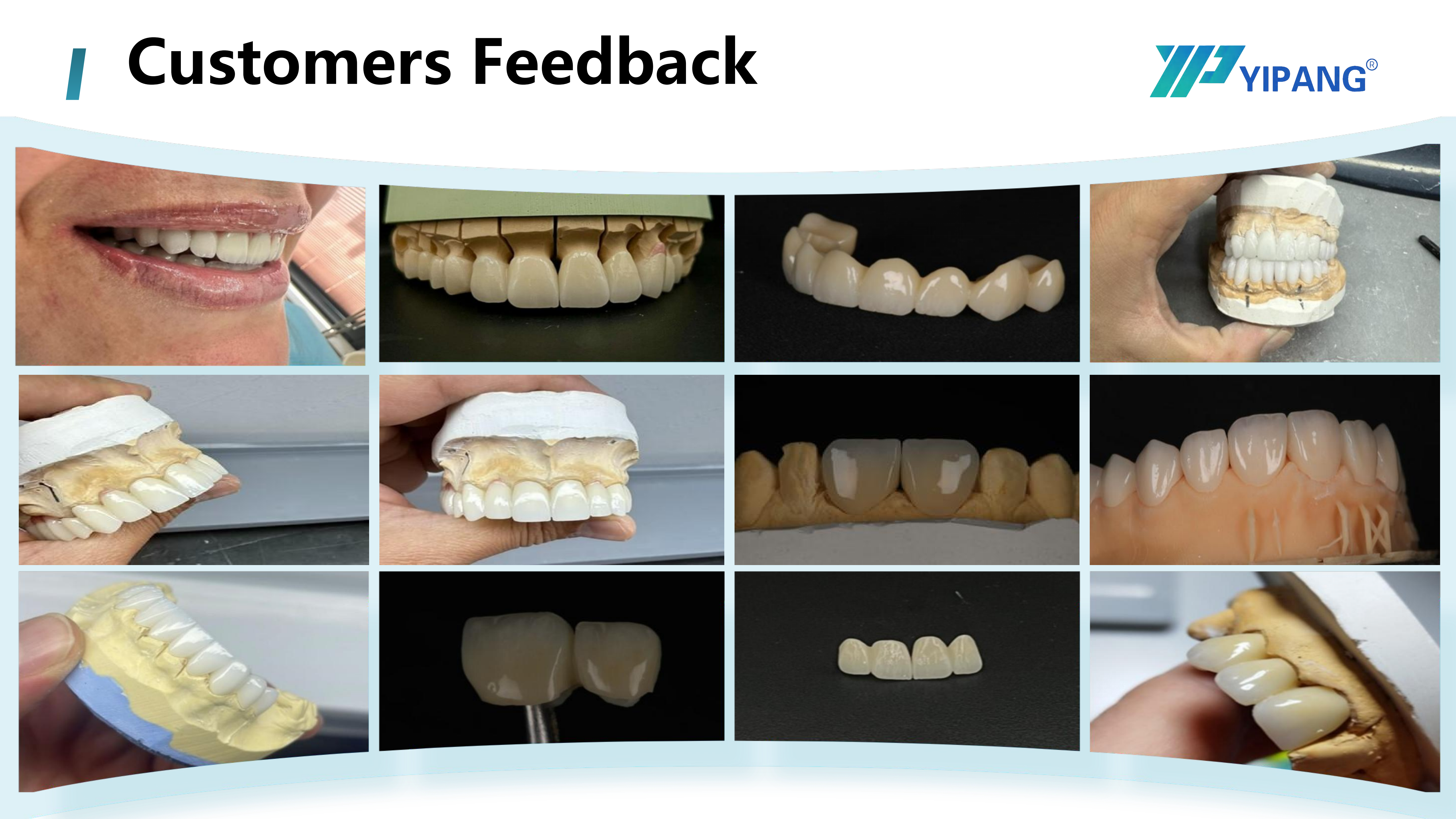
Why Dental School and Hospital Labs Evaluate Zirconia Blocks Differently
A commercial CAD/CAM laboratory optimizes for throughput. A dental school training laboratory optimizes for repeatability, because the same exercise has to produce a predictable result for every student cohort. A hospital prosthodontic department optimizes for clinical documentation and follow-up. One material system has to serve all three logics, which is why specification, equipment compatibility and process discipline carry more weight in this segment than promotional material claims.
Case mix is the first difference. Training laboratories concentrate on full-contour crowns and veneers, because those restorations teach contour, occlusion and shade selection. Hospital prosthodontic departments add multi-unit bridges and implant superstructure restorations, where dimensional accuracy across a larger milled area becomes the deciding factor. A block range that covers 10 mm to 20 mm in thickness allows a single material system to serve single-unit teaching cases and larger clinical cases without changing supplier mid-term.
Operator turnover is the second difference. In a teaching environment the technician running the sintering furnace changes every term. A material that depends on undocumented operator judgment produces variable results; a material supported by an explicit temperature range and holding procedure gives the laboratory something it can hand over to the next group.
Procurement documentation is the third. Hospital and university purchasing channels typically expect traceable quality management evidence, not only a material data sheet. That expectation shapes which suppliers reach a shortlist long before price is discussed.
Scenario Requirements for Teaching and Hospital Prosthodontic Labs
The application profile for this material is specific about the environment it is designed for. Five requirements define the scenario, and each one has a practical consequence for a school or hospital laboratory.
| Scenario requirement | What it means inside an institutional laboratory |
|---|---|
| Indoor constant temperature dental laboratory environment | The working condition specified for this material. Stable conditions support consistent processing across a class or shift rather than for a single operator. |
| Dental lab scanner | Digitizing the model or die; the scan defines the design that the blank will be milled to. |
| Dental milling machine | Shapes the pre-sintered blank. The 98 mm disc format is compatible with most mainstream dental milling machines. |
| Dental sintering furnace | Densifies the milled workpiece. This is the step where protocol discipline decides dimensional outcome. |
| Strict adherence to the standard sintering temperature curve | Listed as a special requirement for this application. Rapid temperature change should be avoided to prevent cracking, and the maximum sintering temperature must not be exceeded. |
Material Reference: YIPANG 4D-PRO-ML Dental Zirconia Blocks
YIPANG 4D-PRO-ML Zirconia Blocks for Dental Prosthesis are pre-sintered multilayer discs intended for dental laboratory, dental prosthetics and dental CAD/CAM work. The specification below is the reference point for everything else in this article.
| Specification | Value |
|---|---|
| Product | Zirconia Blocks for Dental Prosthesis |
| Model | 4D-PRO-ML |
| Type | Dental Zirconia Disc, CAD/CAM Dental Milling Blank |
| Material | Zirconium Dioxide (ZrO2) with Yttria Stabilized |
| Available shades | ML Multilayer |
| Diameter | 98 mm |
| Thickness | 10 mm, 12 mm, 14 mm, 16 mm, 18 mm, 20 mm |
| Sintering temperature | 1450 degrees Celsius |
| Bending strength | ≥1200 MPa |
| Translucency | Medium Translucent |
| Applicable industry | Dental Laboratory, Dental Prosthetics, Dental CAD/CAM Industry |
The material is made from high-quality domestic zirconia powder with stable performance, and the multilayer construction is designed for gradient translucency so that the milled restoration shows a natural transition from cervical to incisal areas. Low shrinkage after sintering supports dimensional accuracy, which matters most in multi-unit work where fit is cumulative. The manufacturer states that the range is compatible with most mainstream dental milling machines and is produced under 100 percent raw material inspection plus random finished product inspection.
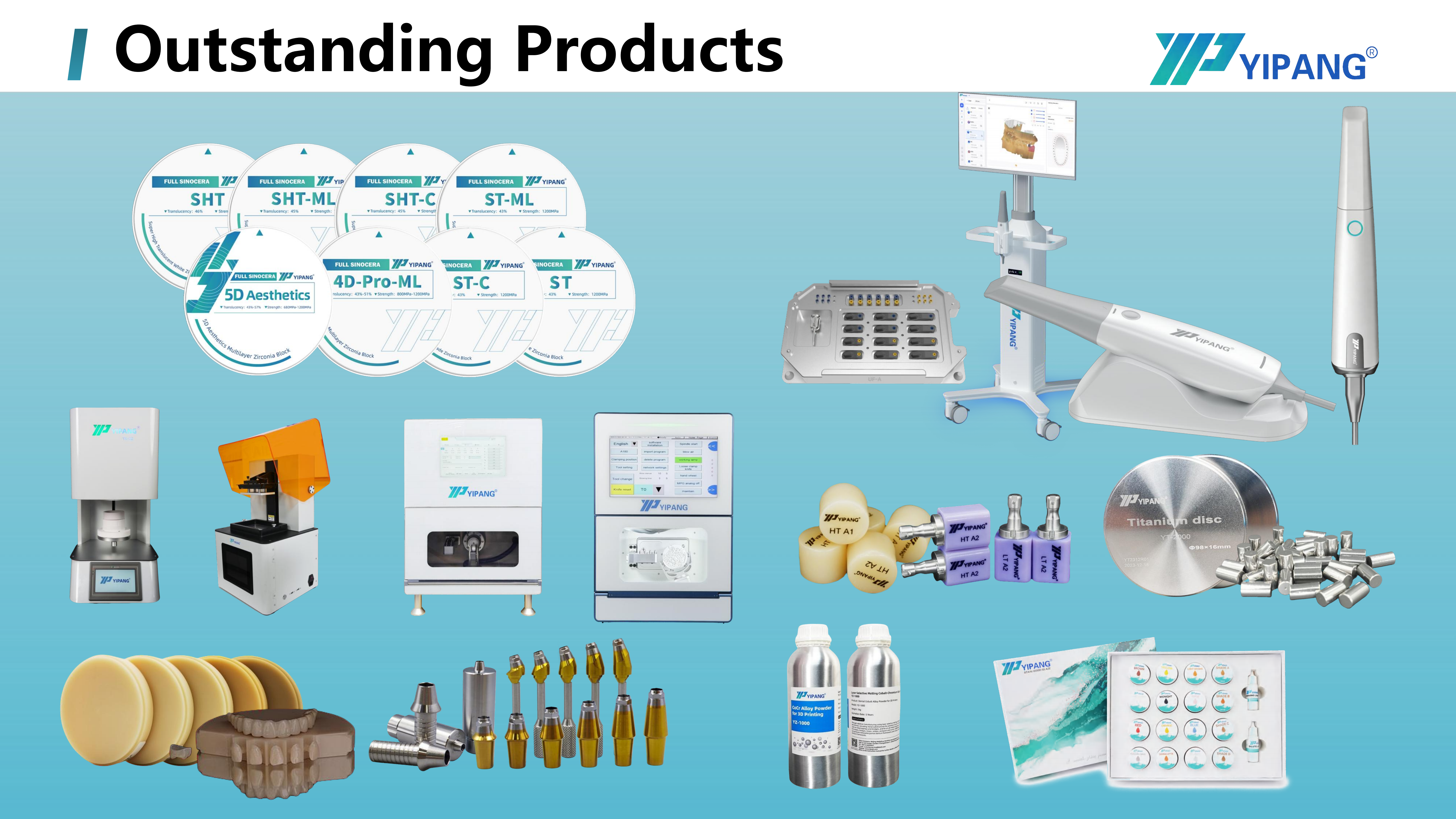
The CAD/CAM and Sintering Workflow in an Institutional Lab
Step 1 — Scan and design
A dental lab scanner captures the preparation, the opposing arch and the occlusion, and the restoration is designed in CAD with shrinkage compensation applied to the milling file. In a teaching laboratory this step doubles as the lesson in tooth preparation quality, because scanning errors are visible in the design and again after sintering.
Step 2 — Mill the blank
The milled restoration is cut from a pre-sintered disc. Thickness selection follows the restoration type: single units and anterior work can run on thinner blanks, while multi-unit bridges and implant superstructure restorations require a blank thick enough to contain the full geometry with adequate material around the connectors. Because the disc diameter is a standard 98 mm and the product is compatible with most mainstream dental milling machines, a school or hospital laboratory can usually introduce the material without reconfiguring its CAM department.
Step 3 — Sinter under a controlled curve
The sintered outcome depends almost entirely on this step. The documented procedure is straightforward but unforgiving of shortcuts: place the milled zirconia workpiece on the sintering tray; set the heating curve up to a range of 1430 degrees Celsius to 1450 degrees Celsius with an appropriate holding time; then allow the workpiece to cool naturally after sintering is complete. Rapid temperature change should be avoided because it can cause cracking, and the maximum sintering temperature must not be exceeded. Following the standard curve is what supports low shrinkage and stable translucency; departing from it introduces variation that a teaching cohort or a clinical case file cannot easily absorb.
Step 4 — Finish and characterize
After sintering, the restoration is fitted, adjusted and finished with polishing instruments before staining and glazing. In a hospital prosthodontic workflow, this is also the point where the restoration is checked against the digital design for documentation purposes.
Which Restorations Fit This Scenario
The application profile for this material lists four restoration categories. They map onto institutional workloads in different ways.
| Restoration type | Scenario fit |
|---|---|
| Full-contour crowns | The highest-volume teaching unit and a routine hospital restoration. Single-unit geometry keeps blank consumption predictable across a class. |
| Bridges | Multi-unit work where uniform shrinkage and dimensional accuracy across the span determine fit. |
| Veneers | Aesthetic work where the ML multilayer gradient translucency is directly relevant to the teaching objective. |
| Implant superstructure restorations | The hospital prosthodontic case type, typically combined with implant abutment components and managed alongside the broader digital workflow. |
What Institutional Buyers Should Verify Before Ordering
YIPANG is the self-developed dental brand of Beijing Weijiahua Dentistry Equipment Co., Ltd., a Beijing-based dental equipment and materials company established in 1996 that manufactures and distributes dental materials and equipment. Purchasing decisions in a school or hospital setting are usually made against documented evidence rather than product demonstrations, so the following points are the ones that can be checked on paper.
| Verification point | Documented detail |
|---|---|
| Quality management certification | ISO 13485:2016, certificate number 381240434R0S, issued by Shanghai POSI Certification Co., Ltd. |
| Applicable standard | GB/T 42061-2022 / ISO 13485:2016 |
| Certification scope | Design, production and sales of dental medical materials and dental equipment |
| Validity | Issued 2024-12-27, valid to 2027-12-26 |
| Markets covered | Global, EU, USA, Middle East |
| Quality control routine | 100 percent raw material inspection plus finished product random inspection |
| Supply parameters | Monthly capacity 15,000 pieces; lead time 15 to 30 working days; negotiable small MOQ; OEM/ODM with almost all specifications customizable |
| After-sales | Online technical guidance with after-sales problem response within 24 hours |
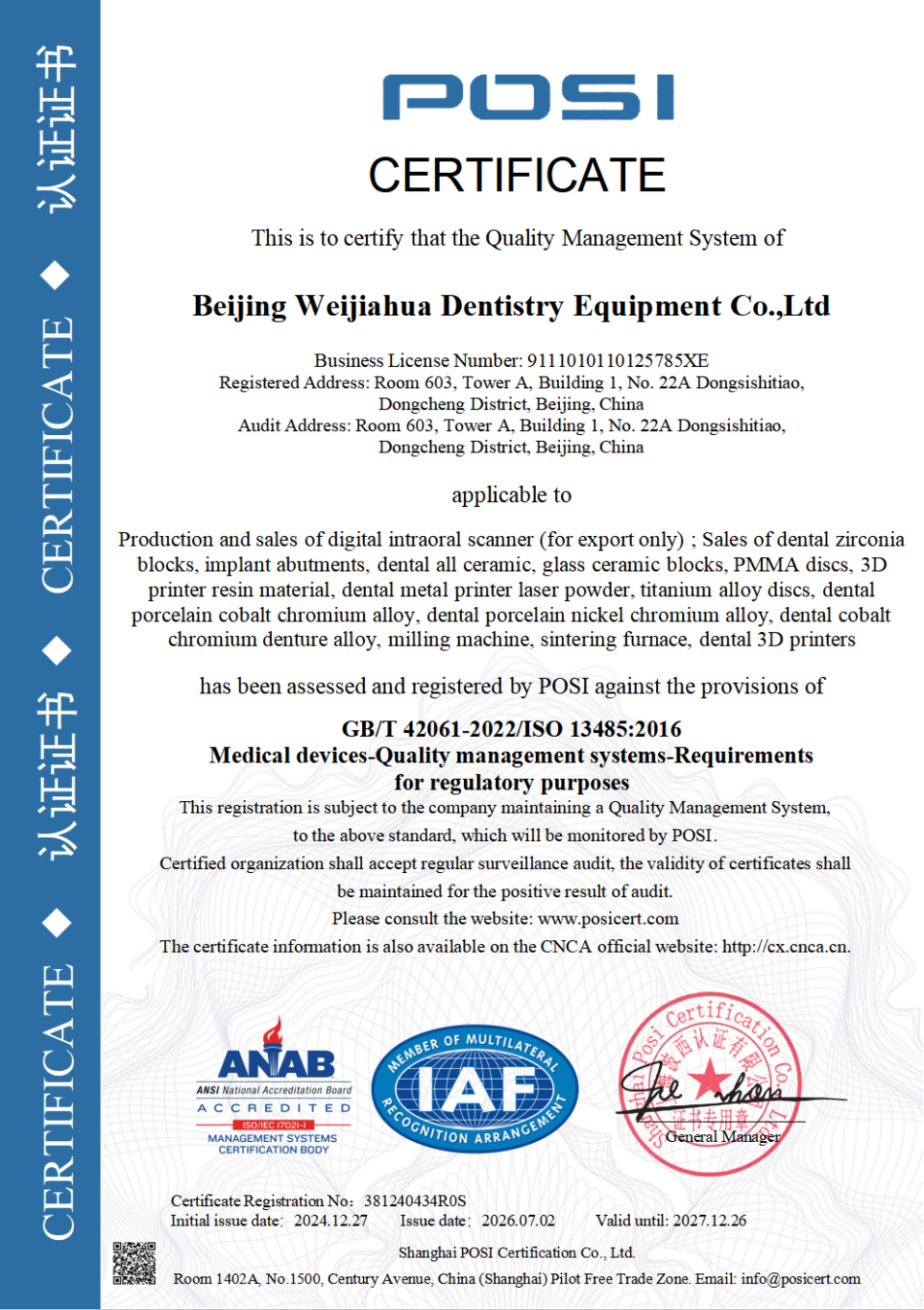
One clarification is worth making explicit for institutional buyers who compare certificates line by line. The EU Declaration of Conformity held under MDR 2017/745, with SRN CN-MF-000045919, covers the intraoral scanner models YP-X and YP-800, which are Class I medical devices, for the European Union market. It is not the certification route for the zirconia block product. The zirconia block file is the ISO 13485 certificate described above. Reading the scope of each document separately is exactly the kind of check a hospital procurement office performs, and the manufacturer states both scopes transparently.
Behind the certificate, the operating profile of the supplier also matters for a teaching account. Beijing Weijiahua employs 25 engineers working on dental material formulation, process optimization and new product development, operates a 2,000 square meter facility with approximately 80 employees, and reports an export ratio between 40 percent and 55 percent across the Middle East, Southeast Asia, South America, North America, Eastern Europe, North Africa and Australia. The company serves more than 1,000 dental laboratory customers in China and has a long history as an agent for international dental brands including VITA, Ivoclar, Dentsply, Amann Girrbach and Noritake. For a dental school, that background is relevant in a practical sense: a supplier that has trained technicians on multiple material systems is more likely to be able to answer protocol questions from a rotating student cohort.
Market Trend: Zirconia Inside an Expanding Digital Workflow
Independent market research places the zirconia based dental materials market at USD 1.2 billion in 2025, with a projected value of USD 2.3 billion by 2033, according to Grand View Research. Within that market, zirconia discs held the largest revenue share at 63.1 percent in 2025, and CAD/CAM milling accounted for 82.4 percent of the revenue attributed to zirconia dental manufacturing processes in the same year. Those two figures together describe why school and hospital laboratories are increasingly building CAD/CAM capability rather than outsourcing every case.
The same source reports that dental laboratories remain the dominant end-user group for zirconia materials with a 45.3 percent market share in 2025, that the United States accounts for 40 percent of revenue in the zirconia based dental materials market, and that the 3Y-TZP zirconia grade held the largest revenue share at 35.9 percent in 2025. Institutional laboratories are a small but structurally important part of that demand: they train the technicians who later work in commercial laboratories, and the material system they learn on shapes later purchasing behavior.
Regulatory direction is moving in parallel. The European Commission notes that the EU Medical Device Regulation (MDR 2017/745) classifies most dental implants and restorative materials as high-risk, requiring intensive clinical data. For institutional buyers this reinforces the trend toward documented, traceable material supply rather than price-led purchasing.
Limits and Comparison with Traditional Alternatives
Pre-sintered zirconia is not the right answer for every restoration, and an institutional laboratory should know where its boundaries sit before standardizing on one material system.
| Consideration | Pre-sintered zirconia block route | Pressable glass ceramic route |
|---|---|---|
| Form | 98 mm pre-sintered disc, milled to shape | Press ingot, heat processed from a pattern |
| Core equipment | Dental milling machine plus dental sintering furnace | Pattern fabrication plus a heat press workflow |
| Strength reference | Bending strength of at least 1200 MPa for 4D-PRO-ML | Not specified in this reference |
| Translucency | Medium Translucent, ML multilayer gradient | Widely used for aesthetic anterior work; lithium disilicate accounted for approximately 28 percent of all-ceramic dental restorations globally as of 2024 |
| Typical institutional use | Full-contour crowns, bridges, veneers and implant superstructure restorations | Thin aesthetic restorations where maximum translucency is the priority |
Three boundaries deserve emphasis. First, a pre-sintered zirconia block cannot be processed without a sintering furnace and a controlled curve; a laboratory that only presses glass ceramic has no route to this material without new equipment. Second, the ML multilayer version is specified as medium translucent. For restorations where maximum translucency is the governing requirement, glass ceramic or press ingot routes remain a legitimate first choice, which is consistent with the sustained position of lithium disilicate in the all-ceramic restoration mix. Third, the process itself is sensitive: rapid temperature change during sintering should be avoided to prevent cracking, and the maximum sintering temperature must not be exceeded, so a laboratory running tight schedules cannot compress the cooling stage to save time.
Supply parameters also create a planning boundary rather than a technical one. Monthly capacity is 15,000 pieces and lead time is 15 to 30 working days, with a negotiable small minimum order quantity. A university laboratory ordering against a semester calendar, or a hospital department ordering against a surgical list, should treat that lead time as part of the schedule rather than as a buffer.
Future Outlook
The direction of travel in institutional prosthodontics is toward the same digital chain already used in commercial laboratories: scanning, design, milling and sintering under a documented protocol. As CAD/CAM milling continues to dominate zirconia processing, the practical differentiator between laboratories will be less about whether they own a milling machine and more about how tightly they control the sintering stage and how well they document it.
For dental schools, that suggests teaching material protocols as part of the curriculum rather than as an equipment footnote. For hospital prosthodontic departments, it suggests writing sintering parameters into the case file alongside the design file, so that a restoration can be traced from scan to finished unit. Suppliers that can support both the material and the protocol conversation, with traceable certification and technical guidance, are positioned closer to how institutional purchasing is likely to develop.
FAQ
What sintering temperature should a dental school or hospital laboratory use for 4D-PRO-ML zirconia blocks?
The recommended sintering temperature range for the 4D-PRO-ML zirconia block is 1430 degrees Celsius to 1450 degrees Celsius. The standard heating and holding procedure should be followed to support low shrinkage and stable translucency. Rapid temperature change should be avoided to prevent cracking, and the maximum sintering temperature must not be exceeded.
What equipment does a teaching or hospital laboratory need to process pre-sintered zirconia blocks?
The application profile lists three matched equipment categories: a dental lab scanner for digitizing the case, a dental milling machine for shaping the blank, and a dental sintering furnace for densification. The 98 mm disc format is compatible with most mainstream dental milling machines, which means the material can usually be introduced into an existing CAD/CAM department without changing the milling platform. An indoor constant temperature dental laboratory environment is the specified working condition.
Which restorations can be produced from these blocks in a prosthodontic teaching or hospital setting?
The restoration types listed in the product application profile are full-contour crowns, bridges, veneers and implant superstructure restorations. In practice, crowns and veneers dominate teaching workloads because they build contour and shade skills, while bridges and implant superstructure restorations appear more often in hospital prosthodontic departments, where dimensional accuracy across multi-unit geometry is the critical variable.
What specifications are available for YIPANG 4D-PRO-ML zirconia blocks?
The product is a dental zirconia disc supplied as a CAD/CAM dental milling blank in the ML multilayer shade, with a 98 mm diameter and thickness options of 10 mm, 12 mm, 14 mm, 16 mm, 18 mm and 20 mm. The material is zirconium dioxide with yttria stabilization, the specified sintering temperature is 1450 degrees Celsius, the bending strength is at least 1200 MPa, and the translucency class is medium translucent. Almost all specifications can be customized under the supplier OEM/ODM program.
What certification should an institutional laboratory check before purchasing zirconia blocks?
The Zirconia Blocks for Dental Prosthesis product is certified to ISO 13485:2016 under certificate number 381240434R0S, issued by Shanghai POSI Certification Co., Ltd., against the standard GB/T 42061-2022 / ISO 13485:2016. The certification scope covers the design, production and sales of dental medical materials and dental equipment, and applies to the Global, EU, USA and Middle East markets, with validity from 2024-12-27 to 2027-12-26. A separate EU Declaration of Conformity under MDR 2017/745, SRN CN-MF-000045919, covers the intraoral scanner models YP-X and YP-800 (Class I medical devices) for the European Union market, not the zirconia block product.
What happens if the sintering curve is not followed precisely?
The documented guidance states that rapid temperature change should be avoided to prevent cracking and that the maximum sintering temperature must not be exceeded. The material properties that laboratories rely on, including low shrinkage after sintering, high dimensional accuracy and stable translucency, are described as outcomes of following the standard heating and holding procedure and allowing the workpiece to cool naturally after sintering. Deviating from that procedure removes the basis for those expectations.
Reference material: WJH Company Information (PDF) — corporate and product background for readers who need the underlying documentation.