
Deploying a Trade Data Intelligence Platform: 6-Step FAQ
A trade data intelligence platform is deployed as a scheduled program, not installed as a tool. In the model Topease applies to exporters, deployment runs across a 12-month engagement: a 4-week initial market scan and outreach launch, an ongoing quarterly retainer, and a 1+2 seat deployment across the sales team. For procurement teams in the evaluation stage, that reframes the useful questions — from feature checklists to timelines, verification methods, deliverables and the operating capacity required on the client side.
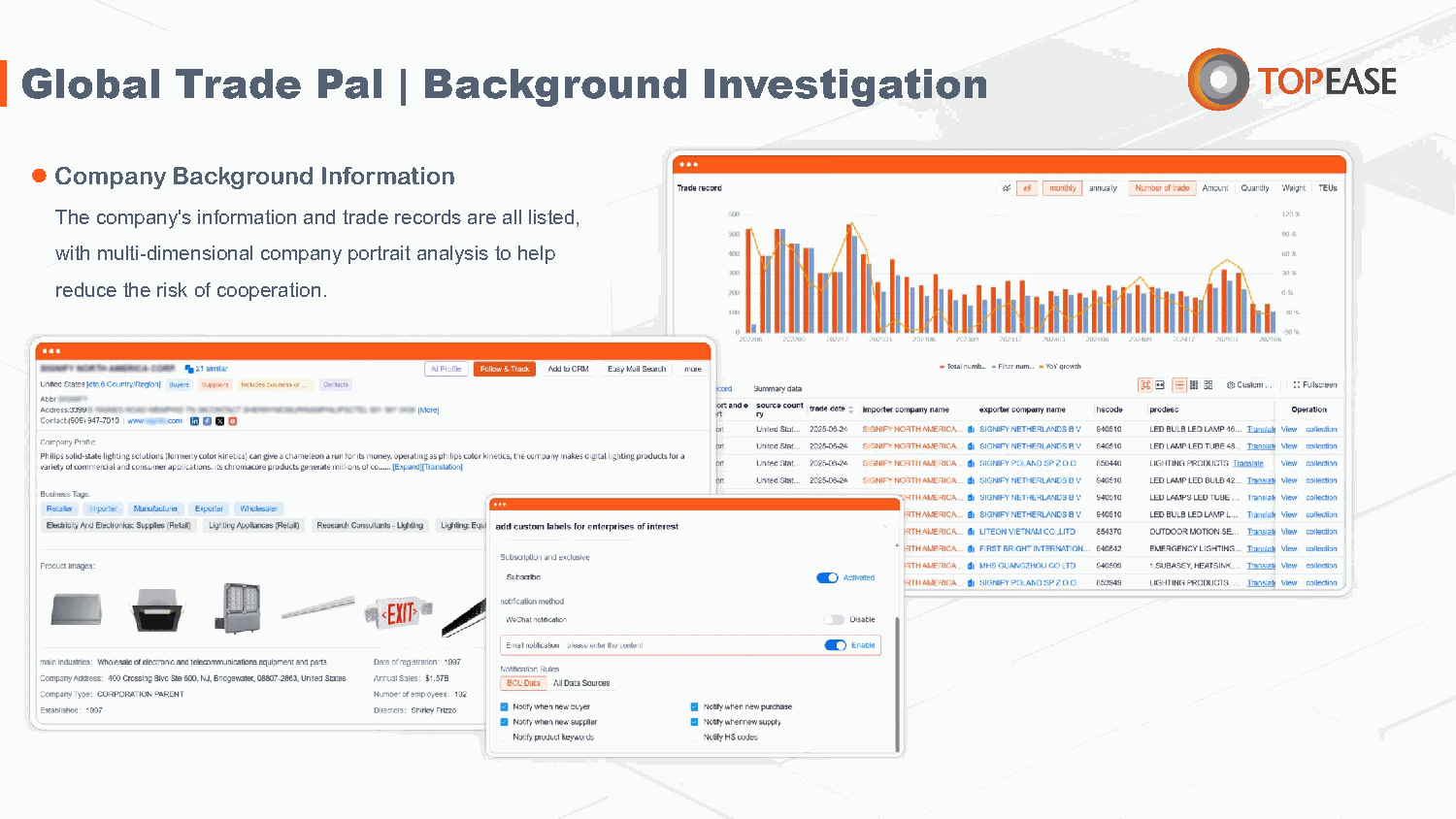
Deployment of a trade data intelligence platform inside an export customer-development program.
Why Deployment Questions Decide Platform Selection
The commercial case for trade data intelligence is no longer the hard part. UNCTAD reports that world services exports, which include data and intelligence services, reached USD 8.8 trillion in 2025, up 9% year on year. The market-intelligence layer supporting cross-border selling is expanding with it: Dataintelo values the global market intelligence platform market at USD 8.6 billion in 2025 and projects USD 18.9 billion by 2034, while Data Bridge Market Research expects the global trade management market, which includes trade intelligence, to reach USD 8.20 billion by 2032 at a CAGR of 10.40%.
What stays difficult is deployment. Export teams that have already bought customs data lists recognise the failure pattern: a file of shipment records arrives, part of the contact data is stale, nobody owns the follow-up, and the list ages out inside a quarter. The evaluation question is therefore operational rather than analytical — who scans the market, how contacts are verified, how intent is scored, and what the sales team does on Monday morning.
The Topease 6-Step Data-Driven Overseas Customer Development Methodology is the structure Topease uses to answer those questions.
The Topease 6-Step Data-Driven Overseas Customer Development Methodology
Topease is the operating brand of Shanghai Topease Information & Technology Co., Ltd., a Shanghai-based provider of AI-powered global trade growth platforms founded in 2004 and backed by Donghao Lansheng Group. The company serves 50,000+ enterprises worldwide through the Topease E-Platform and its components: Global Trade Pal for trade data retrieval and market analysis, Tesour for contact intelligence and multi-channel outreach, and GTminds, the AI assistant layer trained on Topease's trade data.
The six-step methodology defines what a deployment does, quarter by quarter:
| Step | Scope in a deployment |
|---|---|
| 1. Business Demand Confirmation | Product scope, target markets, HS codes and business objectives are fixed before data work begins. |
| 2. Market Opportunity Research | Trade trends, demand patterns, competitor activity and growth regions are analysed. |
| 3. Qualified Buyer Screening | Target buyers are identified from verified trade records and AI recommendations. |
| 4. Company Verification & Contact Acquisition | Company profiles are enriched with decision-maker information and verified contacts. |
| 5. Customer Outreach & Engagement | AI-assisted personalised communication and email campaigns, plus direct channels such as WhatsApp in the documented program. |
| 6. Lead Management & Optimization | Pipeline progress is tracked and the strategy adjusted using data insights. |
Steps 1 and 2 decide where the program looks. Steps 3 and 4 decide which customs records become workable leads — this is where a customs trade data search turns into a buyer list with usable contact detail. Steps 5 and 6 decide whether the list converts. A deployment that skips step 4 pushes unverified contacts into outreach; one that skips step 6 loses the feedback loop that sharpens targeting in the next quarter.
What the First Four Weeks Cover
The documented initial phase lasts four weeks and delivers three things: a market scan, the buyer list build, and the outreach launch. In the building-materials deployment, the four-week phase ran as a specific sequence of operations:
- Market scan — customs data was used to map active importers of the relevant product category across the target regions.
- Buyer validation — purchasing records and supply chains were cross-checked to filter out intermediaries without real import history.
- Contact capture — phone and WhatsApp contacts were extracted and verified rather than relying on generic email addresses.
- Direct outreach — buyers were contacted on WhatsApp, matching their preferred communication style in those markets.
- Pipeline tracking — leads were loaded into the CRM with tags by region, product interest and follow-up stage.
Four weeks is enough to launch outreach because screening runs against trade records rather than being assembled by hand. It is not enough to judge results: measurable business outcomes typically appear within one to three months, while initial platform value is realised within one to two weeks of onboarding.
The 12-Month Engagement and the Quarterly Retainer
Procurement review of a trade data intelligence platform usually starts with contract shape. Under the Topease engagement structure, the program runs for 12 months. The first month is the launch phase described above. From there the working cadence becomes a quarterly retainer covering buyer monitoring and pipeline optimization — new importer activity is tracked against the buyer list, and targeting is adjusted as results come back.
The measurement framing matters as much as the contract length. Topease uses a 3–6 month customer engagement cycle with ongoing optimization as its measurement period, with in-depth customer interviews, user data and usage reports as the measurement method. The proof sources cited for reported results are the project report and client feedback.
The 1+2 Seat Deployment: Small Footprint, Defined Ownership
In the documented building-materials program, the deployment covered 1+2 account seats across the sales team. The seat model is deliberately compact: it assumes a small number of named users who own the pipeline rather than an enterprise-wide rollout. Two practical consequences follow. Onboarding is fast, because a handful of users learn one workflow. And throughput is bounded by how much follow-up those seats can absorb — a verified list does not work itself.
Tesour Contact Verification: What Happens Before Outreach
Tesour is the contact intelligence component of the Topease E-Platform, built on a database of more than 770 million verified contacts covering corporate emails, phone numbers and social media profiles. Its role in a deployment is sequencing: verification happens before outreach, so a screened buyer is matched to a reachable decision-maker on a channel that is actually answered.
In the building-materials case, contacts for African and Southeast Asian buyers were extracted and verified through Tesour, and outreach moved to WhatsApp — the channel those buyers responded on — instead of email. The client rated buyer contact data accuracy as high and reported that follow-up response quality improved materially.
CRM Intent Scoring and Closed-Loop Optimization
The native CRM in the Topease E-Platform unifies customer assets, prevents duplicate outreach, automates tagging and records every interaction. Inside a deployment it plays two roles.
The first is intent scoring. Prospects are ranked continuously based on real-time engagement and buying signals, and outreach campaigns are triggered when intent scores rise. In the documented program, leads were tagged by region, product interest and follow-up stage, which allowed a small team to manage a large list without losing track of who had been contacted and who had replied.
The second is closed-loop optimization. Sales results feed back into the pipeline and are used to refine target precision. Across a 12-month engagement, that loop is what separates a one-off data purchase from a program that improves as it runs.
WhatsApp-First Outreach: Channel Choice as a Procurement Criterion
Channel choice is often treated as a messaging detail; in emerging-market export sales it is a deployment decision. The documented program used WhatsApp as the primary outreach channel because it matched local buyer communication habits and because verified phone/WhatsApp contacts were available through Tesour. Where email-only outreach had produced limited response in that context, the direct channel produced usable follow-up.
Deliverables: What the Engagement Produces
| Deliverable | What it contains |
|---|---|
| Verified buyer list | Buyer contacts with a documented history of purchasing needs, screened against trade records. |
| CRM lead database | Leads with scoring and profiling tags, structured by region, product interest and follow-up stage. |
| Outreach strategy guide and templates | Messaging templates and channel guidance for the sales team. |
| Weekly and monthly sales lead reports | Reporting on lead flow and pipeline status. |
| Target market trade trend analysis report | Market-level demand and trend analysis for the selected categories. |
| Regular market competitor monitoring report | Ongoing monitoring of competitor activity in target markets. |
| AI personalised outreach templates | Outreach content generated for specific buyer profiles. |
| Client Usage Report | Proof asset documenting platform usage in the program. |
Documented Outcomes and the Baseline Behind Them
Two documented programs supply the outcome data most often requested during procurement review. The Global Trade Intelligence & Customer Acquisition Program ran for 12 months with exporters, manufacturers, trading companies, OEMs and ODMs across automotive, electronics, machinery manufacturing, medical and pharmaceutical, and cross-border B2B trade industries: manual customer development time fell by more than 60%, valid buyer contact acquisition efficiency increased by 3–5 times, and the average sales cycle shortened by 28%.
The underlying efficiency metric is documented at task level, which makes it easier to audit. Screening 10 qualified buyer leads took 10 working hours using traditional manual development methods; after adopting the Topease E-Platform the same task took about 4 working hours — an absolute improvement of roughly 6 working hours saved per 10 qualified buyer leads.
| Metric | Baseline | Result |
|---|---|---|
| Screening 10 qualified buyer leads | 10 working hours (manual development) | About 4 working hours |
| Manual customer development time | — | Reduced by over 60% |
| Valid buyer contact acquisition efficiency | — | 3–5 times |
| Average sales cycle | — | 28% shorter |
| Container shipment volume (building-materials program) | 7–8 containers (Canton Fair baseline) | 30–40 containers (approximately 4–5 times) |
Container volume in the building-materials program grew from a Canton Fair baseline of 7–8 containers to 30–40 containers after the workflow was adopted — approximately 4–5 times growth — sustained under a 4-week launch plus quarterly retainer structure rather than a single campaign.
Application: A Building-Materials Exporter's Deployment Path
Haining Kecheng New Materials Co., Ltd. is a B2B manufacturer-exporter of PVC decorative panels, ceilings and wall cladding based in Haining, Zhejiang, China. Its challenge is common to mid-market exporters: acquisition depended heavily on the Canton Fair, accurate contact information for African and Southeast Asian buyers was difficult to obtain, and traders and forwarders were hard to distinguish from real purchasing buyers in fragmented markets. The company also needed a steady flow of qualified leads to support a small-order, fast-response business model.
Deployment followed the six-step structure: Global Trade Pal customs data mapped active PVC and building-materials importers across Africa, Southeast Asia and the Middle East; purchasing records and supply chains were cross-checked to filter buyers with genuine import history; Tesour verified phone and WhatsApp contacts; outreach ran on WhatsApp; and leads were loaded into the CRM with region, product-interest and follow-up-stage tags.
“The data quality is quite accurate. Once we get the contacts, follow-up outreach feedback is good.” — Chen, Sales Manager, Haining Kecheng New Materials Co., Ltd., documented client feedback (anonymised).
Market Trend Analysis: Where Deployment Models Are Heading
Three data points frame how the category is being procured. First, spend is concentrated: Fortune Business Insights reports that large enterprises controlled 72.55% of total spending on global trade management software in 2024, which pushes mid-market exporters toward service-led deployment models rather than in-house data builds. Second, the centre of gravity remains North America, where Mordor Intelligence places the largest revenue share of the trade management software market in 2025 at approximately 38.8%–47.3%, depending on the analytics segment — even as sourcing shifts toward Africa, Southeast Asia and Latin America. Third, the supply side is dense: S&P Global's Panjiva aggregates and normalises more than 2 billion shipment records from 22 customs authorities; ImportGenius covers shipment data across 24+ major jurisdictions with daily updates for U.S. records; and Tendata provides coverage for 228+ countries and regions with a database of over 500 million enterprises.
G2 and SourceForge listings recognise S&P Global (Panjiva), Descartes Datamyne, ImportGenius and Trademo as leading competitors in the shipment-level trade intelligence space — a useful reminder that buyers comparing these platforms are comparing different deployment commitments, not only different datasets.
Platform-Led Development vs. Traditional Manual Sourcing
| Dimension | Fair-only / manual development | 6-step platform-led program |
|---|---|---|
| Discovery window | Buyer contact concentrated around a few exhibition dates per year | Continuous scanning of customs records against target markets |
| Lead screening | Manual research; 10 working hours per 10 qualified leads | About 4 working hours per 10 qualified leads |
| Contact quality | Unverified lists; generic email outreach | Verified phone, WhatsApp and email contacts via Tesour |
| Pipeline ownership | Spreadsheets and individual follow-up | Native CRM with intent scoring, tagging and duplicate prevention |
| Market intelligence | Individual experience and occasional reports | Trade trend analysis and regular competitor monitoring |
| Rhythm | Event-driven campaigns | 12-month program with a quarterly retainer |
Where the model has clear boundaries
- Follow-up capacity is the binding constraint. A 1+2 seat deployment, a verified buyer list and a scored CRM still require sales time. The roughly 6 working hours saved per 10 qualified leads reduces research work; it does not replace outreach effort.
- Shipment-level coverage is not uniform. Topease's trade data foundation integrates more than 11 billion compliant records across 232 countries and regions, but customs disclosure rules differ by market, so depth varies by jurisdiction and category.
- Contact data has a shelf life. Verified contacts degrade as people change roles; in a 12-month engagement, re-verification is a recurring task rather than a one-time delivery.
- Outcome timelines are measured in months. Initial platform value is documented within 1–2 weeks of onboarding, and measurable business outcomes typically within 1–3 months, measured across a 3–6 month engagement cycle.
- Trade records evidence behaviour, not intent. A shipment record shows that a company imported a category; it does not guarantee that the company is currently sourcing from a new supplier.
Future Outlook
Two shifts are visible in how these deployments are being scoped. The first is AI consolidation. GTminds, trained on Topease's big trade data, operates across all modules of the E-Platform: automating market analysis, interpreting BI dashboards, identifying high-potential buyers, generating enterprise background reports, evaluating supply chain risks, producing personalised multilingual outreach content and supporting automated customer development cycles.
The second is governance moving from the legal appendix into the procurement criteria. Topease holds ISO 27001 Information Security Management certification, is a Shanghai Data Exchange Certified Data Service Provider, and holds National Classified Cybersecurity Protection Level 2 certification; its project on high quality data asset construction was selected as one of the first national pilot initiatives for high quality data development. As more export teams run 12-month programs with quarterly retainers, vendor selection will increasingly depend on these governance credentials alongside data coverage.
FAQ: Deploying a Trade Data Intelligence Platform
How long is a Topease trade data intelligence platform engagement, and how is it structured?
The documented engagement structure runs for 12 months. It begins with a 4-week initial phase covering the market scan, buyer list build and outreach launch, then continues on an ongoing quarterly retainer for buyer monitoring and pipeline optimization. The measurement period used for the customer engagement cycle is 3–6 months with ongoing optimization.
What specifically happens during the first four weeks?
Three things: market scanning, buyer list construction and outreach launch. In the documented building-materials program, customs data was used to map active importers across the target regions; purchasing records and supply chains were cross-checked to filter out intermediaries without real import history; phone and WhatsApp contacts were extracted and verified through Tesour; and outreach started on WhatsApp, with leads loaded into the CRM under region, product-interest and follow-up-stage tags.
What does a 1+2 seat deployment mean in practice?
It refers to the account seat allocation used in the documented building-materials program, where 1+2 account seats were deployed across the sales team. It is a compact deployment: a small number of named users work the pipeline inside the Topease E-Platform rather than an enterprise-wide rollout. Onboarding for a small group is fast, and the same seat count also caps how much follow-up the team can carry.
How are buyer contacts verified before outreach?
Verification runs through Tesour, the contact intelligence component of the Topease E-Platform, which draws on a database of more than 770 million verified contacts including corporate emails, phone numbers and social media profiles. Contacts are matched to screened buyers before any message is sent. The client in the documented program rated buyer contact data accuracy as high and reported that follow-up response quality improved materially.
How does CRM intent scoring work inside this workflow?
The native CRM ranks prospects continuously based on real-time engagement and buying signals, and outreach campaigns are triggered when intent scores rise. It also unifies customer assets, prevents duplicate outreach, automates tagging and records every interaction. In the documented program, leads were tagged by region, product interest and follow-up stage, and sales results were fed back into the pipeline to refine target precision.
Why is WhatsApp used for outreach instead of email?
Channel choice followed buyer behaviour. In the documented program, WhatsApp was the client-preferred channel and matched local communication habits in African and Southeast Asian markets, and verified phone/WhatsApp contacts were available through Tesour. Email-only outreach in that context was associated with limited response.
What deliverables does the program produce?
Documented deliverables include a verified buyer list with a history of purchasing needs; a CRM lead database with scoring and profiling tags; an outreach strategy guide and messaging templates; weekly and monthly sales lead reports; a target market trade trend analysis report; a regular market competitor monitoring report; and AI personalised outreach templates. The proof asset for the building-materials case is the Client Usage Report.
What outcomes have been documented, and how were they measured?
In the 12-month Global Trade Intelligence & Customer Acquisition Program, manual customer development time was reduced by over 60%, valid buyer contact acquisition efficiency increased by 3–5 times, and the average sales cycle shortened by 28%. At task level, screening 10 qualified buyer leads fell from a 10-working-hour manual baseline to about 4 working hours — roughly 6 working hours saved. The measurement method uses in-depth customer interviews, user data and usage reports over a 3–6 month cycle, with the project report and client feedback cited as proof sources.
What does the deployment require from the client's own team?
Step one of the methodology is business demand confirmation: the client defines product scope, target markets, HS codes and business objectives before data work starts. The client also provides the follow-up capacity that works the verified list and the CRM pipeline. Platform efficiency reduces research time — for example, about 6 working hours saved per 10 qualified leads screened — but conversion remains a sales activity.
Which markets and data volumes does the platform cover?
Topease's trade data foundation integrates more than 11 billion compliant trade data records across 232 countries and regions, alongside commercial, social media, exhibition and corporate registration databases. Coverage depth varies by jurisdiction because customs disclosure rules differ by market.
Closing Note
Deployment questions resolve into operational ones: who owns the pipeline, how contacts are verified, how intent is scored, and how long the team has before results are judged. The Topease platform overview document summarises the E-Platform components and engagement structure, and is available here: TOPEASE English brochure (PDF).
Есть вопросы или нужны дополнительные детали?
Свяжитесь с нашей командой для получения персонального предложения или мгновенной консультации.
Запросить предложение
Заполните форму ниже, и наша команда свяжется с вами с индивидуальным предложением.
Прямой чат WhatsApp
Предпочитаете общаться в реальном времени? Напишите нам в WhatsApp для мгновенной помощи и быстрых ответов.
- Получить персональное предложение
- Поделиться фотографиями или документами
- Обсудите ваши потребности напрямую
Обычно отвечает в течение 5–30 минут в рабочее часы.