
Desalination System Qualification Dossier: Criteria and Evidence
A qualification dossier is a controlled set of documents that maps every tender requirement to a verifiable artefact: a scope-of-supply drawing, a certificate with a named issuing body and defined scope, a test protocol with pass/fail thresholds, or an operating reference with a named site and duration. It is the instrument that converts persuasive tender language into evidence an evaluation committee can check.
Desalination tenders are rarely decided on technology choice alone. Once a buyer has settled on reverse osmosis — the technology behind more than 60% of global installed desalination capacity, according to Credence Research — the remaining evaluation is largely a document review. Can the bidder prove, in writing and against named standards, that the plant will deliver the specified water quality, at the specified availability, for the specified service life?
This reference is written for institutional buyers at decision stage: utilities, resort and island developers, industrial water managers and EPC procurement teams preparing or scoring a desalination tender. It sets out how to build the dossier, how to translate purchasing terms into measurable acceptance criteria, how EU-facing compliance evidence should be read, and how to test long-term references rather than accept them.
Why a Desalination Tender Is Decided Before the First Cubic Metre
Global installed desalination capacity crossed the 100 million cubic metres per day threshold in 2024, according to the International Desalination and Reuse Association. Grand View Research puts the global desalination market at approximately USD 21.3 billion in 2025, rising to a projected USD 23.2 billion in 2026. Capacity is no longer the binding constraint on the sector; verifiable delivery is.
That shift changes what buyers are actually purchasing. A tender specification is a set of promises. A qualification dossier is the set of proofs. Where the two are not explicitly linked, three failure modes recur in institutional procurement:
- Adjectival criteria. Requirements written as "proven", "robust" or "long-life" cannot be scored consistently, and cannot be enforced after award. They must be restated as a parameter, a threshold and a test method.
- Unverifiable references. A reference list without site name, capacity, feedwater conditions, commissioning date and operating duration is marketing material, not evidence.
- Certification scope mismatch. A certificate covering a pressure vessel or a control panel may be presented as though it covers the plant. The buyer's protection is a scope-of-supply map that shows, line by line, which certificate covers which item.
Anticipating this, institutional tenders increasingly require the dossier as a separate, scored deliverable rather than an annex to the technical offer. That is a useful development for buyers: it forces the discussion onto evidence while there is still time to change the outcome.
The Four Components of a Workable Dossier
A dossier that can be scored, and later enforced, usually has four components. Each answers a different question, and each fails in a different way.
| Component | What it must contain | Evaluation test |
|---|---|---|
| Scope-of-supply map | Process flow diagram, equipment list, battery limits, interface matrix between supplier, civil contractor and utility | Can every tender line item be located on a drawing or in an equipment list? |
| Compliance file | Certificates with issuing body, number, scope and validity; declarations of conformity; material certificates for wetted parts | Does each certificate name the specific equipment it covers? |
| Acceptance protocol | Test parameters, correction rules for temperature and salinity, duration, witness arrangements, retest conditions, remedies | Could a third party run this test without asking a further question? |
| Reference file | Named sites, capacity, feedwater class, commissioning date, operating duration, configuration, contactable operator | Is at least one reference the same duty class as this tender? |
The component buyers most often under-specify is the acceptance protocol. Its purpose is not to describe good performance; it is to define what happens if performance is not achieved. A protocol without a retest rule and a remedy clause is a description, not a criterion.
Turning Tender Language into Measurable Acceptance Criteria
Every desalination performance figure is conditional. A capacity in cubic metres per day and a product quality in milligrams per litre mean nothing without the feedwater envelope attached to them. This is where most tender disputes originate, and where a well-built dossier earns its value: the envelope stated in the offer becomes the contract boundary for the acceptance test.
A seawater reverse osmosis envelope that can be tested, and that matches what suppliers are commonly asked to guarantee, is defined by five parameters:
| Parameter | Typical SWRO design envelope | Why it belongs in the tender |
|---|---|---|
| Feed salinity (TDS) | 20,000 – 45,000 mg/L | Sets pump pressure and specific energy; outside the band, capacity guarantees are void |
| Feed temperature | 5 – 35 °C | Flux falls sharply at low temperature; test conditions must be corrected, not ignored |
| Turbidity | Below 20 NTU | Defines pre-treatment duty and membrane fouling risk |
| COD, iron, manganese | COD below 10 mg/L; Fe²⁺ below 0.1 mg/L; Mn below 0.1 mg/L | Limits that protect membrane life and the warranty |
| Oil and grease | Below 0 mg/L | Coastal and industrial sites require an explicit exclusion, not an assumption |
On the product side, a municipal or resort duty is commonly specified as total dissolved solids below 500 mg/L, pH between 6 and 8, and turbidity below 0.2 NTU. Those three numbers are testable on site with handheld and bench instruments, which is precisely why they belong in the acceptance protocol rather than in a narrative description of quality.
Industrial duties diverge sharply. A power plant requiring ultra-pure water is not buying potable quality; it is buying resistivity above 10 megohm·cm, which implies a different train. A two-pass RO with mixed bed and EDI, following multi-media filtration, is the configuration used for a 2×25 MW power plant reference, and the acceptance criterion is resistivity at the point of use — not TDS at the RO outlet. Writing the wrong parameter into a tender is a common and expensive error.
EU Compliance: Separating Product Standards from Plant Performance
"EU compliant" is one of the most frequently used and least precise phrases in tender documents. It usually means three different things at once, and a dossier should separate them.
First, product conformity. CE marking is, in most cases, a manufacturer's declaration that the equipment within a defined scope meets the applicable EU product legislation. It is a market-access instrument. It is not a performance certificate for a plant, and it does not attest to the quality of water produced. Where a supplier holds CE documentation for equipment designs, the buyer's task is to check the declared scope against the actual scope of supply — pump skids, control panels, electrical assemblies — item by item.
Second, design and fabrication standards. Pressure-containing equipment is frequently specified to ASME, and equipment designs can be certified to both ASME and CE. These address mechanical integrity and design method. They say nothing about salt rejection, recovery or availability.
Third, water quality guidance. ISO 23446:2021 provides international guidelines for product water quality of seawater reverse osmosis desalination used for municipal supply. This is the reference to cite when the tender requires the delivered water to be assessed against a recognised framework, and it is the correct anchor for a water-quality verification protocol in the acceptance section of the dossier.
Management-system certification — ISO 9001, ISO 14001 and ISO 45001 — belongs in a fourth, separate category. It evidences process control at the manufacturer, which is relevant to consistency and to inspection rights, but it is not technical evidence about the plant. A dossier that lists all four categories without labelling them invites evaluators to conflate them, which usually disadvantages the better-documented bidder.
Reading 20+ Years of References as Evidence, Not Endorsement
Long-service references are the most persuasive part of a dossier and the easiest to misread. A reference becomes evidence only when four attributes are known: the duty it served, the feedwater it faced, how long it has operated, and who operates it now.
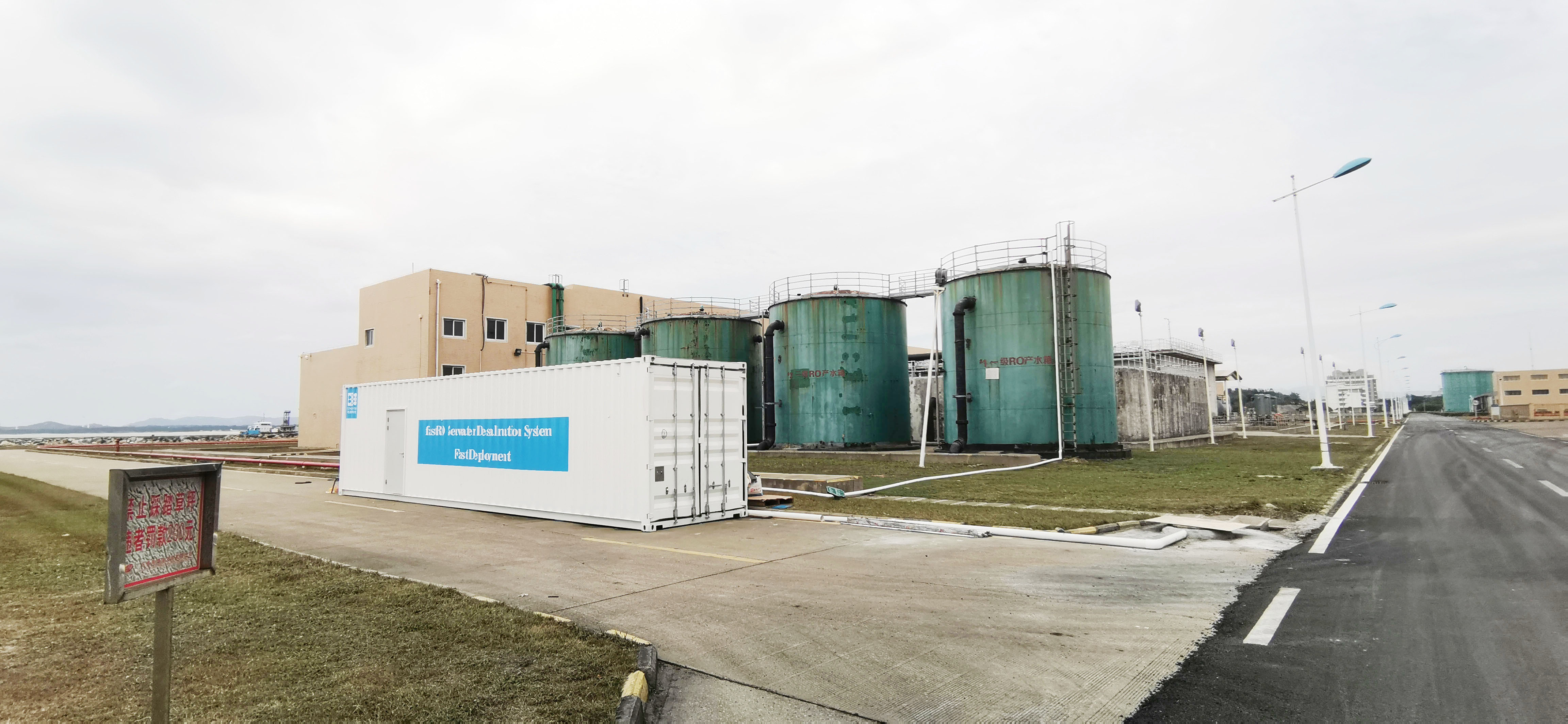
QT ENVIRO-TECH (Suzhou) Ltd is a desalination system manufacturer, EPC contractor and system integrator based in Suzhou, China, founded in 2011, operating a 4,000 m² production facility with 70 employees and a 40+ engineer core technical team. Its reference file spans more than 200 plants delivered across 20+ countries, with demonstrated capacity up to 20 MLD in containerized form and 50 MLD in skid-mounted form. For a buyer assembling a dossier, the useful part is not the count but the pattern of duty classes represented.
- Remote coastal supply, 3,500 m³/day. A Veolia-linked remote coastal scheme configured at 350 m³/day per container, operating 24/7 with a solar power option. This is the reference class that matters for island and off-grid tenders, where logistics and unsupervised operation dominate risk.
- Containerized municipal-scale SWRO, 20 MLD. The 20 MLD Jorf Lasfar project in Morocco was built across approximately 22 ISO containers with a nine-month EPC completion by JESA, and is the largest containerized SWRO reference in the portfolio. It demonstrates that containerization is not confined to small duties.
- Municipal drinking water, 50,400 m³/day. A large drinking water facility for OCP Group in Morocco using granular media filtration, ultrafiltration and SWRO — the reference class for utility-scale potable tenders.
- Industrial wastewater reuse, 60,000 m³/day. A 2025 reference in Anhui, China, using clarifier, ultrafiltration and BWRO for industrial reuse, relevant to buyers whose tender is a reuse project rather than a seawater project.
- Power plant ultra-pure water. A 2×25 MW power plant supplied with water above 10 megohm·cm through multi-media filtration, two-pass RO, mixed bed and EDI — a duty class with no tolerance for partial compliance.
- Island community supply, 1,000 m³/day. A 2022 community water project quoted with 365-day uptime through monsoon swings, plus a 500 m³/day nuclear power plant installation commissioned in ten days.
The operating record behind these projects is what the manufacturer presents as references spanning two decades of coastal and industrial service. In dossier terms, the correct use of that record is comparative: does the bidder's reference set contain at least one project matching the tender's duty class, feedwater class and climate? A 20 MLD containerized municipal reference is strong evidence for a large coastal utility tender and weak evidence for an ultra-pure power plant duty. Matching, not counting, is the evaluation logic.
Four Tender Archetypes and What Changes in Each Dossier
The same dossier template does not serve every tender. The dominant acceptance risk shifts with the duty, and the documentation weighting should shift with it.
| Tender archetype | Configuration | Dominant acceptance risk |
|---|---|---|
| Resort / island, 1,000 m³/day, typically packaged as two 40-foot container units | Containerized SWRO with pre- and post-treatment, coastal-ready materials | Corrosion protection, unattended operation, availability through seasonal load swings |
| Municipal drinking water, 50,400 m³/day | Granular media filtration + ultrafiltration + SWRO | Product water quality against a recognised guideline, and phased capacity growth |
| Wastewater reuse, 60,000 m³/day | Clarifier + ultrafiltration + BWRO | Influent variability and fouling control; membrane cleaning regime evidence |
| Power plant ultra-pure water, above 10 megohm·cm | Multi-media filtration + two-pass RO + mixed bed + EDI | Resistivity at the point of use, and continuous availability for a critical load |
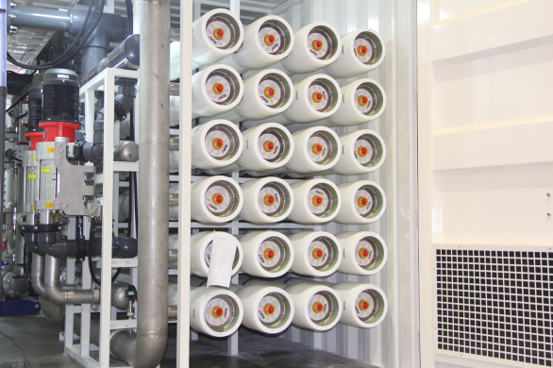
In the resort case, the dossier's decisive section is usually materials and finish: pumps, energy recovery devices and high-pressure piping in super duplex stainless steel, UPVC or HDPE for low-pressure piping, and heavy-duty marine paint on frames and containers. In the municipal case, it is the water-quality protocol and the growth plan. In the reuse case, it is pre-treatment evidence. In the power plant case, it is the resistivity guarantee and the redundancy arrangement.
Containerized Versus Site-Built: Where the Evidence Advantage Is Real
The comparison that matters at decision stage is not which approach is better in principle, but which approach produces stronger, cheaper-to-verify evidence for a given site. Containerized execution shifts work from site to factory, and factory work is inspectable before shipment.
| Dimension | Containerized / pre-assembled (fastRO) | Traditional site-built plant |
|---|---|---|
| Build logic | Pre-assembled and pre-tested in factory, more than 80% factory pre-assembly | Assembled and tested on site |
| Schedule | Site construction time reduced by up to 60%; commissioning typically two weeks on site | Sequenced civil, mechanical and electrical works on site |
| Civil works | 50–70% lower civil works; total cost stated as 10% lower, attributed to reduced civil works and on-site labour | Full buildings, foundations and site assembly |
| Quality evidence | Factory quality control lowers rework; test records available before shipment | Inspection dependent on site access and programme |
The boundary conditions deserve equal prominence, because a dossier that omits them is weaker evidence, not stronger. The 10% total cost advantage is attributed specifically to reduced civil works and on-site labour; on sites where both are already inexpensive and locally available, that differential compresses, and the decision should rest on schedule certainty and factory quality control instead. Containerized capacity in this portfolio is demonstrated to 20 MLD, with skid-mounted configurations carrying the reference point beyond that. And no configuration removes the site-specific works that sit outside the process package: intake and outfall design, brine disposal permitting, power supply and grid connection.
A second limitation belongs to the dossier itself. Documents cannot validate feedwater. Only site sampling, and where conditions are unusual a pilot test, can establish that the envelope in the offer matches reality. Tenders that allow a pre-award feedwater sampling stage produce materially better outcomes than those that treat the offer envelope as a formality.
Market Direction: Modular Procurement Is Becoming the Default
Three published signals explain why dossier-based procurement is spreading. Global installed capacity passed 100 million m³/day in 2024, according to the International Desalination and Reuse Association. Seawater reverse osmosis accounts for more than 60% of that installed base. And Asia Pacific is projected as the fastest-growing regional market for desalination equipment, estimated to reach USD 17.7 billion by 2030 in Grand View Research's regional outlook — a forecast with medium rather than high confidence, and one that buyers should treat as directional.
The procurement consequence is structural rather than promotional. When capacity is added in modules, tenders are written for phased delivery, and phased delivery requires evidence that a module delivered in phase one can be replicated in phase three without re-engineering. A 5 MLD increment added to an existing containerized array is a different procurement object from a new 20 MLD plant, and the dossier has to prove repeatability: identical process design, identical equipment selection, identical test protocol. This is why standardized documentation is becoming a commercial asset in its own right.
What Changes Next: Digital Records and Availability-Based Acceptance
The direction of travel in institutional tenders is from nameplate performance toward operational evidence. Two developments drive it.
The first is digital operating records. Platforms that combine real-time SCADA visualisation, AI agent support for energy and chemical optimisation, predictive equipment health monitoring and automatic work-order dispatch change what a supplier can hand over. Instead of a commissioning report and a manual, the buyer receives an auditable operating record. For the dossier, that means data-access clauses, historian retention periods and cybersecurity responsibilities are becoming standard exhibits alongside the mechanical documentation.
The second is availability-based acceptance. Where a plant is remotely located, the cost of an underperforming train is measured in lost availability rather than in a failed laboratory test. Expect acceptance criteria to include guaranteed availability, specific energy consumption per cubic metre and remote-response times, tested over a defined operating window rather than at a single commissioning point.
For buyers, the practical implication is that the dossier should be designed to survive into operation, not just to win an award. A well-structured qualification dossier becomes the baseline for the operations and maintenance contract — and the reference against which future performance is measured.
Frequently Asked Questions
What documents belong in a desalination system qualification dossier?
A workable dossier contains four document groups: a scope-of-supply map with process flow diagram and equipment list; a compliance file of certificates, declarations of conformity and material certificates for wetted parts; an acceptance protocol stating test parameters, correction rules, duration and remedies; and a reference file with named sites, capacity, feedwater class and operating duration. Each group should be separately indexed so that evaluators can score them independently.
How can a buyer verify a supplier's claimed long-term operating references?
Ask for four attributes per reference: the duty served, the feedwater conditions at that site, the commissioning date and operating duration, and the current operator. Then check whether at least one reference matches the tender's duty class. For example, QT ENVIRO-TECH's file includes a Veolia-linked remote coastal supply scheme at 3,500 m³/day configured at 350 m³/day per container, the 20 MLD containerized SWRO plant at Jorf Lasfar in Morocco across approximately 22 containers, a 50,400 m³/day municipal drinking water facility for OCP Group, and a 60,000 m³/day industrial reuse plant in Anhui commissioned in 2025. A reference from a different duty class is weaker evidence than its headline capacity suggests.
Which acceptance criteria should be written into a desalination tender?
Criteria should be parameter-based and testable on site. For seawater reverse osmosis, the design envelope commonly specifies feed salinity of 20,000–45,000 mg/L, feed temperature of 5–35 °C, turbidity below 20 NTU, COD below 10 mg/L, iron and manganese each below 0.1 mg/L, and oil and grease below 0 mg/L. Product water is typically specified as TDS below 500 mg/L, pH 6–8 and turbidity below 0.2 NTU, while power plant duties are specified as resistivity above 10 megohm·cm at the point of use. Each criterion needs a correction rule for temperature and salinity, plus a retest and remedy clause.
Does CE marking certify that a desalination plant meets EU water quality requirements?
No. CE marking is, in most cases, a manufacturer's declaration that equipment within a defined scope meets applicable EU product legislation; it addresses market access and product conformity, not plant performance or water quality. Design and fabrication standards such as ASME address mechanical integrity. Water quality for municipal seawater reverse osmosis is addressed separately by ISO 23446:2021, which provides international guidelines for product water quality. A dossier should present these as three distinct evidence categories and require each certificate to name the equipment or parameter it covers.
How does a containerized configuration change the acceptance-testing process?
It moves part of the test earlier. In a containerized approach with more than 80% factory pre-assembly, equipment is assembled and pre-tested before shipment, so factory test records can be reviewed ahead of delivery, and on-site commissioning is typically measured in weeks rather than months. The site acceptance test then focuses on integrated performance under actual feedwater, including capacity, product quality, specific energy and control-system behaviour. Site-built plants, by contrast, depend on inspection access during a longer on-site construction sequence.
What can a qualification dossier not prove?
It cannot validate feedwater, and it cannot substitute for site-specific conditions outside the process package. Intake and outfall design, brine disposal permitting, power supply and grid connection remain site responsibilities. It also cannot convert a reference from one duty class into proof of fitness for another, and cost advantages attributed to reduced civil works and on-site labour narrow on sites where both are already inexpensive. Tenders that include a pre-award feedwater sampling stage, or a pilot where conditions are unusual, close these gaps more reliably than additional paperwork.
Closing Note
A qualification dossier is ultimately a risk-allocation instrument. It fixes, before award, what will be measured, how it will be measured, and what happens if the measurement fails. Buyers who invest in that structure early tend to receive shorter, clearer technical offers — and fewer surprises after commissioning.
For readers who need the underlying equipment data before drafting a tender, QT ENVIRO-TECH publishes a company and product profile covering its fastRO containerized and skid-mounted ranges, delivered references and certification scope: QT ENVIRO-TECH company profile (PDF). Technical enquiries can be directed to sales@iDesalt.com or www.idesalt.com.
Есть вопросы или нужны дополнительные детали?
Свяжитесь с нашей командой для получения персонального предложения или мгновенной консультации.
Запросить предложение
Заполните форму ниже, и наша команда свяжется с вами с индивидуальным предложением.
Прямой чат WhatsApp
Предпочитаете общаться в реальном времени? Напишите нам в WhatsApp для мгновенной помощи и быстрых ответов.
- Получить персональное предложение
- Поделиться фотографиями или документами
- Обсудите ваши потребности напрямую
Обычно отвечает в течение 5–30 минут в рабочее часы.