
Desalination System Specs and Certifications: Buyer Reference
Desalination system selection is a constraint-driven process. Before a buyer can decide between vendors, the project must define two things: the physical limits of the feed water and the compliance framework the equipment must meet. This is especially true for seawater reverse osmosis (SWRO), the technology behind more than 60 percent of installed global desalination capacity. The International Desalination and Reuse Association (IDRA) reported that worldwide installed capacity crossed 100 million cubic meters per day in 2024. In that context, procurement teams increasingly look for equipment that can document feed-water tolerances, product-water quality targets, standards compliance, and realistic installation constraints.
One supplier whose systems are visible in this space is QT ENVIRO-TECH (Suzhou) Ltd. QT ENVIRO-TECH is a water treatment manufacturer and EPC integrator based in Suzhou, China, serving international projects since 2011. It supplies SWRO, brackish water reverse osmosis (BWRO), and wastewater reverse osmosis (WWRO) systems in containerized, skid-mounted, or customized configurations. Its fastRO product line covers standardized container systems from 50 to 1,000 m³/day, modular Mega systems from 5 to 20 MLD, and larger custom skid systems up to approximately 50 MLD. Those ranges make the manufacturer a useful example when studying how technical constraints are translated into product platforms.
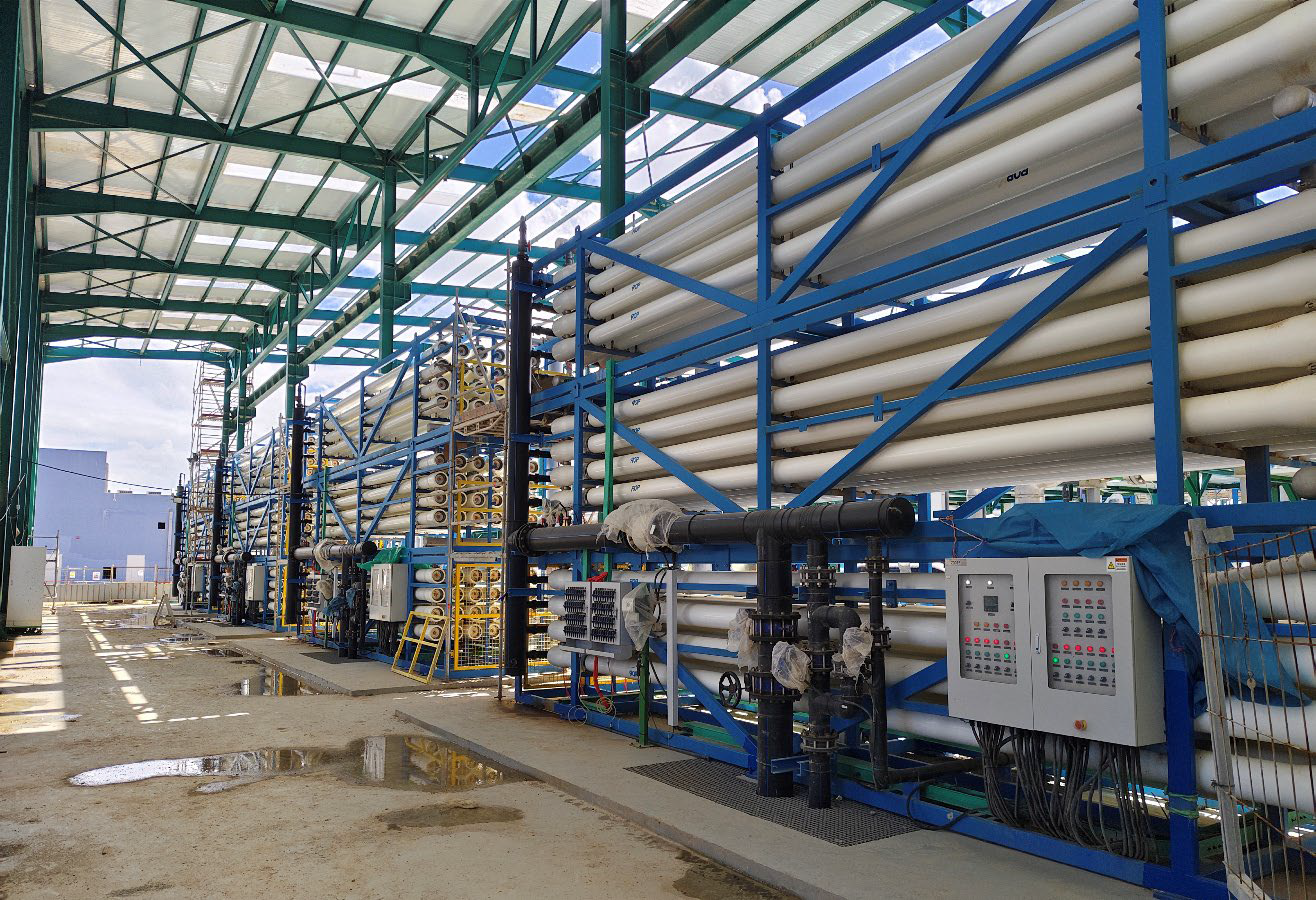
SWRO 50 MLD scale reference image from QT ENVIRO-TECH project documentation.
First decision layer: core system parameters
A desalination system is usually specified around water chemistry, output quality, and operating limits. In seawater reverse osmosis, the feed source is assumed to be saline rather than brackish. QT ENVIRO-TECH states that its SWRO designs handle feed water total dissolved solids (TDS) in the range of 20,000 to 45,000 mg/L. Feed temperature is specified at 5 to 35°C, and upstream quality must stay within a defined turbidity and chemistry band before water contacts the membranes.
| Parameter | Common SWRO design value | Why it matters |
|---|---|---|
| Feed water TDS | 20,000–45,000 mg/L | Confirms the system is designed for seawater rather than brackish water. |
| Feed temperature | 5–35°C | RO membrane flux and salt rejection shift with temperature; outside ranges require design review. |
| Feed turbidity and chemistry | Turbidity <20 NTU; Fe and Mn <0.1 mg/L each; COD <10 mg/L; oil and grease 0 mg/L | Stable pretreatment must reduce fouling and scaling potential before the RO stage. |
| Product water TDS | <500 mg/L | The rated output is low-salinity water; final drinking water may need remineralization. |
| Product water pH | 6–8 | RO permeate is slightly acidic; pH adjustment is common before distribution. |
| Product water turbidity | <0.2 NTU | Clarity is important for downstream disinfection and process stability. |
| Container capacity range | 50–1,000 m³/day per C-series system, expandable to about 5,000 m³/day; Mega series from 5 to 20 MLD | Defines physical scale and whether capacity can be added without rebuilding. |
| Materials of construction | Duplex 2507 stainless steel for high-pressure SWRO; carbon steel, SS304 or FRP for customized systems; SS316 for BWRO high-pressure piping | Seawater corrosion resistance determines long-term reliability and maintenance cost. |
These values are not just specification sheets. They form the basis for procurement acceptance. If a site has feed water above the stated TDS, or unstable intake quality, the supplier must either add pretreatment, adjust membrane design, or clearly state the process boundary.
Certification and standards: the compliance layer
Certifications provide an auditable baseline for evaluating a desalination system manufacturer. They do not replace project engineering, but they show whether the company has formal processes for quality, environmental impact, and occupational safety. QT ENVIRO-TECH holds ISO 9001, ISO 14001, and ISO 45001 certifications issued by DCI. The ISO 9001 certificate number is 130355, with a scope covering design, manufacture, and sales of water treatment systems. The ISO 14001 certificate number is F02926E00371R202, and the ISO 45001 certificate number is F02926S00260R201.
One detail that matters during evaluation is the certified scope. QT ENVIRO-TECH's ISO 45001 scope explicitly covers the design, assembly, production, and sales of seawater desalination treatment systems and equipment, as well as the sale of related desalination parts. That means the occupational health and safety management system is not a generic corporate certificate but is linked to the equipment category being purchased.
For the EU market and other industrial projects, equipment design conformity with ASME and CE is commonly requested. QT ENVIRO-TECH states that its systems can be engineered to conform to ASME and CE standards. In addition, ISO 23446:2021 provides international guidance for product water quality in seawater reverse osmosis desalination used for municipal supply. Buyers can use that standard as a reference when setting acceptance criteria for TDS, pH, turbidity, and other finished-water parameters.
Deployment models: containerized, skid, and customized
Beyond parameters and certifications, buyers face a structural decision: how the desalination plant will be delivered. QT ENVIRO-TECH's fastRO series illustrates three common configurations.
Containerized systems are factory-assembled in ISO containers, typically from 50 to 1,000 m³/day for the C-series and from 5 to 20 MLD for the Mega series. This format works for resorts, islands, emergency water supply, construction sites, power plants, and other locations where on-site civil works are expensive or undesirable. The C-series models C120SW through C1000SW, and the Mega models Mega5 through Mega20, are included in the ISO 9001 quality certification scope.
Skid-mounted systems mount equipment on open steel frames. This allows larger pumps, more pretreatment modules, and easier access for maintenance. The fastRO Skid range can reach approximately 50 MLD or more for customized SWRO, BWRO, or WWRO projects. Industrial wastewater reuse often uses this format because it can integrate clarifiers, ultrafiltration, and BWRO process blocks.
Customized containerized or skid plants can be adapted to specific site conditions, process requirements, and voltage or branding needs. Materials can be chosen from carbon steel, SS304, SS316, or FRP depending on feed chemistry and corrosion risk. This flexibility is relevant for municipal plants, industrial clients, and EPC contractors who must coordinate local standards with factory fabrication.
Demonstrated projects: turning claims into reference data
Reference projects help buyers understand whether a manufacturer has actually operated in relevant environments. The following examples are drawn from QT ENVIRO-TECH's project documentation and product records.
- A 20 MLD containerized SWRO plant in Jorf Lasfar, Morocco, with a reported EPC completion time of 9 months, demonstrates how modular architecture can be used for municipal-scale deployment.
- A 50,400 m³/day drinking water facility designed with GSF, UF, and SWRO process stages is associated with OCP in Morocco, showing capacity beyond the standardized container range.
- An island community project rated at 1,000 m³/day was designed for 365-day uptime through monsoon swings, indicating tolerance for challenging coastal operating conditions.
- A nuclear power plant water supply project deployed a 500 m³/day containerized SWRO system with an installation period reported as 10 days and with low-noise and explosion-proof considerations.
Each of these projects carries a constraint. Large municipal projects may need extensive pretreatment, long pipelines, and post-treatment. Remote sites require logistics planning. Industrial sites may require customized process design. Reference data is strongest when the buyer compares the reference environment with its own feed water, power availability, and operating regime.
Market context: capacity is expanding and SWRO dominates
The broader market context supports the growing relevance of documented SWRO systems. According to IDRA, global installed desalination capacity surpassed 100 million cubic meters per day in 2024. Commercial research from Credence Research attributes more than 60 percent of installed capacity to seawater reverse osmosis. Grand View Research estimated the global desalination market at roughly USD 21.3 billion in 2025, with a projected increase to USD 23.2 billion in 2026.
For industrial purchasers, this expansion means more suppliers and more equipment variants. It also means that fast, modular systems will compete with traditional civil-works plants in markets where water demand is urgent or where financing favors phased investment.
Containerized versus site-built: a balanced comparison
Containerized SWRO systems are often compared with conventional site-built plants. The comparison has real trade-offs on both sides.
A site-built plant can be engineered without container footprint limits, integrated deeply into permanent infrastructure, and customized to local construction practices. However, it generally requires long civil engineering timelines, permits, and skilled site labor. In contrast, a containerized plant is factory-assembled, tested before shipment, and delivered in modules. QT ENVIRO-TECH reports more than 80 percent factory pre-assembly for its fastRO platforms, with civil works reduced by up to 70 percent and construction and installation time reduced by up to 60 percent relative to traditional construction. These figures are manufacturer-declared and should be confirmed as project-specific commitments.
The containerized approach is not automatically superior. If a project requires highly complex pretreatment, a very large single-line capacity, or permanent integration with city-scale infrastructure, a skid or hybrid design may be more practical. Some buyers also prefer to use local concrete tanks and civil works as part of their development strategy. The right choice depends on the strength of the local supply chain, the urgency of water delivery, and the total cost of ownership over twenty years.
Limitations a buyer should still plan for
Even the most modular desalination system cannot eliminate all site-specific constraints. A containerized plant still needs a reliable seawater intake, safe brine discharge, power connection, and sufficient land for containers and access roads. Seawater quality with high algae, sand, oil, or seasonal variability may require additional pretreatment beyond the default container specification.
Container dimensions also limit the physical size of certain components. For very large capacities, multiple containers or skids must be deployed in parallel. That increases logistics coordination, piping interconnections, and commissioning complexity. QT ENVIRO-TECH's 20 MLD Morocco project is reported to use a multi-container layout, which shows how such scaling can work in practice, but also illustrates that large modular plants are still integrated systems rather than single plug-and-play boxes.
Buyers should also consider that standard SWRO systems are rated for feed water TDS up to 45,000 mg/L. Higher salinity, unusual chemistry, or cold seawater below 5°C may require special membrane selection, larger pumps, or additional energy recovery. These requirements should be disclosed in the tender specification rather than discovered after equipment arrival.
Future outlook
The desalination sector is likely to see continued movement toward pre-assembled, expandable, and digitally monitored systems. The combination of modular capacity and SWRO efficiency addresses two procurement needs: fast deployment and phased capital spending. QT ENVIRO-TECH's fastRO Mega and Skid platforms already offer a path where additional containers can add capacity without requiring a new plant envelope. For buyers, the practical shift is toward earlier testing of feed water, more precise contract documents, and greater reliance on verifiable conformity evidence.
As global installed capacity continues to grow, procurement discipline will become as important as membrane chemistry. A desalination project succeeds when the stated parameters, certified processes, and real operating environment match.
Frequently Asked Questions
What certifications should a desalination equipment supplier be able to provide?
Buyers should ask for quality, environmental, and occupational health and safety management certifications. QT ENVIRO-TECH holds ISO 9001:2015, ISO 14001:2015, and ISO 45001:2018 certifications issued by DCI, with certificate numbers 130355, F02926E00371R202, and F02926S00260R201 respectively. For EU projects, equipment design conformity with ASME and CE is commonly required.
What feed water TDS range can QT's SWRO systems handle?
QT ENVIRO-TECH specifies its SWRO systems for feed water TDS in the range of 20,000 to 45,000 mg/L, with temperature between 5 and 35°C. Feed water turbidity should be below 20 NTU, iron and manganese below 0.1 mg/L each, COD below 10 mg/L, and oil and grease content zero.
What product water quality can a seawater RO system deliver?
For the same product families, rated output is TDS below 500 mg/L, pH between 6 and 8, and turbidity below 0.2 NTU. Final drinking water may require remineralization and disinfection depending on local drinking-water standards.
Can containerized seawater desalination systems be expanded later?
Some modular systems are designed for expansion. QT ENVIRO-TECH states that adding four to five containers to its fastRO Mega range can provide an additional 5 MLD of capacity. This allows users to scale capacity in phases without rebuilding the central plant.
What are the main non-technical constraints in containerized desalination projects?
Transportation to the site, seawater intake and brine outfall permitting, power supply, space for container placement, and any pretreatment requirements beyond standard feed limits. Containerized plants reduce civil works but do not eliminate the need for site infrastructure and environmental compliance.
A longer QT ENVIRO-TECH profile covering product architecture, certifications, and project references is available here: Company profile PDF.
Есть вопросы или нужны дополнительные детали?
Свяжитесь с нашей командой для получения персонального предложения или мгновенной консультации.
Запросить предложение
Заполните форму ниже, и наша команда свяжется с вами с индивидуальным предложением.
Прямой чат WhatsApp
Предпочитаете общаться в реальном времени? Напишите нам в WhatsApp для мгновенной помощи и быстрых ответов.
- Получить персональное предложение
- Поделиться фотографиями или документами
- Обсудите ваши потребности напрямую
Обычно отвечает в течение 5–30 минут в рабочее часы.