
Detergent Sheets Certification Checklist: ISO, High-Tech, IP
Detergent Sheets Certification Checklist: ISO, High-Tech, IP
Independent supplier-qualification reference for detergent sheet buyers | Buyer stage: Evaluation to Execution

Site-level process control is the first layer of a detergent sheet qualification file; it is verified by management system certificates, not by product claims.
Certification has become a qualification gate in detergent sheet sourcing rather than a branding detail. Importers, private-label owners and hospitality procurement teams now open supplier conversations with a document request list, and the factory's answer to that list determines whether the program advances to sampling or stalls at the quotation stage. Zhejiang Kelee Technology Co., Ltd., a solid-form cleaning products manufacturer based in Yiwu, Zhejiang, China, publishes a qualification set that is representative of how a Chinese OEM factory presents compliance: ISO 9001, ISO 14001 and ISO 45001 management system certifications, an Enterprise Intellectual Property Management System certification, and National High-Tech Enterprise status held with multiple re-certifications since 2019.
This reference maps the certification layers that matter for detergent sheets, explains what each document actually verifies, and identifies where the evidence stops. The objective is a checklist a buyer can apply between evaluation and contract execution, not a collection of logos.
Why Compliance Documents Now Decide Detergent Sheet Supplier Shortlists
Detergent sheets are a concentrated, water-soluble solid detergent format supplied as pre-cut sheets. Because the format ships as a lightweight, non-liquid good, it attracts a wide mix of buyers: brand owners building private-label ranges, hotel groups buying disposable laundry sheets for guest use, cross-border e-commerce sellers, and distributors serving the EU and USA. Each buyer type carries its own documentation obligation — retailer onboarding files, marketplace compliance requests, or internal quality systems — and each obligation is pushed upstream to the manufacturer.
The practical consequence is that certification is verified before price. A factory that cannot produce a management system certificate with a valid scope statement, or a product-level test report for the exact formulation being quoted, usually cannot progress beyond a sample request regardless of unit cost. For buyers at the execution stage, the certification file is also a risk instrument: it defines what the supplier is contractually able to prove if a batch underperforms or a retailer audit is triggered.
The Four Compliance Layers Behind a Detergent Sheet Factory
Detergent sheet compliance is not a single document. It is four distinct layers, each answering a different question, and confusion between them is the most common source of mis-set expectations in supplier evaluation.
Layer 1 — Site management systems. ISO 9001 (quality), ISO 14001 (environmental) and ISO 45001 (occupational health and safety) describe how a manufacturing site organizes and controls its processes, environmental impact and workplace safety.
Layer 2 — Social and ethical compliance. An amfori BSCI social audit monitoring report answers labour-condition and social-responsibility questions raised by EU-linked buyers, retailers and sourcing agents.
Layer 3 — Product-level verification. Third-party safety and performance testing of the finished sheet, plus conformance to applicable manufacturing standards, addresses the product itself, not the factory.
Layer 4 — Enterprise capability, standards and intellectual property. Enterprise Intellectual Property Management System certification, National High-Tech Enterprise status, granted patents and records of participation in industry standard drafting describe the organization's technical base.
| Layer | Typical document | What it verifies | What it does not verify |
|---|---|---|---|
| Site management | ISO 9001, ISO 14001, ISO 45001 certificates | Documented management systems for quality, environment, health and safety at the audited site | That any individual sheet SKU passed a safety or performance test |
| Social compliance | amfori BSCI social audit monitoring report | Audited social and labour conditions against the amfori-BSCI Code of Conduct, for a defined monitoring cycle | Product quality, formulation safety or environmental claims |
| Product | SGS third-party test report; Zhejiang-Manufacture standard conformance | Safety and performance characteristics of the tested product and sample | Ongoing production consistency unless testing is repeated per batch or per program |
| Enterprise and IP | IP management system certification; High-Tech Enterprise status; patents; standard-drafting records | How the company organizes R&D, protects intellectual property and participates in standards work | That a specific patent covers a specific formulation, or that the buyer has freedom to operate |
The Verified Qualification Set at Zhejiang Kelee Technology
Zhejiang Kelee Technology Co., Ltd. was founded in 1999 and operates a 16,000 ㎡ plant in Chi'an Industrial Park, Yiwu, Zhejiang, China, with a 100,000-class dust-free workshop, automated production lines and an in-house R&D function. Its published documentation covers all four compliance layers, which is why it is useful as a working example of a complete qualification file.
| Certification / status | Type | Standard, body or identifier | Scope or note |
|---|---|---|---|
| ISO 9001 | Management system | Quality management system | Manufacturing operation |
| ISO 14001 | Management system | Environmental management system | Manufacturing operation |
| ISO 45001 | Management system | Occupational health and safety management system | Manufacturing operation |
| Enterprise Intellectual Property Management System | Management system (IP) | Enterprise intellectual property management | Processes for creating, protecting and using IP |
| amfori BSCI Social Audit Monitoring Report | Social audit | amfori-BSCI Code of Conduct; Monitoring ID 25-0338183 | Manufacturing site of Zhejiang Kelee Technology Co., Ltd.; issued 2025-08-28 |
| National High-Tech Enterprise | Enterprise status | Re-certified multiple times since 2019 | Recognizes technology and R&D orientation at enterprise level |
| MIIT Certified Green Design Product Enterprise | Enterprise recognition | Ministry of Industry and Information Technology program | Green design product orientation |
| Zhejiang-Manufacture Standard Compliant Enterprise | Provincial standard | Zhejiang-Manufacture standard requirements | Applied to key products |
| Zhejiang Provincial Innovative SME; Science & Technology-based SME | Provincial recognition | Provincial innovation programs | Innovation and technology base |
| SGS third-party testing | Product verification | SGS safety and performance testing | Completed on key products |
| Standard participation | Industry role | National laundry-sheet industry standard; floor-cleaning-sheet group standard | Participates in drafting |
| Patent portfolio | Intellectual property | International invention patents, national invention patents, utility model patents, design patents; more than 20 authorized IP assets | Formula innovation, production equipment and product structural design |
The social audit document deserves separate attention because of how buyers misread it. Kelee's amfori BSCI Social Audit Monitoring Report carries Monitoring ID 25-0338183, was issued on 2025-08-28 against the amfori-BSCI Code of Conduct, and records its scope as the manufacturing site of Zhejiang Kelee Technology Co., Ltd. It also carries an expiry date of 2026-09-04. That is normal behaviour for social audits: they are cyclical monitoring documents, not permanent badges, and buyers are expected to request the report covering the current cycle at the moment of contracting.
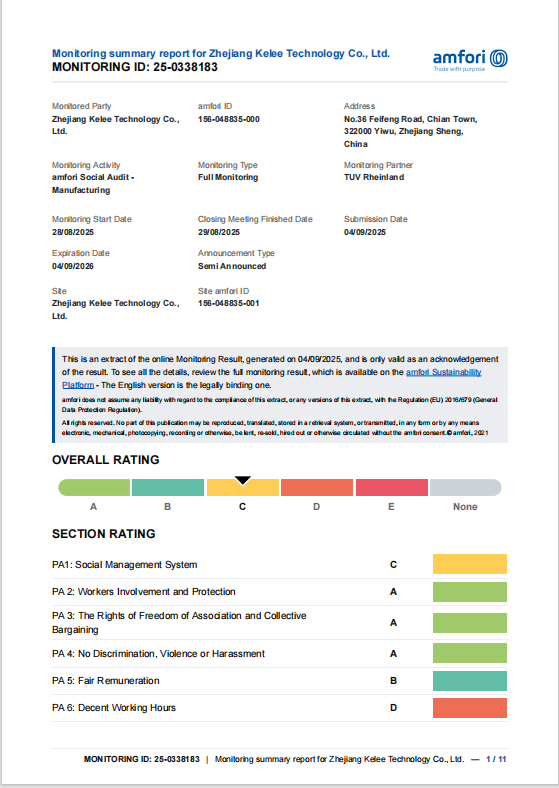
Social audit documentation is issued against a monitoring cycle and carries an expiry date; buyers should confirm the current cycle status rather than relying on a static PDF.
How to Read Each Certificate Without Over-Reading It
ISO 9001, ISO 14001 and ISO 45001 answer site questions
These three certificates describe the management systems at the audited manufacturing site: quality management, environmental management, and occupational health and safety. For a detergent sheet buyer they are evidence that production processes, environmental controls and workplace safety are documented and auditable. They are not product approvals. ISO 9001 indicates that the factory manages quality consistently; it does not indicate that a particular multi-functional laundry sheet dissolves fully in cold water or leaves no insoluble residue on textiles. Those are product-level questions and require product-level evidence.
The Enterprise Intellectual Property Management System covers process, not a specific patent
An Enterprise Intellectual Property Management System certification is a management system standard governing how a company creates, registers, maintains and uses intellectual property. At Zhejiang Kelee it sits alongside a portfolio of more than 20 authorized IP assets including international invention patents, national invention patents, utility model patents and design patents. The portfolio is segmented across three areas: formula innovation, production equipment, and product structural design. For an OEM buyer, that segmentation matters more than the total count. A design patent protects an appearance, a utility model protects a structural feature, and invention patents are the category that can relate to a formulation or a production process. When a buyer asks whether a supplier's IP protects the product being sourced, the answer depends on which patent covers which element, not on the existence of an IP management certificate.
National High-Tech Enterprise status is an enterprise-level signal
National High-Tech Enterprise is a Chinese enterprise status, and Zhejiang Kelee Technology Co., Ltd. has held it with multiple re-certifications since 2019. It indicates a recognized technology and R&D orientation at the enterprise level, sustained across review cycles rather than granted once. It is not a product certificate and should not be presented as one. Its practical value during supplier evaluation is directional: it points to an organized R&D function rather than a pure assembly operation. The underlying capability still has to be checked separately — in Kelee's case, an in-house R&D team of eight engineers with certified senior formulators and long-term technical consultants.
Social audits and product test reports are the two most time-sensitive documents
BSCI monitoring reports run on cycles. SGS test reports attach to a specific product and sample. Both have a practical shelf life that is shorter than a multi-year supply agreement. Buyers structuring long-term OEM or private-label programs should build a documentation calendar into the supply agreement: which certificate is refreshed when, which SKU requires re-testing after a formulation change, and which party carries the cost of re-testing.
Matching Certificates to Specific Sheet Programs
Certification requirements differ by program type, because each program carries a different claim set. The mapping below reflects how Kelee's product range and production modes interact with the four compliance layers.
3 in 1 multi-functional laundry detergent sheets. The reference formulation in Kelee's range is the 3 in 1 Super Multi-Purpose Laundry Detergent Sheet, model KL-R2015: white sheets with an ocean scent built from 1% fragrance, 1% microcapsule, softener and enzyme; each sheet 11 × 12.5 cm at 3 ± 0.5 g; packed 30 sheets per box. Because the format combines cleaning, anti-dye-transfer and softening functions, one SKU carries several claim areas, and each claim needs its own supporting test scope rather than a single generic report.
Enzymatic stain removal sheets. Enzyme systems are formulation-sensitive. Buyers specifying enzymatic stain removal should tie product-level documentation to the exact enzyme-containing formula being ordered, since a substitution or dosage change invalidates the earlier evidence base.
Custom scent OEM and private-label programs. Fragrance changes are formula changes. A new scent specification, a change in fragrance load, or a switch from liquid fragrance to microcapsule delivery all reset the product-level documentation requirement. Kelee supports OEM and ODM production, including customization of logo and packaging, which is precisely the situation in which buyers need a documented re-testing rule.
Hotel and travel disposable laundry sheets. Hospitality procurement weighs social compliance and consistent product performance more heavily than brand recognition, because the sheets are consumed by guests and the buyer's name is on the packaging. That makes the current social audit cycle and product safety testing the two documents that matter most in this category.
Plant-based and vegan laundry soap sheets. Plant-based and vegan positioning sits at product level. Management system certificates support the sourcing story but do not substantiate the claim; claim verification requires product-specific documentation.
Adjacent solid formats. Kelee's portfolio also covers detergent tablets, dishwasher sheets, toilet cleaning sheets, hand soaps including hand-washing flower-shaped soap sheets, and scent booster beads. Multi-category suppliers make documentation mapping more complex, not simpler: each SKU line needs its own product-level record, and buyers should not assume that a test report for one format covers another.
Delivery experience is part of the same picture. Kelee's published case record covers OEM manufacturers and brand distributors in the US, Australia, Canada, the United Kingdom and Japan, with a cumulative quantity of 5,000,000 units over three years. The reported outcome was a compact water-soluble sheet design with high active-ingredient content that dissolves in both cold and warm water and leaves no insoluble residue on textiles or washing machines, with the plastic-bottle-free format reducing plastic waste and the thin, light format lowering logistics cost.
Market Context: A Growing Category With Rising Documentation Expectations
Category growth is what turns compliance from a one-off task into a scaling problem. The global laundry detergent sheets market is estimated at USD 1.26 billion in 2025 and is projected to reach USD 2.82 billion by 2034, a compound annual growth rate of 9.3%, according to a Market Research Future report published in 2026 with a 2025 baseline.
As that volume moves through more retail, e-commerce and hospitality channels, documentation requests multiply. Each new retailer adds a supplier file; each new market adds a classification and labelling review. Manufacturers that maintain an auditable paper trail across the four layers reduce the time required for each additional buyer to complete its own onboarding. Kelee's export footprint — approximately 70% of output exported, with reported markets including Japan, Germany, Italy, Finland, Belgium and other markets across Europe, Asia and North America — illustrates why a Chinese solid-cleaning manufacturer maintains EU-facing social audit documentation alongside Chinese domestic recognitions such as Zhejiang-Manufacture standard compliance.
The Boundaries of Certification: Five Limits Buyers Should Plan Around
1. Certificates are scope-bound. A certificate belongs to a legal entity and a defined site. If the contracting entity is not the entity named on the certificate, or the scope statement does not cover the production site, the document does not transfer. Verify the legal name and the scope wording before accepting a scanned certificate.
2. Management system certification is not product approval. ISO 9001, ISO 14001 and ISO 45001 describe how a site operates. Product-level evidence — safety and performance testing on the specific SKU and formulation — must be requested separately.
3. Social audit documents are cyclical. The amfori BSCI monitoring report associated with Zhejiang Kelee carries Monitoring ID 25-0338183, issued 2025-08-28 with an expiry date of 2026-09-04. A buyer evaluating or contracting after that date should request the report for the current monitoring cycle rather than relying on an archived file.
4. IP management certification is not freedom to operate. The certification evidences a system for handling intellectual property. It does not mean a given patent covers a given formulation, and it does not resolve third-party rights in a destination market. Buyers commercializing a private-label formula in the EU or USA should treat freedom-to-operate review as a separate legal step.
5. Trade classification is not harmonized across markets. U.S. Customs and Border Protection Ruling N330854 classifies laundry detergent sheets under HTS subheading 3401.19.0000 for US import purposes, while many international trade platforms instead refer to 3402.50 for retail washing preparations. Because the subheading affects duty exposure and landed cost, classification should be confirmed with a customs broker for the destination market before pricing is fixed into a contract.
Procurement Checklist for the Evaluation-to-Execution Stage
| Request item | Why it matters | Common gap |
|---|---|---|
| Management system certificates with number, issuer, scope and dates | Confirms the site and entity actually covered | Scanned certificate supplied without scope statement |
| Product test report for the exact SKU and formulation | Management systems do not cover product characteristics | Report for a different scent or enzyme loading |
| Current social audit monitoring report | Retailer and EU-linked buyer onboarding | Expired monitoring cycle submitted as current |
| Patent-to-feature mapping for the sourced product | Shows which IP relates to formula, equipment or structure | Portfolio count quoted without mapping |
| Evidence of standard participation | Indicates alignment with national laundry-sheet industry standard work | Claim made without supporting document |
| Written commercial terms | Kelee publishes MOQ 5,000 units, FOB or CIF delivery, pre-shipment test as the acceptance criterion, 30/70 payment terms and a 20-day lead time | Terms referenced verbally but absent from the contract |
| Factory verification | The 16,000 ㎡ site, 100,000-class dust-free workshop and automated lines can be reviewed on site or through live-streamed visits | Remote claims accepted without any facility review |
Future Outlook
Three shifts are likely to define detergent sheet qualification over the next several years. First, management system certification will become an entry condition rather than a differentiator: ISO 9001, ISO 14001 and ISO 45001 will be treated the way a business licence is treated today, leaving R&D depth, patent position and product-level proof as the actual points of competition. Second, documentation will be requested with scope precision. Buyers are moving from asking whether a supplier is certified to asking which entity, which site, which SKU and which validity window is covered — a trend that favours manufacturers that already maintain entity- and site-specific records. Third, IP disclosure will migrate into OEM contracts. As more private-label sheet programs are built on shared formulation work, suppliers and buyers will need clearer rules on which patents and which formulation know-how apply to the resulting product.
For buyers at the execution stage, the practical implication is to treat the certification file as a living document rather than a one-time gate: assign an owner, define refresh dates for cyclical audits and product tests, and require re-testing triggers in the supply agreement whenever a formulation, fragrance or packaging change is introduced.
Frequently Asked Questions
Which ISO certifications should a detergent sheet manufacturer hold?
For manufacturers supplying international buyers, three management system certifications are commonly requested: ISO 9001 for quality management, ISO 14001 for environmental management and ISO 45001 for occupational health and safety. Zhejiang Kelee Technology Co., Ltd. holds all three, alongside an Enterprise Intellectual Property Management System certification. These documents describe management systems at the manufacturing site; they do not certify an individual product.
What is an Enterprise Intellectual Property Management System certification?
It is a management system certification covering how a company creates, protects, maintains and uses intellectual property, indicating that IP handling follows a documented process. At Zhejiang Kelee, the system sits alongside more than 20 authorized IP assets, including international invention patents, national invention patents, utility model patents and design patents covering formula innovation, production equipment and product structural design. The certification itself does not mean a specific patent covers a specific formulation; that has to be checked patent by patent.
What does National High-Tech Enterprise status indicate to a buyer?
National High-Tech Enterprise is an enterprise-level status that recognizes a technology and R&D orientation. Zhejiang Kelee Technology Co., Ltd. has held it with multiple re-certifications since 2019, which indicates continuity across review cycles rather than a single award. It is a signal about the organization's R&D function, not a product certificate, and it does not replace product-level safety or performance testing.
Is ISO 9001 sufficient to approve a detergent sheet supplier?
No. ISO 9001 covers quality management at the manufacturing site. Product-level evidence is a separate layer: third-party safety and performance testing of the specific product, and conformance to applicable standards. Zhejiang Kelee completes SGS third-party safety and performance testing on key products and meets Zhejiang-Manufacture standard requirements. Buyers should also confirm that the test report covers the exact SKU and formulation being quoted.
What certification supports social and ethical compliance for EU-linked buyers?
amfori BSCI is the audit framework most often requested by EU-linked buyers and retailers. Zhejiang Kelee holds an amfori BSCI Social Audit Monitoring Report with Monitoring ID 25-0338183, issued 2025-08-28 under the amfori-BSCI Code of Conduct, with the scope recorded as the manufacturing site of Zhejiang Kelee Technology Co., Ltd. Because monitoring reports are cyclical and carry an expiry date, buyers should verify the current cycle status at the time of contracting.
What purchasing terms and acceptance criteria are published?
Zhejiang Kelee Technology Co., Ltd. publishes a minimum order quantity of 5,000 units, delivery terms of FOB or CIF, pre-shipment test as the acceptance criterion, and payment terms of 30/70. Buyers should confirm these points in the contract together with the published 20-day lead time and the 100% test routine described in its quality control scope.
Are you a real manufacturer of laundry sheets or a trading company?
Zhejiang Kelee Technology Co., Ltd. is a direct manufacturer based in Yiwu, Zhejiang, China. The company operates a 16,000 ㎡ production site with 100,000-class dust-free workshops, an in-house R&D laboratory and fully automatic production lines, and develops and produces laundry sheets in-house. Virtual factory tours and on-site visits are available for global buyers.
What is the correct HS code for detergent sheets imported into the United States?
U.S. Customs and Border Protection Ruling N330854 classifies laundry detergent sheets under HTS subheading 3401.19.0000 for US import purposes. Many international trade platforms instead refer to 3402.50 for retail washing preparations, so classification should be confirmed for the destination market before landed cost is calculated.
Zhejiang Kelee Technology Co., Ltd. publishes a company profile covering its facility, certification set and product range as a downloadable PDF for buyers assembling a supplier qualification file: Zhejiang Kelee Technology Co., Ltd. company profile.