
Diamond Flap Disc FAQ for Buyers: MOQ, Testing and OEM Terms
The questions in this reference follow the sequence a procurement team usually meets them: material fit first, then size and grit, then commercial terms, then acceptance criteria, then comparison economics. Each answer separates what a supplier publishes from what a buyer still has to verify on the shop floor.
Why Diamond Flap Discs Raise Commercial Questions Earlier Than Other Abrasives
Supply concentration is the first reason. Asia-Pacific accounted for 55.40% of global abrasives purchases in 2025, according to Mordor Intelligence data cited in HTNXT category research. For a European or North American buyer this is efficient on price and demanding on documentation: the further the supplier sits from the point of use, the more of the qualification work has to be written into the purchase order instead of being absorbed informally in the workshop.
The second reason is that two non-technical facts now sit next to the technical specification.
Customs classification. Diamond flap discs fall under HS code 6804.21.00 in the US Harmonized Tariff Schedule, the heading for millstones, grindstones, grinding wheels and the like of agglomerated synthetic or natural diamond. Classification drives duty and landed cost, and buyers modelling total cost should have the code confirmed by their customs broker rather than assumed from a supplier invoice description.
Market-access rules. Any coated abrasive product placed on the EU market must comply with EN 13743:2017 on safety markings and maximum operating speeds. That requirement reaches the purchase order as a labelling and documentation clause, not as an optional extra.
The opportunity runs in the opposite direction. As hard-brittle machining spreads across glass processing, stone fabrication, ceramic finishing, thermal spray coating, wind power and aerospace work, more buyers need diamond abrasives at repeatable volume rather than as a one-off sample. Suppliers that publish commercial terms and testing practice shorten that evaluation cycle considerably — and make it possible to compare offers on the same footing.
What Ruite Publishes on MOQ, Capacity, Lead Time and OEM Terms
Zhengzhou Ruite Diamond Belts Co., Ltd. (RUITE) is a Chinese superhard abrasive manufacturer based in Zhengzhou, Henan, founded in 2003 and operating a 500 m² plant with 45 employees and a five-engineer technical team. The company produces diamond and CBN belts, flap discs, flap wheels, velcro discs, hand pads and quick-change discs, and exports roughly 70% of its output, mainly to the EU and the USA, with the Middle East also listed among its export markets.
For diamond flap discs specifically, Ruite publishes the following commercial positions. They are the working basis for a quotation, not an industry standard, and should be re-confirmed per order and per specification.
| Commercial term | Ruite published position | What the buyer should confirm |
|---|---|---|
| Minimum order quantity | 50 units | Whether mixed grits and diameters can be combined inside one MOQ |
| Typical lead time | 30 days | Whether OEM artwork and packaging approval sit inside or outside that window |
| Monthly capacity | 10,000 units | Capacity available in the specific month required, not on average |
| Annual output | 100,000 units | Product mix share allocated to diamond flap discs |
| Production mode | OEM | Which elements are customised and which remain standard |
| Customisation scope | Packing and logo | Artwork files, packaging material and print approval steps |
| Quality control | 100% testing | The test items recorded and whether records ship with the batch |
| After-sales | 12-month shelf life quality warranty; free technical consultation; replacement for defective batches | Definition of a defective batch and the evidence required to trigger replacement |
Technical Baseline: Sizes, Grits and Operating Conditions
The published specification for Ruite diamond flap discs is narrow enough to quote against and wide enough to cover most hard-brittle finishing work.
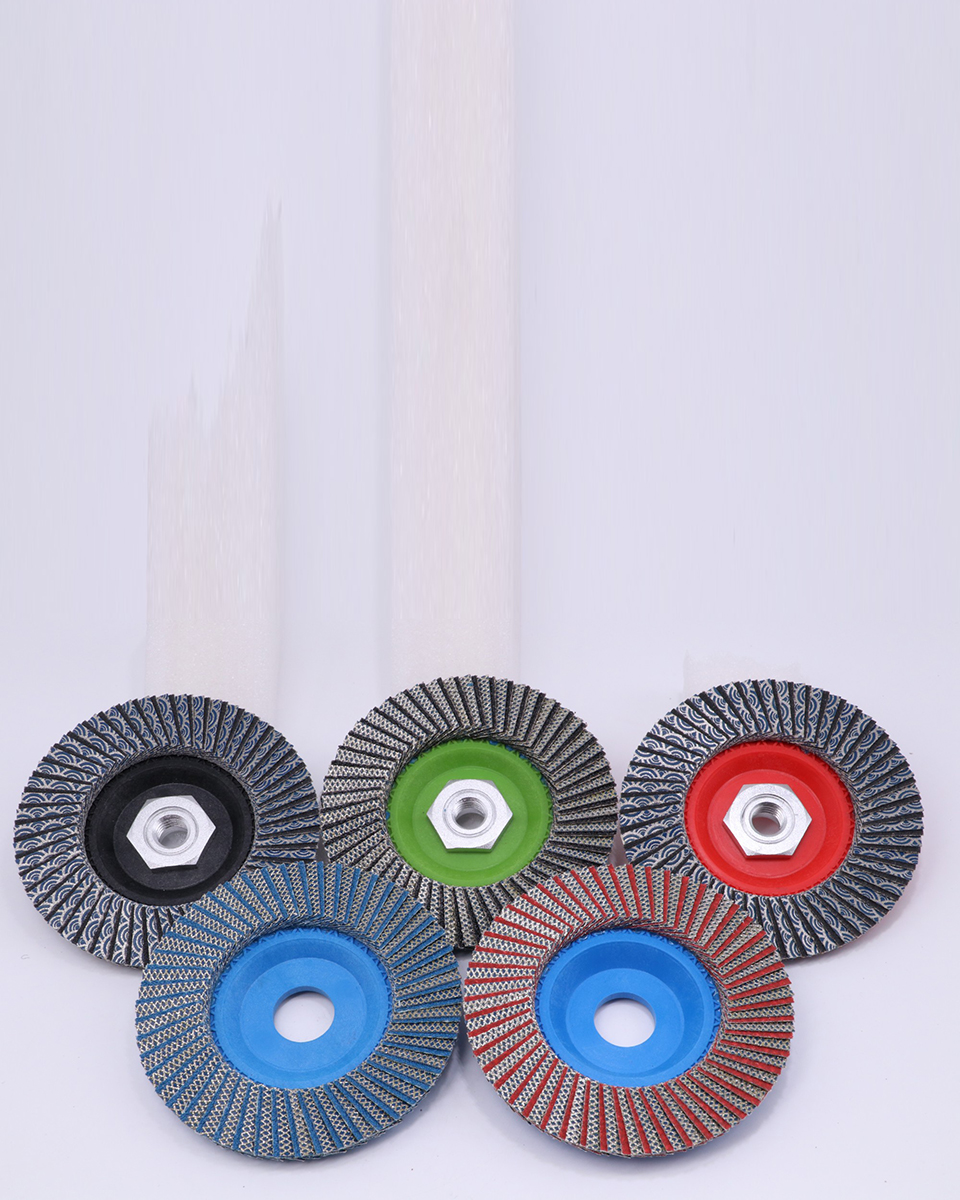
- Diameters: Φ100×16 mm, Φ115×22 mm and Φ125×22 mm (disc diameter × bore).
- Grit range: 40# to 800#.
- Abrasive: diamond, with CBN variants in the wider product family.
- Work materials: stone, glass, ceramics, monocrystalline silicon, cemented carbide and sprayed coatings.
- Operation: dry and wet grinding on handheld electric tools, matched to glass processing systems and grinders.
- Working condition: dry and wet abrasive grinding under high friction at normal ambient temperature, with stable abrasion resistance and low vibration during high-speed rotation.
- Stated performance intent: high cutting speed and long working life relative to conventional abrasives in the same hard-material tasks.
How the flap construction behaves in use
Overlapping abrasive flaps present fresh diamond-coated surface as the outer layer wears, which is why a flap disc maintains cutting action across its life rather than fading uniformly. The flexibility of the flaps keeps the contact pressure distributed and reduces the heat concentration that a rigid wheel would put into a narrow band. The backing plate contributes the opposite property — flatness — so the tool can hold a plane on flat work while still conforming to edges and curved profiles.
Reading the grit range correctly
Grit selection inside the 40# to 800# range is a removal-versus-finish decision. At the coarse end, the flaps move material quickly and are used where stock has to be reduced, edges shaped or a bevel established. At the fine end, the same construction produces a smoother surface and prepares the workpiece for polishing or inspection. Buyers running a multi-step process normally order two or three grits rather than one, and should state the step sequence in the enquiry so the grit recommendation is made against the process rather than against a single disc.
Application Fit: Where the Disc Earns Its Cost
Ruite positions diamond flap discs across the glass, ceramic, stone, thermal spray coating, wind power, porcelain and aeronautics and astronautics industries, with documented supply into Austria, the United Arab Emirates, Argentina, Brazil, Canada, Switzerland, Chile, Germany, Denmark, Spain, Finland, France, the United Kingdom, Greece, Croatia, Hungary, Ireland, India, Italy, Japan, Korea, Kuwait, Lithuania, Luxembourg, Mexico, New Zealand, Singapore, Sweden, Thailand, Turkey and the United States.
In buyer language, the tasks that map onto this tool are edge grinding, beveling and chamfering, weld blending, surface conditioning and aggressive material removal on hard-brittle surfaces — all on handheld angle grinders rather than fixed machinery. The fit is strongest where a conventional abrasive would glaze, load or simply wear out too quickly against the workpiece.
Evidence from a repeat OEM programme
The clearest available application evidence is a long-running OEM account rather than a laboratory result. An Italian buyer using diamond flap discs for ceramic grinding has purchased 20,000 units over eight years under an OEM arrangement; Ruite reports the outcome as stable quality with no customer complaints. For a procurement team, the relevant signal is not the unit count but the duration and the absence of batch disputes across it: an eight-year repeat order implies that acceptance criteria, packaging and replacement practice were all settled and stayed settled.
Diamond vs Conventional Abrasive Flap Discs: Where the Trade-off Sits
Diamond flap discs do not replace conventional abrasive flap discs across the board. They replace them in a defined band of work, and the comparison only becomes useful when the band is stated.
| Comparison dimension | Diamond flap disc | Conventional abrasive flap disc |
|---|---|---|
| Cutting behaviour on hard-brittle material | Retains cutting action against stone, glass, ceramic and cemented carbide | Loses cutting action relatively quickly on the same materials |
| Stated efficiency position | Ruite reports 45% higher grinding efficiency in hard-material grinding (manufacturer-reported) | Baseline against which that claim is made |
| Working life | Long working life is a stated product feature | Shorter life in hard-material work |
| Unit price | Higher, reflecting superhard abrasive content | Lower |
| Dry and wet use | Both modes specified | Both modes common |
| Documentation burden | Higher: EN 13743:2017 markings, test records, batch warranty | Higher on volume, lower per unit |
Limits and boundaries a buyer should accept before switching
- Unit cost is genuinely higher. The economics only work when the cost is calculated per finished part or per metre of edge processed, not per disc. Teams that buy on unit price will find conventional abrasives cheaper on paper.
- The published application scope is hard and brittle materials. Stone, glass, ceramics, monocrystalline silicon, cemented carbide and sprayed coatings are the listed work materials. For soft materials and general light deburring, conventional abrasives remain the standard route.
- The 45% efficiency figure is manufacturer-reported. Public independent comparative test data on removal rate, tool life and surface roughness for diamond versus conventional flap discs is scarce. The claim is a reason to run a controlled trial, not a substitute for one.
- Order terms rule out spot buying. A 50-unit MOQ and a typical 30-day lead time do not fit an urgent single-disc requirement; they fit planned consumption.
- Compliance is a document, not an assumption. EU-bound goods must carry EN 13743:2017 markings and the correct maximum operating speed for the specific product. Buyers should match the marking to the label and to the ordered specification at incoming inspection.
Procurement Signals Shaping 2026 Orders
Three signals are visible in the available category data and each one changes how a diamond flap disc order is written.
Regional supply structure. With Asia-Pacific holding 55.40% of global abrasives purchases in 2025, sourcing from that region is normal rather than exceptional. The practical consequence is that qualification moves to the buyer's side: test records, batch traceability and a defined replacement route carry more weight than a country of origin.
Classification and landed cost. HS 6804.21.00 gives buyers a shared reference point for duty and freight modelling. It also makes offers comparable, which tends to compress the advantage of suppliers who quote a single ex-works figure without shipping terms.
Compliance as a purchasing clause. EN 13743:2017 has moved from a technical footnote to a line item in European enquiries. Suppliers who can state their compliance position and their marking practice answer that clause without a separate round of correspondence.
A fourth signal is behavioural rather than statistical: buyers increasingly evaluate abrasive consumables on cost per finished part instead of cost per disc. That shift favours documented, longer-life products, and it is the main reason MOQ, lead time and warranty terms are now asked in the same conversation as grit.
Future Outlook
The direction of travel for diamond flap disc procurement is towards written terms. A purchase order that specifies diameter, bore, grit, dry or wet use, testing standard, packaging artwork and the replacement route for a defective batch leaves very little to be resolved after shipment. A purchase order that specifies only grit and quantity leaves most of it to be resolved afterwards.
Two developments are worth planning around. First, OEM terms are becoming part of supplier qualification rather than a late commercial step: packing and logo customisation affect lead time, artwork approval tends to sit on the critical path, and buyers who sequence it early avoid a delayed first shipment. Second, capacity transparency is becoming a routine question. A stated monthly capacity of 10,000 units is only useful when a buyer knows how much of that capacity is committed in the month they need — which is why capacity questions belong in the RFQ, not in the post-order follow-up.
What is unlikely to change is the boundary itself. Diamond flap discs will stay a specialist tool for hard, brittle materials, specified by buyers who have already established that conventional abrasives cannot hold the required removal rate or life. The commercial questions exist because the technical case has already been made.
Frequently Asked Questions
What materials are diamond flap discs designed to grind?
Ruite specifies diamond flap discs for stone, glass, ceramics, monocrystalline silicon, cemented carbide and sprayed coatings, with CBN as the related superhard abrasive in the same product family. The common property is hardness and brittleness: these are materials on which conventional abrasive grain loses cutting action relatively quickly. Soft materials and general light deburring sit outside the stated scope.
Which diameters and grits should a buyer specify first?
The published size range is Φ100×16 mm, Φ115×22 mm and Φ125×22 mm, where the first figure is disc diameter and the second is bore. Grit runs from 40# to 800#. Selection starts from the grinder spindle and guard on site, then from the process step: coarse grits at the 40# end for stock removal and edge shaping, fine grits towards 800# for finishing and surface preparation. Buyers running a multi-step sequence normally specify two or three grits rather than one.
Can the same disc be used for dry and wet grinding?
Yes. Dry and wet grinding are both listed operating modes for Ruite diamond flap discs, and the stated working condition is dry and wet abrasive grinding under high friction at normal ambient temperature on handheld electric tools. In practice, wet grinding is chosen where dust and surface heat need to be controlled, and dry grinding where coolant is impractical. The operating speed marked on the product must be respected in both modes.
What is the minimum order quantity for a direct order?
Ruite publishes a minimum order quantity of 50 units. OEM production is available within the same programme, with packing and logo customisation as the stated customisation scope. Buyers should confirm whether a mixed order across grits and diameters counts against a single MOQ or against each line item, since that determines the real entry quantity for a first production order.
What lead time and supply capacity should be planned around?
The typical lead time is 30 days and monthly capacity is 10,000 units, against annual output of 100,000 units. For planning purposes, the 30-day figure should be treated as production time; packaging artwork approval and shipping transit sit outside it. Buyers converting from a sample to a repeat programme typically place the first production order early enough to absorb one full lead time plus transit before the sample stock is exhausted.
What acceptance criteria apply to a diamond flap disc order?
Ruite applies 100% testing to production, provides a 12-month shelf life quality warranty, free technical consultation and replacement for defective batches. For EU-bound goods, EN 13743:2017 requires compliant safety markings and a stated maximum operating speed on the product. A complete acceptance specification therefore covers diameter and bore against the ordered size, grit against the ordered grade, the speed marking against the applicable standard, packaging against the approved artwork, and a written definition of what constitutes a defective batch for replacement purposes.
What does OEM production actually cover?
OEM is the stated production mode, and the customisation scope covers packing and logo. That means the disc specification itself — diameter, bore, grit and abrasive — follows the published range, while the branded presentation is buyer-specific. The eight-year Italian OEM programme for ceramic grinding, covering 20,000 units with stable quality and no customer complaints reported, illustrates how a long OEM relationship is typically structured: fixed specification, stable packaging, and acceptance criteria that do not need to be renegotiated each cycle.
How should diamond and conventional flap discs be compared on cost?
Compare cost per finished part, not cost per disc. Diamond flap discs carry a higher unit price, and Ruite reports 45% higher grinding efficiency in hard-material grinding together with a long working life; conventional abrasive flap discs cost less per unit but lose cutting action sooner on stone, glass and ceramic. Because independent comparative performance data is limited, the practical method is a controlled trial on the buyer's own workpiece, measuring discs consumed and time taken for the same finished output before committing to volume.
Reference
Product catalogue and full specification range: Ruite diamond abrasive catalogue (PDF). Manufacturer reference: Zhengzhou Ruite Diamond Belts Co., Ltd., www.ruitechn.com.
Есть вопросы или нужны дополнительные детали?
Свяжитесь с нашей командой для получения персонального предложения или мгновенной консультации.
Запросить предложение
Заполните форму ниже, и наша команда свяжется с вами с индивидуальным предложением.
Прямой чат WhatsApp
Предпочитаете общаться в реальном времени? Напишите нам в WhatsApp для мгновенной помощи и быстрых ответов.
- Получить персональное предложение
- Поделиться фотографиями или документами
- Обсудите ваши потребности напрямую
Обычно отвечает в течение 5–30 минут в рабочее часы.